If the Pakistani military have assassinated IK in his jail cell; well there are no words.
IK would be a martyr to eclipse the likes of Zulfikar Ali Bhutto.
If the Pakistani military have assassinated IK in his jail cell; well there are no words.
IK would be a martyr to eclipse the likes of Zulfikar Ali Bhutto.
https://www.instagram.com/p/DRVLqaFESpt/
Another Browncast is up. You can listen on Libsyn, Apple, Spotify, and Stitcher (and a variety of other platforms). Probably the easiest way to keep up the podcast since we don’t have a regular schedule is to subscribe to one of the links above!
In this episode Maneesh Taneja and myself talk to Shaifq ur Rahman and Jyoti Rahman, Bangladeshi academics and scholars with an interest in the current political churn.
This post titled “The ‘haraam’ bit” sparked pushback both on the site and in our internal chat. This note sets out the problem, our editorial responsibility (as X.T.M I have overwritten this post), and what this means for BP.
1. What happened
An anonymous author (Bombay Badshah who has used a number of pseudonyms) posted a list of Pakistani-origin porn performers and highlighted a scene where a British Pakistani actress jokes about “haraam” and foreskin. He framed it as an “interesting observation.” The issue was not that he mentioned porn. It was how he used it.
2. Why the post was unacceptable Continue reading On “The Haraam Bit”: Free Speech, Trolling, and Our Red Lines
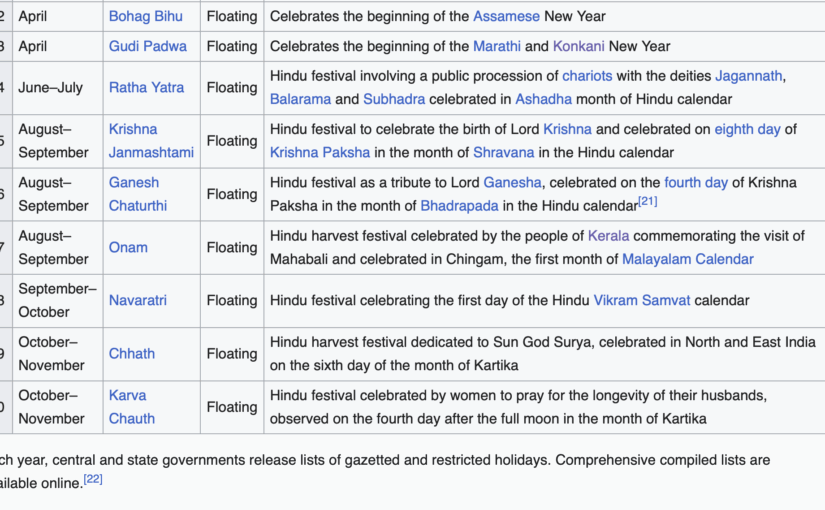
India’s national holidays should reflect its civilisation. They do not. Five Abrahamic festivals sit at the centre of the calendar, while most indigenous ones sit on an “optional” list. This is a distortion, not pluralism.
National holidays are public signals. They show what a country holds to be central. When non-indigenous festivals are guaranteed space and indigenous ones are not, the state sends a clear message: it is unsure of its own foundations.
This was a mistake made at independence. India had full freedom to shape its symbols. Instead of anchoring the calendar in its own tradition, the new state tried to avoid offence. That caution hardened into policy, even though no society builds confidence by sidelining itself. Continue reading Why India’s National Calendar Needs Urgent Correction
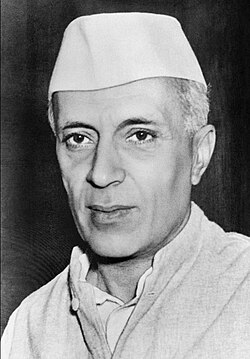
I just read a comment by Kabir about how 2014 changed Nehru’s India drastically ( I do not agree but that’s not for now). But this poses another question.
As XTM’s post pointed out/alluded Hindutva was inevitable and the natural outcome of Pakistan. But why did it take 67 years of Hindutva to assert itself.
In my mind the answer is pretty straightforward and two fold.
1. Gandhi’s murder at hands of a Hindutvavadi.
2. Sluggish economical growth of the socialist era (also called wrongly the Hindu rate of growth).
I would love to hear comments on the question posed above.
Why 2014 happened in 2014?
The heirs of Jinnah are not liberal Pakistani nationalists or English-speaking Karachi elites.
His true heirs are:
This is not provocation. It is structural observation.
I. Jinnah Created a Logic That Outlived His Liberal Aesthetics Continue reading Why Zia, Munir, Ayub, and Even Modi, Are Jinnah’s Children
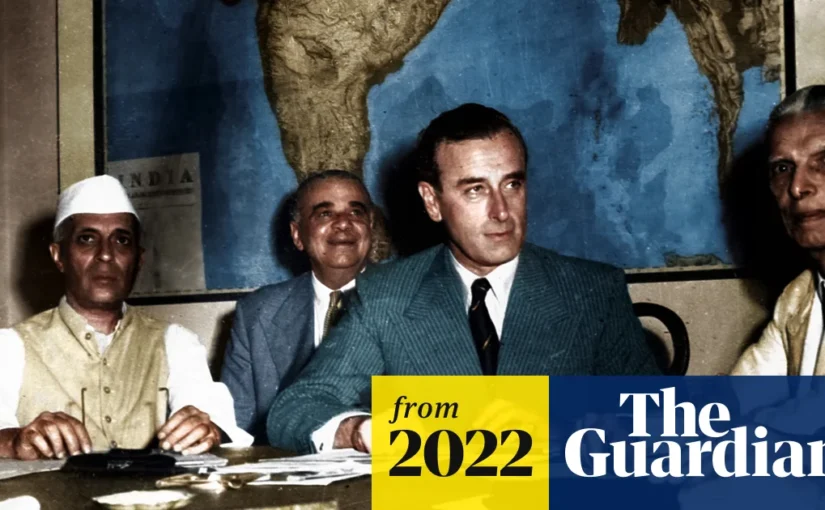
Kabir’s defence of Nehru as the moral compass of the Indian republic reveals something deeper than nostalgia for secularism. It exposes how much of India’s founding moment was shaped by a single man whose class background insulated him from the material and psychological stakes of Partition; stakes that Gandhi, Jinnah, Bose, Ambedkar, and even Savarkar understood far more viscerally.
Nehru was unique among the major players of his era. He was the only one born into national leadership, the only one who inherited a political position, and the only one whose life had been marked not by struggle but by access. While others were shaped by jail, exile, poverty, or ideological intensity, Nehru was shaped by privilege, and privilege has its own blind spots.
This matters because 1947 was not a moment for abstract idealism. It was a moment for negotiation between communities whose elites no longer trusted one another. On that task, Nehru was the least prepared of the principal actors.
I. Nehru’s Privilege Was a Constraint, Not a Qualification
Continue reading Nehru, Privilege, and the Missed Settlement of 1947
A far-right senator, Pauline Hansen, recently walked into the Australian Senate wearing a burqa. Muslim MPs (one of whom wearing a hijab) angrily called it racist, bigoted, Islamophobic. They were right. But they also dodged the underlying question: What does citizenship mean when communities fracture along religious lines?
The same evasion dominates debates about Indian Muslims after 1947. One camp says: “They stayed, they’re citizens, case closed.” The other mutters about loyalty tests and fifth columns. Both positions are intellectually lazy. Neither grapples with what Partition actually did to the social contract.
This isn’t about defending bigotry. It’s about refusing to let bigots monopolize legitimate questions.
I. The Contract That Never Closed Continue reading The Unfinished Contract II: Citizenship, Partition, and the Questions Liberalism Won’t Ask
I was speaking recently with a cousin who grew up in India. Their family has been Bahá’í for generations, but their older relatives once lived as Sunni merchants in Old Delhi. When they visited their grandparents as a child, they noticed something striking: in many lanes of Old Delhi, long after Independence, the sentiment was not Indian nationalism but Pakistan-leaning nostalgia. This was not hidden. It was ambient.
That single observation exposes something almost no one in Indian liberal discourse wants to say aloud: post-Partition India inherited a large Muslim population whose political loyalties were, at best, ambivalent. That is not a moral judgement. It is a historical one.
And once you notice this, a second truth becomes obvious: Kabir’s secularist vision of an emotionally unified India makes sense only in a world where 1947 never happened.
Continue reading The Partition of Elites: India, Pakistan, and the Unfinished Trauma of 1947