Fascists on Hindu Twitter

It’s really getting very disturbing now..

Can a white liberal call a black conservative, a “bigot”

After Chris Evans patronised Kanye I waded into controversial territory myself. I’m being trolled on Twitter for calling out on Owen Jones.

Now a lot of people may think I’m some sort of Social Justice Warrior. I’m not since my inclination is towards High Toryism. I prefer the Monarchy, Aristocracy (it’s why I prefer Urdu High Culture to Hindi low culture, where is the Indian Ghalib?), the Established Church and general veer towards the Tory party. I tend to respect Republicans and Tories since for them their guiding principle is their nationalism/patriotism. Whilst I prefer patriotism to nationalism I can sympathize with native white people who want to keep their countries as they are.

Continue reading Can a white liberal call a black conservative, a “bigot”

A single nation divided by a civilisation

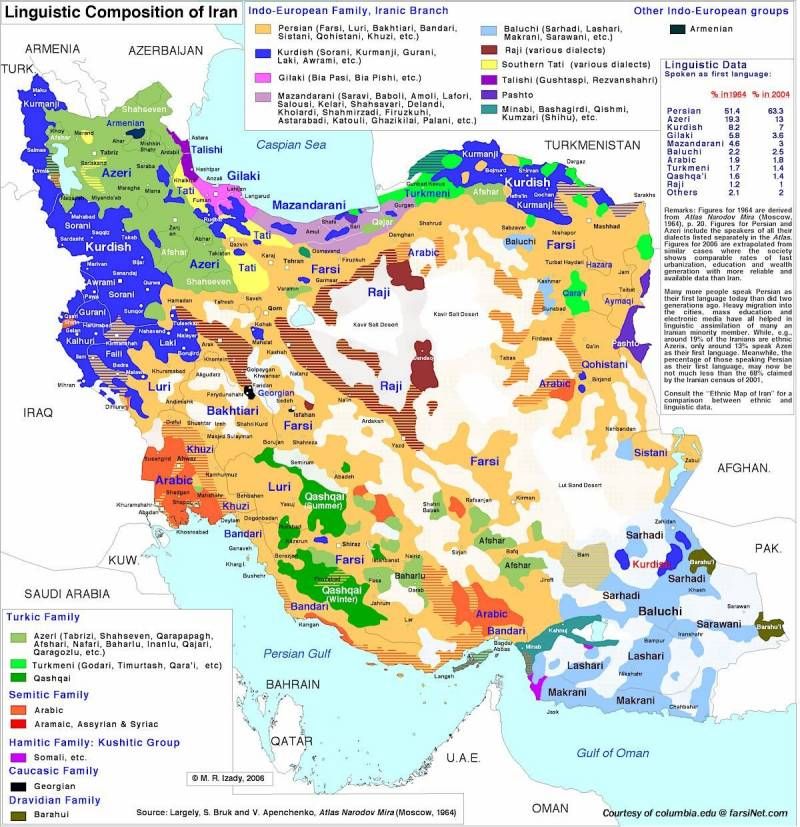
I made an important observation on Twitter after reading about this fantastic article on Ferdowsi’s “Iranianisation” that I thought I would share here:

The article I linked to makes the stunning point that Iran has captured “Turan’s” legacy to the exclusion of any other country in Central Asia. While Afghanistan, which is nominally Dari-speaking, can barely lay claim to Jalaluddin Rumi because Afghan is an ethnonym for the Pashtun speaking population (who historically have been geared towards India rather than Iran).

Iranian (and by extension) Persian national construction in the 19th century is probably one of the most successful enterprises despite the initial difficulties involved. I’ll relay two stories. Continue reading A single nation divided by a civilisation

The bisexual & the Baha’i Twins + why do Pakistanis fake it?

The Bisexual & the Baha’i Twin

As an aside I saw an instagram clip of a new show (I’ve removed the name to protect the privacy). It was directed by this budding bisexual young actress. It wasn’t hard to guess that she was Iranian-American (she doesn’t identify as Iranian though just American) but something about the name was ringing in my ear. I thought she might be a Baha’i of Zoroastrian descent.

It turns out I was partially right in that she has a doppelganger of the same exact age, location and ethnicity who happens to be a friend of a friend and more importantly a Baha’i (and a strong one at that). They are probably distantly related (the bisexual almost certainly has a lapsed Baha’i grandparent since some surnames are distinctly Baha’i and there are so many Iranians who have some hidden Babi-Baha’i ancestry) but what is shocking is too see two similar people (with an astonishingly uncommon first name that I have never ever encountered before) lead such different lives.

The two look so similar that I had to ask Vidhi for help in parsing them about; the Bisexual actress simply looked like the Vamped risque version of the Baha’i twin.

Religion certainly has the power the transform culture; the Bisexual actress is a SJW progressive on Twitter fighting for Queer rights while her Baha’i twin is on Instagram steadfast in our Faith. Continue reading The bisexual & the Baha’i Twins + why do Pakistanis fake it?

Book Review: India’s Wars. A Military History 1947-1971


India’s wars by Air Vice Marshal Arjun Subramaniam is a history of the wars (external wars, not counter-insurgencies) fought by the Indian army from 1947 to 1971. It is a pretty good summary, but does have it’s weaknesses.

The book starts with a bit of the “pre-history” of the Indian army. Interestingly Subramaniam chooses to highlight two distinct streams that he believes should get credit for the internal culture and ethos of the Indian army. One is obvious: the British Indian army, which was the parent organization that was split (unequally) between Pakistan and India to create the Indian army. The second is an angle that would not have been included by an official observer/author in 1950, but that has obviously grown since then to the point that a Pucca Air Marshal gives it near-equal billing in his book: i.e. the armies of the Marhattas and the Sikhs. I think this reflects contemporary politics and cultural arguments in India more than it reflects the reality of the Indian army from 1947 to 1971, but will be happy to be corrected by people who have better direct knowledge of the Indian army in that period. Anyway, the author gives a quick and very brief account of the British Indian army. The origins and growth of that force are dealt with very quickly and summarily, but there is more details about developments closer to 1947. This is not a book that is heavy on relevant numerical data (i.e. this is not the sort of book where you get tables showing “The caste/religious/ethnic composition of the British Indian army from X to 1947”) and this is a weakness that persists throughout the book; the author is not big on tables or data. Perhaps as someone who grew up with some of that history, I did not find it detailed or insightful enough, but most readers may not mind this omission too much. And even if you are a British Indian army brat, the sections on the origins of the Royal Indian Air Force and the Royal Indian Navy are likely to add to your knowledge. Incidentally, many of the early aviators in the Indian air force seem to have Bengali surnames; the author does not comment on this, but I wonder if anyone has more information about this. If you do, please add in the comments section.

Continue reading Book Review: India’s Wars. A Military History 1947-1971

Global alliances and wheels within wheels

Over ten years ago I read Adam K. Webb’s Beyond the Global Culture War with some skepticism. In it, Webb outlined the future revitalization of non-Western societies and cultures and their ultimate face-off with global liberalism.  It’s a really strange book, which talks positively about the Iranian Revolution and Rabindranath Tagore.

But I think elements of the thesis are coming to fruition in ways I couldn’t have imagined. For example, the Western Left has a very strong animus against Hindu Nationalism. case in point, the Western (mostly American) feminist website, Feministing, has published a piece documenting a protesting a Hindu meeting in Chicago: Why These Activists are Protesting Hindu Nationalism in Trump’s America.

Here’s a thought experiment: can you imagine left-wing activists protesting an Islamic Society of North American meeting? Curiously, the atheist ex-Muslim activist Armin Navabi, who was at the meeting in Houston this summer, observed that the people who were most hostile to the ex-Muslims were not the Muslims themselves (most of whom were curious), but philo-Islamic Communist activists. These activists were apparently shouting Islamic slogans at right-wing anti-Islamic demonstrators.

Navabi even reported that the Muslim attendees talked to him and seemed disturbed and confused by the specter of hammer & sickle brandishing Communists, and could not understand why or how they were pro-Islam.

The Wani exception

When I came across news of slain Kashmiri militant Burhan Wani, I was struck by his last name. I had known for a while that Kashmiris had castes or as they call it ‘krams‘, like most other people of the subcontinent. And the Wanis are the kram of converts from the mercantile castes of Kashmir. On the wikipedia page linked above, Burhan Wani is listed as the only notable Wani. To understand how odd this is in the broader context of the subcontinent’s mercantile castes, imagine a (fictitious) militant ‘Altaf Agarwal’ being the only notable Agarwal or ‘Afzal Singhania’ being the only notable Bania.

To reflect further on the oddness of Kashmir’s Wanis, note that conversions of upper caste Hindus (Brahmin, Kshatriya, Vaishya) to Islam, although not completely absent, were quite rare. For example, in Punjab, Dr. Gopal Krishan (Punjab University) tells us,

Conversion was negligible from the higher castes such as Brahmins, Aroras, Khatris and Aggarwals.

There seem to be two major exceptions to this rule. The first are Sindhi, Punjabi and Kashmiri Rajputs (Soomra, Janjua, Bhatti, Rathar), who converted heavily to Islam. The other, less talked about exception are the Vaishya Wanis of the Kashmir valley. I have never heard of a Hindu Wani and the conversion to Islam seems near total. Such a total conversion of mercantile castes to Islam is not seen in any other region of India.

It would be interesting to know what explains the exceptional status of Wanis. This is not just interesting from a historical perspective, but could also be important in understanding contemporary developments. Consider the issue of Kashmir’s industrialization. A crude model of India’s early industrialization would be Brahmin technical/management education + Bania enterprise. Indeed, Aakar Patel points to the Brahmin-Bania complex as a hegemonic force in the economy of modern India,

HDFC is run by a Bania (Deepak Parekh), Hindustan Unilever is run by a Brahmin (Nitin Paranjpe), ICICI Bank is headed by a Brahmin (K.V. Kamath). Jaiprakash Associates is run by a Brahmin (Yogesh Gaur), L&T is run by a Brahmin (A.M. Naik), NTPC is run by a Brahmin (R.S. Sharma), ONGC is run by a Brahmin (also called R.S. Sharma). Reliance group firms are run by Banias (Mukesh and Anil Ambani), State Bank of India is run by a Brahmin (O.P. Bhatt), Sterlite Industries is run by a Bania (Anil Agarwal), Sun Pharma is run by a Bania (Dilip Shanghvi) and Tata Steel is run by a Brahmin (B. Muthuraman).

More examples are given in the linked Aakar Patel article. We can see that the Bania-Brahmin complex is spread across India, from South to North, West to East. In more recent years, there has even been a diffusion of skills and attitudes, with Brahmins moving into entrepreneurship and Banias into higher studies. In important ways, urban Brahmin-Banias are merging into a single caste.

Is it possible that the religious schism between the Kashmiri Brahmins and Wains possibly precluded such a complex from forming ? One could conjecture that this played an important part in slowing the industrialization of the region, and its economic integration with the rest of India.

In summary, what explains the total conversion of Kashmiri trading castes to Islam, a pattern not really seen anywhere else in the subcontinent ?

Did this effect industrial growth in Kashmir, and provide more reasons for the emergence of an insurgency there ?

Twitter trouble..

Razib with his thoughts on Indus in the Mekong & Aryans in China (I should be moonlight as a copy-editor; I just know how to sex things up for the BP readership). I butted into a thread involving Omar and Richard but I’m linking to the controversial bit:

No comment..

This is America

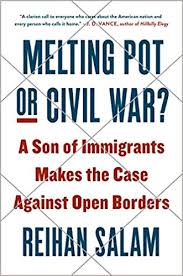
As you may know, Reihan Salam, who I would consider a friend (albeit, one I see in person three years or so!), has a new book out, Melting Pot or Civil War?: A Son of Immigrants Makes the Case Against Open Borders.

It won’t be a surprise to know that I generally agree with him on a lot of issues relating to immigration. The first time I met him in person in 2007 we actually talked about the positive externalities of high skill immigration streams. Since then my views haven’t changed much, though my faith in these United States has declined some to be honest.

I will pass along this interview with Reihan today, A Son Of Immigrants Makes The Case For Tighter Immigration Policy. Reihan, as you may know, is the son of Bangladeshi immigrants who arrived in the late 1970s. The woman interviewing him happens to be ethnically Bengali herself (though her family is from India), raised in Oregon around the same time I was (we’re about the same age).

This is America 2018. An American of Bengali ethnic extraction writes a book and happens to be interviewed by happenstance by another Bengali American. Definitely not a world we could have imagined in the 1980s.

Brown Pundits