Why you are not as smart as you could be and why I am smarter than I should be

Recently regular reader and commenter “ScorpionEater” said something to the effect of “why do you bring up non-Indian history/phenomena in conversations where we are talking about Indian history/phenomena?” The simple answer is that you can’t understand the history and culture of any particular place without understanding the history and culture of other places. Without a cross-cultural perspective, history becomes “just one damned thing after another.”

Perhaps the bigger problem is parochialism in general. As an American, I am aware of this problem firsthand. When the terrorist attacks on September 11th occurred many Americans expressed shock at the proposition that there could be anger and the United States of America abroad. The fact is that most people are stupid and ignorant and don’t know anything, and Americans in particular, in their continent-sized nation, are simply unaware of how they are perceived by other peoples.

Americans have a high self-regard and many blind spots. I was raised as a child to believe that the Revolutionary War was unreservedly good. But as Dr. Johnson observed, “How is it that we hear the loudest yelps for liberty among the drivers of Negroes?” Reality is more complex than our imaginings and myth-making.

With a substantial proportion of the readership from this website coming from India, parochialism has now reared its head differently. My personal experience with Indians has been with the cosmopolitan Diaspora. Indians in India seem somewhat different, and frankly, more like Americans in their self-regard and self-centeredness. India is after all a continent-sized country, with its own long history and cultural predilections.

DoubleQuoting Trees, 2001 – 2019, Greta 2019 – 1898

[ by Charles Cameron — from tree-planting in the millions, via Tolkien’s ents in entmoot mode, to the Yukon, science-fiction time-travel, and a Greta Thunberg lookalike ]
.

A couple, Brazilian photographer SebastiĂŁo Salgado and his wife, planted 20 million trees in 20 years. Some of their product is visible in this photographic DoubleQuote

:

Simply and factually, two states of a hillside are connected by twenty years of planting, similarly but more personally, a photographer and his wife are connected by love and marriage nurtured by their lives together, more abstractly two nodes in a network are connected by edges, in each case, the connections in a network are the strength of that network..

And in this case, trees are the result of planting over time, and over time this marriage of two persons is no doubt deepened. They make a difference, and if a hundred thousand, scattered across the habitable globe, followed their example, the impact would be considerable.

Consider also that in the view of a German scientist whose ideas are, according to the Smithsonian, “shaking up the scientific world”. Anthropomorphosizing more than a little, the Smithsonian writer tells us:

Wise old mother trees feed their saplings with liquid sugar and warn the neighbors when danger approaches. Reckless youngsters take foolhardy risks with leaf-shedding, light-chasing and excessive drinking, and usually pay with their lives. Crown princes wait for the old monarchs to fall, so they can take their place in the full glory of sunlight. It’s all happening in the ultra-slow motion that is tree time, so that what we see is a freeze-frame of the action.

20,000 trees must have quite a conversation.

**


Entmoot

Cue JRR Tolkien on the tree-like Ents, the ancient and wise guardians of trees and forests introduced in volume 2 of the Lord of the Rings:

Quickbeam, for example, guarded rowan trees and bore some resemblance to rowans: tall and slender, smooth-skinned, with ruddy lips and grey-green hair. Some ents, such as Treebeard, were like beech-trees or oaks. But there were other kinds. Some recalled the chestnut: brown-skinned Ents with large splayfingered hands, and short thick legs. Some recalled the ash: tall straight grey Ents with many-fingered hands and long legs; some the fir (the tallest Ents), and others the birch, … and the linden.

A gathering of the ents is called an Entmoot. Tolkien quotes Treebeard:

The ents have not troubled about the wars of men and wizards for a very long time. But now something is about to happen that has not happened for an age… Ent Moot. [ … ] Beech, oak, chestnut, ash… Good, good, good. Many have come. Now we must decide if the ents will go to war.

**

By way of a bookend to this post, here’s a DoubleQuote in images of Greta Thunberg and a 1898 lookalike in a photo from the Yukon:

As usual, parallelisms promote speculation — in this case, the laughable, laudable conspiracy theory that Thunberg is a time traveler.

Conspiracy! Science fiction!

The suggestion is that Greta traveled back from our time, when she despaired of our efforts to reverse human-caused climate change, to the Yukon of 1898, where she set about reversing the problem at its time and place origin. Exactly why human-caused climate change should have started in the Yukon in 1898 is not clear, nor can we understand how, if she began her efforts at reversing the progressive wasting of earth by human impact back in 1898 and had had no notable impact on that process by now, as revealed in the 1898 and 2019 photos of Ms Thunberg.. that too is unclear.

Fabulation, however, is fabulpous by dedfinition — so we record this conspiracy here.

Readings:

  • HuffPost, Photo From 1898 Sparks Hilarious Theory That Greta Thunberg Is A Time-Traveler
  • Owen Sound Sun Times, Greta Thunberg look-alike in 1898 Yukon gold rush photo has sparked time-travel conspiracies
  • **

    Okay, here’s a auggestion:

    Greta Thunberg — or the Entmoot , for that matter — might suggest we plant trees:

    Plant for yourself:

    But be warned

    As we plant trees, we must avoid planting monocultures, and ensure we plant variety, as The Economist suggests.

    Book Review: Baba Nanak Within Reach, by Muzaffar Ghaffar

    Muzaffar Ghaffar on Guru Nanak


    In the cultural wasteland that is our homeland these days, to be a man of culture doesn’t take much effort; you do some literary chit chat or somehow get your name printed with some work people assume as cultural or creative and you become a cultural or literary figure! Having known Muzaffar Ghaffar for over thirty years, he is an honourable and notable exception.  He came to Pakistan with his savings and a couple of books in print, a book of English verse which has had a couple of editions published and a book On How a Government is Run .  In my involvement with Punjabi we came together in the weekly “Sangat” in readings of Punjabi classic poetry held at the residence of Najm Hosain Syed and Samina Hassan Syed.  Najm Sahib was already famous in Punjabi literary circles in both East and West Punjab.  To give you some idea I often quote a well-known Sikh scholar of Punjabi who was Head of Punjabi Department at Guru Nanak University, Amritsar.  He said, “There are two categories of Punjabis – those who have studied Mr. Najm Hosain Syed and those who have not; those who have not read him do not know much about Punjabi language or literature!”  To those not familiar with Mr. Najm Hosain Syed’s work, this may sound like an exaggeration.  But having attended weekly meetings at his house for nearly forty years and having read his poetry and books on literary criticism, plays and poetry, I venture to share this remark.  There are almost forty books of verse and landmark works of literary criticism and four books combining half a dozen plays  in Punjabi to his credit.  He keeps his books small so that the price remains within reach of Punjabi readers. If you are not a serious reader of Punjabi language, these are in a difficult idiom.  I have met many who express ignorance or adverse remarks.

    Najm is Muzaffar’s guide and inspiration for the thirty volumes of the “Within Reach” series on Punjabi Classical poetry that are available to date, all in English.  But neither in the US, nor in England and rest of English speaking world abroad have I seen these books in the market, although Punjabi literature is taught in many places in institutes of repute in these countries, with considerable Punjabi speaking public.  Nor do I know of anyone abroad who talks of these books. In particular the worth and value of this remarkable volume “Baaba Naanak Within Reach” on Baba Nanak’s poetry is incalculable, and it is our enormous loss that this work of M. Ghaffar remains largely unknown.

    These books of Mr. Ghaffar are the result of years of eight hours of daily hard labor with no interruption.  This is the kind of routine that has to be seen to be believed.  A sister of Mr. Ghaffar used to live with him, and occasionally came to the literary programs he arranged under the banner of LEAF (Lahore Arts Forum).  One morning we heard the sad news of her passing away.  Being that she was my wife’s college mate at Home Economics College, she wished we go and condole.  With such a personal loss to reckon with, we were surprised to find him working with utmost dedication.  This is only symptomatic of the style of life he had chosen.  In addition to his daily writing routine, he was also arranging weekly poetry readings and singing of kafis and classical poetry by late Mrs. Samina Hasan Syed, wife of Mr. Najm Hosain Syed. These would be held at Alhamra Hall 3 in Gaddafi Stadium.  In addition he arranged Punjabi readings, in which I was a member of his team.  Poets and scholars were personally requested by him to share their work and many spoke by such invitation and literary audiences held LEAF in great respect.  Sessions were repeated every week at Model Town Library.  Being a Model Towner himself, he knew that the general audience there mostly stays confined to that township in the after-hours!  He tried his utmost to expand the interested audience and readers.

    I assisted him in my humble capacity at the Alhamra Hall 3 events.  After a couple of decades in operation,  literary programs in this hall were discontinued by the authorities. Having not seen any activity there, I think the governing bodies cater to wild birds, who too have no real access to the mostly locked up three halls and an open air stage!

    Muzaffar’s daily labor of love come rain or shine continues ! A spectacular six volumes on Waris Shah’s Heer came out two years back, and two more classical texts are in progress. As a humble student  and writer of Punjabi I can vouch this work will endure ! To encourage readers to not remain oblivious to its rich contents and do justice to this work, I am including a selection from the book under review. This will also give an idea of Muzaffar’s style of explication. I copy below a selection of Nanak’s poetry with a detail of its translation and notes as given in his book :

    Notes on the above selected poetry : {Written by Muzaffar Ghaffar ; these are quoted here directly as appear in his book}

    “Baaba Naanak used virtually all known forms of folk poetry. He used many metres and styles. He wrote long poems (vaars), kaafis (poems with refrains), ashloks (poems of several styles), dohrae (couplets), paoris (ladders), etc. He used available forms to suit his needs and purposes. This poem is a paori from a long vaar. Most of the poet’s work was named after musical raags.

    In a paori, as in this one, the rhyming device is in the middle of the line, not at the end. In this poem Baaba Naanak uses two rhyming devices, one in the middle and one in the end. The usual way of using couplets is not used in the paori. Each line is complete in itself. The rhyme in the middle of the line is the same throughout the paori.  The end rhyme used by the poet changes in every couplet. The middle rhyme maintains a relationship of the couplets. The metre is delicious and powerful. This promoted a specific style of reading. The second part of each line is shorter. This gives a special feeling.

    lt includes many Pahari (of the hill regions) words, many Sanskritised words and also the special language of Sants and Saadhus (Hindu religious mendicants), which was called Sidh Bhaasha or Siddhokri. This language was used much in the Bhakti Movement (in which 3-5000 years of separation of ‘classical language’ and ‘folk language’ was increasingly seen). Here we see Arabic, Persian and ‘classical language’ melded together.  That too had been happening for 4-5 centuries upto the poet’s time.

    Line 1 :

    Raajae raiyyat sikdaar, koi nah rahsi O

    King, subjects, royal officers, none will remain at all

    Kings, those who accept their kingship (the subjects), and royal officers, no one will remain, says the poet. All temporal authority and those who accept that authority are reminded of the transitory nature of authority itself and those who wield it. The end rhyme of this and the next line carries a tone that is strong and almost taunting – almost a sneer that is offered when someone resists a known fact or experience and has to be reminded forcefully.

    Line 2 :

    Hat pattan baajaar, hukmi dhaesi O

    Shops, towns, bazaars, by Order will fall

    Busy shops, flourishing cities, and much-frequented markets, all will fall. Here the poet brings in an essential ingredient of his beliefs and philosophy. All these are not only susceptible to natural cycles but also to the Order of nature. This will happen because it is so Ordained. We can see here a glimpse of Transcendental God, and his Order.

    Line 3 :

    Pakkae bank doaar, murakh jaane aapnae

    Stylish, strong doors, fools consider their own

    The doar (door) has a special meaning in the verse of Baaba Naanak. Getting to the door is the objective of cultivating the self. Only fools consider that the stalwart doors are theirs for the asking. There is also a concern here for considering whatever is made of brick and mortar as the door. The implication is that the door is reached through inward discipline and devoted practice.

    Line 4 :

    Darb bharae bhandaar, reetae ik khanae

    Storehouses filled with treasures, in a moment will be empty

    Warehouses full of treasures will be emptied in a moment (by others who are stronger and win wars; thieves; misfortune, etc.). Again the theme of impermanence of all that we cherish and hoard is present. The experience of Baaba Naanak – who had been a storekeeper in the service of Daulat Khan Lodhi, the governor of the Punjaab – showed him this phenomenon, time and again.

    Line 5 :

    Taazi rath tukhaar , haathi pakhrae

    Arabians, chariots, chargers, elephants in armoury

    Horses of all kinds – those which came from the east or the north (etc.) – as well as elephants in armour (will not remain) .  The images of strong stallions and magnificently armoured elephants come before us. They too will not stay in these roles, says the poet, and could (indeed would) be put to other uses. The power they provide to their owners will be lost. The historical context here is of some Arabs and more Central Asians who came as conquerors. Then they were conquered by the land and stayed on. This  cycle of history has happened before the Arabs and Central Asians came, such as the Aaryans, non-Aaryans and the pre-Aaryans who came to the Indus basin, mainly from Central Asia. But the more immediate invaders are focused on by the poet (which included his employer). He does this by mentioning the sources of the horses. And he puts in elephants to bring in ‘local’ invaders also.

    Line 6:

    Baag milakh ghar baar kithae syaapnae

    Dominions, households, orchards, where will they be known

    Gardens, dimensions, households (all that we recognize as our own), will not be recognized as such. The word Kithae (where) makes us consider the situation after the event as well as , ‘in other circles’ . Perhaps we are being told that they will return to nature. Or not recognizing our ’ownership’ others will take over.

    Line 7 :

    Tanbu palang navaar, saraaecae laalty

    Pavilions, tape laced beds, little inns desirable

    Pavilions and comfortable beds and inns which provide comfort (all will go away or we will not be able to use them). Upto now we may see what we today may consider as a collection of clichĂŠs. There is no particularly new thought or imagery (though the armoured elephants and rearing stallions stay in our minds). What then is special about this poem. We may find some answers in the last line.

    Line 8:

    Naanak sach daataar, shanakhat qudrati

    Naanak truth is the giver, recognition natural

    This line affirms that Truth is the giver. This is recognized by nature. Or that nature gives us the recognition of Truth. All the above is the recognition of excess. And Truth is the ultimate source of life. Truth is God. Another reading, that Naanak is the truth giver is read by some devotees but Baaba Naanak’s humility may not permit such a claim.”

    The prices of books in the series produced by him are rather steep, but having read all the books, I can vouch for both their quality and the value of the translation into English verse, as well as the commentary and detailed glossary of Punjabi words and their literal as well as symbolic meanings.  This is a classic work of which time and scholars of today and the future would be better judges!

    I have not had the time to write my own piece on this occasion, so I will take this opportunity to add a few thoughts of my own before Dr Hamid’s piece; my own personal view is that there is a very strong likelihood that the so-called Babri mosque (which was probably NOT built by the emperor Babar, but may have been built by one of his leutenants or by a later Muslim general or emperor, we simply do not know for sure) was very likely built on the site of a Hindu temple. This was the conclusion of the ASI excavation of this site and since countless mosques were indeed built on the ruins of temples by invading Muslim armies, this would not be surprising in any way. It is also known that Ayodhya was a site of pilgrimage for Hindus and was revered as the birthplace of Ram. The Hindu inhabitants of India were subjected to many atrocities by their Turkic Muslim colonizers (more so by the earlier Delhi sultanate, less in the time of the Mughals, but both sets of rulers (Delhi Sultans and Mughal emperors) were classic colonizers). The conqureing Turko-Afghan colonizers were always far smaller in numbers than their Hindu subjects and as with other colonizers in other parts of the world, they used both terror and co-option to establish their ruler. Over time, especially in the later stages of the rule of the apostate emperor Akbar, many Hindu rulers were incorporated into the ruling elite in exchange for cooperation and “bending the knee”. But there was rarely any doubt about who was boss in that arrangement and later emperors, especially Aurangzeb, were more orthodox than Akbar and Aurangzeb re-introduced Jizya (a poll tax paid by all non-Muslim subjects) and tried (with mixed success) to establish a more “Islamic” ruling elite. Aurangzeb faced a very determined Maratha revolt that he fought for decades and finally suppressed at great cost, but without complete success. This Maratha revolt (particularly in the person of the first Maratha ruler, Shivaji) had a HIndu-revivalist color, though both sides freely used their opposite religious group as allies in subordinate positions (i.e. some senior Hindu generals fought on the Mughal side and some Muslims fought on the Maratha side). This prolonged conflict so weakened the Mughal empire that after the death of Aurangzeb the empire started to fall apart. It was dealt a death blow by the Persian invader Nadir Shah and thereafter it was the Marathas who became the largest empire within India, with most of the rest of the country in anarchy or ruled by smaller local rulers. Parts of the Muslim elite, feeling this loss of power, invited the Afghan ruler Ahmed Shah Abdali to “re-establish” Muslim rule, but while he won a crucial victory against the Marathas at the third battle of Panipat, he was not able to establish stable rule over most of India and even in Punjab (where he had tried to establish provincial authority since before the Panipat war) was snatched from him by multiple Sikh revolts. The end result was that by the late 18th century large chunks of India were ruled by Marathas and Sikhs. If this process had continued, it is likely that much of India would have been divided between resurgent Hindu and Sikh rulers, with local Muslims (whether descendants of the ealier Mughal and Turko-Afghan conquerors or local adventurers such as Haider Ali and his successor Tipu Sultan) ruling several smaller kingdoms. But by this time another, more advanced power had arrived on the scene, i.e. the East India company, who were able to take advantage of European superiority and Indian anarchy to establish a unique English empire that was owned by a trading company, albiet one supervised to an increasing extent by the British government. This British rule froze the 18th century Indian ruling elites in place as puppets or subjects of the British empire, saving the Muslim elite from further depradation at the hands of Marathas and Sikhs. After the Bengal army of the EIC mutinied in 1857, the British crown formally took over the empire, ending the period of company rule. By the early 20th century this British rule was firmly established, but two world wars in Europe and rising nationalism in India finally brought that empire to an end in 1947. At that point the latent divisions between the old Muslim elite and their former Hindu subjects again raised their head, as both parties tried to figure out what an independent India would look like. Many Indian nationalists, now armed with new European nationalist ideals, wanted a united Indian Republic, but given the history of the preceding 700 years, this Republic would include at least two major groups with very divergent views of the past (and therefore, of the future); on the one hand were Hindu nationalists who saw this period as a period of colonization, first by the Muslim and then by the British, and dreamed of a “Hindu rashtra” that would restore what they regarded as the “status quo ante”, a Hindu India. But the intervening 700 years had seen something like 20-25 percent of the population becoming Muslim. The majority of these Muslims were local converts, especially concentrated in the Northwest and North East of the country (forming a small majority in Punjab as well as Bengal), but their elites ( especially in the old Mughal heartland in the Ganga-Jamna region and to a lesser extent in Hyderabad and a few other Muslim ruled states) identified as descendants of the Turko-Afghan colonizers and saw themselves as the natural rulers of this land, unwilling to be subordinate to any democratic or autocratic Hindu rule. Meanwhile the Hindu side included several strands of Hindu nationalists who saw the Muslim elite as foreign colonists and local converts as barely tolerable at best and outright traitors at worst. As can be imagined, any post-British arrangement would have to bridge this divide and somehow create one India out of what had been a patchwork of conflicting states and communities. This was not out of the question, but it would certainly not be easy. The main pro-independence party (the Congress party) included Westernized secularists (both Hindu and Muslim, more Hindus than Muslims though, who felt these divisions would be overcome by a common non-demoninational Indian identity), moderate Hindu nationalists (who were willing to accommodate Muslims as fellow citizens, but who also espoused many traditional Hindu causes, such as cow-protection and a dominant Hindu cultural vision of India), moderate Muslim nationalists (who agreed that Hindus and Muslims will live together in a united India, but with Muslims holding on strongly to their religious identity and even retaining hopes of eventual Islamization of India, albeit by peaceful means)

    Setting the ground straight on the Indian economy

    “I could see some parts of the coastal peninsula approaching Thai levels at best”

    Some comments in our discussion threads necessitate a deconstruction of the Indian economy.

    In my opinion, a good place to start analyzing national economies is nominal industrial output. This is a good measure of the level and depth of industrial prowess of a country. The prices of industrial goods also tend to be less sensitive to locale, than services.

    As an example of the usefulness of this measure, consider the economies of Italy and Germany. Seeing the number of German brands around the world, the reputation of German engineering and more recently, the exodus of highly educated Italians from their country, we have a strong intuition that the German economy is stronger than the Italian one. Yet the difference between Germany and Italy in terms of overall PPP GDP per capita does not seem very large. However, restricting to the nominal industrial output, the German output is more than twice that of Italy.


    The Indian caste of mind

    Because I’m am open-minded person many of my white liberal friends express to me their true views of Islam. Progressives do a lot of ‘solidarity’ with Muslims, but privately many think Islam is a regressive religion. Which, on the whole, is true.

    But this is a general phenomenon. People will tell me things they might not tell others because I don’t judge (unless they are stupid). A friend who is a big player in Democratic and progressive politics has been trying to get a sense of why India has caste, and other regions do not. I can’t give him a good explanation.

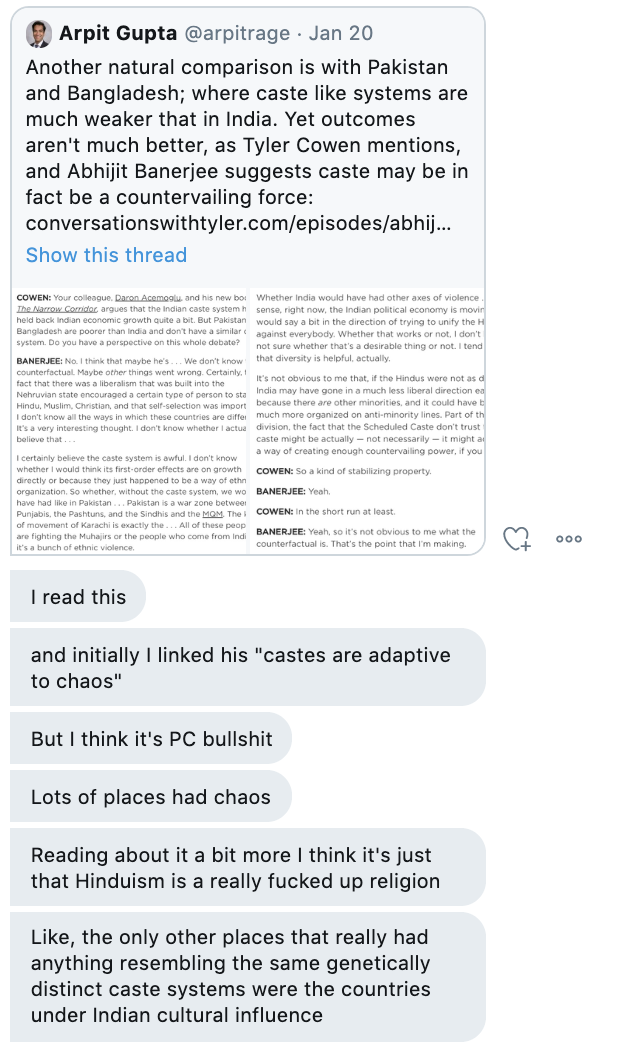
    Ultimately though, he concludes from the existence of caste that Hinduism is a messed up religion

    On the hyphenated American…

    First things first, my mother was shot during the Bangladesh Liberation War. Though, as upper-middle-class Muslims who tended toward being in technical professions (medicine, engineering, etc.) honestly I don’t think we bore the brunt of the violence (I qualify technical, because an uncle-in-law who comes from an artistic family had several relatives shot by the Pakistani army due to their possible propaganda creating skills).

    I was born in Bangladesh. That being said, my parents spent more time as Pakistani citizens than Bangladeshi citizens. And they’ve spent the most time as American citizens. I grew up nearly my whole life in the United States of America.

    When I was a kid people would often assume I was Arab, Iranian, or, most often, Indian. Sometimes I would correct them, and explain my family was from Bangladesh..but then I would have to explain what and where Bangladesh was. So often I would just let it stand, as “Indian” is good enough for government work.

    That being said, some people have objected to my relaxed attitude on this. Mostly, these are Indians and Bangladeshis. People born and raised in India and Bangladesh. Though a few people I know from Nepal or Pakistan or Sri Lanka also are perplexed at my relaxed attitude toward national identity. I think the major issue is that as an American, there is clearly brown provenance to my origins, but the crystallizing national identities in the subcontinent are detached from my own family’s historical experience, which hasn’t experienced much of the last 40 years.

    Of course religion and such matters. People of Muslim origin from the subcontinent who are irreligious are very different in their attitude toward being brown from people who are religious, and these are very different in their attitude toward those who are very very religious (in some ways, the irreligious and the very very religious are more similar than to the group in the middle).

    Is American culture sharply increasing crime? (a)

    Discussing the relationship between culture and crime scares most enormously. But does discussing it help improve human flourishing for people around the world? Please read the first article in this series hyperlinked at the bottom. Please also read these two very fine PDF reports on suspensions of students in the USA and California by race (they also have very good education performance data).

    Asian Americans students are suspended from school at a small fraction the rate of European American students and massively academically outperform European Americans students. I couldn’t believe the extent to which this was true when I first read the numbers and researched many other studies and data sets; all of which had similar results. To be consistent with Is American culture sharply increasing crime let us use California data. See page 25 about California student suspensions by year, summarized below:

    • 7.6% of hispanic students were suspended in 2013
      • 5.2% of hispanic students were suspended in 2015
        • (31.6% less than in 2013)
    • 5.9% of European American students were suspended in 2013
      • 4.4% of European American students were suspended in 2015
        • (25.4% less than in 2013)
    • 23.5% of black students were suspended in 2013
      • 17.8% of black students were suspended in 2015
        • (24.3% less than in 2013)
    • 1.8% of asian students were suspended in 2013
      • 1.2% of asian students were suspended in 2015
        • (33.3% less than in 2013)

    Suspensions started to decline sharply in 2012, dropping 13% from 2011. Suspensions fell again in 2013 from 2012.

    There are hundreds of youtube videos of teachers who have complained about the breakdown of discipline, safety and learning in recent years in schools. Too many to link here.

    https://www.youtube.com/watch?v=lKxrGHqb1Wg

    These videos are probably unnecessary since most Americans teachers who teach at schools that don’t cater to the upper middle class would quietly say as much if asked. Here is a less hysterical and more measured video on this subject:

    It is possible that the sharp drop in student school suspensions in recent years might be causing a sharp increase in school misbehavior t

    Presenter 1 &2:

    Teachers and students in what survey exist overwhelmingly complain that they do not feel safe in school and feel far less safe than they felt a few years ago. Many post modernist activists respond to this by accusing most teachers of being racist. [While this wasn’t stated in the presentation, I would add that post modernists increasingly accuse immigrant/children of immigrant/Asian/Latino/ethnic caucasion students of being racist, prejudiced and bigoted. One shocking trend is recent years is that post modernists are increasingly accusing immigrant and children of immigrant Africans of being racist too.] We are seeing a wave of increased violence against students in schools across America. One presenter speculates that the reason truancy rates [rates at which students miss school] are rising rapidly is because students across America are increasingly afraid of being violently attacked by other students if they attend school. School fights have risen sharply. Many teachers say they are leaving the profession because of threats of violence. [I personally know many teachers who no longer teach at schools with lower middle class students because of they were afraid of being violently attacked.]

    Presenter 3:

    Much of the achievement gap between much higher performing immigrant students (including Asian, Cuban, Central American, Jamaican, South American, African), Asians, and ethnic caucasions on the one hand; and far lower performing non ethnic non immigrant caucasion students on the other is actually a time on task gap. A large and growing percentage time in schools, students are not engaged in productive learning but off task; often due to behavioral disruptions and threats of violence from students. Presenter said without question the largest impediment to academic performance for students is classroom disruption and threats of violence. Getting a schools climate and culture right is far more important than getting pedagogy and curriculum right. This is despite the fact the presenter emphasized that in his opinion pedogogy and curriculum are far more important than school reformers think. He said that even if Nobel prize winner best of class teachers were teaching every class his guts tells him it would make little different if most students were afraid of being jumped by other students.

    America has a national crisis of students who are regarded as nerds and geeks getting beaten up and threatened with violence. Many of these nerds are immigrants, children of immigrants, blacks, asians, latinos, or ethnic caucasians.  This has gotten far worse in recent years. This is a national disgrace and something every American should be deeply ashamed of. One of my saddest disappointments with President Obama was the fact that despite publicly talking about this crisis a few times–he quickly backed down when the caucasion intelligentsia started to chew him apart. President Obama should have let his poll ratings crater and publicly fought for nerds and geeks students. And if this meant that he was widely condemned and regarded by the caucasion intelligentsia, global universities and global media as racist, bigoted, prejudiced, sectarian, hegemonic, imperialist, exploitative, oppressive, white supremacist and evil; so be it. It is far more important to do what is right than to be respected and far more valuable to be respected than popular. Maybe President Obama was right to be afraid of the caucasion intelligentsia; maybe they are far more powerful than I think, touche.

    To quote from the black American economist Walter E. Williams:

    “Dr. Thomas Sowell provides some interesting statistics about Stuyvesant High School in his book “Wealth, Poverty and Politics.” He reports that, “In 1938, the proportion of blacks attending Stuyvesant High School, a specialized school, was almost as high as the proportion of blacks in the population of New York City.” Since then, it has spiraled downward. In 1979, blacks were 12.9% of students at Stuyvesant, falling to 4.8% in 1995. By 2012, The New York Times reported that blacks were 1.2% of the student body.”

    .  .  .

    An Education Week article reported that in the 2015-16 school year, “5.8% of the nation’s 3.8 million teachers were physically attacked by a student.” The Justice Department’s Bureau of Justice Statistics and the Department of Education’s National Center for Education Statistics show that in the 2011-12 academic year, there were a record 209,800 primary- and secondary-school teachers who reported being physically attacked by a student. Nationally, an average of 1,175 teachers and staff were physically attacked, including being knocked out, each day of that school year.

    In the city of Baltimore, each school day in 2010, an average of four teachers and staff were assaulted. A National Center for Education Statistics study found that 18% of the nation’s schools accounted for 75% of the reported incidents of violence, and 6.6% accounted for half of all reported incidents. These are schools with predominantly black student populations.


    For full disclosure, here is a post modernist defense of President Obama’s executive order that explains the Obama administration perspective:


    Allowing, glorifying and justifying indiscipline is anti black and anti African American. Please read “When Disruptive Students Are Coddled, the Whole Class Suffers” by Max Eden.


    In Ferguson 2014, large numbers of young black males locked hands to defend the shops owned by their Latino and Asian brothers and sisters from looters. Their moms and elders sent them to defend their community from out of town violent looters and attackers:

    This greatly infuriated the post modernists and European American intelligentsia. Resulting in hit pieces such as In Defense of Looting:

    For most of America’s history, one of the most righteous anti-white supremacist tactics available was looting.

    As protests in Ferguson continued unabated one week after the police killing of Michael Brown, Jr., zones of Twitter and the left media predominantly sympathetic to the protesters began angrily criticizing looters. Some claimed that white protesters were the ones doing all of the looting and property destruction, while others worried about the stereotypical and damaging media representation that would emerge. It also seems that there were as many protesters (if not more) in the streets of Ferguson working to prevent looting as there were people going about it. While I disagree with this tactic, I understand that they acted out of care for the struggle, and I want to honor all the brave and inspiring actions they’ve taken over the last weeks. [Wow. Simply Wow. This is part of the subtle way the European American intelligentsia and post modernist intelligentsia try to undermine and uproot culture and character. To use post modernist terminology this is an attempt to deconstruct, negate and remove universalist meta-narratives and norms such as “values”.]

    Some politicians on the ground in Ferguson, like alderman Antonio French and members of the New Black Panther Party, block looting specifically in order to maintain leadership for themselves and dampen resistance, but there are many more who do so out of a commitment to advancing the ethical and politically advantageous position. It is in solidarity with these latter protesters–along with those who loot–and against politicians and de-escalators everywhere that I offer this critique, as a way of invigorating discussion amongst those engaged in anti-oppression struggle, in Ferguson and anywhere else the police violently perpetuate white supremacy and settler colonialism. In other words, anywhere in America. [Most local Fergusan blacks likely view these people as criminals. It is insulting to Fergusan African Americans to imply that locals approve of this criminal activity in any way.]

    • • •

    The dominant media is itself a tool of white supremacy: it repeats what the police deliver nearly verbatim and uncritically, even when the police story changes upwards of nine times, as it has thus far in the Brown killing. The media use phrases like “officer-involved shooting” and will switch to passive voice when a black man is shot by a white vigilante or a police officer (“shots were fired”). Journalists claim that “you have to hear both sides” in order to privilege the obfuscating reports of the state over the clear voices and testimony of an entire community, members of which witnessed the police murder a teenager in cold blood. The media are more respectful to white serial killers and mass murderers than to unarmed black victims of murder.

    And yet, many of the people who perform this critique day-in, day-out can get jammed up by media perceptions of protesters. They want to correct the media’s assertion that protesters were all looters for good reason: the idea of black people looting a store is one of the most racially charged images in the white imaginary. When protesters proclaim that “not all protesters were looters, in fact, most of the looters weren’t part of the protest!” or words to that effect, they are trying to fight a horrifically racist history of black people depicted in American culture as robbers and thieves: Precisely the image that the Ferguson police tried to evoke to assassinate Michael Brown’s character and justify his killing post facto. It is a completely righteous and understandable position.

    However, in trying to correct this media image—in making a strong division between Good Protesters and Bad Rioters, or between ethical non-violence practitioners and supposedly violent looters—the narrative of the criminalization of black youth is reproduced. This time it delineates certain kinds of black youth—those who loot versus those who protest. The effect of this discourse is hardening a permanent category of criminality on black subjects who produce a supposed crime within the context of a protest. It reproduces racist and white supremacist ideologies (including the tactic of divide-and-conquer), deeming some unworthy of our solidarity and protection, marking them, subtly, as legitimate targets of police violence. These days, the police, whose public-facing racism is much more manicured, if no less virulent, argue that “outside agitators” engage in rioting and looting. Meanwhile, police will consistently praise “non-violent” demonstrators, and claim that they want to keep those demonstrators safe.

    In working to correct the white-supremacist media narrative we can end up reproducing police tactics of isolating the individuals who attack property at protests. Despite the fact that if it were not for those individuals the media might pay no attention at all. If protesters hadn’t looted and burnt down that QuikTrip on the second day of protests, would Ferguson be a point of worldwide attention? It’s impossible to know, but all the non-violent protests against police killings across the country that go unreported seem to indicate the answer is no. It was the looting of a Duane Reade after a vigil that brought widespread attention to the murder of Kimani Gray in New York City. The media’s own warped procedure instructs that riots and looting are more effective at attracting attention to a cause.

    But of course, the goal is not merely the attention of dominant media. Nor is the goal a certain kind of media attention: no matter how peaceful and well-behaved a protest is, the dominant media will always push the police talking points and the white-supremacist agenda. The goal is justice. Here, we have to briefly grapple with the legacy of social justice being won in America: namely that of non-violence and the civil rights movement. And that means correcting a more pervasive and totalizing media and historical narrative about the civil rights movement: that it was non-violent, that it claimed significant wins because it was non-violent, and that it overcame racial injustice altogether.

    In the 400 years of barbaric, white supremacist, colonial and genocidal history known as the United States, the civil rights movement stands out as a bright, beautiful, all-too-brief moment of hope and struggle. We still live in the shadow of the leaders, theory, and images that emerged from those years, and any struggle in America that overlooks the work (both philosophical and organizational) produced in those decades does so at its own peril. However, why is it drilled into our heads, from grade school onward, in every single venue, by presidents, professors and police chiefs alike, that the civil rights movement was victorious because it was non-violent? Surely we should be suspicious of any narrative that the entire white establishment agrees is of the utmost importance.

    The civil rights movement was not purely non-violent. Some of its bravest, most inspiring activists worked within the framework of disciplined non-violence. Many of its bravest, most inspiring activists did not. It took months of largely non-violent campaigning in Birmingham, Alabama to force JFK to give his speech calling for a civil rights act. But in the month before he did so, the campaign in Birmingham had become decidedly not-non-violent:

    I use the rather clunky phrase not-non-violent purposely. For some non-violence ideologues breaking windows, lighting trash on fire or even building barricades in the street is “violent”. I once watched a group of black teens chanting “Fuck the Police” get shouted at for “being violent” by a white protester. Though there are more forms of violence than just literal physical blows to a human body, I don’t believe a conception of “violence” which encompasses both throwing trash in the street and the murder of Michael Brown is remotely helpful. Frustratingly, in protest situations violence tends to be defined as “whatever the nearest cop or non-violence practitioner says it is.” Calling breaking a window “violent” reproduces this useless definition and places the whole argument within the rhetorical structure of non-violence ideology. Not-non-violent, then, becomes the more useful term.

    protesters had started fighting back against the police and Eugene “Bull” Conner, throwing rocks, and breaking windows. Robert Kennedy, afraid that the increasingly riotous atmosphere in Birmingham would spread across Alabama and the South, convinced John to deliver the famous speech and begin moving towards civil rights legislation.

    This would have been impossible without the previous months of courageous and tireless non-violent activism. But it is also the emergent threat of rioting that forced JFK’s hand. Both Malcolm X and MLK had armed bodyguards. Throughout the civil rights era, massive non-violent civil disobedience campaigns were matched with massive riots. The most famous of these was the Watts rebellion of 1965 but they occurred in dozens of cities across the country. To argue that the movement achieved what it did in spite of rather than as a result of the mixture of not-non-violent and non-violent action is spurious at best. And, lest we forget, Martin Luther King Jr., the man who embodied the respectable non-violent voice that the white power structure claims they would listen to today, was murdered by that same white power structure anyway.

    Though the Civil Rights movement won many battles, it lost the war. Mass incarceration, the fact that black wealth and black-white inequality are at the same place they were at the start of the civil rights movement, that many US cities are more segregated now than they were in the sixties: no matter what “colorblind” liberals would say, racial justice has not been won, white supremacy has not been overturned, racism is not over. In fact, anti-black racism remains the foundational organizing principle of this country. That is because this country is built on the right to property, and there is no property, no wealth in the USA without the exploitation, appropriation, murder, and enslavement of black people.

    As Raven Rakia puts it, “In America, property is racial. It always has been.” Indeed, the idea of blackness was invented simultaneously with American conceptions of property: via slavery. In the early days of colonial America, chattel slavery was much less common than indentured servitude—though the difference between the two was not always significant—and there were Irish, French, German and English immigrants among these populations. But while there had always been and continued to be some black freedmen, over the course of the 17th century light-skinned European people stopped being indentured servants and slaves. This is partially because production exploded in the colonies much faster than a working population could form to do the work–either from reproduction or voluntary immigration–and so the cost of hired labor went through the roof. Even a very poor and desperate European became much more expensive than an African bought from the increasingly rationalized transatlantic slave trade.

    The distinction between white and black was thus eventually forged as a way of distinguishing between who could be enslaved and who could not. The earliest working definition of blackness may well have been “those who could be property”. Someone who organized a mob to violently free slaves, then, would surely be considered a looter (had the word come into common usage by then, John Brown and Nat Turner would have been slandered with it). This is not to draw some absurd ethical equivalence between freeing a slave and grabbing a flat screen in a riot. The point, rather, is that for most of America’s history, one of the most righteous anti-white supremacist tactics available was looting. The specter of slaves freeing themselves could be seen as American history’s first image of black looters.

    On Twitter, a tongue-in-cheek political hashtag sprang up, #suspectedlooters, which was filled with images of colonial Europeans, slave owners, cowboys and white cultural appropriators. Similarly, many have pointed out that, had Africa not been looted, there wouldn’t even be any black people in America. These are powerful correctives to arguments around looting, and the rhetorical point—that when people of color loot a store, they are taking back a miniscule proportion of what has been historically stolen from them, from their ancestral history and language to the basic safety of their children on the street today—is absolutely essential. But purely for the purposes of this argument—because I agree wholeheartedly with the political project of these campaigns—I want to claim that what white settlers and slave traders did wasn’t mere looting.

    It was genocide, theft, and barbarism of the lowest order. But part of how slavery and colonialism functioned was to introduce new territories and categories to the purview of ownership, of property. Not only did they steal the land from native peoples, but they also produced a system under which the land itself could be stolen, owned by legal fiat through force of arms. Not only did they take away Africans’ lives, history, culture, and freedom, but they also transformed people into property and labor-power into a saleable commodity. Chattel slavery is the most barbaric and violent form of work coercion—but as the last 150 years has shown, you can dominate an entire people through law, violence, and wages pretty well.

    Recently an Instagram video circulated of a Ferguson protester discussing the looting and burning of the QuikTrip convenience store. He retorts the all too common accusation thrown at rioters: “People wanna say we destroying our own neighborhoods. We don’t own nothing out here!” This is the crux of the matter, and could be said of most majority black neighborhoods in America, which have much higher concentrations of chain stores and fast food restaurants than non-black neighborhoods. The average per capita income in Ferguson, MO is less than $21,000, and that number almost certainly gets lower if you remove the 35% white population of Ferguson from the equation. How could the average Ferguson resident really say it’s “our QuikTrip”? Indeed, although you might hang out in it, how can a chain convenience store or corporate restaurant earnestly be part of anyone’s neighborhood? The same white liberals who inveigh against corporations for destroying local communities are aghast when rioters take their critique to its actual material conclusion.

    The mystifying ideological claim that looting is violent and non-political is one that has been carefully produced by the ruling class because it is precisely the violent maintenance of property which is both the basis and end of their power. Looting is extremely dangerous to the rich (and most white people) because it reveals, with an immediacy that has to be moralized away, that the idea of private property is just that: an idea, a tenuous and contingent structure of consent, backed up by the lethal force of the state. When rioters take territory and loot, they are revealing precisely how, in a space without cops, property relations can be destroyed and things can be had for free.

    On a less abstract level there is a practical and tactical benefit to looting. Whenever people worry about looting, there is an implicit sense that the looter must necessarily be acting selfishly, “opportunistically,” and in excess. But why is it bad to grab an opportunity to improve well-being, to make life better, easier, or more comfortable? Or, as Hannah Black put it on Twitter: “Cops exist so people can’t loot ie have nice things for free so idk why it’s so confusing that people loot when they protest against cops” [sic]. Only if you believe that having nice things for free is amoral, if you believe, in short, that the current (white-supremacist, settler-colonialist) regime of property is just, can you believe that looting is amoral in itself.

    White people deploy the idea of looting in a way that implies people of color are greedy and lazy, but it is just the opposite: looting is a hard-won and dangerous act with potentially terrible consequences, and looters are only stealing from the rich owners’ profit margins. Those owners, meanwhile, especially if they own a chain like QuikTrip, steal forty hours every week from thousands of employees who in return get the privilege of not dying for another seven days.

    And the further assumption that the looter isn’t sharing her loot is just as racist and ideological. We know that poor communities and communities of color practice more mutual aid and support than do wealthy white communities—partially because they have to. The person looting might be someone who has to hustle everyday to get by, someone who, by grabbing something of value, can afford to spend the rest of the week “non-violently” protesting. They might be feeding their family, or older people in their community who barely survive on Social Security and can’t work (or loot) themselves. They might just be expropriating what they would otherwise buy—liquor, for example—but it still represents a material way that riots and protests help the community: by providing a way for people to solve some of the immediate problems of poverty and by creating a space for people to freely reproduce their lives rather than doing so through wage labor.

    Modern American police forces evolved out of fugitive slave patrols, working to literally keep property from escaping its owners. The history of the police in America is the history of black people being violently prevented from threatening white people’s property rights. When, in the midst of an anti-police protest movement, people loot, they aren’t acting non-politically, they aren’t distracting from the issue of police violence and domination, nor are they fanning the flames of an always-already racist media discourse. Instead, they are getting straight to the heart of the problem of the police, property, and white supremacy.

    Solidarity with all Ferguson rebels! Justice for Mike Brown!

    This is a carbon copy of the techniques European imperialists used in their former colonies to undermine, negate and replace local cultures and civilizations with post modernism.


    PS. Related articles:

    Is American culture sharply increasing crime?

    American Caste

    Intellectual Dark Web

    Intellectual Dark Web (a)

    Brown Pundits