
Review: Directorate S


Review from Major Amin: Directorate S –The CIA and Americas Secret Wars in Afghanistan and Pakistan, 2001-2016-Steve Coll -Allen Lane- Penguin Books-2018-ISBN-978-1-846-14660-2 ISBN-13: 978-1987659184 ISBN-10: 198765918X
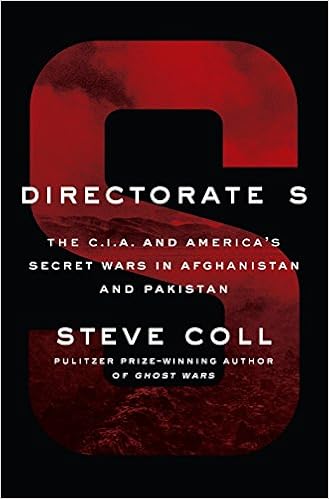

A leading US-Israeli Intelligence analyst and operator recently summed up pathetic state of US intelligence operators in Pakistan as following:–

They are afraid of their own shadows”

As great powers decline , their quality of strategic judgement and decision making and their operational effectiveness also markedly declines.

Steve Coll’s voluminous and bulky book reconfirms this fact .

The first defect of this book is that it does not contain a single relevant map connected to the subject i.e Directorate S.

On page 12 the writer repeats a false and unsubstantiated claim that CIA pilots had to fly Russian MI series helicopters for Northern Alliance , whereas in reality Afghanistan never had any shortage of Afghan helicopter pilots.

On page 14 the author confirms his absolute lack of knowledge of geography when he fallaciously claims that Panjsher valley slices north towards Tajikistan , whereas in reality Panjsher valley inclines towards Chitral in Pakistan towards the Northeast , ending at Anjuman Pass.

The authors analysis is a clear testament to the fallacious assessments of US policy makers about Afghanistan like on page-17 he discusses Al Qaeda and US policy makers obsession with Al Qaeda.

As a matter of fact Al Qaeda was never the real player in Afghanistan all along . It was a puny group with limited strategic ability. The real players in Afghanistan all along were Taliban supported by Directorate S of the ISI.

This basic US perceptual error repeatedly appears in Steve Colls voluminous narrative and Steve Coll himself is quite confused about it.

Steve Colls factually flawed statements like page-17 where he states “Recalling the miserable fates of Imperial Britain” while referring to Britain”s Afghan wars. Why Coll has to make such baseless statements is perplexing. As a matter of fact all three Afghan wars were a strategic success , the first being waged by a British private company. All three Afghan wars made British strategic position in India and West Asia stronger and created a more stable Afghanistan.I guess it is fashionable in western authors to make such statements about what a terrible place Afghanistan was and is . Continue reading Review: Directorate S
Afghanistan. Exit to Chaos?

Prompted by some discussion on Twitter, a few random thoughts:

  1. The US has spent 100s of billions of dollars in its longest war and Trump has had it and wants out. He is not wrong in regarding this as a colossal waste of money. But Trump being Trump, he will probably end up wasting whatever gains the US DID make in the region in the process. Zalmay Khalilzad may be sincerely interested in a viable Afghanistan, but his boss has neither the interest nor the ability. Without knowing ANYTHING about the various layers of secret planning and execution going on right now, just on general principles (losers don’t get to dictate terms, winners are not bound by promises they made, Trump is an ignorant conman, etc) this is not going to end well. There WILL be blood.
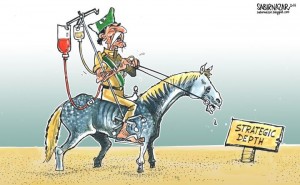
  2. The waste is going to get blamed on “corrupt Afghans”, but really, the Afghan elite (while undoubtedly corrupt in many cases) is not the main actor here. The United States is simply not a very effective imperial power. Much of the corruption is on the US side (contractors for the most part) and all of it is ultimately the responsibility of the imperial power cutting the checks. The US has a frighteningly capable military and a huge war chest. For the US to spend 100-1000 billion dollars and be unable to manage Afghanistan is a tribute to American incompetence, not Afghan resistance or corruption. If they were fooled by Pakistan is it Pakistan’s fault? if they were fooled by Afghans, is it all the Afghan’s fault? Beyond the obvious corruption on the US side there is the issue of ideological incompetence; the US is neither a capable imperial power, nor an innocent spectator with no interest in meddling in far away countries. And somehow its processes are so designed that it is easier to waste a 100 billion per year than it is to sit back and figure out what the aims are, where the carrots and sticks are most likely to work and now to apply them.
  3. The threat of withdrawal is not necessarily a bad idea. There is an obvious moral hazard in this situation, where Afghan (and other anti-Taliban parties, including India, Iran, Russia, China etc) have limited incentive to shape up or step up as long as the US is walking around with a generous checkbook and a tremendous fighting force willing to act on their behalf. In better hands, this might have been exactly the way to make everyone shoulder their own share of the burden.. but these are not “better hands”. Trump has no plan and less interest in any good (or bad) outcome. I find it hard to imagine that this could end up as a US “win”. As a US citizen, I will be happy if it does, but I am not holding my breath.
  4. Pakistan, supposedly the “winner” in this war, will not find victory too satisfying. The Taliban will not take orders (I mean they probably WILL entertain requests to kill X or Y as a favor to us, but they won’t do things they don’t want to do anyway), anti-Taliban Afghans will not roll over and play dead. India will continue to support them and Indian support is not insignificant. Russia, Iran and even China probably do not want a Taliban govt either. Instead of peace, we will have renewed civil war and more violence, not less violence. (Including blowback IN Pakistan). While the US may pay us (directly or more likely, indirectly via Gulf allies) for help in getting out, they will not keep paying once they are out. And they may not leave either. They may stick around to support the rump Afghan regime, and may pay troublemakers in Pakistan. And China will never be as generous as Uncle Sam used to be. Our troubles will not end with “victory” in Afghanistan.
  5. It would have been better to work WITH the US to stabilize a pro-US Afghan regime back in 2002 instead of playing double games. The cost of these games may extend beyond “victory”.
  6. 316743_10150340654784292_529734291_7856373_1074019852_n1-300x185

Book Review: The Stan

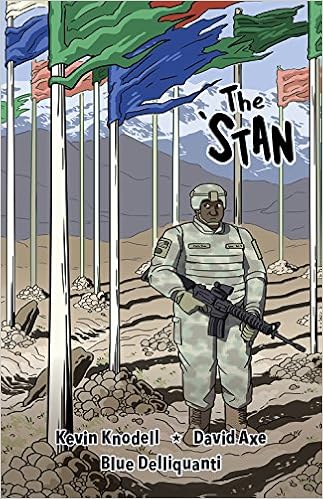
Dead Reckoning is a (fairly new) imprint of the Naval Institute Press that publishes military-themed graphic novels and books (e.g. they have published “All Quiet on the Western Front” as a graphic novel).   The Stan is a comic book based on stories collected by two American journalists (autors Kevin Knodell and David Axe) who have spent a long time covering the war in Afghanistan. The only story not based on their work is the opening chapter, which is a comic based on the life and words of former Taliban ambassador to Pakistan, Abdus Salam Zaeef. They use this first comic as a capsule history of the background to this war as well as a prediction of its futility and eventual failure.  This is the only comic that gives a nod, albeit a minimalistic and relatively simple one, to the “big picture” of the Afghan war and it is a strictly anti-war and anti-interventionist one. The other comics are all about the “little people”, ordinary soldiers, an Afghan interpreter, an Afghan soldier and an Afghan policeman. The last comic is about one of the authors (Kevin Knodell), who may have some PTSD, and his parting words are that “America’s longest war was going to stretch on longer”. Continue reading Book Review: The Stan

Brown Pundits