Was India ever really “secular”?

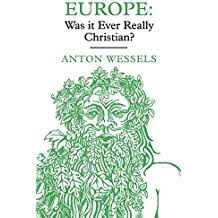
Anton Wessels, a Reformed Christian professor of “missiology”, wrote a book many years ago, Europe: Was It Ever Really Christian? The title reflects on the fact that a secular ‘post-Christian’ Europe may never have been very Christian at all, at least in Wessels’ telling.

Wessels writes from a Reformed Protestant perspective. This tradition has taken a very dim view historically of ‘popular folk religion’ during the medieval period in much of Northern Europe. Wessels’ catalog of non-Christian beliefs and practices before and during the Reformation emphasize that from the perspective of a confessing Reformed Protestant it may actually be a fact that most of the population never truly internalized in the gospel, even if they made outward show of affiliation with the Christian religion. Christendom was nominal, not substantive.

There are many arguments one can bring to bear to critique Wessels’ views. In particular, some historians of religion assert that in fact, late medieval piety resulted in the spread of genuine deeply held Christianity to the peasantry of much of Europe. The argument then is that this sincere Christianity is actually one reason that the Reformation occurred when it did. Additionally, even granting Wessels’ contention about the medieval period, the competition between Protestants and Catholics after 1500 guaranteed attention to popular beliefs and practices for several centuries before secularization. The suppression of pagan practices among Lithuanian peasants occurred during the period when Catholic clerics were fighting off the expansion of Protestants.

And yet I think we need to give the nod to some element of Wessels’ thesis: that popular Christianity was quite distinct and different from the faith promulgated from on high, and officially claimed as the ideological basis of Western societies. Perhaps the rise of modern secularism is in some ways the proletarianization of European culture?

What does this have to do with India? In the comments below, and in the media, some Indians are bemoaning the death of secular India. But was India ever secular truly? Nehru was an agnostic. His great-grandchildren now make a show of attending Hindu temples and asserting their Brahmin lineage.

I grew up in the United States of Ameria with the children of elite Indian Americans, who left in the 1960s and 1970s. These people were all urbane, and most of them were not particularly religious. But, like my own parents, they were all very self-conscious of their “communal” identity. These were people who grew up in a “secular India”, and moved through good universities. Because of the times, and when they left, many still retained socialist sympathies (as my own parents do). But, these were not liberal cosmopolitans. Most of their children were absorbed into American culture, but they were products of something very alien to liberal individualism.

The India that people are mourning was a weird chimera. Traditional, collectivist, and communal on the broad level. But ruled by a small English-speaking elite with cosmopolitan pretentions, Macaulay’s children. Generations of secularism and socialist rule did not erode the ancient foundations of Indian society, with caste and community reigning paramount.

What we are seeing is the death of the chimera and the revolt of the middle class. True change and secularization are going to occur only with broad-based prosperity and urbanization. Secular socialist India couldn’t bring that, and so nothing changed on the fundamental structural level. Its failure laid down the seed-bed for the emergence of the Hindu Right, which draws deeply at the well of communal sentiment which is stitched throughout the fabric of Indian society.
By request — the ouroboros game

Callum Flack saw my recent post here and wanted to see examples of the Ouroboros board in use — so this post is for him, and Ali Minai too if self-reference interests him — I’m guessing it does, unless computer science has moved so far ahead since Hofstadter wrote Godel Escher Bach that it no longer applies..

**

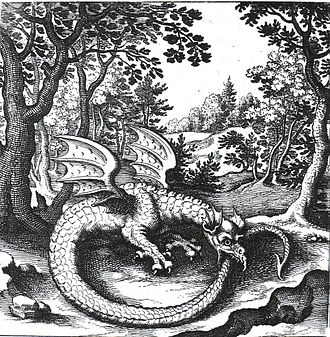
How to explain the ouroboros? It’s the ancient and ubiquitous symbol, found earliest, perhaps, in Pharaonic Egypt, of a serpent biting its own tail:

More recently, it’s a popular image in alchemy

Self bites itself. And that’s a pattern worth watching.

**

Wikipedia tells us, quoting a Harvard study by Michael Witzel:

in the Aitareya Brahmana, a Vedic text of the early 1st millennium BCE, the nature of the Vedic rituals is compared to “a snake biting its own tail.”

Then there’s this example from a medieval Indian scripture, the Yoga-Kundalini Upanishad:

The divine power, Kundalini, shines like the stem of a young lotus; like a snake, coiled round upon herself she holds her tail in her mouth and lies resting half asleep as the base of the body

That’s ouroboros.

There’s a marvelous moment in the film Silence of the Lambs when the young FBI trainee, Clarice Starling, asks the psychiatrist and serial killed Hannibal Lecter:

You see a lot, Doctor. But are you strong enough to point that high-powered perception at yourself? What about it? Why don’t you – why don’t you look at yourself and write down what you see? Or maybe you’re afraid to.

That’s ouroboros.

The paradox of Epimenideas, the Cretan philosopher who declared “all Cretans are always liars” which St Paul mentions in his Epistle to Titus, is ouroboric.

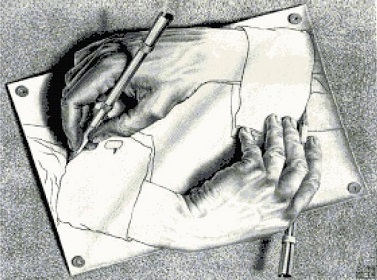
Artists, too, can take an interest in such things as hands that are drawing hands drawing hands — a double ouroboros (MC Escher)..

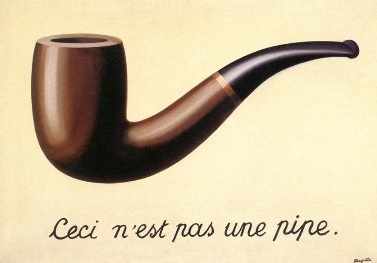
or pipes that are not pipes (Magritte):

**

Anyway, here for any who are interested, are some instances of the one-move self-referential Ouroboros board in use:

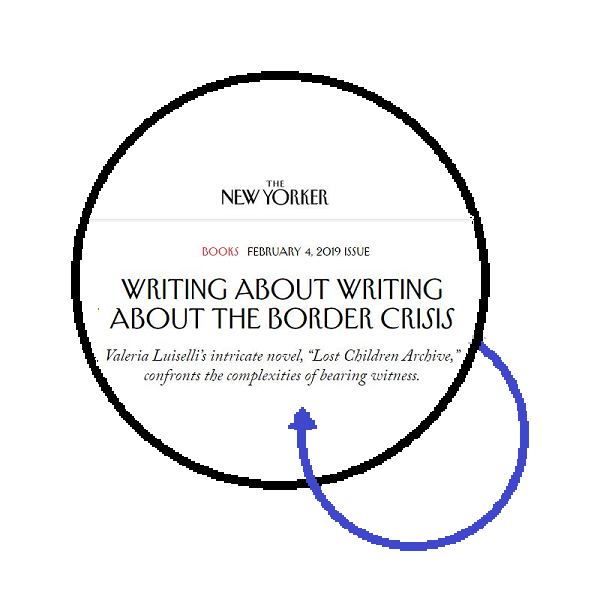
I think you’ll see why this New Yorker title jumped out of the page at me:

Writers like ’em!

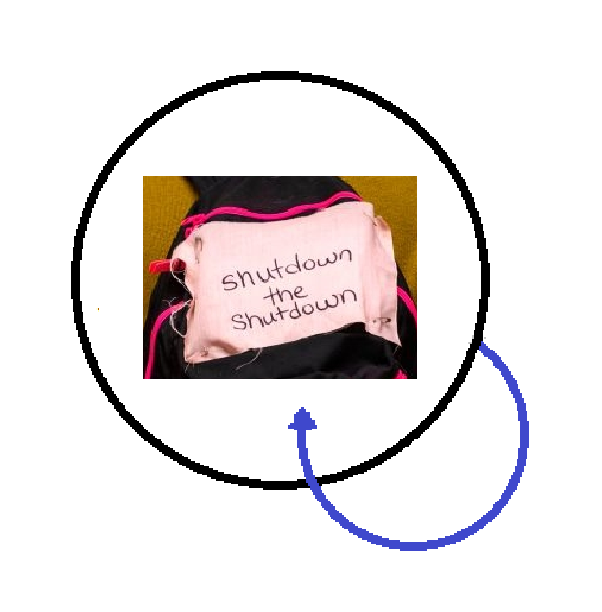
I really liked these two examples, carried by political activists — the first on a back-pack:

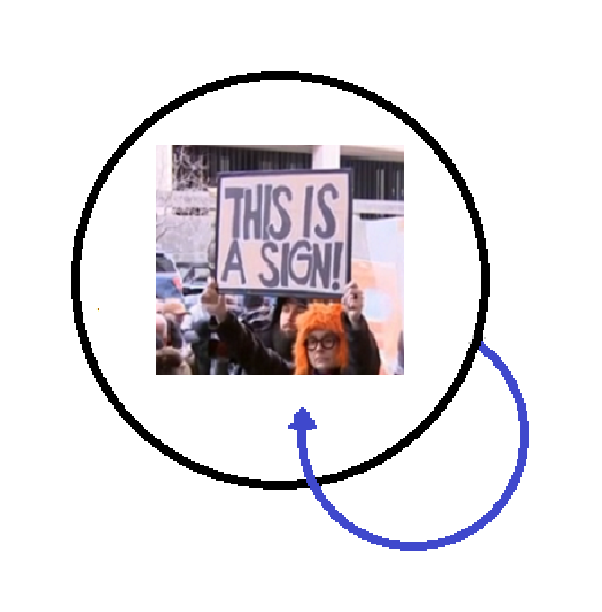
and the second on a placard — totally surreal, bearing no relation to the political event which was being protested:

That, too, is an ouroboros.

Nancy Pelosi used a weird ouroboros the other day, saying:

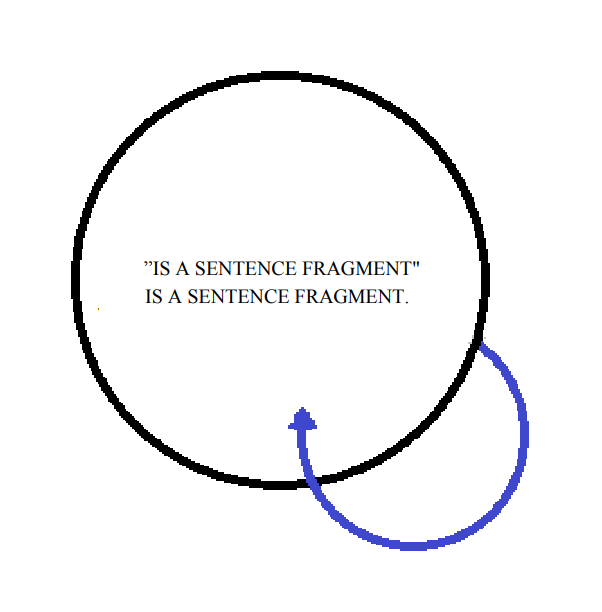
The logo of 8chan, home of the image-board where the extremists of the alt-right meet and plot away from prying eyes is another double ouroboros:

Here’s one from Hofstadter’s book, Godel Escher Bach:

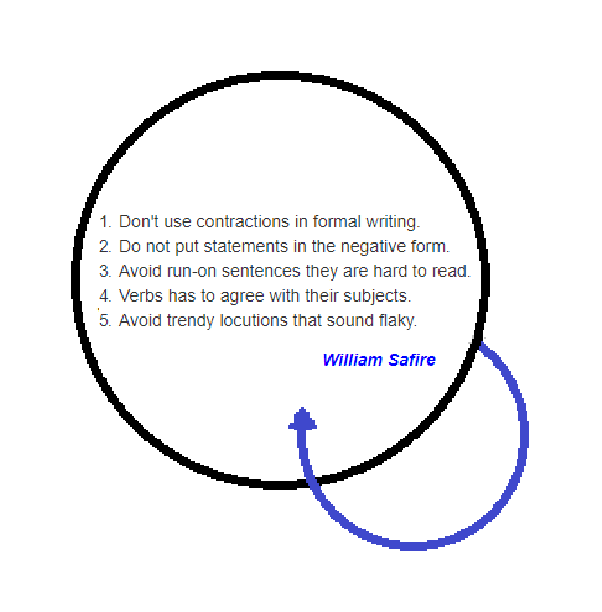
And finally, here are five instances collected by the writer William Safire:

**

I hope you like these, and find your own — here, again, is the empty Ouroboros game board in case you wish to drop your own examples into it!

Enjoy!

Analysing The Election Podcast –

I woke up this morning to commentary on Episode 38:

https://twitter.com/bharat_policy/status/1130700354146971649?s=20

We had a bit of a twitter exchange though I find it odd that Aashish zeroed in on V by claiming that she was misinformed.

https://twitter.com/bharat_policy/status/1130830244603207680?s=20

I do not understand a community where the daughter is called Asifa Bano and the father Muhammad Yusuf are *not* Muslim. People who pray to Sai Baba retain Hindu nomenclature and would be understood to be Hindus.

To somehow *disregard* Asifa’s Muslim identity in an increasingly religiously identified India is irresponsible to say the least and to somehow only raise an ethnic angle is only part of the story.

Continue reading Analysing The Election Podcast –

Magic and advertising

This is to alert BrownPundit readers to a series I’ve begun on Zenpundit, my other punditry-posting place. It’s about Ioan Couliano’s argument in his book Eros and Magic in the Renaissance that the Renaissance art of Magic was essentially a matter of conjuring desire in the recipient by means of visual imagery, and that the Art has been revived with great success in the present day, in the form of commercial advertising.

Roughly speaking, then, Magic is the defendant, modernity-secularity-technology is the prosecution team — who don’t bother to call witnesses because, m’lord, it’s plain obvious that magical thinking is superstitious nonsense — and a bucket-load of TV commercials form the evidence presented by the defense.

**

But wait a minute — here’s magic:

**

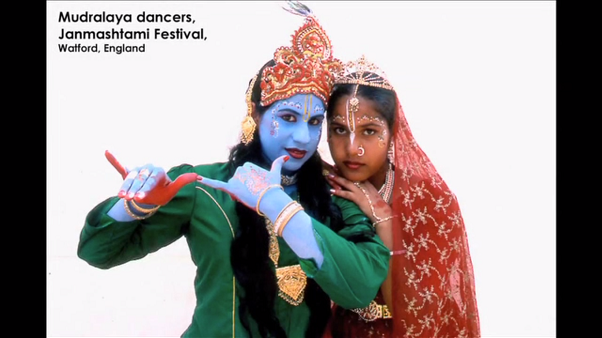
Whether you’re secular or a devotee, that photographic image is magical in that a simple hand-gesture conjures up a flute. The flute isn’t there, objectively speaking — and yet there’s a flute, Krishna is quite obviously playing it, and indeed its mellifluous power of enchantment has drawn the lovely Radha to his side.

About Krishna’s flute — you may know far more than I, but at least I can point to Denise Levertov and Edward C Dimmock’s poem in Songs in Praise of Krishna — from the Bengali:
.

Radha is terrified on her way to the forest

O Madhava, how shall I tell you of my terror?
I could not describe my coming here
if I had a million tongues.
When I left my room and saw the darkness
I trembled:
I could not see the path,
there were snakes that writhed round my ankles!

I was alone, a woman; the night was so dark,
the forest so dense and gloomy,
and I had so far to go.
The rain was pouring down —
which path should I take?
My feet were muddy
and burning where thorns had scratched them.
But I had the hope of seeing you, none of it mattered,
and now my terror seems far away. . . .
When the sound of your flute reaches my ears
it compels me to leave my home, my friends,
it draws me into the dark toward you.

I no longer count the pain of coming here,
says Govinda-dasa

**

And what does all this have to do with advertising?

My response is that the Krishna and Radha in this photo were captured, and Krishna’s flute conjured, by the eye of a pro commercial guy:

JEREMY HUNTER began his career in advertising – as a television creative, working for Young and Rubicam, Leo Burnett, Ogilvy and Bates, along the way winning a number of international awards in Cannes, Venice, New York and Los Angeles. During this time he worked with some of Britain’s most iconic film directors – John Schlesinger, Ken Russell, Tony Scott, Dick Lester, Nic Roeg, Richard Loncraine as well as Oscar-winning Editor Jim Clark and photographer Terence Donovan.

That’s the resume of a contemporary magician.

**

In case you’re interested, the posts in my Magic and Commercials series on Zenpundit to date are:

Advertising series 01: Music
Eros, the Renaissance and advertising
Authentic, spiritual magic!
The magic of advertising or the commercialization of magic?
Here’s magic!
The magic of miniatures

I imagine there will eventually be about twenty posts in the series — but more and more evidence keeps turning up in favor of the defense.

Magic, court observers seem to think, is likely to be vindicated.

Moves in the Glass Bead Game

I came across two images recently which seemed closely parallel, and yet distinctly different.

When I saw this image:

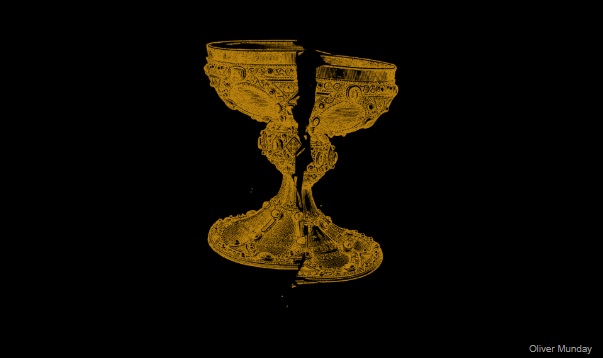
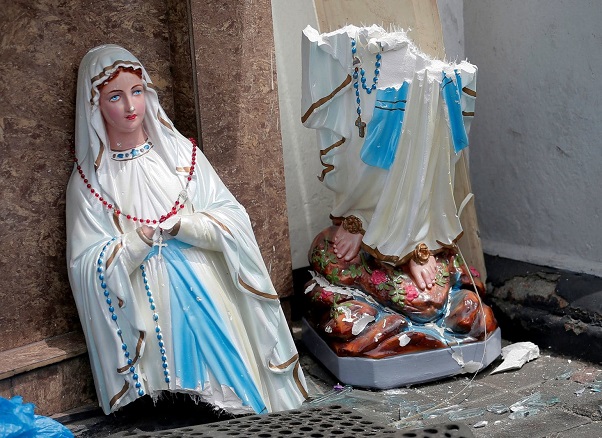
it immediately reminded me of this one, which I’d seen a few hours earlier:

That’s the first clue as to how to play the Glass Bead Game: it’s as simple as this reminded me of that.

**

The two images are very different, yet very similar.

Each is an image with a strong Catholic resonance — one image is of a statue of the Virgin Mary, mother of Jesus, the other is an image of a chalice, the cup which Jesus passed to his followers on the night before his crucifixion, and which Christians to this day drink in their various communion services, remembering him.

And both images are very visibly shattered — the shattered statue representing the devastating impact of jihadist suicide-bomber attacks on churches across Sri Lanka, the shattered chalice representing the Catholic Church, “broken” by priestly sexual abuses, and in urgent need of reformation.

In playing Hesse’s Glass Bead Game, at least in the variants that I have devised and which I call the HipBone family of games, the move from one of those images to the other is a move. And the nature of the move is their resemblance across a cognitive distance.

**

Hesse’s book was written in 1943, a time when elite thinkers — and Hesse was certainly elite — were more comfortable than we are today with sheer erudition — and he gives as an example of a move in the game, a player who had been studying —

…the rhythmic structure of Julius Caesar’s Latin and discovered the most striking congruences with the results of well-known studies of the intervals in Byzantine hymns…

— and here’s another move for you, one of my own. Little did Hesse know it, but I myself was studying up on Church music one day, and dis=covered a book by a nun, Jane-Marie Luecke OSB, entitled:

Measuring Old English Rhythm: an Application of the Principles of Gregorian Chant Rhythm to the Meter of Beowulf

Not only is Sister Jane-Marie’s book itself a monograph length move, buy my association of Hesse’s move in his book and the good Sister’s monograph — one reminded me of the other — is also a move, and a most fortuitous one, starting in the pages of the book I devoted ten or more years of my life to, and ending in a discovery in an area of my own scholarly interest — and now, in my proud ownership of Sister Jane-Marie’s slim blue volume.

**

Remember, mnthe scope of the game allows moves to be made from the whole range of human intellectual production:

The Glass Bead Game is thus a mode of playing with the total contents and values of our culture; it plays with them as, say, in the great age of the arts a painter might have played with the colors on his palette. All the insights, noble thoughts, and works of art that the human race has produced in its creative eras, all that subsequent periods of scholarly study have reduced to concepts and converted into intellectual values the Glass Bead Game player plays like the organist on an organ. And this organ has attained an almost unimaginable perfection; its manuals and pedals range over the entire intellectual cosmos; its stops are almost beyond number. Theoretically this instrument is capable of reproducing in the Game the entire intellectual content of the universe.

If you can think it, imagine it, jot it down, sketch it, hum it, or represent it as an equation, you can make a move of it, linking it to some other move already in play, or proposing it for others to link to.

**

Music is notated in a score, and in the music of ideas which Hesse’s game proposes and my HipBone Games attempt to make playable, my suggestion is to notate such moves as simple graphs — in the form of two named nodes with an edge connecting them.

Here’s a board I’ve devised to allow you to notate a move with two concepts and a linkage between them. I call it my DoubleQuotes Board, and it represents the smallest board on which a HipBone Game can be played — either solo or with a friend:

You can then assign your move to to a node in your game, and link it to another in a way that is rich in content at both ends, and which features rich connections between them, across some conceptual distance — perhaps across distinctly separate disciplines.

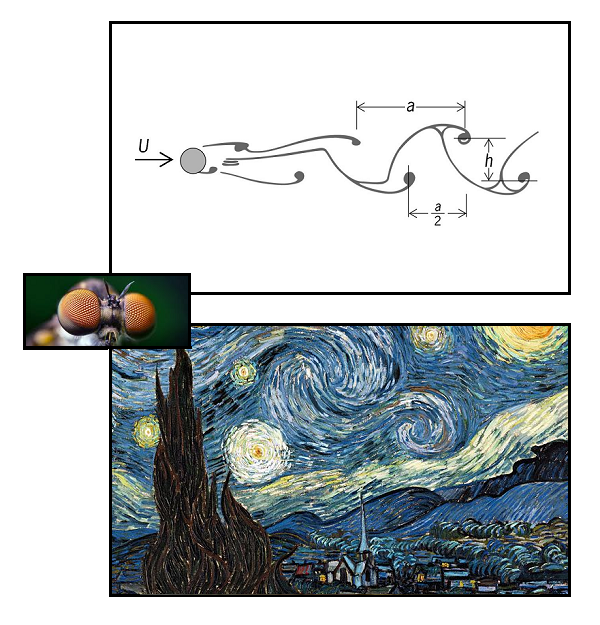
Here’s a DoubleQuote between Theodor von Kármán’s Vortex Street, and Van Gogh’s painting of the night sky:

From the dynamics of flow nto post-impressionist modern art — that’s quite a leap! And yet the two are so close, they might as well be twins!

**

So — the challenge:

What memory-leap — what associative leap, what creative leap can you come up with that most neatly and beautifully links two conceptually distant but richly associated concepts? If you feel like it, you can identify them in the Comments section, or email me at my gmail address — my handle there is hipbonegamer.
You’ll be playing one of my playable variants of Hermann Hesse’s Nobel-winning Glass Bead Game. And if you have the skill-set to drop your move onto my DoubleQuote board and post it, so much the better.

Here’s that game board again:

**

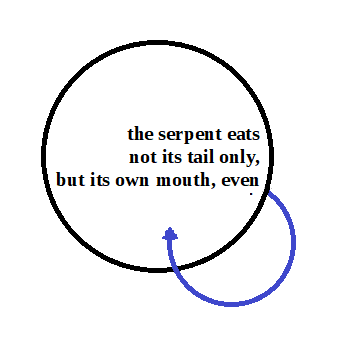
Oh, and for Ali Minai in particular, given that self-referential paradox must be an issue in AGI — here’s a board for the self-referential one-move game, with one of my poems in it:

Wanna try?

**

Enough — until next time..

Genetic variation across many South Asian communities

Someone in the comments posted the results from The Genomic Formation of South and Central Asia. I put the percentages with a few ratios in a Google doc. I don’t know what a lot of these groups are. Can readers illuminate? We need to be careful about the sample size, but I think there are a lot of interesting patterns in there.

Remember that “Steppe”, “Indus Periphery” and “Onge” are populations artifacts within a model. The way I explain it to people is that rather than focusing on the percentage, look at how the populations vary across the parameters. That is a pretty robust result. No matter what outgroups you’re going to use, Brahmins in most of South Asia seem to have more “West Eurasian” type ancestry than other populations (except in the NW). Because “Indus Periphery” has a minority of “Ancient Ancestral South Indians” (AASI) as part of its ancestry, the “Onge” fraction should be seen as a floor on AASI ancestry (the Onge ancestors diverged from the AASI ~40,000 years ago, so it’s a very large difference).

Continue reading Genetic variation across many South Asian communities

Pakistani Christian teen ‘raped, forcibly converted to Islam’

A teenage Christian girl claims she was raped, forcibly converted to Islam and then married off to a 45-year-old Muslim divorcee in the Pakistani port city of Karachi.

Neha Pervaiz, 15, a resident of Ittehad Town, told ucanews.com about her ordeal. “I was taken by my aunt, a Muslim convert, to her house on April 28 to help her look after her sick son.

But there I was asked to marry a Muslim man named Imran. When I refused, they beat me up and threatened to kill my minor brother who was with me,” Neha said.

“Later I was taken to a room where I was raped by Imran.

They then pressurized me to convert to Islam and marry Imran.“On April 29, I was taken to an Islamic cleric, who asked me to recite Quranic verses and gave me a new name, Fatima.”

Pakistani Christian teen 'raped, forcibly converted to Islam'

Unfortunately, no authentic data is available on forced conversions and forced marriages in Pakistan, but about 1,000 cases involving Hindu and Christian girls were estimated to have taken place in Sindh province alone in 2018, according to the Human Rights Commission of Pakistan (HRCP).

Do they even pretend to care about BAME anymore?

https://twitter.com/barstoolsports/status/1128828665322590208?s=20

I thought the US was a lot more “racially aware” than the UK. I’ve seen countless ads that always put BAME actors in blue-collars roles.

Why didn’t they put a white UBER driver and a black couple in the back? And for those who huff and puff that Art must mirror Life; art never imitates life, have you ever seen an ugly actor? Actors and actresses are order of magnitudes better looking than the rest of the population; it’s a stylised representation of what we want life to be. Continue reading Do they even pretend to care about BAME anymore?

Brown Pundits