
I'm in Lahore and was not fasting. At lunch I ran through complete MM Alam road to grab something to eat, none of the restaurants including KFC McDonald's was serving. So what are minorities, sick people, women on menstruation & any other person who is not fasting supposed to do?
— Ahsan (@ahsanzawar) May 15, 2019
Tag: Identity and culture
Browncast Ep 36: Karl Smith, Communist to neoliberal
Another BP Podcast is up. You can listen on Libsyn, iTunes, Spotify, and Stitcher. Probably the easiest way to keep up the podcast since we don’t have a regular schedule is to subscribe at one of the links above.
You can also support the podcast as a patron (the primary benefit now is that you get the podcasts considerably earlier than everyone else…).
 On this episode, I talk to Karl Smith. A former economist, Smith is now a columnist at Bloomberg. Smith’s style is that of a nonpartisan neoliberal driven by empirical considerations, but he actually has a very interesting background as someone who came out of an orthodox Marxist family. He was raised, quite literally, as a Bolshevik.
We also talk about his experiences being a relatively heterodox black American public intellectual, and how both of us see how racism has played out in our lives and in the country at large.
Finally, we discuss what we see in store for the United States in the future on the global stage.
We would definitely appreciate more positive reviews. Many of you listen to us, but don’t leave any reviews!
Why I hate the Hijab
It aint over till the fat lady sings.. but it is likely that harsher regime measures will be needed in the coming years (unless the CIA actually pulls off regime change, which, given the recent history of such efforts, will end up w a cure worse than the disease) https://t.co/DTMWlXWqEd
— omar ali (@omarali50) May 13, 2019
The Hijab is a part of the Middle Eastern-Levantine cultural matrix so I don’t have a problem when I see Arab women wear it . But it’s risible when Desi Muslims try to flaunt what is essentially an alien garment. If one wants to be modest why not just wear a salwar kameez and elegantly drape the dupatta?
After I ranted to V about yet another uppity Hijabi (the offending lady in question had secured herself a booth for 4 people in a crowded cafe); V made a profound remark.
V didn’t mind the Hijab per se; women should be allowed to wear what they want. However what she found to be so strange about the Muslim hijabi activists in the West is that they had no sympathy for their Iranian sisters who are dying for the right to dress as they please.
Contemplating the weave of the world
- [ exploring various versions of how the world of concepts can itself be conceptualized ]
.
**
Have patience with me: Omar Ali has invited me to post here, an honor I greatly appreciate, and I am introducing myself.
I’m an outsider. I’m your guest, and I only just arrived.. To be precise, I’m a Brit, resident in the United States:
If I’m to write on BrownPundits, I need to you know how ignorant I am in many respects, before I shed some of what knowledge I do possess — and also to focus myself in the Brown direction, because this place is devoted to “a discussion of things brown” — and while I’ll no doubt wander far afield as I post, I want to acknowledge and honor the purpose of this blog as I introduce myself here.
**
My interest, my fascination, my obsession even, is with the weave of the world. And indeed, if my friends Omar Ali, Ali Minai, and Hasan Asif can be any indication, the Punditry of Brown extends intellectually across all of history, geography and genius, to encompass the world of ideas and the world world to which the ideas refer in their combined entirety..
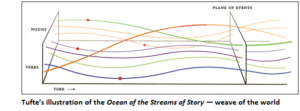
And thus the weave of the thing. That’s how the Kathasaritsagara, or Ocean of the Streams of Story, comes in to my story. Somadeva Bhatta’s concept of the oceanic streams of story caught Salman Rushdie’s eye, and Rushdie reference to it —
He looked into the water and saw that it was made up of a thousand thousand thousand and one different currents, each one a different colour, weaving in and out of one another like a liquid tapestry of breathtaking complexity; and Iff explained that these were the Streams of Story, that each coloured strand represented and contained a single tale. Different parts of the Ocean contained different sorts of stories, and as all the stories that had ever been told and many that were still in the process of being invented could be found here, the Ocean of the Streams of Story was in fact the biggest library in the universe. And because the stories were held here in fluid form, they retained the ability to change, to become new versions of themselves, to join up with other stories and so become yet other stories; so that unlike a library of books, the Ocean of the Streams of Story was much more than a storeroom of yarns. It was not dead, but alive.
— it’s a universal mapping of the sort that enchants the likes of Jorge Luis Borges and Umberto Eco, librarians both, encompassing the realm of human thought in narrative terms. And it’s one subcontinewntal form of the universal map, or model, or metaphor — the Net of Indra in the Avataṃsaka Sutra would be another.
Outside the subcontinent — but well within the compass of Brown Punditry– there are other such metaphors for the whole of the whole. Teilhard de Chardin’s oosphere is another, as is Sir Tim Berners-Lee’s >World Wide Web, in which complex weave of thoughts we now find ourselves.
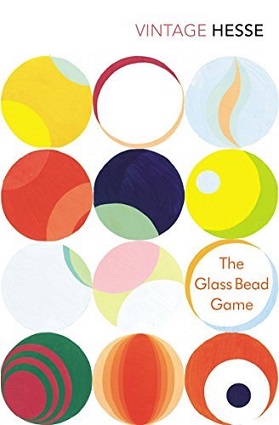
But for my own purposes, the most interesting figure of the whole, the universe as we are able to think and name it, conceptually speaking, is the Glass Bead Game as described by Hermann Hesse in his Nobel-winning novel of that name
**
My own personal predilections run from cultural anthropology through comparative religion to depth psychology, and from violence to peace-making. But that’s a huge sprawl at best, and to bring all that into some kind of focus, to learn how to map that immense territory, and the vaster universe beyond it, I turn not just to strong>Hesse’s novel, but particularly to the Game which he describes in that book:
The Glass Bead Game is thus a mode of playing with the total contents and values of our culture; it plays with them as, say, in the great age of the arts a painter might have played with the colors on his palette. All the insights, noble thoughts, and works of art that the human race has produced in its creative eras, all that subsequent periods of scholarly study have reduced to concepts and converted into intellectual values the Glass Bead Game player plays like the organist on an organ. And this organ has attained an almost unimaginable perfection; its manuals and pedals range over the entire intellectual cosmos; its stops are almost beyond number. Theoretically this instrument is capable of reproducing in the Game the entire intellectual content of the universe.
You’ll see how that description covers much the same ground as Rushdie’s description of the Kathasaritsagara, and Edward Tufte’s image of the Ocean of Story which I’ve placed at the top of this post could also be a depiction of Hesse’s great Game.
There are many voices in the Ocean, and many voices in the Game, and they are interwoven: they form which a musician would recognize as a polyphony — their concepts and narratives at times clashing as in musical counterpoint, at times resolving, at least temporarily, in a refreshing harmony.
And what better model of the world can we contemplate at this moment, that one in which a multitude of at times discordant voices wind their ways to concord?
**
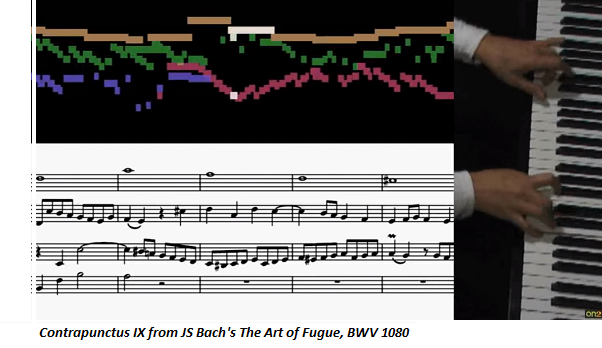
[ above: conventional score, bar-graph score and keyboard recordings of JS Bach, contrapunctus ix
Johann Sebastian Bach is the master of contrapuntal music, and, be it noted, a great composer for and improviser on the organ. And it is Bach whose music I listen to as I approach the business of modeling the world of ideas.
My mantram ca 1999/2000 was:<To hold the mind of Bach..
Where Bach devises and holds in mind melodies that collide and cohere, I want us to hold thoughts in mind — at times clashing thoughts — and learn to weave them into a coherent whole..
That’s my approach to making the Glass Bead Game which Hesse conceptualized, playable. And my playable variants on Hesse’s Game, the HipBone family of games, will be the topic of my next few posts — thanks to the kind inquiries of my BrownPundit friends, and Omar’s generous invitation to me to post here.
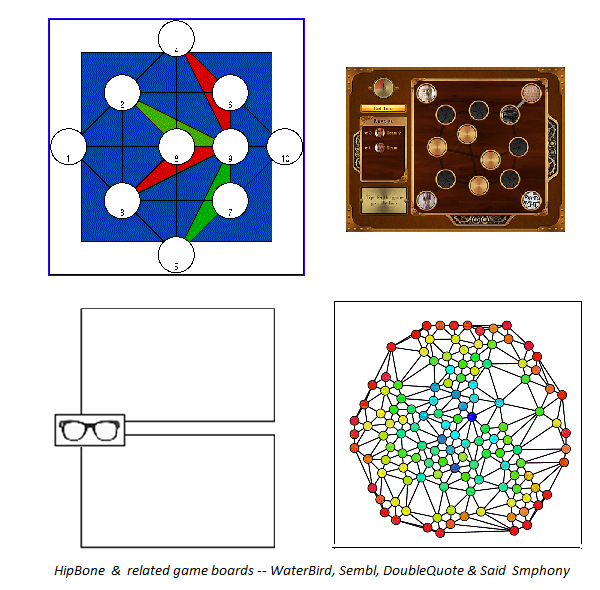
And perhaps, if you’re interested, we’ll play a few rounds of my games, or explore across the world of ideas and your and my interests, what I’ve come to think of as the HipBone style of thinking..
___________________________________________________
Charles Cameron is a poet and game designer, managing editor of the Zenpundit blog, and now an invited guest at BrownPundits. You can hear a discussion of the overlap between the Glass Bead Game and Artificial Intelligence featuring Omar Ali, Ali Minai and myself on this BrownPundits podcast — with an appreciative bow to Razib Khan.
The Indian Muslim question
I can see BP Open Thread has exploded into a flame war about Pakistani Hindus vs Indian Muslims.
I thought I would share my experience. The moment I go to India; I subconsciously de-Muslimfy. Indians & Hindus are just not comfortable and since I’m the non-confrontational type (only Kabir can role me up) I adapt accordingly.
When I’m with Pakistanis I tend to change colours accordingly however I have increasingly made my personal (and increasing) distaste of Islam known.
Pakistan is very riven with a class dynamic so it doesn’t matter what religion you are so as you belong to the right class. There are issues with Ahmadis.
Both societies have so much to do in improving minority rights but I do feel they mirror their ideological priors. Indians look at Muslims almost as a caste and Pakistanis internalise accordingly to class divisions (certain minorities belong to certain stratas).
Open Thread – Brown Pundits
Please keep the other posts on topic. Use this for talking about whatever you want to talk about.
The survey now has 160 responses. Below the fold I’ve summarized the results.
The only time when a Hijab looks good
https://www.instagram.com/p/BxQimXEp7j6/?utm_source=ig_share_sheet&igshid=x4wdncii2nj7
Short Note on “outsiders”
I’ll write a short note since my name has been taken in vain repeatedly in the past few days.
Our resident hero, Kabir, writes:
The demand for Persianization/Arabization is not coming from Pakistanis but mainly from outsiders on this blog. I fail to understand the logic of trying to change a country’s national identity when there is no grassroots demand for it.
Addendum: What have Pakistanis accomplished or achieved in the English language? I can only think of Kamila Shamsie, who won an award for Home Fire. Decolonisation must begin with the gradual displacement of English from prestige to merely technical.
Open Thread – Brown Pundits
Please keep the other posts on topic. Use this for talking about whatever you want to talk about.
Islam encourages rage-
https://twitter.com/JohnnyMercerUK/status/1123994781317779456?s=20
I can’t understand the video or what Tommy Robinson was telling the young Asian Man. Continue reading Islam encourages rage-