
Please keep the other posts on topic. Use this for talking about whatever you want to talk about.
Tag: Identity and culture
Questions for the genetics of India podcast….
Zach, Omar, and myself will do a podcast on Indian genetics next week. I already did one on this topic for my main podcast, so I’m curious what readers of this weblog want to hear about. We can’t guarantee we’ll use the questions, but it’s possible. I think the format will mostly involve Zach and Omar leading the conversation and I’ll try to talk as fast and concisely as possible.
Also, we got our first review on iTunes. Would still like to get some on Stitcher. And in case people want to hear more from me, I was a guest on the Two for Tea podcast. My episode should drop in the next day or so.
White people will still define the non-white age..
After the jump is a thread on the brief history of the North Sentinelese by “Respectable Lawyer.” This thread appeared in my Moments Page. His bio reads as “Anti-corporate pirate who gains access to courthouses with foolproof cosplay of a Respectable White Lawyer.”
There are three actors in this recent Missionary saga:
(1.) The (part) Chinese American missionary, John Allen Chau, who is technically a PoC.
(2.) The Sentinelese themselves who are the pristine natives.
(3.) The Indian government, which is not Western.
Essentially in a rather amusing way it involves the three great non-white colours of mankind (black, brown and yellow). Also to make the matter even more tantalising when we think “remote Indian tribes” we don’t usually think of India but rather Native American or Amerindian peoples. So the story involves Christianity, missionaries, colonialism and native people trying to fight back; a real life Desi version of Avatar.
https://twitter.com/kaeshour/status/1065545714485403648?s=20
Also when the NY Times did profile an Indian anthropologist (with the helpful name T.N Pandit), they had to throw in these lovely lines (cue eye-roll for helpful mention of caste and colour):
Mr. Pandit, the pale-skinned son of a Kashmiri professor, reaches to pass a coconut to a group of naked, dark-skinned young men who have waded waist-deep in water to greet him. He sits companionably beside a dark-skinned young woman, whose hand rests casually on his thigh. Film shot in 1974 shows him — a reserved Brahmin — dancing exuberantly with a bare-breasted Jarawa woman.
Continue reading White people will still define the non-white age..
A film of the Jarawa people
Why China will be the Greatest Power in Asia-
The Shanghai event was supposed to be the biggest fashion show in Dolce & Gabbana’s 33 year history.
Speaking to journalists during Monday evening’s fittings, Dolce said: “All my team is so nervous because we spent too much money on this." https://t.co/6XSEHxk01Y
— Bibek Bhandari (@bibekbhandari) November 21, 2018
It’s using “woke SJWism” to punish Dolce & Gabana. Shanghai was meant to be their biggest fashion show in 35 years.
The ads were racist (a Chinese model struggling with pasta) and China is now making full use of that faux-pas to drive in a lesson in National Honour. As one e-retailer said “the Motherland is more important than anything else.”
I don’t know what to make of the article below.
https://www.facebook.com/551630878316505/posts/1646998772113038/
The Abrahamicisation of Hinduism is one thing but is it worth projecting those values? I know that copulating deities are on temple walls so I’m just asking how do Hindu deities need to be treated.
A funny story last night; V asked me if I knew what the Shiva Lingam was. Apparently she had just found out what it actually was since she had been told throughout Hindu school that it was one of Shiva “limbs.” The Victorian legacy in India is fascinating to observe.
Also this moved me greatly:
My nana went to nankana sahib, Pakistan and sent me this😂 this was their welcome pic.twitter.com/Ixpi5aImnK
— Hindi and urdu are kusra langauges (@dmvbanda) November 22, 2018
Aasia Bibi case comes full circle (part 2)
I showed up at the Institute of Peace and Secular Studies (IPSS) a few days after the rally. The person who had called the meeting was running late so I just loitered around. It was a two-room apartment that had been modified into a makeshift office space with some spare area for sitting, with floor cushions etc. There was a book rack full of books in one corner. The lady who managed the place was present there and said Hello. A few minutes after I had arrived, two boys a few years younger than me showed up as well. We started chit-chatting and it turned out that one of them was a student at LUMS and the other went to another private school. We were talking about democracy when they revealed that they were not in favor of democracy at all and then spent the next hour arguing why they thought so. They were under the influence of Hizb-ut-Tehrir, an Islamist organization that wanted to establish a caliphate. I tried to argue with them using rationality and logic but they were not willing to listen to a counter-argument and eventually stormed off. I discovered that IPSS was offering a short course in Political Economy and History and all I had to pay for was a copy of their syllabus.
Salmaan Taseer (ST) was a larger than life person. He grew up in a literary family, with his father passing away at an early age but the familial ties and his family’s social standing in the Lahori society gave him a footing in the tightly-knit hierarchy of Lahore’s elite circles. He was an active member of the Pakistan Peoples Party (PPP) during its heyday, starting in 1968 and through Zulfikar Ali Bhutto’s rule (1972-77). After Mr. Bhutto was hanged (1979) and PPP was under threat by Dictator Zia’s government, ST wrote a biography of Mr. Bhutto. I attended a talk by one of the fact checkers on ST’s book (at the cafe, Books n Beans, a small liberal enclave for such events) and she remembered how hard she had to work to meet ST’s standards. ST was instrumental in arranging for Benazir Bhutto’s arrival in Lahore in 1986 and the grand reception that ensued. He was elected in the PPP wave that swept most of Pakistan during the 1988 elections. He didn’t win another election in during the rest of his political life. However, he was considered PPP’s man in Lahore, someone who could take on the Sharif’s of PML(N). ST started an English daily in the early 2000s, called Daily Times (DT) which started with much fanfare and even had an Urdu counterpart. Continue reading Aasia Bibi case comes full circle (part 2)
Proud of Pakistan-
https://twitter.com/khurram_dogar/status/1064797206023204864?s=21
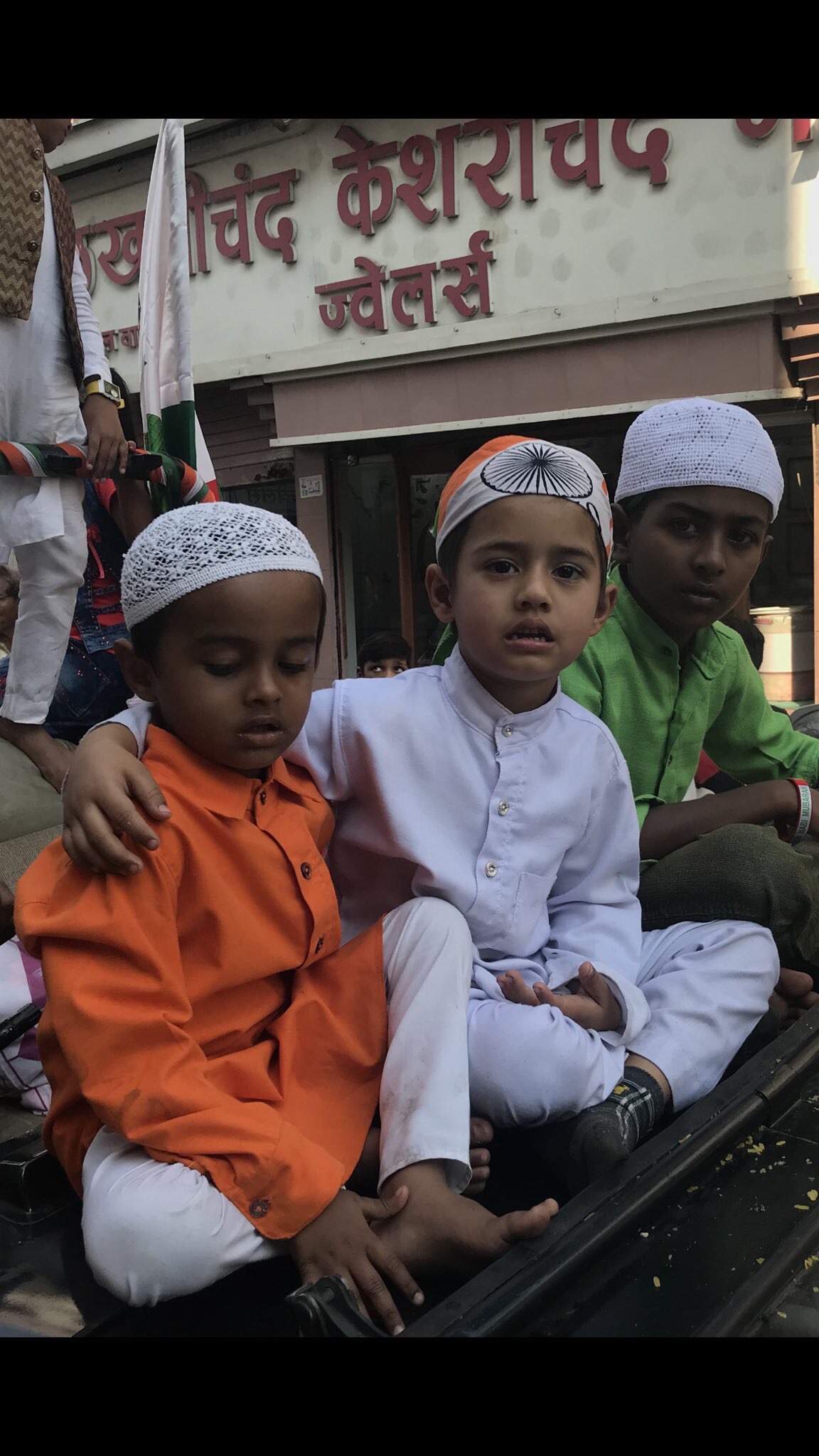
I’ve been pretty upset with Pakistan because of Asia Bibi however this important news gives me hope for the Homeland.
The picture below (stolen off Omar’s feed) gives me hope about India’s Muslims.
These symbols are important since they signal society’s direction.
I will be honest I feel Indians & Hindus are forced to be far more liberal and enlightened than what their current Socio-economic level whereas Pakistanis are similarly forced to be much more conservative given their basic Indic Cultural orientation. Both will have much to learn and give one another if ever see an Anchsluss (since our Brave Pandit has started using Nazi analogies).
Why is India allowing foreign missionaries?
Christian missionary activist John Allen Chau of Alabama was allegedly killed by Sentinelese tribals on Andaman Islands, India. The Sentinelese tribe are known to be the world’s last ‘uncontacted’ people which has a history of resisting contact with the outside world, police say. pic.twitter.com/X3ZuInqNUU
— Parthiban Shanmugam (@hollywoodcurry) November 21, 2018
Of course I’m sympathise with this earnest young missionaries passing however why is India allowing missionaries into the Andaman Islands. Continue reading Why is India allowing foreign missionaries?
Have we seen the face of Rama?
One of the problems with looking up pictures of the Kalash people of Pakistan is that photographers have a bias toward highlighting the most European-looking villagers. Let’s call this “Rudyard Kipling Lost White Races” syndrome. Therefore for your edification, I post the YouTube above which is probably more representative of what the Kalash look like.
The reason I post a link to what the Kalash look like is that it is germane to the answer to the question: what did the Indo-Aryans look like? The past tense is key since “Indo-Aryans” today means a lot of people in South Asia, in a literal sense.
In the post below Zach L. made a passing comment:
(1.) The AASI’s, which are sort of co-equivalent to the Negritos and Anadamese Islanders (one of the first coastal waves out of Africa that somehow also ended up in the Amazon). It’s interesting that they are substrate to every South Asian population (I think there are trace amounts in Central Asia, Afghanistan and even Iran).
(2.) the “Dravidian” farmers out of Iran. They are probably related to the J1/J2 types and might be an olive skinned population. Prominent in Sindh and Southern Pakistan through to South India (high % in Gujarat – must have been a locus of some sort).
(3.) our beloved Aryans who are especially prevalent among Brahmins, the Punjab and Haryana (though arguably the Haryanvis and East Punjab descend from Scythians to some extent). These look “European” but it’s a very different look to #2.
The Aryans are conventional European (light eyes, light hair, white skin) the ancient Dravidians would have (probably) looked like Middle Easterners (olive skin, dark hair dark eyes) and the AASI, ” looks like Papua New Guineans.
I can’t see any disagreement with point number two.
As for the AASI (“Ancient Ancestral South Indians”), we need to be careful here. They diverged from the ancestors of the people of Papua New Guinea ~40-50 thousand years ago. The divergence from the Andamanese, who probably migrated from mainland Southeast Asia, was not too much later. Aside from being very dark-skinned, the various extant “Australasian” people can be quite distinctive in appearance. The people of Papua, and native Australians, are quite robust. A substantial minority have blonde hair color due to a mutation common among Oceanians. The “Negrito” people of Southeast Asia and India all seem to be have adapted to a narrow relic niche, and may not be representative of their ancestors.
That being said, there is a particular non-West Eurasian look that many South Asians have which we can presume is the heritage of the AASI.
The comment about Aryans looking like Europeans raised my eyebrows a bit. This is a touchy subject, and to be honest my initial reaction was to be skeptical. But the more I read the primary literature to check up on Zach, the more reasonable this seemed to be. The dominant steppe signal into South Asia does resemble the people who were pushing into Central and Western Europe 1,000 years earlier than the Indo-Aryans, who were moving southward probably ~3,500 years ago. This is clear in rather simple statistical genetic analyses-populations such as the Kalash and Pathans for example show strong evidence of “European-like” gene flow.
Current work out of David Reich’s lab suggests that the Kalash are the best modern proxies we have for the “Ancestral North Indians,” the ANI. This population is modeled as:
– ~30% “steppe”, which is very similar to the ancestry which expaned westward into Europe between 3000 and 2500 BCE
– ~70% “Indus Periphery”, which seems the likely ancestral contribution of the people of the IVC, and is a heterogenous mix of Iranian-farmer and AASI
The mid-range estimate for the emergence of the Kalash mix is ~2,500 years before the present, but these usually have some downward bias, so it is reasonable that it would be greater than ~3,000 years. The samples from the Swat Valley dating to this period show gradual increase of “steppe” ancestry over time.
So one reason to be skeptical that the Indo-Aryans were “European-like” in appearance is that by the time they were flourishing in the lands previous inhabited by the IVC they may already have been more than 50% genetically like the people of the IVC. In which case, a minority would be very European-looking, but most would look vaguely West Asia, with some looking more stereotypically South Asian. If you look at the video above I think you do see the Kalash look this way.
One reason I’ve always been skeptical of the idea that the Indo-Aryans looked European, or, that their demographic impact was large, is that it seemed unlike both could be true. The expression of blue eyes among Indians was too low of a percentage.
Here is the frequency at a major SNP which predicts a lot of the blue vs. brown eye color.
Open Thread – Brown Pundits
Please keep the other posts on topic. Use this for talking about whatever you want to talk about.