Ayesha Siddiqa’s succint history of anti-Shia Deobandis

(Article originally posted at the These Long Wars blog)

Ayesha Siddiqa covered the sudden rise of anti-Shia extremism in Pakistan, in a recent article. In it she gave a short history on the provenance of anti-Shia, Sunni extremism in the country that’s worth reading:

Though the first instance of Sunni-Shia tension erupted around 1951 in Sindh, it built up more decisively during the 1980s. General Zia-ul-Haq’s regime looked away while the Anjuman-e-Sipah-e-Sahaba (ASS) took birth in Jhang, South Punjab in 1986. It later turned into the Sipah-e-Sahaba Pakistan (SSP) that became the mothership of all Deobandi militancy. It gave birth to Lashkar-e-Jhangvi (LeJ) during the early 1990s, and also the Harkat-ul-Mujahideen, Harkat-ul-Ansar, and later Jaish-e-Mohammed (JeM).

During counter-terrorism operations by Pakistan, segments from the SSP, LeJ and JeM went into making the Tehreek-e-Taliban Pakistan (TTP). Some members of this even went on to join Daesh. The SSP was also one of the first organisations to fight in Afghanistan. Besides militancy, the organisation also engaged in politics. Its leader, Haq Nawaz Jhangvi, initially contested elections in 1988 from a Jamiat-e-Ulema-e-Islam–Fazlur Rehman (JUI-F) ticket, and later formed his own party. Around the time Haq was killed in 1990 outside Islamabad, Pakistan saw a lot of bloodshed, including sectarian violence, through the decade of the 1980s, 1990s, and the 2000s. Like the evolution of its militant wings, the SSP’s political face also evolved. One of its current forms is the group Ahle Sunnat-Wal-Jamaat (ASWJ), which is visible in electoral politics. The SSP and other militant groups are part of the Deobandi network that comprises militant outfits, political groups, and welfare institutions.

The network is so well spread out in the largest province of Punjab that there are over 20,000 staunch Deobandi voters in every constituency, which makes the group important for all political parties and builds their influence. The JUI-F, headed by Maulana Fazlur Rehman, is one of the most prominent faces of the network. It is instrumental in partnering with the Pakistan Peoples Party (PPP) and spreading the influence of Rehman’s network in Sindh and Baluchistan.

I think that’s a good enough bite-size history by Dr Siddiqa on the rise of sectarian extremism in Pakistan.

Below is an election poster of anti-Shia candidates, with my opinion on them.

https://twitter.com/TheseLongWars/status/1314616671018024960
Their Muslim Problem—And Ours


Every now and then there is a controversy on Indian-Twitter which bleeds over into my timeline that I have to notice.

Some quick observations:

– There are those who lambast the critics of this ad. Many of the critics are low-IQ vulgarians. So the criticism is not without foundation. But, most of the responses dodge the gendered nature of the objection. The fact is that in Islam it is understood that Muslim men can marry non-Muslim women. It is also tolerated for Christians and Jews to retain their religion after marriage. The children are considered Muslim. This practice in a patriarchal society was seen as a boon to the Islamic nation.

The advertisement plays into this Islamic trope. The converse of this is that most interpretations of sharia ban the marriage of Muslim women to non-Muslim men. Again, the rationale for this is straightforward: the children inherit the religion of the father, and therefore the children are lost to Islam. If the supporters of the beauty of the advertisement of interfaith marriage believe in this custom, then they should support more speech. In particular, they should support an advertisement where a Hindu man marries a Muslim woman in a Hindu ceremony to show that there is nothing wrong with this act so long as the people consent freely.

Continue reading Their Muslim Problem—And Ours

Noakhali rape victim video

Bangladesh: Protests Erupt Over Rape Case:

Protests in Bangladesh erupted this week after a video of a group of men attacking, stripping, and sexually assaulting a woman went viral, Human Rights Watch said today. Protesters called for the resignation of Home Minister Asaduzzaman Khan Kamal over the government’s failure to address an alarming rise in sexual violence against women and girls.

Noakhali Gang Rape Victim: Delwar raped her several times before:

Our Noakhali correspondent’s personal office is in a computer market in Maizdee Old Bus Stand area. Over the last two days he has witnessed how the video spread over the whole market. It was played and replayed in public on computer screens as everyone crowded to perceive first-hand the horror inflicted on the woman.

“Bhaiya, do you have the video? I had it but it got deleted… I wanted to show it to someone,” said a computer businessman, approaching our correspondent, who declined to entertain the request.

Snippets of conversation overheard on the street also attest to how widespread the video has become. Two elderly men out on their evening stroll complained to each other, “The video keeps popping up on my mobile phone. This is so awkward, especially in front of the wife and kids…”

So perhaps a naive question: why are people sharing this video??? Every few years I hear about a gang-rape video coming out of MENA and South Asia, spreading virally. Why do people want to see this? It’s like sharing a video of a murder..

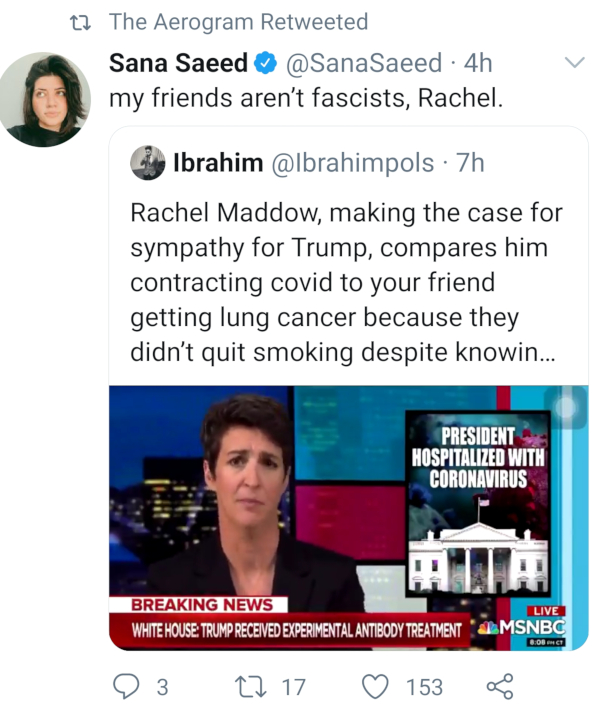
The AJPlus exception! Fascism for thee, but not me


I am not a media person, so I do not understand the deal with AJPlus and its “woke” journalists.

AJPlus is owned by the Al Jazeera Media Group, which is a catspaw of the government of Qatar. Qatar is a Salafi petrostate run for the benefit of the Thani family and is run like a capitalist caste state. I’ve been to Qatar. It’s a fine place if you have money, but perhaps less fine if you one of the laboring classes.

I don’t begrudge Sana Saeed for making a living, but I doubt she would begrudge herself that opportunity if she was on the outside looking in.

The world is complicated. I dislike engaging in guilt-by-association but woke journalists at AJPlus do it constantly. It’s like they don’t see the glasshouses that they live in.

Afghan Conundrum

From Dr Hamid Hussain. 

“A real friend is one who takes the hand of his friend in times of distress and helplessness’.  Afghan proverb

 In September 2020, Afghan government and Taliban representatives met for the first time publicly in Qatar to start intra-Afghan dialogue.  There were lot of hurdles between the first step of signing of agreement between United States and Taliban in February 2020 and start of intra-Afghan dialogue in September 2020.

 All parties are asking Taliban for a ceasefire during intra-Afghan dialogue.  Taliban are not agreeing to this condition and violence has escalated in the last few months.  Taliban leadership is concerned that if it agrees to a ceasefire then foot soldiers and local commanders will head back to their homes.  This will weaken Taliban negotiation position and it will require some effort to re-mobilize foot soldiers.  In addition, there is also fear that hardline Taliban may break away.  The price that Taliban are paying is negative public opinion inside Afghanistan.  Large number of Afghans are angry that Taliban have signed a truce with foreign troops; the very rai-son d’etre of Taliban fight while shedding the blood of fellow Afghans with impunity. Continue reading Afghan Conundrum

The Ambition of the Emirates


For a large part of history, the inhabitants of the Arabian peninsula were on the fringe in the rise and fall of empires. They alternated raiding and trading as this wheel of fire rolled on across the dunes. But eventually, the Arabian caravan would be equipped with both sword and word to make haste across the Old World in a relentless raid that would change both history and humanity.

Yet just as quickly as the prized Arabian horses would gallop into newly conquered lands, the Arabs would soon scatter leaving their language, faith, and the prestige of their roots behind in strange lands. Tribalism trumped their newfound unity and the Arabs would once again retreat into their wildernesses and pilgrimages.

That is until wealth erupted from its wastelands. The old elites of the Middle East would now return from their desert exile to begin another round of a game of thrones.

Continue reading The Ambition of the Emirates

Browncast – Cliff Smith and Sam Westrop: The Origins of South Asian Islamism

Another BP Podcast is up. You can listen on LibsynAppleSpotify,  and Stitcher (and a variety of other platforms). Probably the easiest way to keep up the podcast since we don’t have a regular schedule is to subscribe to one of the links above!

You can also support the podcast as a patron. The primary benefit now is that you get the podcasts considerably earlier than everyone else. This website isn’t about shaking the cup, but I have noticed that the number of patrons plateaued a long time ago.

This episode features Akshar and Mukunda talking to Cliff Smith and Sam Westrop of the Middle East Forum. We get into topics surrounding the relevance of the Deobandi movement, how Islamism percolates between South Asia and the West, and the political ramifications of Islamism in the US and the UK.

Pakistan and India: Why Did They Diverge?

@FrankBullit67 is a well-read Rajput from India, and an active presence on Twitter. He composed a thread on partition and his view of why India and Pakistan have diverged in many ways since independence. I tweeted it with the comment that it was interesting, but I may not agree with all of it. Which led to several people asking me “what do you disagree with?”. I had not really thought it through, but here is what I came up with; Frank’s tweets are combined into paragraphs and any comment I may have is under the tweet in red. (1. that India and Pakistan have not diverged as advertised here is another possible argument, I skipped that for now, and 2. everybody forgets Bangladesh, which fact was nicely summarized by @shivamsethi01 and i have attached a screenshot at the end of this post).

Frank: I was going to do a thread on Partition in the form of a historical chronology – I think that can wait. I’ve decided to do a thread which is more “philosophical” and on “principles” about Partition. So here goes. As we know, “partition” carved two countries out of one in 1947. One with a Hindu majority (~85% Hindu in 1947 but now 79%). The other with a Muslim majority (over 90% Muslim in 1947 – even more skewed now).

The process was extremely bloody resulting in over a million deaths (some think the figure could be two million).

For those who are unfamiliar with the scale of the carnage, it is worth Googling Margaret Burke-White’s pictures of partition for LIFE Magazine (see here).

Indians, Pakistanis and Brits can keep arguing for centuries about who was responsible for what but that’s another subject. The purpose of this thread is to concentrate on what I think is the key philosophical divergence between Hinduism and Islam which made violent conflict or a “partition” unavoidable. Although one can write an encyclopaedia on the theological differences between the two Faiths, the key difference to me is on the question of “Blasphemy”. Broadly, Hinduism has had atheists in the mix for millennia (or those with a weak adherence to faith or those who have created new sects). This was never punished. As a result, Hinduism, Jainism, Buddhism and later Sikhism lived next to each other for millennia or centuries despite enormous theological differences. Continue reading Pakistan and India: Why Did They Diverge?

History beyond the screaming

Last night I realized I’m not going to weigh in on history discussions on Twitter if they pertain to the Indian subcontinent. Even people who I know are not 13-year old incels behave totally emotionally and engage in shitposting posturing constantly. It’s really impossible to get a signal out of the discussion.

Indians and Pakistanis seem so intensively invested in various topics that it is literally and seriously impossible to get value out of any exchange, the swell of stupidity and bad faith (on all sides!) is so intense. There is a reality out there. There is a true history. But this is not what most of you really care about it, is it?

For example, reading India in the Persianate Age: 1000–1765 gives a nuanced and fully textured picture in outlines of the subcontinental elite in the premodern period. It aligns in broad sketches with what I know about human psychology and history elsewhere. But attempting to bring nuance seems like a fool’s errand in most of these debates.

Understanding the history of the Indian subcontinent is rewarding to me because there are comments here on the general human condition. I will not turn away from that. But, I do need to reflect on whether that is best done in solitude rather than engaging with the world “out here.”

Note: I don’t mind or care too much if particular truths are leveraged in some ideological manner. Rather, my suggestion is ideological priors are doing all the sifting of which truths are correct or not.

Hello, Nurse!

Aloha! Wassup? Kaisay ho yaar?

My name’s TheseLongWars, TLW for short, known for twitter.com/TheseLongWars, currently from these-long-wars.blogspot.com, formerly of theselongwars.blogspot.com (RIP: 2010-2020).

It is an absolute Goddamn pleasure and honour to have been invited to be here as a writer and opinion-ator at BrownPundits.com!

As you may have seen my tweets, I have been commenting in-depth about my native Pakistan for a decade now. I’m from the city by the sea, Karachi, and I am a happy partisan for that over-grown beach-hole. I’m not a big genetics or phrenology fan. However, I love talking politics, I love talking some culture, I love history, and I enjoy getting the chance to write.

But let’s not make this intro long-winded. Snappy posts are fine, but some effort later at longer posts, will come later.

For now, here’s where the catch-phrase my title is based on is from. Do read what I write; you’ll always learn something worth knowing 😉

Ciao!

Brown Pundits