Browncast – Cliff Smith and Sam Westrop: The Origins of South Asian Islamism

Another BP Podcast is up. You can listen on LibsynAppleSpotify,  and Stitcher (and a variety of other platforms). Probably the easiest way to keep up the podcast since we don’t have a regular schedule is to subscribe to one of the links above!

You can also support the podcast as a patron. The primary benefit now is that you get the podcasts considerably earlier than everyone else. This website isn’t about shaking the cup, but I have noticed that the number of patrons plateaued a long time ago.

This episode features Akshar and Mukunda talking to Cliff Smith and Sam Westrop of the Middle East Forum. We get into topics surrounding the relevance of the Deobandi movement, how Islamism percolates between South Asia and the West, and the political ramifications of Islamism in the US and the UK.

Pakistan and India: Why Did They Diverge?

@FrankBullit67 is a well-read Rajput from India, and an active presence on Twitter. He composed a thread on partition and his view of why India and Pakistan have diverged in many ways since independence. I tweeted it with the comment that it was interesting, but I may not agree with all of it. Which led to several people asking me “what do you disagree with?”. I had not really thought it through, but here is what I came up with; Frank’s tweets are combined into paragraphs and any comment I may have is under the tweet in red. (1. that India and Pakistan have not diverged as advertised here is another possible argument, I skipped that for now, and 2. everybody forgets Bangladesh, which fact was nicely summarized by @shivamsethi01 and i have attached a screenshot at the end of this post).

Frank: I was going to do a thread on Partition in the form of a historical chronology – I think that can wait. I’ve decided to do a thread which is more “philosophical” and on “principles” about Partition. So here goes. As we know, “partition” carved two countries out of one in 1947. One with a Hindu majority (~85% Hindu in 1947 but now 79%). The other with a Muslim majority (over 90% Muslim in 1947 – even more skewed now).

The process was extremely bloody resulting in over a million deaths (some think the figure could be two million).

For those who are unfamiliar with the scale of the carnage, it is worth Googling Margaret Burke-White’s pictures of partition for LIFE Magazine (see here).

Indians, Pakistanis and Brits can keep arguing for centuries about who was responsible for what but that’s another subject. The purpose of this thread is to concentrate on what I think is the key philosophical divergence between Hinduism and Islam which made violent conflict or a “partition” unavoidable. Although one can write an encyclopaedia on the theological differences between the two Faiths, the key difference to me is on the question of “Blasphemy”. Broadly, Hinduism has had atheists in the mix for millennia (or those with a weak adherence to faith or those who have created new sects). This was never punished. As a result, Hinduism, Jainism, Buddhism and later Sikhism lived next to each other for millennia or centuries despite enormous theological differences. Continue reading Pakistan and India: Why Did They Diverge?

History beyond the screaming

Last night I realized I’m not going to weigh in on history discussions on Twitter if they pertain to the Indian subcontinent. Even people who I know are not 13-year old incels behave totally emotionally and engage in shitposting posturing constantly. It’s really impossible to get a signal out of the discussion.

Indians and Pakistanis seem so intensively invested in various topics that it is literally and seriously impossible to get value out of any exchange, the swell of stupidity and bad faith (on all sides!) is so intense. There is a reality out there. There is a true history. But this is not what most of you really care about it, is it?

For example, reading India in the Persianate Age: 1000–1765 gives a nuanced and fully textured picture in outlines of the subcontinental elite in the premodern period. It aligns in broad sketches with what I know about human psychology and history elsewhere. But attempting to bring nuance seems like a fool’s errand in most of these debates.

Understanding the history of the Indian subcontinent is rewarding to me because there are comments here on the general human condition. I will not turn away from that. But, I do need to reflect on whether that is best done in solitude rather than engaging with the world “out here.”

Note: I don’t mind or care too much if particular truths are leveraged in some ideological manner. Rather, my suggestion is ideological priors are doing all the sifting of which truths are correct or not.

Hello, Nurse!

Aloha! Wassup? Kaisay ho yaar?

My name’s TheseLongWars, TLW for short, known for twitter.com/TheseLongWars, currently from these-long-wars.blogspot.com, formerly of theselongwars.blogspot.com (RIP: 2010-2020).

It is an absolute Goddamn pleasure and honour to have been invited to be here as a writer and opinion-ator at BrownPundits.com!

As you may have seen my tweets, I have been commenting in-depth about my native Pakistan for a decade now. I’m from the city by the sea, Karachi, and I am a happy partisan for that over-grown beach-hole. I’m not a big genetics or phrenology fan. However, I love talking politics, I love talking some culture, I love history, and I enjoy getting the chance to write.

But let’s not make this intro long-winded. Snappy posts are fine, but some effort later at longer posts, will come later.

For now, here’s where the catch-phrase my title is based on is from. Do read what I write; you’ll always learn something worth knowing 😉

Ciao!

Some musings on the Bengal riots of 1949-50

While any discussion of Partition tends to focus a lot on the migrations and violence circa 1947, we tend to forget the mayhem that followed in Bengal with a lag. As late as 1950! In Bengal the violence peaked in late 1949 – 1950 unlike in Punjab. Particularly in East Pakistan.

The discussion of these riots and the agreements that ensued in 1950 in TCA Raghavan’s book “The People Next Door” make an interesting read.

The partition in 1947 had left both sides of Bengal with similar proportions of minority populations. West Bengal had five million Muslims in a population of twenty one million. East Pakistan was left with eleven million Hindus in a population of thirty nine million.

Unlike in the Punjab, a full-fledged ethnic cleansing did not occur in Bengal. Perhaps in part because of the presence of Gandhi in Bengal for a couple of crucial months in 1947. There could be other reasons that can explain why Bengal didn’t start with a blank slate unlike Punjab. I can only think of the Gandhi-factor as of now

The violence festered in Bengal right up to 1950, but it peaked in the month of February that year, particularly in East Pakistan. The violence against Hindus provoked much political unrest in India, causing Nehru to assume stances that seem very hawkish to us today.

Jawaharlal Nehru addressed the Parliament on Feb 23rd of 1950, expressing outrage at the East Pakistan riots
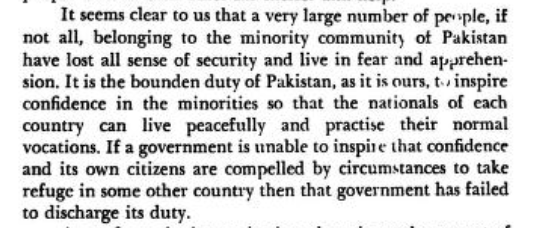
Image

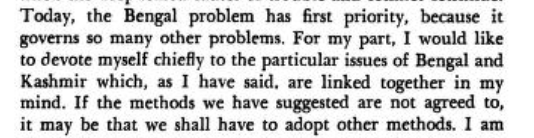
Then he went on to suggest a possible military action against East Pakistan while concluding his speech – Note the words – “We shall have to adopt other methods

Image

But then the invasion idea was dropped. It was not just a question of Nehru being pusillanimous. The President of India, Rajendra Prasad, a supposed right winger, wrote a letter to Nehru, suggesting that he drop the idea of attacking / annexing East Pakistan!
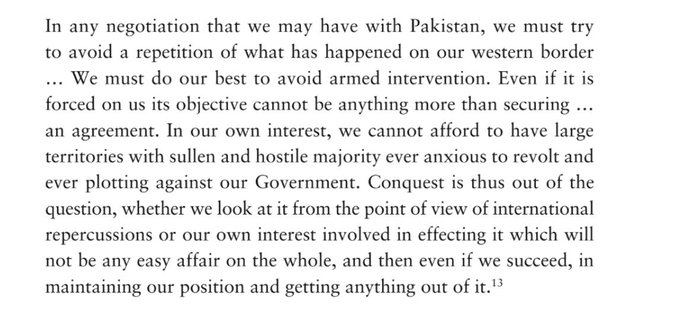
Image

I find this curious.

An interesting example of a “conservative” voice in India (Rajendra Prasad) persuading the supposedly more dovish and liberal Nehru to drop the idea of military action against East Pakistan

Another thing that I find curious about this episode is that the very large scale migrations that ensued in early 1950, were mostly undone by the end of the year by reverse migrations, following the Nehru-Liaquat agreement in April 1950.

Between February 7th and April 8th 1950, 1.5 million people crossed the borders! 850K Hindus from East Pakistan to West Bengal, and 650K Muslims from West Bengal to East Pakistan.

The agreement was signed on 8th April 1950, but it did not reverse the migration tide immediately. Between 9th April and 25th July, 1.2 million more Hindus left East Pakistan for India, while only 600K returned back to Pakistan prompted by the agreement.  That’s roughly a return-ratio of 1 in 2.

But it appears the ratio was much better for Muslims for exactly the same period (9th April to 25th July) following the treaty. In this timeframe, 450K Muslims left West Bengal for East Pakistan, but 300K returned back.  That’s a ratio of 2 in 3.

So it appears the agreement reassured the Muslims more than it did the Hindus. But nevertheless it did prompt Hindus to return back to East Pakistan in larger numbers by the end of the year.  A million Hindus had returned back to East Pakistan by December of that year.

One wonders if we could’ve had a more peaceful subcontinent in later decades, had the powers that be sat down and planned a more systematic population transfer, instead of idealistic reassurances to minorities, which did help stall the large scale transfer in the short run, but kept communal tensions simmering for several more decades.

References:

  • TCA Raghavan’s “The People Next Door”
  • Jawaharlal Nehru’s Speeches, Vol II

The author tweets @shrikanth_krish

Open Thread – 08/22/2020 – Brown Pundits

The usual.

But I’ll make a comment here. I am of the school that thinks facts matter a lot. Many of you trade in standard Hindu nationalist tropes and generalities about Islam. As someone who told Shadi Hamid on our interview, I am not a big personal fan of Islam, I don’t really mind people fearing Islam. I have personal experience of the religion after all.

But, facts matter. And a lot of the “facts” that get bandied about here are false.  I won’t tolerate that. There are two general categories I will point to:

1. First, people take traditional Muslim historiography at face value. You shouldn’t. This is like taking Christians at face value when they talk about the Four Gospels are pure positive history, when they were finally compiled and redacted decades later. Whether Muhammad exists is an empirical question in the same way that whether Jesus exists is an empirical question. As it happens, I’m modestly confident both figures existed in some form but were quite different from what Christians and Muslims depict them as (I do suspect that Josephus was a later interpolation).

The broader issue here is that Muslims on the whole have not gone through the modernist transition in regards to a critical-rationalist take on their religion. In Christianity, traditionalist-fundamentalists exist, but they have to take dialogue with modernists as a given. They exist in large part as reactions to modernism. This is not the case with Islam. Muslims accept that non-Muslims reject their religion, but within Islam, there is not a strong rationalist engagement with their texts that applies the sort of criticism than the Germans pioneered within Protestantism in the 19th century. That means they present a “unified face” about their early history which too many non-Muslims take for granted. Islam with all of its constitutive elements is not truly recognizable to us until about 850 A.D.*

2. Because this is a blog with a South Asian focus a lot of Hindu nationalist tropes and facts get presented at face value. I don’t really mind them as mythologies that give people succor or create their identity, but a lot of them have as much factual basis as a pagan Mecca: not much.

Most of the Hindu nationalist commenters do reflect a reality of “lived experience.” As someone who grew up around South Asian Muslims, I can admit they have total contempt on the whole (there are exceptions) for Hindus and their “bizarre” beliefs. But, as someone who is personally anti-Islam and literally tolerant of diverse views, many people from Hindu backgrounds of all ideologies have told me what they really think of Muslims, and the contempt is returned.

My issue is always when people turn their personal experiences into deep historical insights. Do not do that if you don’t enjoy me jumping down your throat, because if I’m not busy, I will do so.

More broadly, lots of Indian readers would benefit from reading more history. Especially non-Indian history. A broad cross-cultural perspective is essential, so do more!

For the curious here are a few books:

China: A New History
History of Rome
A History of the Byzantine State and Society
A History of the Arab Peoples: Updated Edition

* The Shia-Sunni split starts to become discernible in a way we’d recognize, Hadith culture is already on track to marginalize the “philosophers” and Hellenists, and the ulema centered around madrassas spread from the east to the west.

Citizenship Amendment Act – the straw that broke the camel’s back

Since the Ram Janmabhoomi movement, which culminated in the demolition of the Babri Masjid, nothing has polarized Indian politics and society as much the Citizenship Amendment Act. On its own, its fair to assume that CAA is not  a particularly insidious piece of legislature, but when it gets combined with National Register of Citizens (NRC) as explained by Amit Shah below, it becomes some to be vary of.

As Amit Shah stated, CAB(A) will be applied before carrying out the process of NRC. In his own words, the refugees(non Muslim migrants) will be granted citizenship and the infiltrators (Muslim migrants – he also referred to them as termites at one instance) will be thrown out or prosecuted (there was some talk of throwing them into the Bay of Bengal).

Its clear to conclude that by refugees – he means Bangladeshi Muslims who reside illegally in India as almost no Muslims from Pakistan and Afghanistan come to India illegally with an intention a  better life. (When they do cross the LOC illegally, they’re treated as enemy combatants or terrorists)

The ACT: 

The instrumental part of the act reads

any person belonging to Hindu, Sikh, Buddhist, Jain, Parsi or Christian community from Afghanistan, Bangladesh or Pakistan, who entered into India on or before the 31st day of December, 2014 and who has been exempted by the Central Government by or under clause (c) of sub-section (2) of section 3 of the Passport (Entry into India) Act, 1920 or from the application of the provisions of the Foreigners Act, 1946 or any rule or order made thereunder, shall not be treated as illegal migrant for the purposes of this Act

While this amendment to the ACT is seen as problematic, one must point out that large portions of the existing ACT are also extremely problematic – most of which were added after 1955 under various governments at various times. In particular the 1986 amendment (under Rajiv Gandhi) – which meant children born to both illegal immigrants wouldn’t get citizenship. This is seen as a contradiction with the Birthright naturalization (Jus soli ) principle of the Constitution. The 2003 amendment (under Vajpayee) further restricted citizenship to children, when either of their parents is an illegal immigrant.

The 2003 amendment also prevented illegal immigrants from claiming naturalization by some other legal means. So in short with the CAA 2019, this particular amendment (2003) has been annulled for Non Muslims who have come to Indian sovereign land from Bangladesh, Pakistan and Afghanistan.

In other words, the CAA facilitates the imagination of India as the natural homeland of subcontinental Non-Muslims (but not a Hindu Rashtra or Hindu State).

Objective Reasons for opposing the CAA:

Continue reading Citizenship Amendment Act – the straw that broke the camel’s back

The Indo-Pakistan problem — To be or Not to be

THIS ESSAY WAS WRITTEN IN 2016 in the immediate aftermath of the URI ATTACKS with the aim of bringing some nuance in the increasingly binary discussions of Pakistan. Looking back at it in 2020 there are a few points in the essay I mildly disagree with but on the whole, I stand by my arguments. 


For anyone willing to read a shorter -TL-DR version find the link HERE:

Note: This is not a scholarly analysis of Indo-Pak question but an essay ((*mildly subjective)) on the question with references being presented for most of the essay. 


Every well-read Indian who has thought enough about the India-Pakistan issue will have faced Hamlet’s dilemma — “To be or not to be”. It’s fair to assume that national patience, with everything related to Pakistan, is waning very fast nowadays aided by the explosion of social media. Simply put — most Indians have had enough of this shit for 69 + years (the Idea of Pakistan being older than Pakistan). The leftist solution to the Pakistan problem has always been the Aman ki Asha narrative. The reactionary position of some of the Right-wing is to totally boycott anything related to Pakistan every-time a terrorist attack takes place in India. This position though backed by popular opinion at times like this seems to be no closer to a permanent solution to the problem. To come up with potential solutions for this problem, we need to discuss both these approaches and we also need to dig deep into the Nation-state of Pakistan.


Continue reading The Indo-Pakistan problem — To be or Not to be

Browncast Episode 118: Professor Ahmet Kuru, Islam, Authoritarianism and Underdevelopment

Another BP Podcast is up. You can listen on LibsynAppleSpotify,  and Stitcher (and a variety of other platforms). Probably the easiest way to keep up the podcast since we don’t have a regular schedule is to subscribe to one of the links above!

You can also support the podcast as a patron. The primary benefit now is that you get the podcasts considerably earlier than everyone else. This website isn’t about shaking the cup, but I have noticed that the number of patrons plateaued a long time ago.

In this episode we talk to Professor Ahmet Kuru. Professor Kuru teaches at San Diego State and is the author of (among others) “Islam, Authoritarianism and Underdevelopment”. We discuss his book and the causes of the (relative) decline of the Islamicate world in the last 800 or so years.

Brown Pundits