Afghanistan, Next Round

From Dr Hamid Hussain

Some questions and then more questions came my way about recent events in Afghanistan. My two cents put together in the piece.

Afghanistan – Next Round Afghan Style

Hamid Hussain

“However tall the mountain is, there is a road to the top of it”.   Afghan Proverb

United States and Taliban signed an agreement in February 2020.  The agreement was to pave the way for withdrawal of US troops and integration of Taliban in Afghan political system. The next step was exchange of 5000 Taliban and 1000 Afghan government prisoners.  This also proved to be the first hurdle.  Afghan President Ashraf Ghani insisted on linking prisoner release with cease fire.  Taliban rejected it and under US pressure, Ghani released few hundred Taliban prisoners.

In the deal with US, Taliban agreed not to threaten “security of US and its allies’.  Taliban defined only Europeans as ‘US allies.  Off course they don’t consider Afghan government as US ally therefore they continued to attack government forces. On the start of the Muslim holy months of Ramazan, Ghani asked again for a ceasefire.  Taliban representative in his response called this call ‘illogical’.  Organization of Islamic Countries (OIC) also called for a ceasefire during negotiations between Taliban and Afghan government.  Taliban are not likely to agree to this.  They see attacks on Afghan security forces as a lever to extract more concessions. Taliban also want to calibrate its military operations to keep momentum of its cadres.  If they agree to a prolonged ceasefire and few months later need military operations, they may face difficulties in re-activating its own cadres.

Current violence in uneven geographically.  Violence has decreased in Taliban controlled areas in south and east and large cities.  In Taliban controlled areas, night raids by Afghan forces and air strikes by US forces and attacks by Taliban on government posts and convoys, Improvised Explosive Device (IED) attacks and target killings was the main engine of violence.  Afghan forces have stopped operations in Taliban controlled areas resulting in marked reduction of violence.  In government controlled large cities, Taliban were attacking government and civilian targets.  They have markedly reduced these attacks that resulted in reduction of violence in large cities. In some parts of eastern Afghanistan, Daesh was responsible for most attacks.  An unlikely alliance of US, Afghan forces, Taliban and local militias confronted Daesh from all sides eliminating most pockets of Daesh that contributed to marked reduction of violence. In all these areas, with reduction of violence, general public feels somewhat secure with economic activity picking up in towns and rural areas. Continue reading Afghanistan, Next Round

The Abbasid invention of Islam

Since many readers of this weblog have rather naive views of Islam and its interaction with the Indian subcontinent, I thought they might appreciate my post on my other weblog, The Myth Of Arabian Paganism, And The Jewish-Christian Origins Of The Umayyads.

It wasn’t emphasized in the piece, but I will make it clear here: the development of Sunni Islam as we understand it was strongly conditioned on the cultural influences from the matrix of Iranian-Indian religious and social thought which matured in Turan. In fact, one of the early Abbasids, the son of an Iranian mother, even considered moving the capital of the Caliphate to Central Asia, in particular, the city of Merv.

The aspects of Islamic thought most clearly a product of this period and place? I believe that this is the hadith culture embedded within the institutions of the madrassa. Many argue the madrassa is a modification of the Central Asia vihara, and the analysis of proper practice due to religious law was a major function of the religious within these viharas.

Interview with a Mujahid: Maj Gen Tajammal Hussain Malik

The late Major General Tajammal Hussain Malik had an illustrious military careere (and a very controversial retirement career). In 1965 his unit played an important role in the defense of Lahore (a battle that the Indian army could have won if led by someone like Sagat Singh, but luckily for Pakistan, their GOC was Niranjan Prasad and Lahore was saved) and in 1971 his brigade was the only major force that the Indian army could not break in its lightning campaign in East Pakistan. Gen Tajammal was also a true believer who dreamed of the standard “Pak army true believer” stuff (abolish provinces, impose shariah law, unite the ummah), but with the interesting twist that he hated the crook Zia ul Haq and actually planned to assasinate him on 23rd March 1980 (his second coup plan, more serious than his first, which had been little more than a vague thought that arose when he was denied a well-deserved promotion). By the way, when Islamophobes think of Pakistan they tend to imagine that the median army officer is as fanatical as Gen Tajammal (though they obviously assign a more negative valence to that fanaticism than Islamophiles do), but as the following interview makes clear, his level of belief is not exactly common in the senior ranks of the army.

Anyway, here is an interview that Major Amin conducted with Gen Tajammal in 2001 (a couple of years before Gen Tajammal passed away). I am posting it here both as an important historical document and as a window into the mind of someone who was NOT the median Pakistani army officer, but is probably representative of what we may call the “PMA ideal”: an officer who combined professional competence with a Nasim Hijazi level view of history, a PMA-level view of Pakistani politics and a naive but intensely sincere faith in what can only be described as the Chakwal version of Islam. Comments welcome. (I put Major Amin’s words in red, the rest is Gen Tajammal speaking)

Postscript: I have added the full text of an article Abdul Majeed Abid wrote about General Tajammal in the Pakistani newspaper “The Nation” at the end of this interview.. it add more detail to the picture of Gen Tajammal.

Major General Tajammul Hussain Malik

Agha H Amins Note:—

This is the man who was praised by Indians and they established a commission to study his masterpiece Battle of Hilli .He was praised by his Indian battle opponent in his book “Indian Sword penetrates East Pakistan” as a singularly brave man .

He was miles above pygmies like Zia , Ayub and Musharraf. When we joined the army, we were inspired by his battalion 3rd Baloch’s attempted coup of 23 March 1980 to wipe out despicable clown Zia and his dirty clique !

We had to wait till glorious 17th August 1988 when that plane finally crashed right into the Hindu Shamshan Ghat on Basti Lal Kamal !

One good thing that General Beg did immediately after that glorious crash in 1988 was to restore Tajammuls complete military honours and privileges. Tajammul was serving a sentence of 14 years RI for planning to liquidate all army generals and Zia on 23 March 1980, a brilliant scheme indeed !

Tajammul has thrown light on Zias shallow personality in this interview !

May God Bless His Soul !

Major Agha H Amin (Retired)

Maj Gen (Retd) Tajammal Hussain Malik

A.H Amin

September 2001

Please tell us something about your early life, parents? Continue reading Interview with a Mujahid: Maj Gen Tajammal Hussain Malik

A Mongol India, a pagan India?

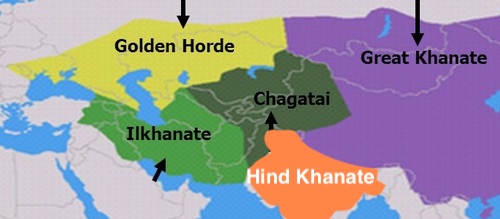
On Twitter there was a thread which posited what “might have been” if the Mongols had forthrightly smashed the Delhi Sultanate and added India, at least its north, to their vareigated domains. After the death of Genghis Khan, the Mongol Empire split into four broad political-geographical zones.

– to the north and west, was the Golden Horde. These Mongols and their Turkic subjects battered Europe held suzerainty over the principalities which succeeded Kievan Rus and bickered and battled with the Il-Khanate to their south.

– The IlKhanate centered around modern-day Iran, and for much of its early period controlled the Levant, much of Anatolia, and Mesopotamia.

– The Chagatai Khanate, which occupied Central Asia, to the west and east of the Altai and Tien Shan (roughly, Transoxiana and modern Xinjiang)

– The Yuan, which encompassed China and Mongolia

Genghis Khan’s conquests occurred in the early 1200s. By the 1300s all of the three “western” domains took up Islam as the primary religion of the Mongol elite. The Yuan in the east remained non-Muslim, mixing patronage of Tibetan Buddhism with the Mongols’ customary shamanist Tengrism. When they were expelled from China they retreated to Mongolia and the descendants of the Yuan ruled Mongolia until their integration into the Manchu Empire in the 17th-century.

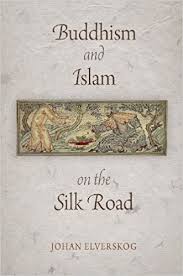
One thing that is illuminated in Buddhism and Islam on the Silk Road is that the eastern Mongols flirted with adopting Islam before they finally shifted to Tibetan Buddhism in the 16th-century. Some of their leaders took Muslim names and seem to have adopted the trappings of Islam, before falling away.

Though the transition of the western Mongols toward Islam differed across the three Khanates. The IlKhanate ruled over mostly Muslims. The fact that for several generations Muslims were ruled by Tengrists, Buddhists, and Christians (Persian Christianity had a foothold in Mongol in the 12th-century) was always a tension. Ultimately, the IlKhan conversion to Islam was not of major consequence because the IlKhanate collapsed earlier than the other domains.

The Golden Horde adopted Islam in large part because that was the religion of the Turks who comprised the majority of the nomads in the confederation. But, in the early period, the Golden Horde was hegemonic over many Christian regions, and the majority of its subjects may have been nominally Christian. And yet the Mongol elite was naturally assimilated into the Turkic elite, not the Christian princes (though they did intermarry with the Christian nobility, and some Lithuanian and Russian noble lineages have Mongol ancestry from the Golden Horde).

The Chagatai Khanate’s adoption of Islam in the 14th-century was ironic, because Chagatai, one of the sons of Genghis Khan, was a fierce Mongol traditionalist who personally detested Islam. As with the Golden Horde, the Islamicization of the Chagatai lineage seems to have been a function of the reality that the non-Muslim Mongols swam in a sea of Turkic Muslim subjects.

Which brings us to India. Most readers of this post will know that the Mongols had various military encounters with the nascent Delhi Sultanate, but ultimately India never truly became a part of their empire. But what if it had?
The person who initially posted this counterfactual fantasized about the destruction of Islam in India because the Mongols were against Islam. This is objectively not so. In the 13th-century, the Mongols were religiously peripatetic and latitudinarian. The only “higher religion” that they were initially familiar with was the Persian Christianity of their Kerait and Naiman neighbors. Most of Genghis Khan’s sons married Christian women from these tribes.

Though Genghis Khan himself took to developing a special relationship with a Daoist adept, repeatedly the early Mongols seemed to exhibit a strong affinity toward Tibetan Buddhism, prefiguring the Mongol mass conversion of the 16th-century. Buddhist lamas were presences in both the Golden Horde and the IlKhanate, and Persia in the 13th-century saw a renaissance of Buddhist temple building.

My initial thought about the counterfactual is that the Mongols would surely have become Muslim, as they did in the Golden Horde, because of the large number of Turkic Muslims present in India. The analogy here is with the Golden Horde. In the Golden Horde Mongols and Turks shared the same mode of production, as pure pastoralists and rent-seekers. Mongols who lived a sedentary lifestyle may have eventually simply been absorbed into the Russians.

But then I began thinking: what about the Yuan dynasty example? Here Mongols used Muslims as an intermediary caste with the local population, and never became Muslims themselves. Additionally, while the Han Chinese did not have a military caste (the military profession had a low status in China at the time), obviously India’s Rajputs were a local group of non-Muslims with whom the Mongols might identify. Many of the Mongols were already nominally Buddhist, and so concepts such as Dharma might be familiar to them.

So let’s imagine a fork where Mongols arrive as non-Muslims, and somehow establish a synthesis with Hindus and eventually assimilate as a Hindu caste. This is not totally crazy. In 1228 the Tai Ahom arrived in Assam. They were already partially Buddhist, though eventually, they became Hindus.

Of course, many Hindus want to know: would this be the end of Islam in the subcontinent? I don’t think so for two reasons.

First, the Mongols were generally religiously tolerant. This often held even after their initial conversion to Islam, which was often quite nominal and practical. It seems unlikely they’d wage a religious vendetta against Islam as such. The Turks and Afghans who arrived in the earlier decades would probably simply go into service with the Mongol Khanate. Eventually, they’d be the core of a religious minority in a post-Mongol but Hindu dispensation. This is what happened in China, where many of the Chinese Muslims clearly descend from Central Asians and Turks who arrived with the Yuan.

Second, there may simply be structural reasons why Muslim Turks would move into India no matter what at some point. India was rich. The Turks and Afghans were not. Additionally, as pastoralists and nomads with ready access to horses, the Central Asians had structural advantages against local polities, who could not mobilize the whole of local economies. I suspect, to be honest that the Mongols would only arrest and delay a process that was inevitable.

Cultural evolution at work!


‘God Will Protect Us’: Coronavirus Spreads Through an Already Struggling Pakistan:

And the extremist clerics who often heckle or march against the civilian government, with the tacit approval of the military, are refusing to help. They largely ignored Mr. Khan’s call to limit Friday prayer gatherings. And even after the military deployed to try to enforce a lockdown, several clerics made videos that went viral in recent days, urging Pakistanis to come back to the mosques to worship.

To avoid mosques on Fridays would only invite God’s wrath at a time when people need his mercy, the clerics warned.

“We cannot skip Friday prayers because of fears of coronavirus,” said Shabbir Chand, a trader who attended a packed service in Karachi, the country’s biggest city. “Instead, we should gather in even larger numbers in mosques to pray to God to protect us from this fatal disease.”

One of the major aspects of Islam that some Hindu nationalists are obviously jealous of is its seeming unitary cohesion. A hadith attributed to Muhammad is that “the Ummah shall not agree upon error.” And Muslims famously come together weekly to pray together.

But in a time of coronavirus, the fractured and somewhat antisocial aspect of Hindu religion may have some benefits.

Pogrom in Kabul

Islamic State Attacks Sikh Temple in Kabul, Killing 25:

An Islamic State militant stormed a Sikh temple in the heart of Kabul, killing 25 worshipers and taking dozens of people hostage in a prolonged siege that once again exposed the ability of insurgents to carry out attacks in the Afghan capital.

Dozens of Sikh worshipers were gathering for morning prayers on Wednesday when a gunman stormed the temple, according to the Interior Ministry. Men, women and children scrambled out of the compound as the attacker moved through the temple. An Afghan security official initially said there were two gunmen, but the investigation later concluded there was only one.

Even in the time of pandemic they still stick to their old script…

Why Musa was made C in C Pakistan Army

(via Major Amin)

By Aslam Minhas

In October 1958, Ayub appointed General Mohammed Musa (who rose from the ranks) as the next C-in-C with Lt-Gen Muhammed Habibullah Khan as his Chief of Staff. In doing so, Ayub overlooked Lt-Gen Habibullah Khan, an officer technically and professionally more qualified than Gen Musa. It was an appointment that clearly sent a wave of resentment throughout the senior ranks in the GHQ.”I vividly remember my father who was a Lt-Col serving in GHQ at that time being acutely distressed at Ayub’s preference of Gen Musa over Ali’s (later Lt-Gen Ali Kuli Khan) father, Lt-Gen Habibullah Khan Khattak to command the Army. Till his death my father, who had a strong belief in merit over nepotism, maintained that was the precise moment from where necessity and nepotism started to matter far more than merit in the primary selections of the Armed Forces. Not to say that from time to time people with merit would not slip through.” (Ikram ul-Majeed Sehgal Defence Journal, December 2001, p.7).

In words of late Aslam Khattak, elder brother of late Lt-Gen Habibullah and a respected name and a political heavyweight of Pakistan, Ayub rang up Lt-Gen Habibullah Khan (CoS) and said: “Biboo (General Habibullah’s nickname in the family), I am fed up with Musa (the then C-in-C) and want to get rid of the stupid chap. You please rush to Rawalpindi immediately to take over command. A formal notification will be delivered to you at the GHQ tomorrow morning.” The next day he did receive the letter but only to be told that he stood relieved with immediate effect. (Murtaza Malik The Curtain Rises: Uncovered Conspiracies in Pakistan and Afghanistan, Royal Book Company, 2002, p.16).

After a few months, Gen Musa asked Ayub to relieve Habibullah from the army. One of the charges put up by Gen Musa against his CoS, Lt-Gen Habibullah, was that while in London on a trip, he had misbehaved with the maid of his host. Lt-Gen Altaf Qadir had the retirement order for Gen Habibullah with him. The order had to be served at the general’s home. He didn’t have the courage to deliver the letter. Gen Habibullah was capable of shooting the messenger. He asked Maj-Gen (later Lt-Gen) Abrar Hussein, the then military secretary to the GHQ to deliver the news. It would have been embarrassing for a junior officer to deliver the bad news to his senior. In spite of Maj-Gen Abrar’s protestations, he was forced to become the reluctant messenger. When Maj-Gen Abrar Hussein went to the residence of Lt-Gen Habibullah and handed the letter to him, the latter said: “So here it is.” It seemed Gen Habibullah knew what was coming. (Interview with Brig Noor Ahmed Hussein (younger brother of late Lt-Gen Abrar Hussein) on Aug5, 2002, in Rawalpindi). Gen Habibullah was then 46.

In a memo of the US State Department from the US Embassy, quotes its informant in Pakistan, saying that Musa (as C-in-C) neither controlled nor enjoyed any respect in the military (The American Papers 1965-1973 compiled by Roedad Khan OUP p. 120 Dispatch of 18 January, 1966, 12.05am). “Musa’s appointment to the top military job over the head of senior and perhaps better generals was Ayub’s idea of a strong army under a weak command ultimately responsible to him. He (Musa) was often scornfully (though uncharitably) referred to as the ‘mess waiter’.” (Brig A.R. Siddiqi The Military in Pakistan: Image and Reality, Vanguard Books Pvt Ltd, 1996, p. 55). “Musa ran the Army. The most important of Musa’s traits was one of loyalty — straight and simple. If Ayub had mentioned 10,000 yards of front, then the front had to be 10,000 yards, and so on. The framework of defence became more and more mathematical. The importance of imponderables of war was not catered for.” (M. Attiqur Rehman Back to the Pavilion, Ardeshir Cowasjee, Karachi, 1990 p. 133-134). Musa, though described as honourable and honest, “is hardly the stuff of which great generalship is made.” (Brian Cloughley A History of Pakistan Army, Wars and Insurrections, OUP, 2002, p.127).

MUSA’S VERSION: On Dec 30, 1985, when Ziaul Haq lifted martial law, General Musa was appointed Gov Balochistan. Brig Noor Ahmed Hussein (Golf buddy of Musa) visited Quetta during Musa’s governorship. Musa invited Brig Noor for a dinner. It turned out to be a dinner for two. On a full stomach, Brig Hussein asked Musa: “Sir, you were sixth in line. How did you become the C-in-C?”

Musa: “I will tell you the whole story and I have never told it to anyone before. I was a major posted at Quetta in August 1947 when I was transferred as Assistant Adjutant and Quarter Master General, (AA&QMG) Headquarters, 8th Division, Malir, Karachi. The train reached Rohri station at 2 O’ clock. Suddenly, I heard the Station Master shouting on the platform: ‘Maj Musa, telegram for you’. I waved at him from out of the window, and got hold of the telegram. According to the message, my previous Karachi assignment had been cancelled and I was promoted to the rank of Lt-Col and posted as General Staff Officer First Grade (G1) at Lahore 10 Division. I immediately shifted my baggage to the Lahore-bound train. I was to work under an English GOC, Gen Briggs, who said: “I know you lost your appointment at Karachi, but I am sure you will find this one as exciting.” Lo and behold, first day, the first pending file on my table, I open and the title reads: Court of enquiry in respect of temporary Brigadier, Substantive Colonel M. Ayub Khan, Punjab Regiment.

Musa chuckled: “The way I handled that file, the day I became the C-in-C.”

Brig Noor’s words were: “Ayub was accused of accepting cash and jewellery from fleeing Hindus during the days he was in the Boundary Force that lasted for five months in the later half of 1947. The charges were serious enough to warrant a court of enquiry against Ayub.” (Interview with Brig Noor Ahmed Hussein)


Brown Pundits