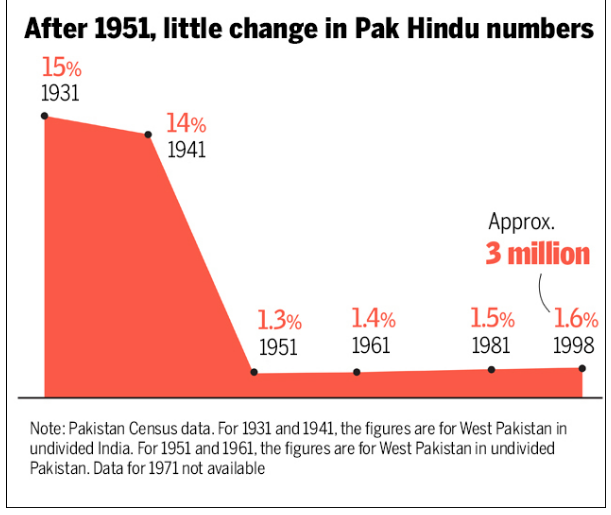
Since many of you are innumerate, I first want to make it clear that Sindh province is 10% Hindu. These Hindus are concentrated mostly in rural areas. As you likely know most elite Sindhi Hindus no longer live in Pakistan. These are poor and relatively powerless people.
The mass ceremony was the latest in what is a growing number of such conversions to Pakistan’s majority Muslim faith in recent years — although precise data is scarce. Some of these conversions are voluntary, some not.
News outlets in India, Pakistan’s majority-Hindu neighbor and archrival, were quick to denounce the conversions as forced. But what is happening is more subtle. Desperation, religious and political leaders on both sides of the debate say, has often been the driving force behind their change of religion.
Treated as second-class citizens, the Hindus of Pakistan are often systemically discriminated against in every walk of life — housing, jobs, access to government welfare. While minorities have long been drawn to convert in order to join the majority and escape discrimination and sectarian violence, Hindu community leaders say that the recent uptick in conversions has also been motivated by newfound economic pressures.
As someone who has read a great deal about religious dynamics, this is not subtle, but a very typical. Contrary to some claims, very few conversions to Islam were “forced” in a physical sense. Rather, historically, individuals converted out of self-interest or desperation. Often there were whole communities who make this choice.
A second issue is that there are attempts to present a symmetry between what is happening in India and Pakistan. This story illustrates how no such symmetry exists. Muslims in India are obviously at a disadvantage, but their situation is not analogous to Pakistani religious minorities.
Part of the story here is obviously about the treatment of religious minorities under Islam, which was not out of the ordinary in 1000 A.D., but 1,000 years later is anomalous, insofar as low-grade persecution is common. But it is also a story about the lack of Hindu solidarity with these people who were literally “left behind” as the Lohannas decamped for Mumbai.
Book Review – The Quetta Experience: A Study of Attitudes and Values Within the Pakistan Army by David O Smith
Hamid Hussain
David Smith’s book The Quetta Experience is a groundbreaking and unique study of Pakistan army’s prestigious Command & Staff College that trains army officers for higher ranks. This book is based on interviews of American army officers who attended Command and Staff College at Quetta in Pakistan. Foreign Area Officers (FAO) of US army spent a year at Staff College.
The following are two posts (originally written many years ago) from the Pakistani military historian and analys Agha Humayun Amin. It is interesting to y see that nothing has changed since 2002 (the article is from 2002 and the interview is from early 2001, before the fall of the taliban). Anyway, whether you agree or disagree with his analysis, you will always get interesting nuggets of information from Major Amin… The first post is a newspaper article he wrote. the second is a very detailed interview he conducted with General Naseerullah Babar, an outstanding military officer who served as Zulfi Bhutto’s Governor in NWFP, then as Benazir Bhutto’s interior minister and played a role in the Karachi operation against MQM as well as in the setting up of the Taliban (as IGFC he was also involved in setting up the first Pakistani-sponsored insurgency in Afghanistan way back in 1973). He was an eyewitness to many important events and whatever you may think of his views, his interview is an extremely important historical document..
Essence of the Matter
A.H Amin
August 21 2002
Daily Nation , Lahore
www.nation.com.pk
While analysis of todays Pakistani politics is outwardly subtle and convincing , serious historical analysis remains the weak point. What is lacking is the long view , the inability to penetrate through appearances, the motivation to write with an ulterior motivation to please or to secure personal business objectives, and worse of all, to criticise simply because a writer has acquired the reputation of a cynic and his writings are read simply because his cynicism provides a catharsis for many! This does not mean that all is well or all military or civil rulers are well meaning reluctant coup makers !
This article is an attempt to capture the crux of the whole issue in a few paragraphs! An ambitious but certainly not impossible endeavour! First of all the basis of modern Indo Pak politics was initially a type of liberal set of beliefs based on faith in British parliamentary system and liberalism mixed with the philosophy of self rule. The British introduced Western democracy in India with a view to afford a vent to the Indians desire for participation and sense of involvement ! The urban professional classes picked it up as a means for self realisation or self advancement ! The feudals picked it up as a means of continuing their unfair advantage or position of influence in the Indian society. The middle classes ran after government jobs as a means of self advancement and economic benefit. The Indian soldiers served in the army as mercenaries motivated by economic benefits and in part propelled by espirit de corps. The politicians came into conflict with the British not because all of them were heroes or martyrs but because it was a struggle for power! The civil servants and mercenary pre 1947 Indo Pak soldiers collaborated with the British because it improved their prospects of self advancement ! The pre 1947 Indian Army , the father of the post 1947 Indian and Pakistan Army had nothing to do with Indo Pak political struggle at least in what they voluntarily or deliberately did less a platoon of Garhwal Rifles which refused to open fire on Muslims demonstrating in Peshawar in 1930 ! After all who was shooting down Indo Pak civilians like partridges in Wana , Razmak ,Sindh and Jallianwalla Bagh other than the British Kings Indian Army ! Four brigades in tribal areas , two brigades in Sindh in the Hur Rebellion! The Indian or Muslim civil servant, soldier and policeman till 14th August (and some to date) were collaborators of the Western power which ruled India till the transfer of power!
The Hindus were better organised politically since the Indian National Congress was dominated by a strong Hindu professional and business class while the Muslims were condemned to be politically more backward since because of peculiar historical reasons Mr Jinnah had no choice but to accept the Muslim feudals who dominated Muslim politics! Mr Jinnah was forced to ally with the Unionists in Punjab and the Sindhi landlords in future against the advice of Punjabi Muslim urban leaders like Dr Iqbal because it was a strategic compulsion. Thus from August 1947 India inherited a strong political culture while The Muslim League was destroyed just a few years after Mr Jinnah’s death by the feudals who had joined it out of fear of land reforms and because of being in debt to Hindu money lenders! Here again economics played a major role ! It has been estimated that in pre 1947 Punjab and Sindh money lending was the most important occupation after agriculture and that while the net revenue of Irrigation Department of Punjab was 267 Lakh Rupees that of money lenders was 500 Lakh Rupees! In 1911 out of a total of 803,560 money lenders in India some 25 % or 193,890 lived in Punjab alone! Thus while the total population of pre 1947 Punjab was one eleventh of India ,it had some one fourth of India’s money lenders! All this ensured that the feudal elements jumped on the Muslim League band wagon not out of genuine motivation but because of economic compulsion!
Now the post 1947 era; While post 1947 Indian Congress leaders like Nehru and Patel chided the Indian Army for their un-nationalistic role in British rule and reduced their basic salary Pakistan was condemned to be ruled by a civil military clique within eleven years of independence! Men who had collaborated with the British before 1947 became Pakistan’s rulers within seven years of Independence! Officials of Indian Audit and Accounts Service like Ghulam Mohammad and Mohammad Ali! Feudals like Kalabagh who before 1947 were faithful servants of a man no higher than the British Deputy Commissioner of Mianwali! Compare the fact that while Nehru abolished Cantonment Boards within no time after independence even today a Pakistani civilian living in a plot of land bought by paying through his nose in a cantonment area lives within perpetual awe of the cantonment boards simply because no Pakistani statesman had the courage or the vision to reduce the military or civil bureucrats to size! Continue reading Pakistan and Military Rule (and a long interview with General Babar)
The Hagia Sophia reconversion ultimately points to the failure of the Kemalist project of top-down secularism. Much like the state secularism of nationalist authoritarian leaders in Egypt, Iran, Iraq etc had failed to lead to the secularisation of the wider society, it seems Turkey is no longer the exception it was long hoped to be. More fundamentally, the failing secularism of Turkey and India begs the question: is secularism even possible in non-Christian/non-Western societies? Without the Western experiences of Reformation and the Enlightenment, hard-fought victories as they were, can non-Western societies value the principles of freedom and secularism? Why is it that, unlike in the West where democratisation and secularism went hand in hand, greater democratisation has seemed to only bring religious chauvinism in India and Turkey?
Too often non-white intellectuals, in particular those from the Indian subcontinent and the Middle East, look only to Europe as their historical exemplars.
There is a legitimate argument that secularism in the Westphalian nation-state context, and using the model of the American republic, is the contingent outcome of the Reformation, and in particular Radical Protestant anti-state sentiment as well as Calvinist disenchantment with the world, and the sieve of the Enlightenment. But I don’t think this is what the author meant. Rather, I think the author is highlighting the importance of religious identity across the world.
In India and Islamic societies, your religion defines you in a very deep way. Religion and state have been deeply connected. The American and French models are objects of emulation but from a deeply alien tradition.
But these are not the only models and outcomes. China, Korea, and Japan are all societies where public religious identity is not nearly as important as it is in the Indian subcontinent and the world of Islam. I am not saying that people in East Asia are not religious or do not have supernatural beliefs. On the whole, they are less religious and more atheistic. But looking at religious affiliation numbers overstates this truth.
Rather, these are societies where religion does not dominate public political life because they have a particular history with organized religion which subordinates it to the political life of the society and nation.
Let me give three examples
– In the 9th century, the Tang dynasty expropriated property from Buddhist monasteries and defrocked monks and nuns. This is due to the fact that Buddhism was starting to become as powerful in China as the Catholic Church was to become in Europe.
– In the 15th century, the Joseon dynasty of Korea suppressed Buddhism in cities and drove the religion to the mountains. The percentage of Buddhists in Korea has actually increased in the 20th century for this reason.
– In the 16th century, Oda Nobunaga broke the power of Buddhist monasteries, in part by burning the down.
There is a history out there that is not European. Read some books.
The Pakistan Muslim League-Quaid (PML-Q), an ally of Prime Minister Khan’s ruling Tehreek-e-Insaf recently opposed the construction of the temple by claiming that it was “against the spirit of Islam.”
Let’s be frank: isn’t this correct?
Religions are what people make of them, and there are some latitudinarian Muslims who would object to the assertion that the building of a Hindu temple was “against the spirit of Islam.” But historically this action, the obstruction of the building (and repairing) of religious buildings of minority communities has been normative in many Muslim majority societies. Egyptians Copts, for example, have long had to obtain very high level dispensations to repair their churches.
The basic theory from what I recall from Islamic jurists is that minority communities under the protection of Islamic rulers were tolerated, but they need not be encouraged. Their religious liberties were provided at sufferance, and that was enough.
The issue with Hinduism is even deeper: Hinduism is rather explicit in that it is a form of shirk. Whether you conceive of your Hinduism as fundamentally monotheistic or polytheistic, from a Muslim perceived it is polytheistic, and therefore an abomination. The Pakistani polity is illiberal in its behavior, but it is operating squarely within the orthodox parameters of Islamic accommodation to some level of religious pluralism, which combines subordination with delimiting the purview of minority religious beliefs and practices.
This is not limited to Islam, as some readers will be aware that Late Antique pagan practice slowly reconfigured its outline into a shape less offensive to Christianity as the price of toleration (e.g., public animal sacrifice disappeared). In Indonesia Buddhism and Hinduism are both explicitly monotheistic religions, so as not to offend Islamic sensibilities (though in Indonesia Muslims can also convert to Christianity or Hinduism legally, unlike many Muslim nations).
What’s the solution to this illiberality? In the long term, the only answer is greater secularization. As long as orthodox Islam, looking back to the past remains central to Pakistani identity I can’t see any other reaction to the attempt by Hindus to practice and express their religion in the public domain, as opposed to private practice.
Note: There is a long tradition in Abrahamic religions which believes that the gods of polytheistic faiths are actually devils and demons. This is one reason that Christians in Korea have attacked Buddhist statues, and Muslims in Pakistan are expressing horror at the building of a temple to Krishna, who they believe to be a demon who actually exists.
Would like to propose expanding CAA to include the following groups of muslims to:
get everyone’s feedback on what can practically pass the Indian Lokh Sabha quickly
see if several major Indian leaders will publicly endorse this
The following text will be continually edited based on feedback.
Proposing to expand CAA to include the following “AND ONLY THE FOLLOWING” groups of muslims IF AND ONLY IF they can prove persecution inside Bangladesh, Pakistan or Afghanistan:
13 classes AND ONLY 13 CLASSES of Muraqabah Sufi muslims:
3 classes of Muraqabah Irfan Sufi Shia muslims
Sixer Ishmaeli Muraqabah Irfan Sufi Shia muslims
Dawoodi Bohra Sixer Ishmaeli Muraqabah Irfan Sufi Shia muslims
Twelver Jafari Muraqabah Irfan Sufi Shia muslims
10 other classes of Muraqabah Sufi muslims
Chisti Muraqabah Sufi muslims
Qadiri Muraqabah Sufi muslims
Pir Nund Rishi Muraqabah Sufi muslims
Pir Shirdi Sai Nath Muraqabah Sufi muslims
Pir Kabir Muraqabah Sufi muslims
Pir Janardhan Swami Muraqabah Sufi muslims
Pir Hazrat Babajan Muraqabah Sufi muslims
Pir Syed Mohammed Baba Tajuddin Muraqabah Sufi muslims
Pir Baba Fariduddin Ganjshakar Muraqabah Sufi muslims
Pir Baba Budan Muraqabah Sufi muslims
Agnostic, Atheist and Ex muslims
LBGTQ plus muslims
Female femnist muslims
Any and all Muraqabah Sufi muslims admitted under CAA need to be certified and verified as Muraqabah Sufi muslims by a council of Muraqabah Sufi muslims chaired by Pir Diwan Sahib Syed Zainul Abedin. Pir Diwan Sahib Syed Zainul Abedin will appoint a committee of Muraqabah Sufi muslims at his own discretion to assist him in this task.
Any and all Agnostic, Atheist and Ex muslims, LBGTQ plus muslims and female femnist muslims admitted under CAA need to be certified and verified by a council of muslims chaired by Tarek Fatah . Tarek Fatah will appoint a committee of muslims at his own discretion to assist him in this task.
In addition to approval by above councils of muslims, any and all muslim CAA applicants are subject to extensive deep background security checks and can be vetoed by the Indian government for any reason.
NO OTHER MUSLIMS will be permitted to apply for CAA. No other aspect of CAA will be affected.
Please provide your suggestions about how to improve the above draft.
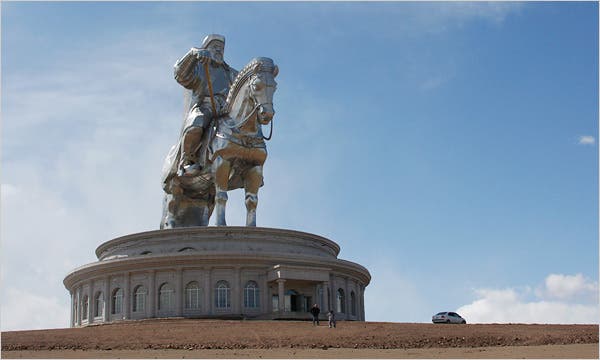
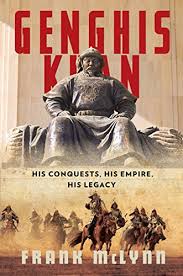
Today Genghis Khan is a hero in Mongolia. This, despite the fact that the rise of his Mongol Empire was associated with mass death. This mass death resulted in reforestation, which changed atmospheric CO2 levels.
During Genghis Khan’s lifetime, the most impactful and catastrophic conquests were of Central Asia and the obliteration of the Khwarezmian Empire. After the death of Genghis Khan, his heirs further obliterated the world of Islam, including killing the last significant Caliphs of the Abbassids. To a great extent, Genghis Khan ended with finality the world of the Iranian people of Turan, leaving the Tajiks as the Persianate rump. Economic historians have suggested that the destruction of Iranian agriculture (e.g., the qanat system) that occurred during the Mongol conquest was so great that the region did not recover until the modern era.
Muslim historians, some under the service of Mongol successor dynasties, have taken a mixed view of Genghis Khan and those who descend from him. On the one hand, their destructive impact is impossible to deny. The Mongols were one of the last of the steppe nomads to explode out of the Eurasian interior, but they were one of the largest military-political shocks, destroying multiple polities. But descent from Genghis Khan became prestigious in the Turkic world.
This is somewhat discomfiting and paradoxical because Genghis Khan was proudly pagan. And, it was not in dispute that the Mongol invasions had been brutally destructive. The prestige and glamor was clearly a nod to the fact that Genghis Khan’s conquests were evidence of glory sanctioned by God.
Despite Genghis Khan’s pagan beliefs, and the negative impact that the Mongol conquests had on Islam, somehow elements of Mongolic ruling culture became normative among the Muslims of Central Asia. This is how the name “Khan” became associated primarily with Muslims in the Indian subcontinent. Though there are non-Muslim Khan’s in South Asia, on the whole, the surname is associated with those of Muslim background, which is ironic given that it is a purely pagan title.
The details and subtleties of this history are on my mind because of the conversation I had yesterday with Neha Srivastava. It strikes me that in some ways she is haunted by history. In particular, the history of Turco-Islamic domination and brutality in the Indian subcontinent. She mentions offhand a Bollywood star giving her son the name Timur, which is reminiscent of a brutal Turco-Muslim conqueror, Timur the Lame.
This is where details became important. Neha no doubt remembers the brutal sack of Delhi. Though most of the dead were not Muslim, it is important to remember that Timur’s target was a polity ruled by Turco-Muslims, like himself. Importantly, and ironically, despite being a Muslim, Timur the Lame wrought his destruction exclusively in Muslim lands, or lands ruled by Muslims (India).
Though many facts of history are beyond dispute (e.g., Timur’s sacking of Delhi), the valence with which we recollect them varies. The Mongols view Genghis Khan as a great leader and a cultural figure of worth and note. Muslims take a more mixed view. Meanwhile, for European Christians and the Chinese, the Mongols are a purely destructive force. Whether the Mongols and Genghis Khan are worthy and of admiration is clearly filtered through a cultural lens.
Because I’m a bit of a Mongol history nerd, the name Timur to me actually is not closely associated with Timur the Lame! It as in fact closely associated with Khans of the Yuan Dynasty of China and Mongolia, who never converted to Islam. But then, I’m not an Indian Hindu.
Nevertheless, the issue of the name Timur is an illustration of the general phenomenon: a lack of the acknowledgment of the cultural brutality and domination which Turco-Muslims wrought upon the Indian subcontinent and its native peoples in the period between 1200 and 1800. Six hundred years of domination to varying degrees.
I will interject here an objection to what I see as some hyperbole. Oftentimes Hindus make the case for almost Nazi-like domination of Islamic power in medieval and early modern India. There are two major objections to this extreme characterization.
First, premodern societies did not have totalitarian state capacity. Both the Byzantine Empire and the Islamic polities were fixated on a universal state religion. But their coercive power had limitations. There were pagans who lived in southwest Peloponnese until about the year 1000 A.D., when they were finally converted. State Christianity did not have the power to coerce these isolated people, because the state was thin and weak. Similarly, the pagans of eastern Afghanistan, the Nuristanis, were forcibly converted to Islam in the last decade of the 19th century.
Second, the vast majority of the people in the upper Gangetic plain, the core of Turco-Islamic rule in the Indian subcontinent, remain Hindus. That is, practitioners of native Indian religious traditions. This is simply incompatible with the idea of centuries of totalitarian rule. Again, going back to the first point, premodern states had limited capacity for domination and coercion. The power of the Roman state or the Caliphate was an ideological one, as local officials were bound together by their allegiance to a figurehead. But if a local ruler or administrator wanted to operate at sharp variance from the ultimate ruler, it was entirely feasible. Central state capacity was weak.
The Islamicization of much of the Punjab and Bengal were not a function of the greater state capacity of the Turco-Muslim rulers of northern India. Rather, they were a function of the peculiar characteristics of unstable borderlands, which tend to be much more attracted to dynamic novel ideologies promoted by ruling elites, which in the late medieval and early modern period meant Islam. This is the same reason why Zoroastrianism (and Buddhism) was replaced by Islam much more quickly amongst the populace in Central Asian Turan than in Iran proper. Turan was frontier land. Iran was not.
With that preamble out of the way, it is not disputable to me that the Turco-Muslim conquest elites in the Indian subcontinent engaged in plunder, extraction, and subjugation, in a relatively brutal manner. The emergence of ISIS in the middle of the teens illustrates the nature of Islamic dominionism. The sexual exploitation of Yazidi women is in keeping with a tradition in Islam of sexual slavery of the women of conquered infidel peoples. This is not unique to Islam of course, but neither is not something one can deny as being part of Islamic history.
Now let us imagine an alternative history where the Turks who invaded the subcontinent were not Muslim. It is quite likely that like the Tai Ahom they would have become Hindu. It is quite likely that initially, they would have been just as brutal and exploitative as the Turco-Muslims. And, if they retained self-awareness as a distinct people for long enough that nature of a ruling class would persist despite the slow accretion of Indian cultural features. But, eventually, they would have become fully Indian, and gone into the mists of a legend like the Huna of yore.
The premodern world was brutal. The brutality of the Turco-Muslims was not unique. Julius Caesar may have been responsible for the deaths of 1 million Gauls. It must be noted here that the death was often not by direct killing, but through the starvation that occurred when populations were dislocated and dispersed. The brutality of the premodern world has an instrumental, material, rationale. Conquest was a way for elites to extract wealth out of the population. Death was not optimal, because extraction required bodies, but capture may have entailed some death.
Brutality was necessary, but not sufficient, to generate the trauma of modern Hindus.
But again, I need to step back, and admit something: there is some evidence that brutality is accentuated across ‘meta-ethnic’ boundaries. This comes from research by the quantitative historian Peter Turchin. He shows that civil wars tend to be characterized by less atrocity, while the most brutal killings occur across civilizational boundaries. The sack of Jerusalem during the First Crusade, for example.
This implies that the Turco-Muslim treatment of local Indian populations would be more exploitative and inhuman with a lack of common identity. The Turco-Muslims considered themselves white, and the natives black, and retained a separate language for much of their tenure. And, of course, they had a distinct religion from the native people.
In the modern Middle East, all of the subcontinental people are objects of contempt from the native Arab Muslims. But non-Muslims in particular seem to be the targets of unmitigated contempt (and, due to legal inequality, targeted for sexual predation).
Though on the whole, I would argue that the religious difference between the conquest elites and the native people makes the former more brutal toward the latter, I think the biggest distinction is that the conquest elites are more culturally destructive.
Neha discussed at length the impact on the temples of native peoples. Cultural displacement in terms of public religion is a key sign of hostility between the ruled and the rulers. The end of paganism in the Roman world began with the shutting down of public temples. Private paganism in household shrines continued for decades, but it slowly withered. I have written at length elsewhere about the robustness of Hinduism in the face of Islamic rule, so I will go no further on that issue. Rather, note that despite attacks on public Hinduism in North India the religion maintained and persisted due to its decentralized nature.
The crux of the issue is that modern Hindu Indians have to acknowledge that the core of Aryavarta was dominated politically by Muslims between 1200 and 1750. During this period Indian culture and society changed, some of it through interaction with the Muslim rulers, and some of it in situ. In either case, in some ways separating North Indian culture from the Islamicate period is insuperable. But Hindus know and understand that their role in this culture was as inferiors. Subordinates, if not slaves.
The flip side of this is that the Muslims of the Indian subcontinent are almost all descendants of converts from the local population, and their culture is clearly subcontinental. Though they may bear Arab, Persian, and even Turkic names, their faces are no different from their Hindu neighbors. It is hard to deny that fundamentally their past is one of subordination (as non-Muslims) and capitulation. They assimilated their own subcontinental identity, with brown faces, Indo-Aryan languages, and native cuisines, with the Islamic faith which had them face toward Mecca.
I may quibble and dispute some of the details of Neha’s assertion of inter-generational trauma due to the conquest (as I implied in the podcast, I believe women kidnapped and raped by Muslim elites today have Muslim descendants, so I would suggest that the trauma is elsewhere in the specifics), but the fact remains that Hindus with a profoundly different religious outlook and identity from Muslims are often uncomfortable praising a Mughal Golden Age where their own identity was of a conquered people. Dhimmis.
If Indian was 99% Muslim this might not be a great issue. Arabs can look dimly on their period of Ottoman hegemony in their nation-states, as very few Turks remain (there are Turkomans in Iraq!). But in a place like Uttar Pradesh, 20% of the population is Muslim. These people have a different identity in some deep ways from their Hindu neighbors, despite shared ancestry, language, and cuisine. I have never met a person from this background who was not proud and whistful about the period of Mughal rule in India. They identify this with this dynasty, and its predecessors, because of shared religious identity.
This is the fundamental tension in modern India. A substantial minority of the population is an adherent to the mythology of a conquest elite which the majority perceives to be traumatic, even genocidal. I do not have solutions for this issue, and I am not taking sides because it is really not my history anymore. But there it is.
Book Review – The Battle for Pakistan by Shuja Nawaz
Hamid Hussain
Shuja Nawaz’s new book The Battle for Pakistan is a timely release of a work that reviews Pakistan’s security challenges and U.S. Pakistan relations. A new unpredictable era of U.S.-Pakistan relations is around the corner in view of recent U.S.-Taliban agreement and uncertain future of Afghanistan.
There are not many analysts and scholars of the region with access to both Pakistani and American sources. Shuja is uniquely equipped for such a project as he has access to Pakistani army high command as well as Pentagon and State Department sources. Book covers U.S.-Pakistan relations, working of Pakistan army high command and fraught civil-military relations in Pakistan.
Shuja gives a comprehensive view of expectations and disappointments of Pakistan and United States. The dilemma of this un-equal and transactional relationship is that each side fail to understand the interests of the other party and ends up blaming its own failures on the duplicity of the other party. This has been a predicted cycle over the last seventy years.
Shuja gives insight into power struggle among senior officers of Pakistan army. The first round was when General Pervez Musharraf was forced to give up his uniform and his confidant and successor General Ashfaq Pervez Kayani worked to bring his own team. He superseded and removed from important positions officers considered close to Musharraf. Kayani brought his own team of senior officers and then eased Musharraf’s ouster in 2008 to enjoy two three years tenures as the master game-keeper of the reserve.
Several segments of the book deal with civil-military relations. Shuja provides details of many episodes of serious friction. Army is the dominant force and civil-military relations are seriously imbalanced. Mutual distrust, antipathy and outright disdain for each other ensures repeated cycles of crisis. Each side has become expert in self-goal seriously damaging country’s reputation. Army high command has not been able to work with two major political parties; Pakistan People’s Party (PPP) and Pakistan Muslim League – Nawaz (PML-N). This forced them to put their chips on the third option. Current Pakistan Tehreek-e-Insaaf (PTI) government headed by Prime Minister Imran Khan is actively supported by army high command. Army high command and PTI repeatedly claim that they are on the ‘same page’, however, army is taking lead in tackling different problems faced by the country. Army nominated and supported serving and retired military personnel, bureaucrats and politicians have found place in all corridors of power. The seeds of distrust are thus sowed, and friction will inevitably increase between army and new political force of PTI.
Shuja also provides details about increasing role of Saudi Arabia and United Arab Emirates (UAE) in Pakistan’s internal affairs. In many cases, United States used Saudi Arabia and UAE to manage delicate domestic political matters of Pakistan. Pakistan is increasingly dependent on Saudi and UAE largesse due to difficult economic state. Crown Prince Muhammad Bin Salman (MBS) has developed close personal relation with President Donald Trump and Washington uses this connection to manage some areas of Pakistan policy.
Book is a must read for everyone interested in U.S.-Pakistan relations and the region. In Pakistan, the book launch became unintended casualty of controversy over Chief of Army Staff (COAS) General Qamar Javed Bajwa’s three years extension of service. Book’s South Asian edition was published in India in August 2019. When Pakistan enacted trade ban with India, book could not be delivered to Pakistan. A Pakistani publisher released the book and Shuja travelled to Pakistan for book launch ceremonies in several cities. Pakistan Supreme Court took the case of extension of COAS shaking the army brass. They asked Shuja to delay the book launch as it could generate criticism of the army although book presents Pakistan army point of view on various issues. Shuja refused to cancel book launch and army directly pressurized event organizers to cancel the events. More copies were sold in Pakistan due to silly acts of the brass.
Shuja Nawaz. The Battle for Pakistan: The Bitter US Friendship and a Tough Neighborhood (Karachi: Liberty Publishing), 2020
The usual. Talk about what you want. Or not. Pakistan, Islam, etc. Or American riots.
Also, starting a semi-regular podcast with Surya Y. about American politics from two viewpoints (Left and Right). The first episode is up, check it out. If you don’t want to do Apple Podcasts, try this.
Influence is an art. It is a dance of subtlety and force. A moving of the mind and a journey of the heart. It is difficult enough to master at an individual level; so how can one possibly master it at a geopolitical level?
Yet, influence is the invisible hand in geopolitics. Hard to quantify and in constant flux, some countries wield it with brute might, while other countries seduce their counterparts into submission.
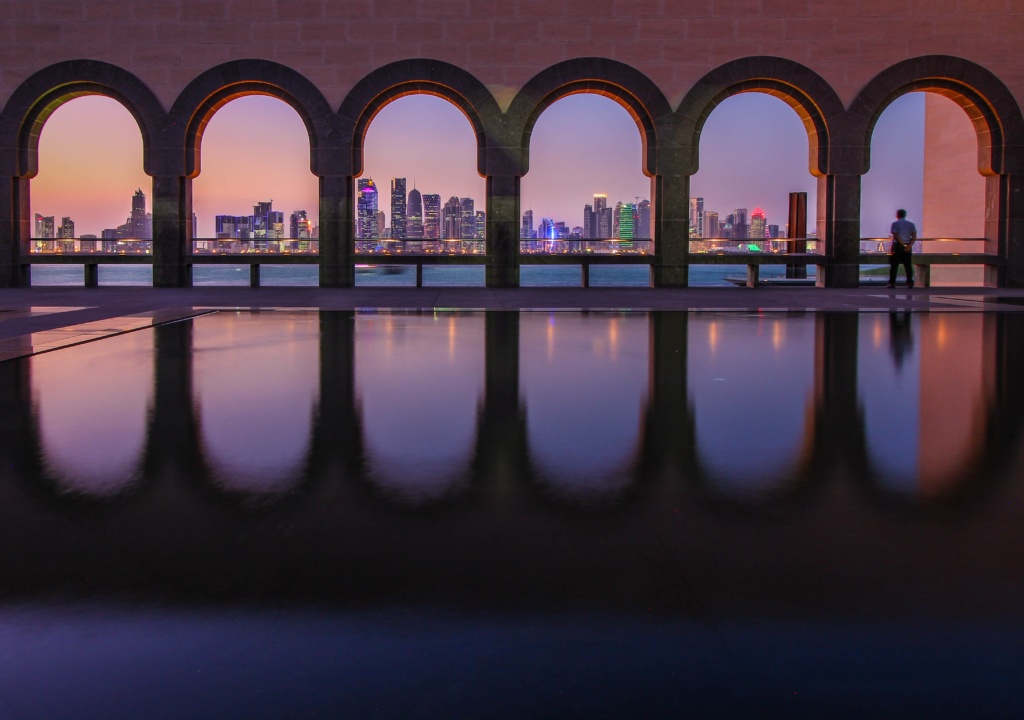
Qatar may be the per square mile most influential nation in the world. This little, lavish country has mastered the painting of perceptions through the art of influence. And more than that, Qatar has turned its art into action.