The rise of Islam after 1500 in the Indian subcontinent

For me, Richard Eaton’s The Rise of Islam and the Bengal Frontier, 1204–1760, is the best analysis of the peculiar spatial distribution of religion in South Asia today. This is not because Eaton’s work is without flaw, or beyond reproach. It is because few have made as concerted an effort to analyze this issue in a dispassionate manner.

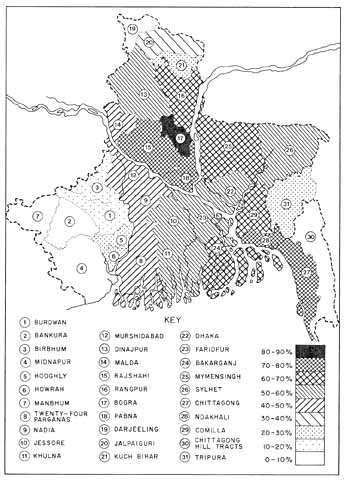
The map to the right shows the proportion of Muslims within united Bengal in ~1870 by region. The outlines of Bangladesh and West Bengal are already clear. That being said, one feature that seems clear is that the more marginal areas are curiously mostly Muslim (e.g., the far southeast). Eaton’s broad argument, following upon others, is a consequence of the fact that these areas came under intensive cultivation only during the Mughal period, and therefore under the aegis of Muslim elites. Therefore, the local peasantry took up a nominal Muslim identity as a matter of course. To reinforce the mechanism, Eaton points out that there are noted cases of villages founded by Hindu zamindars in the east where Hindu shrines were built, and the peasants nominally adhered to the sect of Hinduism professed by the zamindar.

The Rise of Islam and the Bengal Frontier, 1204–1760 is fully available online. I encourage you to read it. One thing that is now clearer to me again after reading it is that Islam as a religious identity of the peasantry of eastern Bengal is a notable feature only after the Mughal conquest of 1576. Visitors to Bengal from other regions before this date mention Muslims only as residents of cities and towns. Additionally, these Muslims often have some foreign connection, whether it be Afghan, Turk, or Persian. As far as the rural people go, none are mentioned as Muslim. Some of them described in eastern Bengal also seem likely to have been Tibeto-Burman in origin. They are described as “beardless”, and Muslim commentators assert they are neither the religion of India nor are they Muslims.

After 1600 visitors began to observe large numbers of Muslims in places such as the lands on either side of the Meghna river. In contrast, observers of the Hooghly basin note that all the inhabitants are Hindus (e.g., a Jesuit declares they are all “idolaters”).

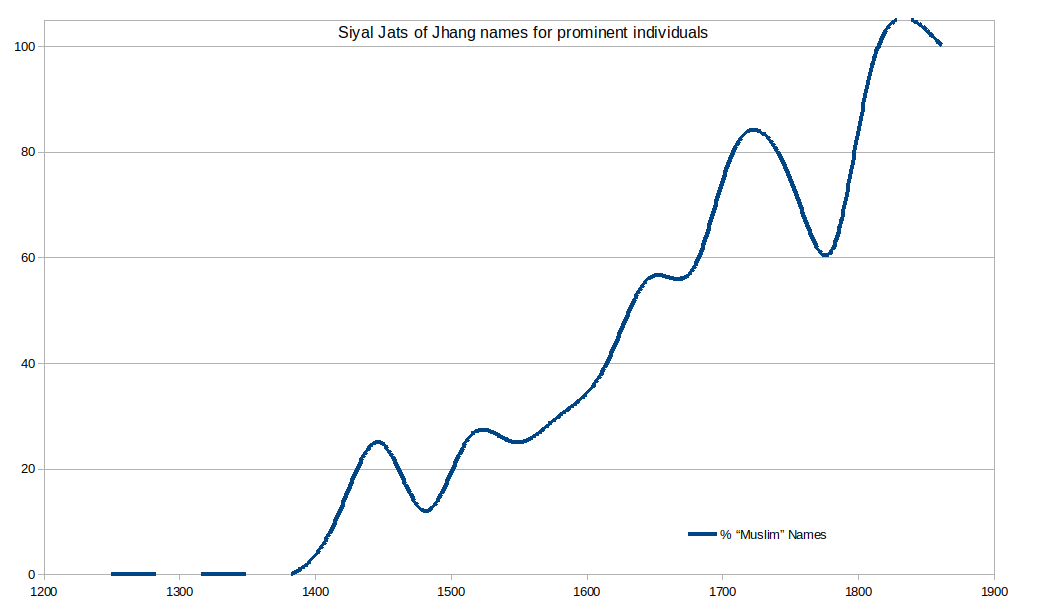
In another paper Eaton analyzes Punjab. While the Islamicization of Bengal was driven by small mosques and shrines in newly founded hamlets, Eaton argues that in western Punjab Islamcization was driven by the transition of pastoralist Jatts to farming, and their settlement around charismatic Sufi shrines. But, he presents data that suggests that this process of Islamization was gradual and somewhat later than the present-day Muslims assert. Siyal Jatts of Jhang in northern Punjab assert they have been Muslim since 1250. But a record of names of notables from this community suggests this is unlikely.

Islamicization began in the period between 1400 and 1500. But the shift from Punjabi names to self-conscious Muslim names did not complete in totality until 400 years had passed.

Ammar Rashid and the frailty of Pakistan’s state narrative

ImageI don’t personally know Ammar Rashid, but I know many people like him and many people who either went to school with him or moved in the same circles. Unlike many (most?) Pakistani students who study abroad and develop a deep understanding of the mess that is Pakistan, Ammar Rashid chose to return to his country. He lives his life according to what he believes in (no matter how unpopular those beliefs and ideas may be), and not a lot of people in Pakistan can say that. I heard him singing Faiz Ahmad Faiz’s Intesaab (Acknowledgement) many years ago, and that is my favorite version of that verse ever sung. I do not agree with everything that Ammar believes in (Listen to him eloquently explain his positions here: soundcloud.com/howtopakistan/episode-14-awami-workers-party-the-pakistani-left), he is an officeholder for the Awami Workers Party (AWP), an artist, writer, and a teacher. He participated in the 2018 national elections for a National Assembly seat. He was one of the leaders of the movement to preserve katchi-bastis (slums) in the I-11 sector, Islamabad.

Why was he arrested?

He was protesting alongside his comrades against the arrest of PTM leader, Manzoor Pashteen. Pashteen galvanized the youth and adult population in former federally administered tribal areas (FATA) that border Afghanistan. The presence of PTM threatens the ‘national narrative’ put forth by Pakistani establishment that they ‘cleared’ FATA of all militants during the Zarb-e-Azab operation (2014-2017). PTM contends that during and after the operation, military demolished homes and business places of non-militants living there and killed (or facilitated the killing of) many tribesmen who were actually anti-militant (Pashteen wrote about this for the NYT, read here. )

Following Ammar’s arrest, there were more protests in different cities in Pakistan. In Faisalabad, many protestors were picked up by the police today for protesting against the arrest of Ammar, who was protesting the arrest of Manzoor Pashteen.   This suppression of dissent is reminiscent of fascist regimes around the world. There are not a lot of people as well-read and politically conscious as Ammar and his fellow protestors and muzzling their voices by force merely exposes the fragility of the military’s narrative. The number of people who think like Ammar in Pakistan is probably less than five hundred. Compare that to the numerical strength of Army proper: half a million (and millions of admirers). Since January 2017, when bloggers were abducted by agencies (and later released), there has been an uptick in ‘disappearances’ of progressive activists and students. Due to the abovementioned numerical mismatch, these abductions don’t always get the media coverage they deserve, and mainstream political parties almost never defend these dissenters. In such dark times, just a safe release of these protestors would be a welcome step.

P.S A twitter thread of tributes to Ammar by creative comrades: https://twitter.com/tooba_sd/status/1224025720873275394?s=21


Junaid Hafeez and Teaching in Pakistan

I could have been in Junaid Hafeez’s place. He was born in a small town in Punjab and was ‘foolish’ enough to leave a career in medicine to pursue the arts. He got a Fulbright scholarship and studied literature, photography, and theatre at Jackson State University in Mississipi before returning to Pakistan and working as a guest lecturer at Multan’s Bahauddin Zakariya University. In 2013, he was arrested on charges of blasphemy. In 2014, his lawyer, Rashid Rahman, was killed in broad daylight, and some lawyers in Multan celebrated that killing. According to witnesses, when Rahman’s body was being bathed before being buried, someone was beating the dhol (signifying happiness) outside their house.  This month, Junaid Hafeez was sentenced to death (link from BBC). He has been kept in solitary confinement for years, for his own protection. What was Junaid Hafeez’s fault?

He chose to say (or just think) things that are not supposed to be said or thunk in Pakistan. He could have chosen to return to the United States or to another country where his life was not in constant danger and where he would not be held in solitary confinement for his own sake. He also chose to teach younger generations and give back to the country, which is also a grave sin in the land of pure. (Read my friend Komail’s experience in his recent piece here).

Sometime during medical school, I myself got disillusioned with medicine and thought about alternative careers. It took me a few years to figure that out and in the meanwhile, I graduated from medical school and completed the necessary medical training. I also got a scholarship to visit the United States and was writing for blogs and newspapers during that interim period. I got sick and tired of sitting at home and applied to be an instrutor in Anatomy (never my favourite subject but that was the only job open at the time) at a private medical school in my hometown. I had never formally taught a class, much less a class of fresh faced medical students on their first day. I did my best effort to hide my nervousness (using my experience as an actor during med school) and hopefully succeeded. There is not a lot of ‘concept-based’ teaching in Anatomy which made my life hard and the fact that in Pakistan, most med schools spend an inordinate amount of time teaching anatomy that students will never use (2-3 months on upper limb!!). I tried to mix things in, just because i wanted them to pay attention. Some of my first lectures would include a mention of the theory of evolution and anatomic signs of that alongside the scientific method. I once started a presentation with a small biography of Karl Marx that I had written for an urdu newspaper, as the day was Marx’s birthday. I tried to not bring up religion or politics in class (other than that one Marx episode, and I wasn’t even a Marxist!) because i wasn’t teaching them social sciences and didn’t want to get into trouble. I was however once asked what an atheist is, to which i gave a very diplomatic answer. The place was run by a political family, who had bought the land for that med school when one of their members was a local nazim under in the Musharraf era. They ran the school like a traditional patriarchy. Female students were prohibited from openly mingling with their male classmates. They eventually started giving ‘tickets’ to such micreant girls and started calling their fathers when they were ‘found’ talking or sitting with a male. I taught at that place for about a year and then moved to Lahore to start my residency.

During residency, we were supposed to oversee students during their labs but there were very few opportunities to actually engage them in a conversation. I took a break from residency after ten months to study for USMLE exams and got a teaching job at another med school in Lahore. That place was the worst of my three experiences mostly because it was a diploma mill. It was also a hybrid campus, so med students would attend classes alongside pharmacy, physical therapy and social sciences students. The social sciences segment was a net-negative for the med school since there was a lot of reactionary views (Orya Maqbool was a frequent guest at their events) going on. One day, I was studying in the lab (the only reason I went to campus every day) when a media student came in and asked if he could do a mock interview for his project to which I agreed. He wanted to ask generic questions so I fed him generic answers without delving too much into specifics. Otherwise, that place was quite toxic. The lab staff (high school graduates and diploma holders) treated female teachers (all of them doctors) as their equivalent and misbehaved with them. One of the lab staff tried to sell the annual exam questions to the highest bidders and was caught on tape (thanks to WhatsApp). Before anything could be done against him, he had fled. I felt sorry for the students and their parents who spent millions of rupees on their offsprings’ education.

No wonder the best and the brightest (not including myself) don’t bother coming back to Pakistan.


Browncast Episode 79: Mohammed Zeeshan

Another BP Podcast is up. You can listen on LibsyniTunesSpotify,  and Stitcher. Probably the easiest way to keep up the podcast since we don’t have a regular schedule is to subscribe at one of the links above.

You can also support the podcast as a patron. The primary benefit now is that you get the podcasts considerably earlier than everyone else.

Would appreciate more positive reviews! Alton Brown’s “Browncast” has 30 reviews on Stitcher alone! Help make us the biggest browncast there is!

In this episode we talk to Mohammed Zeeshan, who is a foreign affairs analyst and columnist. He has written for The Diplomat, The National Interest, Swarajya and DailyO, among others and is a founder of the Freedom gazette. We talk about the current anti-CAA protests, the current and future prospects of Indian Muslims and how they perceive the BJP.

Browncast Episode 78: Omar Al Nidawi

Another BP Podcast is up. You can listen on LibsyniTunesSpotify,  and Stitcher. Probably the easiest way to keep up the podcast since we don’t have a regular schedule is to subscribe at one of the links above.

You can also support the podcast as a patron. The primary benefit now is that you get the podcasts considerably earlier than everyone else.

Would appreciate more positive reviews! Alton Brown’s “Browncast” has 30 reviews on Stitcher alone! Help make us the biggest browncast there is!

In this episode we talk to Omar Al Nidawi, who is an Iraqi-American who works to promote development and democracy in Iraq and talks to us about his impressions of the current crisis in Iraq and what may lie in the future.  He also tells us a little about homebrewing beer and how he got to be the President of the Washington DC homebrewers club.

Image result for omar al nidawi


Years of Rice and Lentils

Going back twenty years I have been fascinated by “alternative history” science fiction. This is often termed “Uchronia.” If you want to explore this genre, I suggest the Uchronia website.

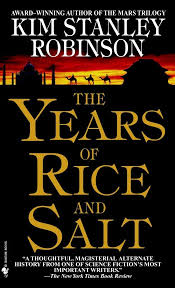
Probably the biggest breakout into “mainstream” science fiction of this sort of work is Kim Stanley Robinson’s The Years of Rice and Salt. Here the “Point of Departure,” where history forks from our timeline, is the Black Death. White Christian Europeans go extinct, with small groups getting absorbed by expanding West Asian and North African Muslims. Eventually, Europe becomes one of the outposts of the Near Eastern Islamic civilization.  The world becomes defined by a “Cold War” between a Chinese-led bloc, and an Islamic-led bloc, with the Indian subcontinent, split between the two (though leaning toward the Chinese-led bloc).

The reason I’m bringing this up is that it presents a thought experiment: what if the Hindu Rajputs had managed to prevent the expansion of Turco-Muslim polities into the Indian subcontinent beyond the Sindh and parts of Punjab? If this had happened, the shock of the Mongol sweep south would probably be even more devastating for the Turco-Muslim polities of Persia and Central Asia (India being less of a fallback). One can imagine a scenario playing out where Islam and Muslims in the Indian subcontinent remain a small distinct minority, with higher concentrations in coastal areas impacted by trade. Islam would perhaps play the same role in India as it does in mainland Southeast Asia: a minority religion that serves mostly as an interface with the Indian Ocean trading network, rather than a religion of a dominant ruling class.

A more interesting question is what are the cultural ramifications of this historical fork? A comment was made on this weblog stated that to a great extent it is hard to imagine North Indian culture without Muslim (so Turkic and Persian) influence. One may disagree with this comment, but it is not a crazy assertion.

But the question of the nature of the alternative history is interesting. Because it is a way one can get at an answer as to what a reconstructed Hindu identity which genuinely strips away Islamicate accretions would look like. Something some people do aspire to…

Welcome back Mahathir Mohamad, Hero of Asia! (a)

https://www.youtube.com/watch?v=7_NMXgdCP-U

This is a follow up to:

Welcome back Mahathir Mohamad, Hero of Asia!

Rishabh Gulat–who I respect greatly has a different take on Datuk Mahathir Mohamad, Hero of Asia, than I do. Some argue that Datuk Mahathir has recently shifted his policy and allied with conservative Wahhabi (subset of Salafi, subset of Sunni) muslims, MBS, Saudi Arabia and Pakistan against India. Mr. Gulat implies that Datuk Mahathir is backing Brown Pundit favorite Dr. Zakir Naik against India:

https://www.youtube.com/watch?v=GfhVQoIvGIs

Please watch Mr. Gulat and come to your own conclusions.

The Indian Malays (7% of the population, 15% of the professional workforce, 40% of all Malaysian doctors, economic engine that moves Malaysia) are rallying the opposition to Datuk Mahatir. Mr. Gulat thinks the global Indian diaspora and global Eastern philosophy diaspora (presumably inclusive of Confucians, Toaists and Chinese) should back the Indian Malays in this.

I need to do a lot more research before proposing an alternative course of action. But here is a question. Can the Indian Malays, global Indian diaspora, global Eastern Philosophy, global Muraqabah tilted Sunnis and Shia and global liberal muslims unite and offer Datuk Mahathir Mohammed an offer he can’t refuse?:

There are many great and powerful Indian and Indonesian muslims–friends of PM Modi–who can make the offer.

As an aside, many Brown Pundits readers know Dr. Zakir Naik fanboy and heart throb Veedu Vidz. Please ask him to come on the Brown Pundits Podcast!

Mr. Rishabh Gulat is a great thought leader and expert on Indonesia, Malaysia and South East Asia more generally. He says that India and Indonesia should make a civilizational, cultural, economic and geopolitical alliance. Is there an interest in the Brown Pundits Podcast interviewing Mr. Rishabh Gulat?

Please let us know in the comments.

Race and religion trump class

Another month, another “Asian” grooming gang scandal. “Asian” usually, but not exclusively, seems to mean Pakistani British men.

A lot of the discussion around this issue centers on the perpetrators of the crimes. Their ethnoreligious distinctiveness. The cultural preconditions which allow for the development of these practices of abuse and exploitation as normative in certain circumstances and toward certain people (though the details differ, from what I know of South Asian communities, in general, there’s a fair amount of sexual abuse going on within the subculture that isn’t discovered because of norms of shame and concealment).

But, I want to focus on the victims. Whenever these stories surface the victims are invariably described as “troubled” and from “broken” homes. These were vulnerable children. Additionally, the powers that be did not see these girls as their girls. If gangs of Pakistani British men were abusing and raping the daughters of middle-class burghers, I am 100% sure that the police would pay immediate attention and follow-up on these cases no matter the sensitivities.

I think it is fine and important to highlight the subculture that fosters this sort of behavior through their assumptions about the sexual nature of non-South Asian women (e.g., I have had it explained to me by several men of Indian subcontinental origin whose tastes were toward the prurient that “our women are pure”). But these cases also illustrate stark class divides and the total lack of concern and interest by the bureaucratic and public service class toward individuals from the lower class.

An early modern Pax Islamica

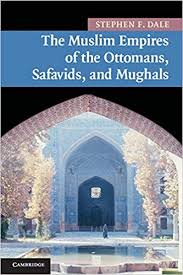
The Muslim Empires of the Ottomans, Safavids, and Mughal has been in my “stack” for a while. It’s a short and academically-oriented work. What’s great about this book is that it is cross-cultural and comparative. I don’t know about you, but these sorts of narrative frames make recall and retention far easier for me. The integration of facts with other facts means that the sum of the parts is greater than the parts evaluated alone. In this, it has similarities with Strange Parallels: Integration on the Mainland: Southeast Asia in Global Context, c.800–1830.

The title itself is informative. These were Islamic polities in a self-conscious manner. The Ottoman Sultan emerged out of a parvenue lineage on the western Anatolian frontier whose claim to rule was based on their status as ghazis. Warriors of the faith. Their Mandate was confirmed through victory. The Safavids had religious charisma before they were temporally powerful. They were hereditary leaders of a Sufi order (their adoption of Shia Islam was a relatively late event). Finally, the Mughals were arguably the least religiously inflected of the three early modern dynasties, despite their appeal to the ghazi ethos.

Rather, the Mughals were notable because of their lineage, which was the most prestigious of the three. The Timurids descended from Timur, obviously, but more importantly, they descended on their maternal side from Genghis Khan. Though Genghis Khan was a pagan, whose scions destroyed much of the Islamic civilization of the Near East (and killed the last Abbassid Caliphs), the raw power and impact of the conqueror was such that he cast a shadow over the whole Turco-Persian world.

The key issue here is that these were dynasties of the Turco-Persian world, more or less. These were not states of the Islamic Arab world, though the Ottomans eventually absorbed much of that world in their later expansionary phase. Nor were they states of the Far East, or even Inner Asia. Despite all their other antecedents,* these dynasties were of Turkic provenance, and yet their entry into Islam was associated with their entry into Persianate culture.

The Muslim Empires of the Ottomans, Safavids, and Mughal takes a chronological tack in that it explores the origins of the three polities as far back as 1000 A.D., and also addresses thematic elements (e.g., architecture, poetry, and economics). Because of the thematic component it is not a work that needs to be read in sequence chapter by chapter, though perhaps doing so would allow for full appreciation.

One thing that jumps out is that in many ways the Safavid Iranian regime is an outlier in many ways. This is obviously true in regards to religion. The Safavids began as a vaguely Sunni but very Sufi religious order in eastern Anatolia. But by 1500 they were promoting arguably ghulat forms of Shia Islam, before settling down on mainstream Ithna Ashari beliefs. It is to this period that connections between Iran, a term that they resurrected, and the Shia cities of Iraq and the Shia regions of Lebanon, were established. It is during this period that Iran was forcibly converted from a mostly Sunni cultural region with Shia pockets to a Shia domain.

The Safavid domains corresponded roughly to what we now know as the Iranian nation-state (Mesopotamia was part of the Safavid domains for a few decades here and there). Despite early attempts at expansion into their Anatolian homelands, rebuffed by the muscular Ottoman military machine, the Safavids were preoccupied with internal concerns. The religious transformation of a whole region through coercion expended a great deal of capital. The early Ottoman state before 1500, and the Mughal domains for its entirety, was different from the Safavids insofar as the ruling military elite were of a different religious identity from the majority whom they ruled (Christians and Hindus respectively).

In contrast, the Ottomans did not attempt to forcibly reshape the culture of their vast domains. The millet system established subordinate roles for non-Muslims, while Ottoman hegemony over their 16th-century conquests in Arab lands did not disrupt native elites (the Mameluke Sultanate was conquered, but the Mamelukes remained Egypt’s ruling caste for centuries under the Ottomans). Within Anatolia and parts of Rumelia a process of assimilation of Greeks, Macedonians, and Armenians, to a “Turkish” identity occurred organically through conversion to Islam. Over the centuries the cosmopolitan tastes of the early Sultans, who spoke Persian at court and styled themselves, successors of the Roman Emperors, gave way to a classical Ottoman identity as leaders of the Muslim world who nevertheless had their own linguistic identity.

The Mughals, though just to the east of Safavid Iran, were a polity characterized by extremely different concerns and resources. Mughal controlled India was the second most populous polity in the world after Ming China. It dwarfed Safavid Persia, even the Ottoman Empire. The Timurids conquered a civilization, or perhaps more accurately a coalition of civilizations. Unlike the Ottomans and to a lesser extent Safavids the Mughals did not create “slave” armies and “slave” bureaucracies. The native resources of India’s people were such that this was not necessary (the argument in regards to labor also is often used to explain why slavery was never popular in China). Hindu Rajputs served in the Mughals in military roles, while groups such as Kayasthas served them in civilian roles.

But the Mughal story is not simply one of “going native.” The Ottomans and Safavids relied on “slave” armies due to the fact that these were often more loyal to the regime than regional or tribal levies. The Mughals opened up India to vast numbers of Turkic warriors and Persian literati. These two groups were regime loyalists because like slaves they lacked local roots.

As Persia become more Shia, many of these foreigners who arrived in India were Shia, but there were also broader connections to the Hanafi Sunni world, as far afield as the Ottoman domains. For example, the Mughal Emperor Aurangzeb patronized the compilation of a series of religious codes, which apparently became quite well known and popular in Ottoman Anatolia.

It is often said that Indian Islam became rooted in the soil of the subcontinent and took upon syncretistic aspects. This is true as far as it goes, but it seems clear to me that the integration of the Mughal ruling class into Turco-Persian culture served as a major check upon this process. The Mughal Emperor Akbar clearly exhibited a tendency toward synthesis and innovation in his religious thought, but his views did not win the day. Rather, it is notable that The Muslim Empires of the Ottomans, Safavids, and Mughal reinforces the contention that each successive Mughal Emperor from Akbar, to Jahangir, to Shah Jahan, and finally Aurangzeb, adhered more closely to West Asian normative Islam.

A distinctive aspect of the Mughal polity is that it assimilated and promoted individuals who were ethnocultural distinct from the core ruling elite. In fact, arguably very disparate groups were all bound together as part of the core ruling elite. In particular, the Rajput generals who served the Mughals. This is in contrast with the Ottoman and Safavid cases, where conversion of the slave to Islam entailed eventual ethnic assimilation. The problem with Aurangzeb, despite his military victories, is that he began aggressively espousing a more West Asian style of ideological assimilating, coaxing and coercing Hindu military elites into Islam. The Mughal equipoise was broken, and while Safavid Iran gave way to polities which inherited all its major features (the Zand and Qajar regimes), and the Ottomans persisted in their long decline, Mughal India quickly shattered in the 18th-century, to leave behind a broad cultural influence.
More generally The Muslim Empires of the Ottomans, Safavids, and Mughal illustrates that a ruling elites with a similar ethos can span multiple polities. Despite the religious distinctiveness of the Safavids, which became more clear over time, the three early modern Muslim polities fostered trade and intellectual exchange. Large colonies of Indian merchants were resident in Isfahan (from which they eventually sojourned to Astrakhan and eventually Moscow).

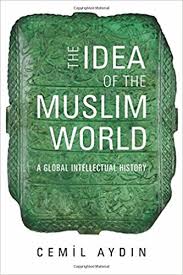
As noted in The Idea of the Muslim World Indian Muslims after the fall of the Mughal Empire had a major influence on Islam in what became Turkey. In Bernard Lewis’ oeuvre there is discussion about the West’s rise and its supremacy over the world of Islam, and the psychological shock that that entailed. But what about the Maratha captivity of the Mughals and how they shaped the confusion of Indian Muslims?

The Muslim Empires of the Ottomans, Safavids, and Mughal illustrates that cross-cultural and cross-national civilizational affinities and ties are quite common. Today many view the West as sui generis. In some ways that are true, in magnitude, and scope. But around the year 1500, a group of Turkic tribesmen had conquered remnants of Byzantium, the Persian Empire, and India. In the ensuing centuries, they transformed these regions, and were themselves transformed. Today to be Persian and to be Shia are almost synonymous (Tajiks tend to be Sunni of course). But this was the consequence of Turkic tribesman. Today Anatolia is mostly Turkish speaking, but that is due to centuries of cultural assimilation. Finally, many elements of Indian culture are hard to imagine without the Mughal period.

* The Safavids had Greek and Kurdish origins as well, though in their early period the Turkic ethnic component was most important. Similarly, the Timurids had recent Mongol ancestry, but their primary identity was with the Turco-Persian world. Finally, the early period of the Ottomans is obscure, but it is hard to imagine that these Anatolian Turks did not absorb some of the “substrate” elements. Mehmet the Conqueror had a Christian, possibly European, mother.

Book Review: Blood Over Different Shades of Green: East Pakistan 1971 History Revisited

Book Review

Hamid Hussain

 Ikram Sehgal & Dr. Bettina Robotka.  Blood Over Different Shades of Green: East Pakistan 1971 History Revisited (Karachi: Oxford University Press, 2019)

 This book is history of the last chapter of united Pakistan in 1971.  Ikram Sehgal is in a unique position to write about the separation of eastern wing of Pakistan and emergence of independent Bangladesh. His father was Punjabi and mother Bengali.  He had personal relations with Bengali and non-Bengali senior political and military leaders.  He understands the passions involved on both sides.  In addition, he was a young army officer and served in both theaters of war in 1971.  He had a front row seat to the final act of the tragedy, and he gives his side of the story candidly. 

 First few chapters give details of social, political and economic differences between two wings.  It then highlights events that gradually widened the gulf and then details about final days of united Pakistan and emergence of independent Bangladesh.  Ikram also narrates his personal experience in 1971 war and many brushes with angel of death. 

 This book highlights for the first time, the role of 1965 India-Pakistan war in almost complete alienation of Bengali public. At psychological level, separation was complete after the war as almost all Bengalis were shocked to see that West Pakistan risked fifty five percent of its Bengali population surrounded by India on three sides and with very meagre resources to defend itself against India for few hundred thousand Kashmiris.

 Civilian and military leadership dominated by West Pakistanis never understood Bengali view point.  The defense doctrine of ‘defense of east Pakistan from west Pakistan’ was never seriously evaluated in the broader context of national security. If one region of the country arrogate itself the title of ‘heart of the country’ and relegate another region as less important ‘periphery’, it is bound to have serious reservation from the entity relegated as periphery.  This was the reason that this doctrine was viewed as absurd from Bengali point of view.

 In discussing Pakistani 18 Infantry Division operations in western desert, authors raise the question of why Jacobabad airfield was not activated regardless of whether GHQ asked for it or not?  Air Commodore ® Sajjad Haider has provided the answer in his memoirs Flight of The Falcon.  Air Chief Air Marshal Rahim Khan visited army headquarter on 04 December 1971 and was informed by Chief of General Staff (CGS) Lieutenant General Gul Hassan about the attack of 18 Division in south-west towards Indian city of Jaisalmer.  Air Chief protested and informed him that closest Pakistan Air Force (PAF) bases of Sargodha and Karachi were over 300 miles away.  He also explained that Jacobabad airfield could not be activated due to paucity of resources and even if decided PAF needed ten days to activate the airfield.  He also informed CGS that Indian Air Force had three air bases in that area that could play havoc with the advancing Pakistani troops without air cover.  Army went ahead with the operation despite Air Chief warning and hence the disaster. 

 There is a minor error regarding U.S. base in Pakistan.  It is mentioned that U-2 surveillance flights operated from Badaber Air Station near Peshawar.  Badaber was only a listening post and not an airfield.  It was an electronic listening facility run by National Security Agency (NSA) and project was code named ‘Operation Sandbag’.  Peshawar and Lahore airfields were used for U-2 surveillance flights.  There were no permanent stationing of U-2 planes in Pakistan.  Detachment 10-10 based at Incirlik, Turkey flew missions from Pakistan.  U-2 pilot and some ground personnel were flown in a C-130 plane to Pakistan a day before the flight.  A standby pilot brought U-2 from Incirlik to Lahore or Peshawar.  In four years, there were only twenty four U-2 overflights.  Out of these twenty four, ten originated from Pakistan; five from Lahore and five from Peshawar.  (I have written a detailed piece about these missions titled Eye in the Sky).  

 This book adds to the literature of 1971 Indian-Pakistan war and independence of Bangladesh by a first-hand witness.  Book is a must read for everyone interested in history of Pakistan and Bangladesh.

 Hamid Hussain

coeusconsultant@optonline.net

28 December 2019

Brown Pundits