The Bahá’í Position on Palestine: A Note for the Record

Comments of late have drifted, as they sometimes do here, into territory where the Bahá’ís are invoked as a rhetorical chess piece by people who know very little about them. We believe in free speech, and on this blog more than most, in authorial autonomy; contributors and commenters speak for themselves, and we are not in the business of policing opinion. But because the question of Palestine sits adjacent to much of what has been said, we thought it worth setting down what the actual position is.

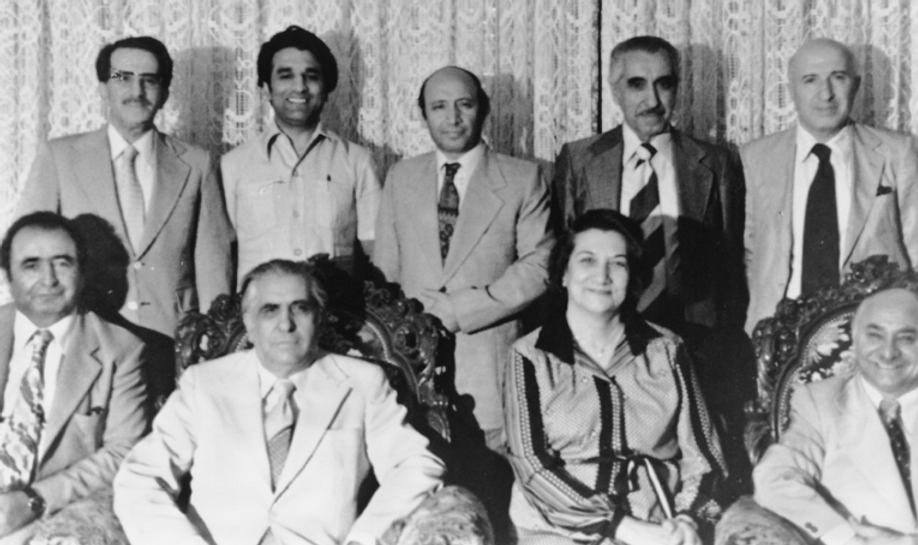
“Members of the National Spiritual Assembly who disappeared in August in 1980. All are presumed to have been killed” by Bahá’í Media Bank.

One caveat first. When we write or administer here, we do not speak for our Faith in any official capacity. We are members of it. That is the limit of our standing.

The clearest statement of the Bahá’í position comes from the pen of the Beloved Guardian of the Faith, Shoghi Effendi, who in July 1947 was asked directly by the United Nations Special Committee on Palestine to clarify the relationship of the Bahá’í community to the country and its political future. His reply, written from Haifa and reproduced in The Bahá’í World, Volume 11, is as close to a foundational text on this question as exists. We quote it at length, because paraphrase would not do it justice.

Letter to the United Nations Special Committee on Palestine

On July 9, 1947, Shoghi Effendi received a letter from the chairman of the United Nations Special Committee on Palestine requesting a statement on the relationship, which the Baha’i­ Faith has to Palestine and the Baha’i­ attitude toward any future changes in the status of the country. From Shoghi Effendi’s reply, the following paragraphs are quoted in The Baha’i­ World, Volume 11 (1946-1950), pp.43-44.1

HAIFA, ISRAEL—15 July 1947

“The position of the Baha’i­s in this country is in a certain measure unique: Whereas Jerusalem is the spiritual center of Christendom it is not the administrative center of either the Church of Rome or any other Christian denomination. Likewise although it is regarded as the second most sacred shrine of Islam, the most Holy site of the Muhammadan Faith, and the center of its pilgrimages, are to be found in Arabia, not in Palestine. The Jews alone offer somewhat of a parallel to the attachment which the Baha’i­s have for this country, inasmuch as Jerusalem holds the remains of their Holy Temple and was the seat of both the religious and political institutions associated with their past history. But even their case differs in one respect from that of the Baha’i­s for it is in the soil of Palestine that the three central Figures of our Religion are buried and it is not only the center of Baha’i­’ pilgrimages from all over the world but also the permanent seat of our Administrative Order, of which I have the honor to be the Head.”

“The Baha’i­ Faith is entirely nonpolitical and we neither take sides in the present tragic dispute going on over the future of the Holy Land and its people nor have we any statement to make or advice to give as to what the nature of the political future of this country should be. Our aim is the establishment of universal peace in this world and our desire to see justice prevail in every domain of human society, including the domain of politics. As many of the adherents of our Faith are of both Jewish and Moslem extraction, we have no prejudice towards either of these groups and are most anxious to reconcile them for their mutual good and for the good of the country.”

“What does concern us, however, in any decisions made affecting the future of Palestine, is that the fact be recognized by whoever exercises sovereignty over Haifa and Acre, that within this area exists the spiritual and administrative world center of a world Faith, and that the independence of that Faith, its right to manage its affairs from this source, the right of Baha’i­s from any and every country of the globe to visit it as pilgrims (enjoying the same privilege in this respect as Jews, Moslems and Christians do in regard to visiting Jerusalem), be acknowledged and permanently safeguarded.”

Three things are worth drawing out.

Continue reading The Bahá’í Position on Palestine: A Note for the Record

At Negombo, the Indian subcontinent meets where it still can

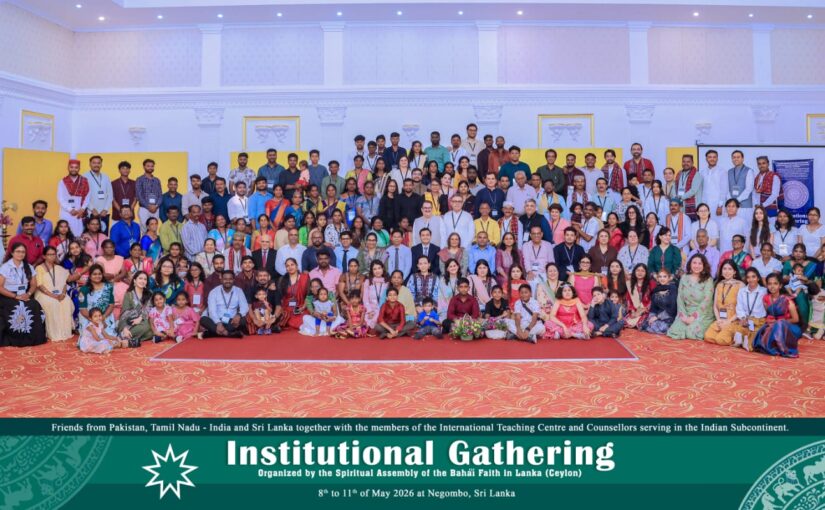
The photograph above was taken on the 11th of May in Negombo, on the western coast of Sri Lanka. The caption records the occasion plainly: friends from Pakistan, from Tamil Nadu, and from Sri Lanka, gathered with members of the International Teaching Centre and the Counsellors serving in the Indian subcontinent, at an Institutional Gathering convened by the Spiritual Assembly of the Bahá’ís of Lanka.

We want to say something about what this image makes possible, and where.

Indians & Pakistanis cannot meet any longer

The hard fact first. There is no longer any practical way for an ordinary Indian and an ordinary Pakistani to sit in the same room inside either of their own countries. Visa regimes have hardened to the point of farce. The land border is sealed in spirit if not in law. What remains are the smaller states of the subcontinent and the wider diaspora. Of the smaller states, Sri Lanka is the one that handles the meeting most gracefully: visa-on-arrival to both passports, no overland complication, no political theatre, and a civic culture that does not ask either side to perform a position.

Which brings us to the older question, whether Sri Lanka belongs to our civilisational space at all. Some friends north of the Palk Strait still treat the island as adjacent rather than constitutive. We think this is wrong, and the reasons are not sentimental.

Sri Lanka is Dharmic? Continue reading At Negombo, the Indian subcontinent meets where it still can

Founder Sites and Institutional Sites: A Note on Sikh Sacred Geography

This post is to be treated as Precedent on two matters.

First, on moderation

We have been alerted by Hamza that a number of Pakistani commentators on this site have been using anti-Dravidian racialised language against South Indian communities. This will not be tolerated on Brown Pundits.

Any comment that uses racialised language against Dravidian, Tamil, or South Indian communities will be removed, and the offending commenter will have twenty comments removed instantly as an automatic fine. There is no warning phase.

This is personal as well as editorial. DLV’s family was driven out of Sindh by Muhajirs at Partition. It was the Dravidians and the Tamils of Chennai who welcomed them, gave them a second home, and treated them as their own. Any racialised language against those communities on this site will be met with the full weight of the moderation tools available.

To Kabir’s credit, as far as we are aware, he is the only regular Pakistani voice on this blog who has never used racialised language of any kind, even in sharp disagreement. He remains institutional and high-minded even when the argument turns to nuclear rattling. He does not share in the wider Desi pathology with regards to skin colour and race, and that exception is worth naming. It may be the American side of him. Whatever the source, it is the standard this site expects of every commenter, Pakistani, Indian, Bangladeshi, or otherwise.

Second, on substance

The post below establishes a framework for how this site will discuss the sacred geographies of Partition going forward. The recent Kabir-Kishore exchange on Sikh holy places, is the occasion, but the framework is intended to apply across all such disputes: Hindu sites in Pakistan, Muslim sites in India, Sikh sites on both sides of the Wagah, Buddhist sites across the subcontinent. Future BP posts on sacred geography should refer back to the founder-institutional distinction laid out here.


Founder Sites and Institutional Sites: A Note on Sikh Sacred Geography

A recent exchange on this site sets out two claims about Sikh holy places. The first says Sikhs lost most of their sacred sites to Pakistan in 1947. The second calls that claim nonsense. Both are right, and the disagreement turns on a distinction neither has named: founder sites versus institutional sites.

The Pakistan-side Holy Sites

Continue reading Founder Sites and Institutional Sites: A Note on Sikh Sacred Geography

Brown Pundits