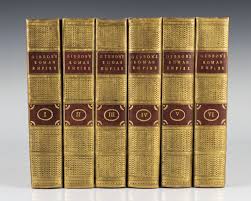
Recently my friend Josiah Neely mentioned offhand how in The Decline and Fall of the Roman Empire Gibbon argued that one reason paganism couldn’t reverse the tide of Christianity is that once a society or individual became Christian and ceased pagan practice, there wasn’t a good roadmap on how to reembrace the old traditions. In contrast, Christianity’s ideological content meant that even if there was a period of apostasy or public cessation of practice, ideological continuity could be maintained.
To be more explicit and extend the argument, I think the key is that there was a class of religious professionals who were devoted in a deep way to the ideological content of Christianity. If, as occurred in Britain and the Balkans, Christianity collapsed, they would endeavor to reconvert the populace, as they did.
There are other cases of this. Han Yu was a Confucian scholar who denounced Buddhism in the year 800 A.D. during the Tang dynasty. This period, between 600 and 900 A.D. was the “high water” point of public state Buddhism in China. But there always remained an alternative tradition of Chinese scholars and officials who were expositors Confucianism. Eventually, these people “recaptured” China during the Song dynasty for Confucianism, and Buddhism became a religion of the popular people and not the state.
As I said elsewhere, this may explain the persistence of Hinduism. Hinduism, like Greco-Roman paganism, is diverse and variegated. But unlike Greco-Roman paganism, there seems to have been a dynamic and reciprocal tension between philosophy and folk religion, mediated by Brahmins. Greco-Roman paganism was fundamentally an expression of ethnicity and identity. Tradition and custom. Greco-Roman metaphysics was the purview of secular philosophers. Hinduism is arguably more fused, and this may have given it more robustness.
Two books recently have made me wonder about the insights into the development of religion and culture in the Indian subcontinent. The Final Pagan Generation: Rome’s Unexpected Path to Christianity explicitly makes an analogy to local Hindu gods and shrines to allow us to conceptualize what pre-Christian Roman religion was like. The whole city was the purview of the gods, and their presence pervaded the world. The Final Pagan Generation notes that even though the attack on grand public temples such as the Serapion at the end of the 4th century are salient and notable, even 100 years later Christian mobs were able to collect thousands of items of religious significance through Alexandria.
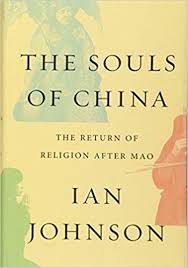
Recently I have been reading The Souls of China: The Return of Religion After Mao. The author notes that though the great traditions of Buddhism, Daoism, and Confucianism, warrant public notice, the reality is that pre-modern Chinese religion was dominated by local gods, with numerous temples to the gods of a particular city, or a particular profession. Reviled as “superstition” in the early 20th century, these local gods and their shrines were torn down and destroyed first by the Nationalists, and later the Communists. 21st century China has only slowly been allow for the reemergence of this religious substrate.
One could argue that Abrahamic religions lack these organically developed local twists. But this is actually not true, as for Catholic Catholics saints and relics are a critical intermediary layer in their religious institution, and within many forms of Islam, the shrines of saints are critical. Rather, particular forms of Protestant Christianity and Salafist Islam are peculiar in their abstraction and rational decoupling from place.
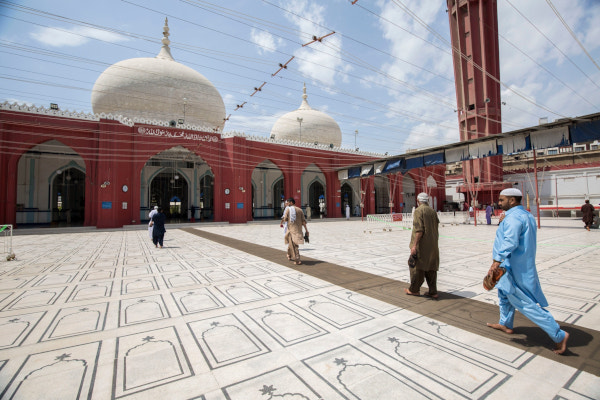
And the extremist clerics who often heckle or march against the civilian government, with the tacit approval of the military, are refusing to help. They largely ignored Mr. Khan’s call to limit Friday prayer gatherings. And even after the military deployed to try to enforce a lockdown, several clerics made videos that went viral in recent days, urging Pakistanis to come back to the mosques to worship.
To avoid mosques on Fridays would only invite God’s wrath at a time when people need his mercy, the clerics warned.
“We cannot skip Friday prayers because of fears of coronavirus,” said Shabbir Chand, a trader who attended a packed service in Karachi, the country’s biggest city. “Instead, we should gather in even larger numbers in mosques to pray to God to protect us from this fatal disease.”
One of the major aspects of Islam that some Hindu nationalists are obviously jealous of is its seeming unitary cohesion. A hadith attributed to Muhammad is that “the Ummah shall not agree upon error.” And Muslims famously come together weekly to pray together.
But in a time of coronavirus, the fractured and somewhat antisocial aspect of Hindu religion may have some benefits.
For me, Richard Eaton’s The Rise of Islam and the Bengal Frontier, 1204–1760, is the best analysis of the peculiar spatial distribution of religion in South Asia today. This is not because Eaton’s work is without flaw, or beyond reproach. It is because few have made as concerted an effort to analyze this issue in a dispassionate manner.
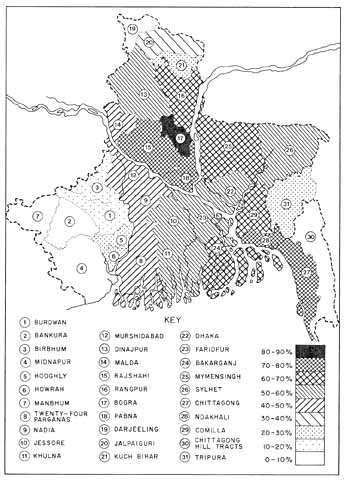
The map to the right shows the proportion of Muslims within united Bengal in ~1870 by region. The outlines of Bangladesh and West Bengal are already clear. That being said, one feature that seems clear is that the more marginal areas are curiously mostly Muslim (e.g., the far southeast). Eaton’s broad argument, following upon others, is a consequence of the fact that these areas came under intensive cultivation only during the Mughal period, and therefore under the aegis of Muslim elites. Therefore, the local peasantry took up a nominal Muslim identity as a matter of course. To reinforce the mechanism, Eaton points out that there are noted cases of villages founded by Hindu zamindars in the east where Hindu shrines were built, and the peasants nominally adhered to the sect of Hinduism professed by the zamindar.
The Rise of Islam and the Bengal Frontier, 1204–1760 is fully available online. I encourage you to read it. One thing that is now clearer to me again after reading it is that Islam as a religious identity of the peasantry of eastern Bengal is a notable feature only after the Mughal conquest of 1576. Visitors to Bengal from other regions before this date mention Muslims only as residents of cities and towns. Additionally, these Muslims often have some foreign connection, whether it be Afghan, Turk, or Persian. As far as the rural people go, none are mentioned as Muslim. Some of them described in eastern Bengal also seem likely to have been Tibeto-Burman in origin. They are described as “beardless”, and Muslim commentators assert they are neither the religion of India nor are they Muslims.
After 1600 visitors began to observe large numbers of Muslims in places such as the lands on either side of the Meghna river. In contrast, observers of the Hooghly basin note that all the inhabitants are Hindus (e.g., a Jesuit declares they are all “idolaters”).
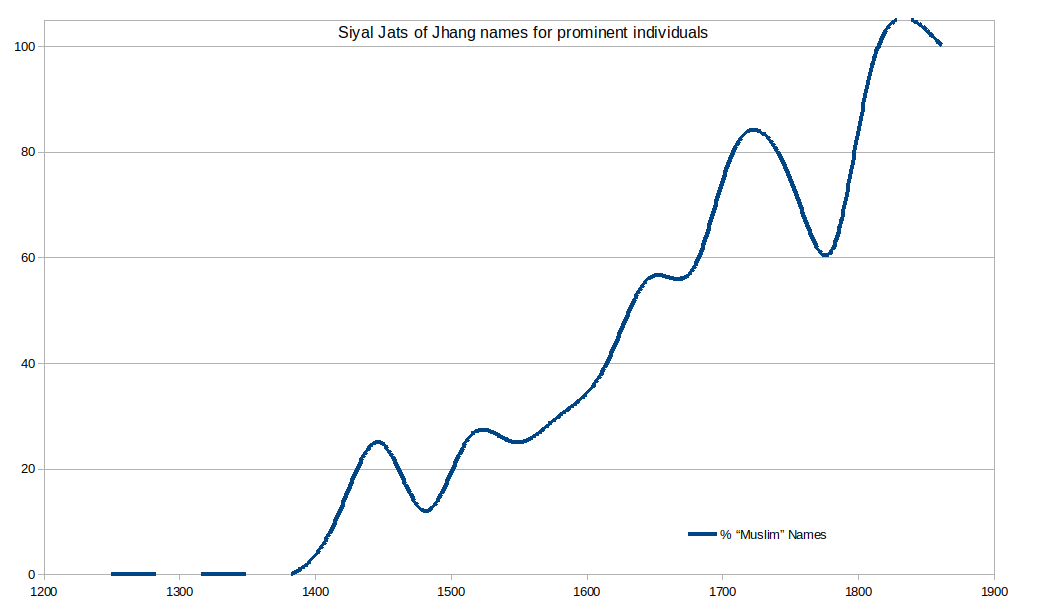
In another paper Eaton analyzes Punjab. While the Islamicization of Bengal was driven by small mosques and shrines in newly founded hamlets, Eaton argues that in western Punjab Islamcization was driven by the transition of pastoralist Jatts to farming, and their settlement around charismatic Sufi shrines. But, he presents data that suggests that this process of Islamization was gradual and somewhat later than the present-day Muslims assert. Siyal Jatts of Jhang in northern Punjab assert they have been Muslim since 1250. But a record of names of notables from this community suggests this is unlikely.
Islamicization began in the period between 1400 and 1500. But the shift from Punjabi names to self-conscious Muslim names did not complete in totality until 400 years had passed.
An argument that emerges now and then on this website has to do with the nature of the ancestors of Indian (South Asian) Muslims. Where they Hindus? Much hinges on semantics. The term “Hindu” after all simply meant Indian in the days of yore, so by definition, they were.
On the other hand, Hindu today denotes a set of beliefs, practices, and identities, which exists at counterpoint with the confessions of Islam, sects like Jainism and Sikhism, and the dharmic world religion of Buddhism. To say that the ancestors of Muslims were Hindus may not give the correct impression due to the fact that that implies a level of fidelity to practices and beliefs which we today recognize as Hindu. Even setting aside the fact that substantial numbers may have been adherents of counter-cultural sects such as Buddhism, many of the threads of contemporary Hinduism developed in situ in the Indian subcontinent at the same time as many regions became predominantly Muslim.
And yet I think I have come to an elegant and accurate solution to this problem: those of us of Muslim origin or belief should simply admit that we were the descendants of idolators. Whether Buddhist, caste Hindu, or animistic peasant, from a Muslim perspective all these groups are idolators.
Rishabh Gulat–who I respect greatly has a different take on Datuk Mahathir Mohamad, Hero of Asia, than I do. Some argue that Datuk Mahathir has recently shifted his policy and allied with conservative Wahhabi (subset of Salafi, subset of Sunni) muslims, MBS, Saudi Arabia and Pakistan against India. Mr. Gulat implies that Datuk Mahathir is backing Brown Pundit favorite Dr. Zakir Naik against India:
https://www.youtube.com/watch?v=GfhVQoIvGIs
Please watch Mr. Gulat and come to your own conclusions.
The Indian Malays (7% of the population, 15% of the professional workforce, 40% of all Malaysian doctors, economic engine that moves Malaysia) are rallying the opposition to Datuk Mahatir. Mr. Gulat thinks the global Indian diaspora and global Eastern philosophy diaspora (presumably inclusive of Confucians, Toaists and Chinese) should back the Indian Malays in this.
I need to do a lot more research before proposing an alternative course of action. But here is a question. Can the Indian Malays, global Indian diaspora, global Eastern Philosophy, global Muraqabah tilted Sunnis and Shia and global liberal muslims unite and offer Datuk Mahathir Mohammed an offer he can’t refuse?:
There are many great and powerful Indian and Indonesian muslims–friends of PM Modi–who can make the offer.
As an aside, many Brown Pundits readers know Dr. Zakir Naik fanboy and heart throb Veedu Vidz. Please ask him to come on the Brown Pundits Podcast!
Mr. Rishabh Gulat is a great thought leader and expert on Indonesia, Malaysia and South East Asia more generally. He says that India and Indonesia should make a civilizational, cultural, economic and geopolitical alliance. Is there an interest in the Brown Pundits Podcast interviewing Mr. Rishabh Gulat?
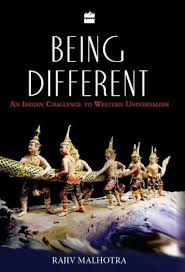
In this way, I would suggest that Malhorta’s work is analogous to Tariq Ramadan’s exposition of a conservative Muslim world-view that is aware of, and engages with, Western values and traditions.
The main difference is that Ramadan’s work is more academic, which makes sense since he is trained as a classical European intellectual. In contrast, the main nagging issue I have with Malhotra’s work so far is that he regularly imputes elements of Western American Protestant culture and civilization to the Abrahamic traditions writ large. This makes sense since Malhotra’s biography suggests much of his adult life was in the United States. But whenever he writes “Judeo-Christian” about 75% of the time it makes more sense to write “American Protestant”, since that is really what the term is pointing to.
I assume that in the broad conclusions Malhotra and I come down on different positions. But the outlines of the methods and arguments he uses are quite familiar and intelligible, and that’s a nice change from other things that I have read.
[Author’s note: With the celebrations of Guru Nanak’s 550th Anniversary and the opening of the Kartarpur Corridor being in the news, this is an opportunity for discussing the importance of the Sikh message, not just from a religious perspective – for Sikhs – but for Indian history. This article places the founding of Kartarpur, and Guru Nanak’s message, in a historical context – juxtaposing it with Babur’s founding of the Mughal Empire.]
I. Turning of the Wheel: Baba Nanak and Babur
In 1519, Babur invaded India – ‘ever since coming to Kabul we had been thinking of a Hindustan campaign, but for one reason or another it had not been possible,’ he writes in the Baburnama (translated by William Thackston, see pp 270-280). For some time his armies had been campaigning on the frontiers of the Hindu Kush, but these campaigns had yielded ‘nothing of consequence to the soldiers’. So, he turned to Hindustan. In the next few months, despite dogged resistance by the Afghans, Gujjars and Jats of the upper reaches of the Jhelum and Chenab, northern Punjab was subjugated, and plundered, by Babur’s armies. Babur himself spent most of his days inebriated, contemplating the legacy of Timur and setting poems to rhythmic metres. While his next great invasion of Punjab would come few years from then, in this interregnum, Punjab burned.
Among the towns and villages devastated was the settlement of Sayyidpur.
It was not long after Babur’s march of death through Punjab that Guru Nanak returned home from his western voyages – to Mecca, through Baghdad, Masshad, Khurasan, to Kabul, Peshawar, and, finally, to Sayyidpur. To the house of a humble carpenter, Bhai Lalo (Janam Sakhi Parampara by Kirpal Singh, pp 138-140). Continue reading Sangat and Society: the Sikh remaking of the North Indian Public Sphere
America has a national crisis in math capacity, competence and merit. American students sharply underperform students in many countries all over the world. Including Vietnam, which is a poorer country than India per capita. We will heavily refer to the 2018 OECD PISA report in below paragraphs, but the below chart graphic is from the 2015 OECD PISA scores report because math scores are reported for more countries in the 2015 report. Perhaps the 2018 report will be revised to add more countries in the future:
In my view a level 5 PISA score is the minimum requirement for a person to be considered a high school graduate who is literate in math, able to function in the modern global economy, or be qualified to attend college. The PISA report defines a level 5 PISA score or better as a fifteen year old that “can model complex situations mathematically, and can select, compare and evaluate appropriate problem-solving strategies for dealing with them.” How does America perform in the 2018 PISA report?:
United States: 8% of students scored at Level 5 or higher in mathematics
OECD average: 11%
Six Asian countries and economies had the largest shares of students who did so:
Beijing, Shanghai, Jiangsu and Zhejiang (China): 44%
Singapore: 37%
Hong Kong (China): 29%
Macao (China): 28%
Chinese Taipei: 23%
Korea: 21%
Note that these six countries were among the poorest countries in the world in the 1950s, far poorer than poor Americans or poor Europeans or poor Chileans can even imagine. In 1979 China was unbelievably poor. Much of the population of China–perhaps as many as 100 million–had starved to death because of extreme poverty in the 1970s. Poor children around the world are outperforming American children in mathematics despite extremely low education spending per student and very low socio-economic level of their legal guardians, where socio-economic level is defined as:
income
wealth
formal education of parents
Do any American high school student subgroups perform well in Mathematics? Yes, “people of color” or “minority” Americans perform well in Mathematics. America’s “people of color” or “minority” students are orders of magnitude more likely to get an 800 on the mathematics SAT than European Americans. If we assume this is an extreme tail end distribution issue related to European Americans having a lower standard deviation and non standard distribution in mathematics performance relative to “people of color” or “minority” Americans, we can explore the breakdown of Americans who score between 750 and 800 on the Mathematics SAT. Here European Americans perform far better relative to “people of color” or “minority” Americans. In 2015 16,000 European Americans scored 750 or higher. 33,000 “people of color” and “minority” Americans scored 750 or higher. We further know that 51% of SAT test takers were European Americans and 49% were “people of color” or “minority” Americans. “People of color” or “minority” Americans are [33,000/16,000]*[51%/49%] or 2.15 times as likely to score 750 or higher on the mathematics SAT compared to European Americans. If we examine the 107,900 test takers who got SAT math scores of 700 or higher; 59,900 are “people of color” or “minority” Americans, versus 48,000 European Americans. “People of color” or “minority” Americans are [59,900/48,000]*[51%/49%] or 1.30 times as likely to score 700 or higher on the mathematics SAT compared to European Americans. For data junkie geeks like me there is a lot more data on SAT math score distributions here and here. The Greta Anderson article’s comment section in particular has some very intelligent commentators who have studied the American SAT score distribution. This is likely to be the subject of many future blog posts and Brown Pundits Podcasts.
What about this is worrying?:
European Americans in particular are sharply under-performing both very poor children around the world and “people of color” and “minority” Americans in mathematics.
American mathematics SAT scores have fallen between 1972 and 2016. 1972 is the earliest year for which I could find comparable SAT mathematics scores. In 2017, 2018 and 2019 the SAT mathematics exam was completely restructured to make scores no longer comparable to SAT mathematics scores between 1972 and 2016.
90% or more of current jobs and businesses are likely to be replaced by artificial intelligence (AI), brain electro-therapy (meditation . . . practiced by civilizations around the world for over 5,000 years), brain sound therapy (naad or mantra yoga and their equivalents in Native American, Egyptian, Sumerian, Taoist and other civilizations around the world for over 5,000 years), bio-engineering tissue, genetic editing, and fused AI-brain interface synthesis intelligence. Almost all of these future disciplines are complementary to mathematics.
Future articles and podcasts are planned all six of these future disciplines. If you are curious about fused AI-brain interface synthesis intelligence, please watch my main man Elon Musk:
Some say that the tension and relationship challenges between America’s four big castes–European Americans, European “Latino” Americans, Black Americans and Asian American–are driving low math scores for European Americans “AND” other Americans. One example is where thought leader Mark J Perry explores the possibility that tension between the European American caste and the Asian American caste are lowering American mathematics performance. Excerpts of his article are reproduced below: