
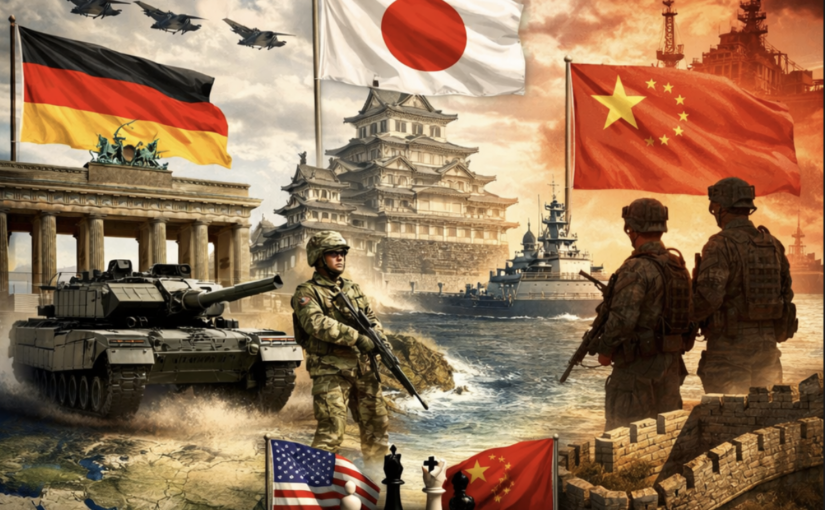
Germany Is Rearming. Japan Is Shifting. And Desis Are Arguing Like Teenagers.

Running a platform is not the same as winning an argument. It is about tone, trajectory, and whether the conversation rises or sinks. I edit out BB’s comments not because I fear disagreement, and not because I am fragile about India or Pakistan. I edit them because they are crude. Crudeness is not courage.

Between Critique and Provocation

There is a difference between sharp critique and coarse provocation. Kabir and I disagree deeply about India. He defends the fake term ā€œSouth Asiaā€ as necessary. It’s a neocolonialist invention designed to dissolve the world’s oldest and most prominent civilisation (the Indian Subcontinent) into a compass direction. We argue. We contest premises. We clash over legitimacy, sovereignty, and naming. But the disagreement is structured. It is intelligible. It is civil. It forces clarity.

BB’s interventions, by contrast, tend to flatten everything into sneer and insinuation. That degrades the space. A forum that tolerates permanent coarseness slowly becomes defined by it. Readers do not return for noise. They return for thought. There are, to be fair, strong exceptions; for instance when he analysed the cricketing economy to illustrate how much weaker the Pakistani consumer-tax base is compared to its Indian counterpart.

Japan & Germany wake up

Continue reading Germany Is Rearming. Japan Is Shifting. And Desis Are Arguing Like Teenagers.
Borders, Blind Spots, and the Mirror Game of South Asia

A recurring tension in South Asian discourse is the question of consistency: how states interpret borders, secession, and sovereignty; not in principle, but in practice.

Liberalstan’s case is that India acted selectively in 1947: Junagadh saw a plebiscite, Hyderabad faced military action, and Kashmir was referred to the UN. From this perspective, India chose whichever method suited its interests in each case. To Liberalstan, this isn’t pragmatism, it’s hypocrisy. The charge: if self-determination wasn’t good for Kashmir, why should it be for Balochistan? And what of Sikkim, Goa, Pondicherry, Khalistan, Nagaland, or the Naxalites?

Hindustan’s reply is rooted in realpolitik: decisions were shaped by demography, geography, and threats; not abstract norms. Q.E.A. Jinnah’s attempt to absorb Junagadh and court Jodhpur are seen as deliberate provocations, since Junagadh was Hindu-majority, non-contiguous, and largely symbolic (home to Somnath). After that, New Delhi abandoned any illusions of standard rules. From Hindustan’s view, Liberalstan’s moral framing is not only naĆÆve but deeply asymmetrical; ignoring 1947, 1965, Kargil, Mumbai, and the long shadow of Pakistan’s own interventions.

When it comes to Balochistan, Hindustan notes its accession was closer to annexation, comparable to Nepal or Bhutan vanishing into India. Three major insurgencies since the 1960s complicate the narrative of ā€œfinality.ā€ But here, Liberalstanflips the script: what is labeled a disputed territory in Kashmir is declared settled in Balochistan. This inversion doesn’t go unnoticed.

In truth, both sides are mirrors. Each demands flexibility for itself and finality for the other. Each invokes ā€œconsentā€selectively; whether that of a prince, a people, or a state. The tragedy, perhaps, isn’t inconsistency but the absence of a shared regional framework for self-determination. One not held hostage by grievance, revenge, or exception.

Until then, accusations of hypocrisy will persist, each side fluent in the other’s blind spots.

Brown Pundits