Book Review: The 1965 War by Shaukat Riza

From Major Amin

  1. THE PAKISTAN ARMY –WAR 1965 MAJOR GENERAL SHAUKAT RIZA (RETD) –ARMY EDUCATION PRESS 1984-309 PAGES , MAPS AND PHOTOGRAPHS Reviewed by Major Agha H Amin (Retired)
  2. This book was the first official effort to record military history of 1965 war. Major General Shaukat Riza an artillery officer dabbled in military writing and had penned many articles and military papers etc. He was described as a soft spoken gentle man who did not take kindly to being ordered to carry out ruthless action against civilians thus his removal from 9 Divisions command in 1971 in East Pakistan. On the other hand Brigadier Amjad Chaudhry when I met him in 1977-78 described him as not getting along well with major general abrar in the staff college in 1967-68 while serving as chief instructor. In addition he had a long record of having served as an instructor at various army schools of instruction including the prestigious command and staff college. The first major attempt at writing the 1965 war history was made by Brigadier Amjad Ali Khan Chaudhry whose book on 1965 war was published in 1977. Shaukat Rizas book was officially sponsored and he was provided access to all records.
  3. However as all official publications are , the book was doctored and sanitized and the author did not enjoy the right to critical analysis. The book nevertheless has great value. First it contains almost all major orders of battles of all major formations . Second it gives a clear picture of major events of the war. Third it manages to give insights about some most decisive battles of the 1965 war. Most interesting battle of Gadgor where Shaukat Riza described how clueless the 24 Brigade commander was when the Indian 1st Armoured Division broke in and all he could say was “ Nisar, Do Something”.
  4. Brigadier Shaukat Riza’s analysis of Operation Grand Slam is also reasonably critical.  where he faults 12 Division with bad handling of artillery and dispersing artillery fire. He totally misses out how armour was divided by 12 Division on first day of the war thus leading to failure although B Squadron 11 Cavalry had reached Chhamb at Tawi River at 0830 Hours in the morning. However with regard to change of command it appears that major general shaukat riza was forced to give legitimacy to the post 1965 pakistan army whitewash, i.e that change of command of operation grand slam was pre planned and not a surprise as was mostly believed. His treatment of Pakistan Armys First Armoured Division attack is critical and incisive.He admits that whole 4 cavalry. was captured by the Indians .Further he admits that there was much exaggeration of enemy strength in the reporting of armoured division commanders at various levels. When he describes how various brigades of Pakistans 1st armoured division were ordered left and right away from the scene of attack he hints at a Pakistan Army general headquarters deeply afflicted and paralysed by supreme indecision, vacillation and irresolution.
  5. The maps of the book are weak in details of what actually happened merely showing topgraphic details while what formations actually did is left to the readers imagination. However when we received this book via the army book club in 1985-86 this was a revolutionary development as till that time censorship had deeply plagued the cause of military history in Pakistan. Much blame of the failure was passed to ZA Bhutto while Generals Ayub and Musa were presented as innocent bystander pure maidens !
  6. One must admit that the general was handicapped by too many cooks doctoring his book and practicing sycophancy with the usurper and dictator zia , at the height of his power. Even General Mc Chrystal confessed that his book was subjected to some kind of official censorship and sanitization. This is the cost of becoming generals in any army where a man has to compromise over many things . As Sir Francis Bacon brilliantly summed it up , men gain dignities through indignities.
  7.  Major General Saeeduz Zaman Janjua many times recounted how even General Asif Nawaz , although his close relative , had to be obsequious and flexible with his seniors , as a brigadier and major general , failing which he would not have been promoted. Particularly he recounted a situation where a very senior officers son was caught cheating in the Pakistan Military Academy and General Asif Nawaz had to stop at relegation while the minimum punishment was withdrawal from the academy. This is how the world moves and only those who compromise and submit climb high in the so called systems or hierarchies. A man with no war record but one who was all in all in Pakistan of 1984.A sad year like George Orwells book 1984.
  8.  The book ignores how badly Pakistan Army was organized with formations like 12 Division holding an area of responsibility occupied by some five Indian divisions. What stopped Ayub Khan from raising 5 more divisional headquarters in 12 Division area of responsibility. At least this book gave us some idea about what had happened and a skeleton structure to construct a more detailed picture. His two later books Pakistan Army 1947- 59 and Pakistan Army 1966-71 were also similarly handicapped by censorship and sanitization by the Pakistan Army GHQ but more of this in subsequent book reviews.

Continue reading Book Review: The 1965 War by Shaukat Riza

Obituary: Brigadier Nisar Ahmed SJ

From Dr Hamid Hussain. Perhaps not of general interest on this site, but worth preserving in any case. See details of Col Nisar’s critical (and courageous) action in 1965 are added below this obituary.

Obituary – Brigadier Âź Nisar Ahmad Khan (28 March 1920 – 30 July 2019)

Hamid Hussain

Brigadier ¼ Nisar Ahmad Khan passed away on 30 July 2019 in Michigan; United States.  He was nick named ‘Kaka Nisar’.  A fine officer and gentleman who was instrumental in a very important holding action of armor in 1965 Indo-Pakistan War faded away into the fog of history.  He was born on 28 March 1920 at Bassi Pathana near Sirhind in Patiala state.  This Muslim Pathan colony was established during Mughal era.  This small Muslim enclave in a Sikh state provided soldiers to the Maharaja of Patiala.  Several generations of Nisar’s ancestors proudly served Patiala state. According to Maharaja Patiala Captain ¼ Amarindar Singh, Kaka Nisar was sixth generation of the family to serve Patiala state.  He followed the family tradition, joined Ist Patiala (Rajindra) Lancers and commissioned on 21 March 1943. Continue reading Obituary: Brigadier Nisar Ahmed SJ

Toward a beige future

Update: They removed the slander on Vance. But it will happen again. There is clearly a strong demand for this judging by the reaction of liberal Twitter. End update


The Washington Post:

As border controls tighten, though, the links between pronatalism and nativism have once again become visible. Inspired by Steve King’s admiring remark about Geert Wilders, Ayla Stewart, creator of a popular white nationalist blog called Wife with a Purpose, issued a “white baby challenge” that went viral in alt-right circles; the mother of six asked audience members “to have as many white babies as I have contributed.” Meanwhile, as replacement discourse enters the conservative mainstream, talk of birthrates comes along with it. “Our people aren’t having enough children to replace themselves. That should bother us,” J.D. Vance, author of the best-selling “Hillbilly Elegy,” told his audience at the National Conservatism Conference last month; earlier this year, he described himself as “appalled” by Democrats’ permissive attitudes toward abortion. Vance did not spell out exactly who was included in the word “our.” He didn’t need to.”

As I have noted on this weblog Vance’s wife is South Indian, his son is mixed-race. He also recently converted to Roman Catholicism. His life is a literal reflection of cosmopolitanism.

This piece goes into a long line of thinking whereby liberals think that they can infer things about conservatives. But the reality is many liberals don’t have the cultural competencies to do so. It’s like non-Muslims trying to understand the idioms and signs within Muslim subculture. We’d all acknowledge that something beyond what you might read in a newspaper is probably important in this case. But American liberals and conservatives don’t give each other this benefit of the doubt. Conservatives are racist. Liberals are socialists. You know what they really think….

(I strongly suspect most liberals have a model where white conservatives can’t marry and have children with non-white people, so the writer and publication didn’t bother to check)

Is it time for Asian Americans and Latino Americans to ask to be considered “white”? (c)

This is the next article in the series “Is it time for Asian Americans and Latino Americans to ask to be considered “white”, “Is it time for Asian Americans and Latino Americans to ask to be considered “white” (a)”,  Razib’s  “Hasan Minhaj’s Patriot Act on Affirmative Action“, and “Is it time for Asian Americans and Latino Americans to ask to be considered “white” (b)”.

A growing part of the global caucasian intelligentsia are attacking Hong Kong protesters as far right fascists. This is part of a growing trend among xenophobic caucasians attacking Asians for “white supremacy”, “nazism”, “racism”, “oppression”, “patriarchy”, “imperialism”, “colonialism”, “hegemony”, “exploitation.”

Why is this happening? Is it just jealousy? Is it that many caucasians fear that “darkies” own a growing percentage of global wealth, earn a growing percentage of global income? Is it fear that “darkies” have growing competence, capacity, merit, mental health, intelligence? Is it fear about improving “darkie” academic outcomes?

I am not sure. Can everyone share their thoughts?

How should us “darkies” react?

I believe in loving and respecting our enemy with all our hearts, all our souls, all our minds and all our might. This includes everyone who is disrespectful, not loving, racist, bigoted, prejudiced, white supremacist, Nazi, facist, oppressive, hegemonic, exploitative, patriarchal towards us. And everyone who accuses us of being disrespectful, not loving, racist, bigoted, prejudiced, white supremicist, Nazi, facist, oppressive, hegemonic, exploitative, patriarchal. And everyone who labels and mislabels us. And everyone who falsely accuses us.

Everyone has the right to freedom of art and thought. If we truly love and respect others, then how can we not respect their right to disrespect and not love us?

The sweetness of love will gradually melt their hearts.

Some might say that this works for most people who are mean to others, but is insufficient for dangerous people. For particularly dangerous people, we can combine the deepest of love and respect with dialogue. And for the most dangerous people, we can combine love, respect, and dialogue with other things.

Can there be any other way?

This topic is one of the reasons The Brown Pundits Podcast would like to interview Irshad Manji:

Irshad Manji has touched the sweetness of the heart, the silence that is always with us. And while I agree with her that we should respect and love others, and not label others. I don’t think we have the right to limit the freedom of art and thought of others by asking them not to label and mislabel us.

One example that inspires me is how Krishna dealt with harsh bigotry, criticism, false allegations, others mislabeling him, disrespect, bigotry, prejudice, white supremacy, Nazism, fascism, oppression, hegemony, exploitation, patriarchy. Krishna insisted that others be allowed to criticize Krishna.

I would be curious to listen to Irshad Manji’s thoughts about this.

Browncast Episode 64. We Talk with Meru Media about India, Pakistan, Hinduism, TNT, Aryans..

Another BP Podcast is up. You can listen on Libsyn, iTunes, Spotify,  and Stitcher. Probably the easiest way to keep up the podcast since we don’t have a regular schedule is to subscribe at one of the links above.

You can also support the podcast as a patron. The primary benefit now is that you get the podcasts considerably earlier than everyone else. I am toying with the idea of doing a patron Youtube Livestream chat, if people are interested, in the next few weeks.

Would appreciate more positive reviews!

In this episode we talk to Mukunda Raghavan, who runs Meru Media (“your home for all things Indic”). We talk about Hindu drinking culture, India, Pakistan, Tambrams, Aryan Invasion, all the fun stuff. Do check it out and leave comments.


The masses hitting the internet


Back in the mid-90s people on the newsgroups and message boards we would complain about people with AOL addresses. More recently, I think one reason Twitter is a problem today is that so many people are on the platform, and that means more stupid people are on the platform.

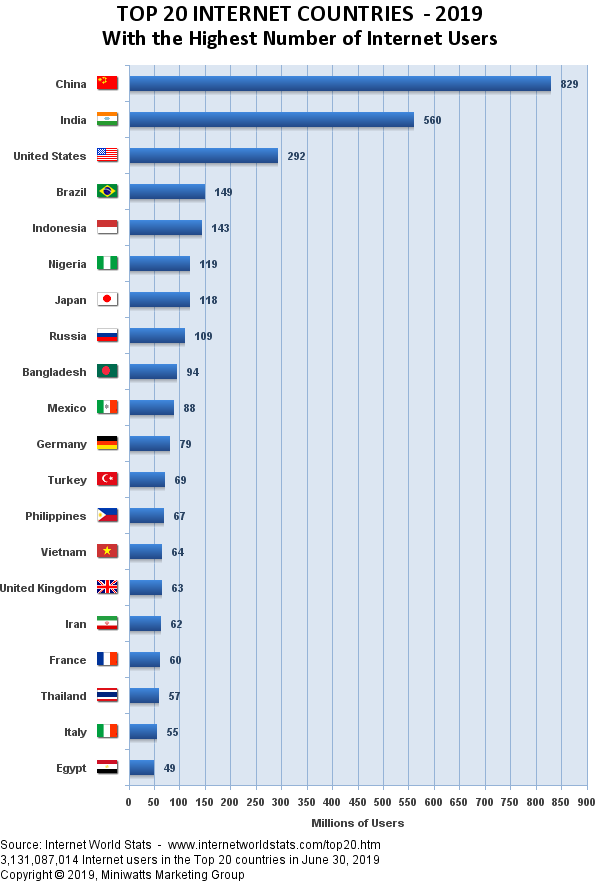
Another aspect I’ve noticed is the prominence of “Indian Twitter.” India is one of the top countries for the platform. Many of these people are quite dumb and inane…but most people are that way. The chart above shows how many people from India are on the internet. It strikes me that a bit of the “OMG AOL people are on the internet!” effect is going on. This too shall pass.

Note: In the last few years Bangladesh has apparently zoomed up the list of internet penetration due to various initiatives. The ranking surprised me, especially in light of the fact that Bangladesh sends very little traffic to this website even compared to Pakistan.

Letter of General Akhtar Malik (Re Grand Slam)

There is endless controversy in Pakistan about the way Gen Akhtar Malik, who led the opening phase of Pakistan’s invasion of Kashmir in 1965 (operation Grand Slam) was removed from command the day after the attack started. The Pakistan army had decisive superiority in tanks and artillery and on the first day captured Chamb and were threatening to break through towards Akhnur, but on the 2nd day of operations there was an abrupt change in command as Gen Malik was replaced by Gen Yahya Khan. This led to some delay and gave the Indians the chance to reinforce their defenses. Many in Pakistan blame this command change for the failure of Grand Slam. You can read more about the operation in another post. The controversy will no doubt continue. Here is a letter from Gen Malik to his brother, written 2 years after the war, which gives his version of events (I received this via Major Amin).
Gen Akhter Hussain Malik’s Letter to His Brother Gen Abdul Ali Malik
My Dear brother,
I hope you and the family are very well. Thank you for your letter of 14 Oct. 67. The answers to your questions are as follows:
a. The de facto command changed the very first day of the ops [operations] after the fall of Chamb when Azmat Hayat broke off wireless communications with me. I personally tried to find his HQ [headquarters] by chopper and failed. In late afternoon I sent Gulzar and Vahid, my MP [military police] officers, to try and locate him, but they too failed. The next day I tore into him and he sheepishly and nervously informed me that he was ‘Yahya’s brigadier’. I had no doubt left that Yahya had reached him the previous day and instructed him not to take further orders from me, while the formal change in command had yet to take place. This was a betrayal of many dimensions.
b. I reasoned and then pleaded with Yahya that if it was credit he was looking for, he should take the overall command but let me go up to Akhnur as his subordinate, but he refused. He went a step further and even changed the plan. He kept banging his head against Troti, letting the Indian fall back to Akhnur. We lost the initiative on the very first day of the war and never recovered it. Eventually it was the desperate stand at Chawinda that prevented the Indians from cutting through.
c. At no time was I assigned any reason for being removed from command by Ayub, Musa or Yahya. They were all sheepish at best. I think the reasons will be given when I am no more.
d. Not informing pro-Pak Kashmiri elements before launching Gibraltar was a command decision and it was mine. The aim of the op was to de freeze the Kashmir issue, raise it from its moribund state, and bring it to the notice of the world. To achieve this aim the first phase of the op was vital, that is, to effect undetected infiltration of thousands across the CFL [cease-fire line]. I was not willing to compromise this in any event. And the whole op could be made stillborn by just one double agent.
e. Haji Pir [Pass] did not cause me much anxiety. Because [the] impending Grand Slam Indian concentration in Haji Pir could only help us after Akhnur, and they would have to pull out troops from there to counter the new threats and surrender their gains, and maybe more, in the process. Actually it was only after the fall of Akhnur that we would have encashed the full value of Gibraltar, but that was not to be!
f. Bhutto kept insisting that his sources had assured him that India would not attack if we did not violate the international border. I however was certain that Gibraltar would lead to war and told GHQ so. I needed no op intelligence to come to this conclusion. It was simple common sense. If I got you by the throat, it would be silly for me to expect that you will kiss me for it. Because I was certain that war would follow, my first choice as objective for Grand Slam was Jammu. From there we could have exploited our success either toward Samba or Kashmir proper as the situation demanded. In any case whether it was Jammu or Akhnur, if we had taken the objective, I do not see how the Indians could have attacked Sialkot before clearing out either of these towns.
g. I have given serious consideration to writing a book, but given up the idea. The book would be the truth. And truth and the popular reaction to it would be good for my ego. But in the long run it would be an unpatriotic act. It will destroy the morale of the army, lower its prestige among the people, be banned in Pakistan, and become a textbook for the Indians. I have little doubt that the Indians will never forgive us the slight of 65 and will avenge it at the first opportunity. I am certain they will hit us in E. Pak [East Pakistan] and we will need all we have to save the situation. The first day of Grand Slam will be fateful in many ways. The worst has still to come and we have to prepare for it. The book is therefore out.
I hope this gives you the gist of what you needed to know. And yes, Ayub was fully involved in the enterprise. As a matter of fact it was his idea. And it was he who ordered me to by-pass Musa while Gibraltar etc. was being planned. I was dealing more with him and Sher Bahadur than with the C-in-C. It is tragic that despite having a good military mind, the FM’s [Foreign Minister Z.A. Bhutto’s] heart was prone to give way. The biggest tragedy is that in this instance it gave way before the eruption of a crisis. Or were they already celebrating a final victory!!
In case you need a more exact description of events, I will need war diaries and maps, which you could send me through the diplomatic bag.
Please remember me to all the family.
Yours,
Akhtar Hussain Malik
Brown Pundits