
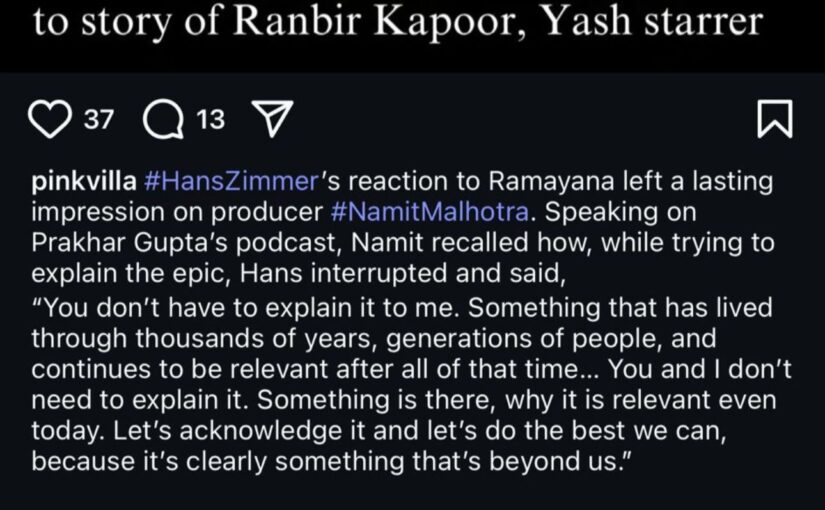
When producer Namit Malhotra began explaining the Ramayana to Hans Zimmer, the legendary composer cut him off:
“You don’t have to explain it to me. Something that has lasted thousands of years clearly has meaning. Let’s just do our best. It’s beyond us.”
Malhotra took this as reverence. In fact, it was erasure.
No serious Western artist would score The Ten Commandments or Schindler’s List without knowing the story. Imagine a composer saying, “Don’t explain the Illiad to me, it’s beyond me.” They’d be fired. But when it comes to Indian epics? The bar is subterranean. That’s not reverence.
That’s: I’m Western, I’m famous, I’m here for the cheque; not the history. The tragedy isn’t Zimmer’s line. It’s Malhotra’s awe. A Westerner shrugs off our most sacred text, and we call it wisdom. That’s not cultural pride. That’s civilizational confusion. It’s a pattern. Many elite Indians are fluent in the language of Islamic grievance; but tone-deaf to Western condescension.
Divide and rule still works:
-
Hindus thank the British for “freeing” them from Muslim rule
-
Muslims thank the British for “protecting” them from Hindu majoritarianism
Meanwhile, the West shrugs at our stories and we applaud.
Shravan Monday at the New England Temple
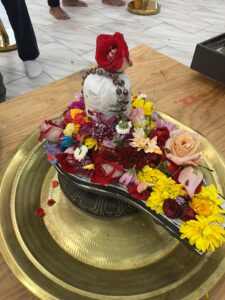
This Monday, I attended Shravan Puja at the New England temple. I was unprepared for how deeply it would move me; I had attended it on behalf of Dr. Lalchand, for whom Lord Shiva is her favourite Deity.
The Vedic chants echoed with the same solemnity as the Gregorian chants. But this wasn’t performance. It was something older, deeper; a Divine transmission, not a show. The Lingam was adorned with exquisitely adorned.
The Mandir radiated care. And yet I couldn’t shake the thought:
What discount does this tradition suffer because it is Indian?
Because it belongs to a civilization colonized, reframed, and underestimated? Shravan doesn’t demand recognition. It doesn’t explain itself. Unlike Hans Zimmer, Shravan doesn’t say “don’t explain it to me.” It says: “Be still. And listen.”
There’s a strange dissonance here, of grandeur that doesn’t announce itself. Of beauty that expects no acknowledgment. And I feel fortunate to have received even a fragment of the immense Blessing.
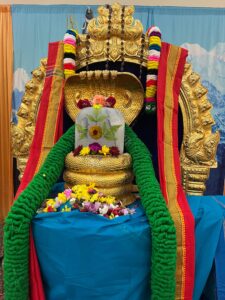
Om Namah Shivaya,
India is changing. With wealth comes pride and arrogance and dignity. The press isn’t keeping up with the change. They have always been subservient and keening for western recognition, ready to lap up any morsel and wax eloquent about the bone flung at them.
Happily the western press is aiding this along with their editorial ‘slants’.
Much as social media is reviled for the tendency of radicalization and the echo chamber phenomenon it has also changed the nature of media from semi dictatorial or majority dominant discourse to proportional representation. There is now space for competing ideologies to take root and grow even if some of them are toxic.
Tbh first time I’ve see this opinion that Hindus feel grateful to the British for freeing them from Muslim rule. This doesn’t even sound historically accurate. Then again, there is no shortage of foolishness around, now that we all get to voice our opinions.
There is a lot of “gratitude” since the ire is more focussed on Muslims.
I do think Subhash Chandra Bose was a better option than either Gandhi, Nehru or Q.E.A-Jinnah.
absolutely – I think there was a serious problem in how Independence was structured
Are you reading a bit too much into it or am I being tone deaf ?
What does he mean by, “It’s beyond us”? Does he mean that he knows the gist of it and doesn’t need to be reminded and Ramayana is eternal? Or something else ?
Even so when your “boss” is trying to explain something; it’s good to listen to it?
yes let us not forget the Muslim period of India was also “colonisation.”
So it is 1,000 years of alienation.
There’s always been this Bombay elite crowd that has half a foot in India and half abroad. While abroad they crave recognition and acceptance, performed by aping the progressive west in morals, language and culture. In India they lord it over the brown people enjoying the servants, the dominance, the hierarchy.
These ‘in’ crowd have been in an incestuous circle of running the press (TOI Midday etc) and the Films (Bollywood).
As the country rapidly decolonises and reclaims/forges it’s identity they are left behind writing editorials bemoaning the loss of the fantasies of their youth and making films which no one wants to watch. Their children strut their mediocrity over screens. Some adapt and turn their lives into reality tv spectacles enjoyed for both the depravity and aspirational wealth.
Meanwhile the country is large enough to have options, the south, historically scorned for melanin and traditionalism is filling in the need for epic cultural glory films amongst others.
News media on the other hand has gone chaotic and cacophonic, the less said about it.
https://www.youtube.com/watch?v=bkEEXK_4Mbo
Check out the 20 min mark. Boney Kapoor gets all defensive and upset before Archana and the anchor divert and course correct.
All self indulgent unwatchable nonsense really, until the north-south, new-old conflict unlocks the engagement virulence. Youtube even gives you a most replayed feature to make life easy.
it’s interesting how everyone speaks in English..
That ends up being the case with South Indians in the picture. Typically South Indian Hindi, if not absent is unfluent and accented (and historically mocked for). English is more of a level playing field.
What struck me most from the clip was the body language. Boney Kapoor is really lording it, sitting that way, waggling a foot in the air, pointing the sole to either side is simply appalling to a viewer.
he was also bang in the centre; also when the presenter told the Aishwarya he’s going to move on from her felt a bit off?
Oh yes Hindi emerged in the Delhi area right? Interesting to reflect on that.
Hindustani– both “Hindi” and “Urdu”– developed from Khari Boli which was the dialect originally spoken in northwestern UP, outside of Delhi.
https://en.wikipedia.org/wiki/Kauravi_dialect
Yes Khari Boli (or Kauravi) developed outside the old city of Delhi, in the northwestern belt of UP — Meerut, Baghpat, Muzaffarnagar, etc. But it means that: Hindustani emerged from a dialect zone with high internal variation, which is a classic hallmark of a linguistic center of origin.
Agreed.
Khari Boli only got standardized as “Hindi” and “Urdu” because it was associated with the dialect of the imperial capital (Delhi).
Otherwise, Braj Bhasha was the literary language. Many Hindustani classical bandishes are written in Braj.
yes I wonder why Braj wasn’t made the national language.
That’s the problem with choosing Hindi, it’s really Sanskritised Urdu
Boney’s remarks are very off-key but what is fascinating about the Indian Union is that it is congealing gradually (imperfectly) but very noticeably.
for a 1.5bn people to feel so connected without the homogeneity of China (millennia upon millennia of political unity) is a breath-taking feat!
That’s an interesting interrogation thought; what does it mean to be civilisationally Indian.
I think Dharak is from a Marathi film?
oh sorry yes I wrote as to how it was pronounced 🙂
yes that’s a very good point; South India is a real bastion of authenticity I find.
“This Pakistani theatre group brought Ram and Sita to the stage. ‘It’s our Ramayana too'”
https://theprint.in/feature/this-pakistani-theatre-group-brought-ram-and-sita-to-the-stage-its-our-ramayana-too/2696251/
that’s very good I do agree- Pakistan can reinvent itself as a highway of sorts.
As a liberal, I think we should own all of our culture.
I’ve never been against “The Ramayana”. I am against its being forced on people. If an Indian Muslim (for example) doesn’t identify with it that shouldn’t be a problem.
Personally, it doesn’t do very much for me. I’ve read a modern adaptation of it (forget which one) but I didn’t find it compared favorably with say The Iliad or The Odyssey. But that’s of course a purely literary judgement.
Yes but it is also as to what you are habituated too.
I’ve read a lot of fiction from all around the world. As a piece of literature, The Ramayana did not do much for me.
Since I’m not Hindu and therefore don’t consider it to be scripture, I am considering it purely as a work of art.
I haven’t read it yet