
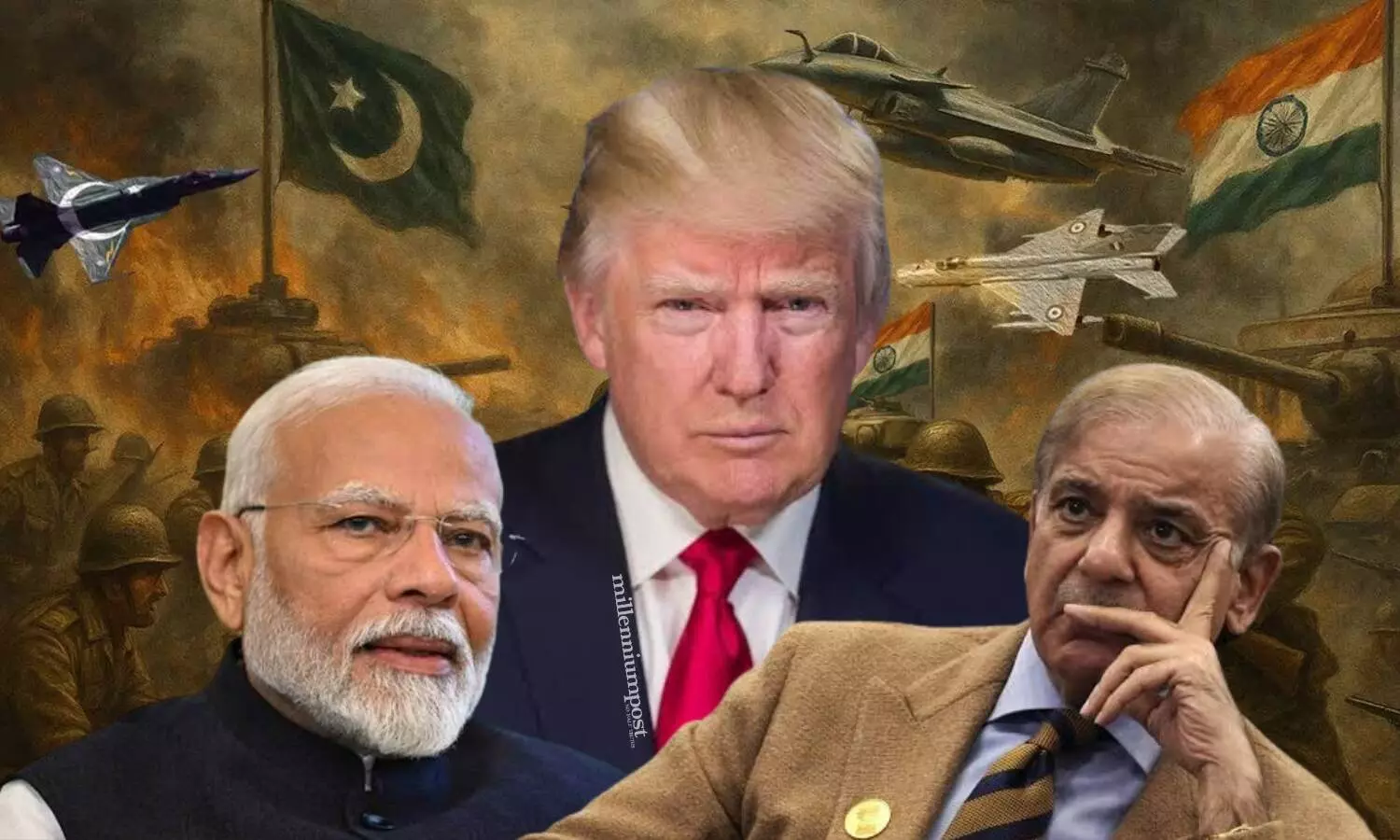
Since the 1990s, Western powers (aka the USA and it’s vassals) have been building up a relationship with India that paints India as a fellow liberal Democracy (and a possible future partner against the new enemy bloc led by China). Beyond these propagandistic talking points, there is supposed to be real convergence on some big things: Demographics, slowly laid economic foundations and baseline cultural strengths combine to make India a rising economy; At a time when birth rates are below replacement in the first world, there is going to be no bigger source of labor or talent. If businesses have to “derisk” from china, they have southeast Asia and India as the natural targets. If other Asian countries are to resist total Chinese hegemony, there is no way to do that without Indian help. And so on.
Throughout this period there have been many prickly issues between the partners (eg a recurring complaint from India that the West supports Pakistan, which sends terrorists into India; on the other hand there is a recurring Pakistani complaint that the USA does not pay enough and (especially in the last decade) is too willing to accept India as the regional hegemon; and well justified complaints from everyone that India is too protectionist) but the public diplomacy has remained positive and feelgood for the most part. All that started to change somewhere in May 2025 and it has been rapidly downhill in the last one month as Trump has publicly attacked India for being protectionist, accused it of being a dead economy, and completely ignored Indian “sensitivities” about Pakistan.
Until now, Indian officialdom has tried to stay sober and avoid inflammatory responses, but they have also resisted the choice (already taken as the path of least resistance by UK, EU and Japan) of massaging Donald’s massive ego and nominating him for some Nobel prizes to get past any personal hurdles. But of course India’s social media army has no such hesitation and on that front the bonhomie of the last few years has completely evaporated, with Indian nationalists and White Nationalists (let us not be coy and recognize that MAGA is a White nationalist movement at heart) going at it hammer and tongs.
So what is going on? and why? and what happens next? I have no inside information, so I am perfectly placed to make some general comments and then ask better informed people to tell me why I am wrong. Here goes:
A: What is going on? (roughly in order of importance, my guess)
- Russia is not cooperating with Donald and is not giving him a deal he (or the deep state) can live with. Donald wants to put serious pressure on Russia. Serious pressure means cutting off oil revenue. That takes India. India has not promised to cooperate, so India is being pressurized. Sounds legit, but this sounds like a very transient problem. You would not blow up a long term relationship over a transient problem if you can help it, but Donald is publicly on the offensive, which makes it very hard for Modi to compromise because Modi does not rule a dictatorship, he rules a prickly Democracy and his whole brand is “strongman”; it will be VERY hard for him to bend in public. American diplomats mostly know this, so public pressure is not the first step. But Trump has gone public. It can still work, but it makes his ask harder for Modi, not easier. And if Trump likes to go with his “I am crazier than you” dealmaking, it still does not explain why the rest of the American establishment is endorsing this approach?
Could it be about something else? - Protectionism. India is a very protectionist country and has extremely cumbersome non-tariff barriers as well. This is all about tariffs and India’s refusal to bend enough on tariff. But the same objections to doing this fight publicly apply here as well. Again, American official know Indian sensitivities and realize that public pressure is LESS likely to work than behind the scenes dealmaking, and if the partnership is real then such angles tend to be taken into account. Why not here?
- May Ceasefire credit. Trump insists he got India and Pakistan to agree to a ceasefire in May and wants a Nobel prize for that effort. India says it was not forced into any ceasefire by the US and stopped because Pakistan had signaled willingness to stop and India had “achieved objectives”. This sounds like a minor PR dispute, but neither Trump nor Modi want to be seen publicly backing down in this domain. All the public nastiness from Trump is purely personal, because he feels India should be giving him credit and nominating him for that prize which he very clearly wants and wants desperately. The question remains, Trump may be such an egomaniac, but the American deep state is not resisting him at all, why? Personally I think this has contributed, but it cannot be the main factor. That said, I can easily imagine Trump telling his more cautious advisers “Dont be scared little crybabies; its a third world shithole and I am AMERICA. I know who is winning this one”.
- Nothing is happening. There is no strategic shift anywhere. Trump is being Trump, and will eventually reach a deal with India and this is just how he makes his deals. He is courting Pakistan for entirely unrelated reasons (Iran, Israel, family bitcoin reserve, whatever) and Indians are losing their shit for no good reason. The problem with this argument is that events seem further along than this. It does not seem very likely to me that nothing has changed.
- Trump has been paid off by Pakistan. Clearly Pakistan has made a concerted effort to get into Trump’s good books via his friends and family (see this episode for details), but while this may explain why he is suddenly nice to Pakistan, it is not really easy to believe that the American state has decayed to the point that such matters as the long term alliance with India can be decided by simply bribing the President; and the question remains, why is the deep state going along?
- Military disappointment; The IAF had a rocky initial performance in their last contest with Pakistan. Considering how much more India spends on their air force, this raises questions about how much use India would actually be in a war with China. India of course denies the entire premise of this particular argument, but even beyond that, it is not like India was being prepped to fight wars on behalf of others; strategically the existence of a competitor is itself the point, they dont have to join NATO. I personally dont think that 5 day war leads in any way to such weighty changes of opinion.
B: What Happens Next?
I don’t know what happens next in the short term. But I also think that there IS a level of punditry where you ignore these short term dramas and look at the big picture. The big picture remains unchanged. India has the demographic and (just barely, but still) the state power foundation and cultural strengths to be in a serious economic growth phase and nothing short of RUINOUSLY HUGE war will change that. Nothing.
If American and Indian deep states go off in different directions that economic growth will take a hit, but it will continue. If they kiss and make up, it will accelerate hugely. But in any case, it is going to continue. Short of being brought down by war (and then it would have to be a BIG war), this Indian experiment is not going down. All ups and downs are part of the game, but the overall direction remains upward. The fork in the road is further down: At some point India will reach Latin American levels of development. THEN it can stay there (this is the terminus of anglo supervised growth in South Asia), or it can become an all round competitor on the world stage. To reach that second level is much harder and will take real work, including cultural work. But for now, the direction is set.
For Pakistan, the direction, unfortunately, is also set for now. The army rules. It gets paid by foreign sponsors for services rendered. It plays a deft game between China and the USA and stays alive. If American money flows for a few years, another Musharraf boom would be the BEST outcome. The worst outcomes are for another day.
Add your insights in comments.
We can compare notes in 5 years (if I am still around) on my last points.


Wonderful piece; I think the situation has been summed up perfectly!
well summarized, but I think there’s one plausible explanation that’s missing in Dr Saab’s list. There’s a lot of rumors flying around that Drumpf wants to cut back on US military footprint in the Persian gulf and wants to outsource it by renting PakMil. Not a lot of substantive evidence for this yet, but on paper, it seems to be the only real tangible value that Pak can offer to the US, apart from the usual bribes and flattery for Drumpf.
To be fair that’s a win on all counts.
Hardly makes sense. Between NWFP, their soldiers scrambling in Balochistan & keeping PTI activists jailed, how much bandwidth do they have left?
The US primarily hung around the gulf to protect Israel and oil. Technology has moved on, shale oil is extractable and Canada-US has the largest reserves. Israel seems both fully in control of the Middle East and US policy in it.
Just a small note: “NWFP” doesn’t exist anymore. The province is called “Khyber Pakhtunkwa” (KPK) and it is has been called that for nearly a decade at this point.
Oh yes .. sad for the Hindkos who are essentially the indigenous population of the regions.
The “regions” of Pakistan, apart from Sindh, aren’t well drawn. I wonder what the Mughal provinces were
All the provinces of Pakistan are named after their majority population. Adding “Khyber” to Pakhtunkwa was a compromise. The Pakhtuns wanted it named only “Pakthunkhwa”. In any case, “Northwest Frontier Province” was a British colonial term so it had to go.
There has long been talk about making a separate province in Hazara Division (the non-Pakhtun parts of KPK) as well as a separate South Punjab province but those plans seem to not have gone anywhere.
I think provinces should follow geography..
I think the Pakistani provinces are based on British colonial boundaries.
A case can definitely be made for creating more provinces. We can start with “Hazara” and “South Punjab”. But the creation of these provinces would require consent from the respective provincial assemblies and at least the Punjab Assembly is not likely to agree to dilute its own power.
Yes India & Pakistan haven’t really shaken off the British yoke, which really reinterpreted the Mughal matrix..
But a healthier division of the regions and provinces of the Indian Subcontinent would have been much better. I suspect the pre-industrial maps of 1850 are very good proxies
India created linguistic states. It has 28 states currently as opposed to 4 Pakistani provinces (not counting AJK and GB).
I don’t think Israel is in control at all?
Whatever one’s opinions on COAS or Pakistan’s establishment, one cannot deny that we are good at diplomacy. COAS has just completed his second visit to the US in six weeks. He was the first Pakistani Army Chief to have a private lunch with a US President.
India’s diplomats are clearly struggling.
Pakistan’s diplomatic victory has been about nominating Trump for the Nobel prize and trying to insert him into India-Pakistan dialogue through slavering praise.
Apparently all that ‘izzat’ only rears its ugly head when a woman steps out of line.
Trump & Pakistan want 3rd party negotiation, India doesn’t. It’s quite easy to lubricate a ball rolling downhill.
The objective fact is that tariffs on Pakistan are 19% while those on India are 50%.
You don’t have to like Pakistan. But it is an objective fact that the US-Pakistan relationship is improving while the US-India relationship is deteriorating.
It is kind of curious; does Trump want to cozy up to China maybe ?
This is relevant:
“Has Donald Trump Turned Against India and Is There Anything We Can Do About it?”
https://www.youtube.com/watch?v=VGAPdB7cBb4
Daniel Markey says that the phone call in June in which Modiji tried to “set the record straight” with respect to the Indo-Pak ceasefire infuriated President Trump and made him decide to destroy India. Politicians from any country should have learned by now that you upset the President of the United States at your own peril.
Also, India’s utility to the United States is essentially as a tool to use against China. Trump doesn’t seem to be too interested in that.
Yes Trump wants to do a deal with China, with whoever. He doesn’t want the USA to be #1; just #1 in its own hemisphere region and him as King
Also Daniel Markey noted that Pakistan was “in the doghouse” (his words) during the entire Biden Administration. So if we’ve now smartly learned how to play President Trump that’s a major victory for us.
Biden was a fan of India. Trump isn’t.
Pakistan and China have an all-weather friendship.
Pakistan and the US have a transactional one.
from the WhatsApp group where I posted the article: “Money and Nobel maybe but mostly it is better diplomacy and their army officers train with Americans at West Point for last three generations so many have personal friendships.”
I have no idea tbh
Apparently Pakistanis were training at West Point until 2018 when Trump barred them from doing so. I don’t know if he will reverse course on this now.
https://nypost.com/2018/08/10/us-bars-pakistani-military-officers-from-training-programs/
Will probably reverse that ..
I think Pakistan would like to balance ties with both the US and China (I don’t know how realistic this is).
Let’s not forget that for years Pakistan was firmly in America’s camp while India was non-aligned.
Regarding author’s comments on India’s positives India’s state power foundation and cultural strengths. I understood it as terms of liberal democracy and secularism as laid by India’s left liberals . but i guess author dislikes left liberals and think that these were the cause of India’s failure. Now India is moving towards Hindutva in last 10 years which author likes. . will author clarify what does he mean by India’s state power foundation and cultural strengths?. In my view , due to Hindutva , there is undermining of its institutions and significant weakening of secularism. Democracy indices has gone down. social harmony is getting torn. Will it have any long term effects on it’s outcomes.
1.This was the most U S friendly regime in India. Earlier Bjp leaders were leading figures in India USA friendship society.
2.india will and should become transactional.
3. Some in India are sensing that Pakistan will get more adventurous under u s ‘friendship ‘. This time India will be very dangerous.
why would Pakistan be adventurous?
Because it seeks to change the status quo, and outside of the jihadi option, it has no real other levers to do so. And with the PakMil firming up its continuing domination of the Pakistani state, the proabability on ‘misadventures’ go up.
Arguably, identifying and murdering hindu tourists in Pahalgam had a massive positive impact on PakMil’s consolidation of power within Pakistan. Incentives drive choices, if it ‘worked’ once, folks have a tendency to repeat tactics.
earlier it was led by gen bajwa, a pragmatic jat, who got India to agree to a ceasefire.
Pakistan is now led by a religious syed, who believes in his divine destiny to fight infidels.
America will be tricked into being a participant in this venture.
There is Syed and there is Sayyid; I doubt Asim Munir is Sayyid in the way you are alluding to.
It’s the Shi’ite Sayyids who are fastidious and particularly about Sayyid bloodlines.
From a distance I find the whole ‘Syed’ thing is laughably caste-ist in subcontinental Islam – for a self-professed egalitarian faith system, the human tendency to be tribal just can’t help itself.
It really depends – Persian Sayyids are pretty authenticated I find . It was a very big deal
Amreeka…doesn’t care about India’s problems, or dead bodies courtesy jihadis. That’s an Indian problem. And not just under corrupt Drumpf, push comes to shove, left or right American politicians dont stand for principle on terrorism in the face of realpolitik. Americans likes their international ‘partners’ who can be used and bent to American policy objectives, PakMil or Pak civvies are enthusiastically willing to be used.
I voided it – I liked the rhyming but contextualise it