
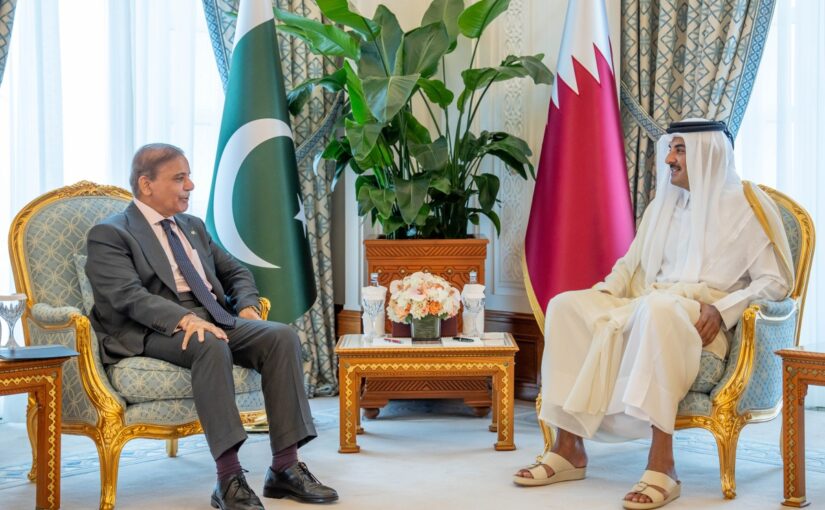

🇵🇰 | A Feudal, Fragile State That Keeps Getting Foreign Policy Right
I haven’t had a moment to breathe lately. I’ve been in Dubai; a city whose heat and ambition leave little room for reflection. But even in the desert haze of hyper-modernity, some themes press through. And perhaps none more than this: the sheer tactical genius of Pakistan’s foreign policy in recent months.
Let me be clear. Pakistan is not a strategic power. It is a fractured, feudal, low-HDI state with deep structural issues. It’s trapped in cycles of elite capture and ideological rigidity. But it is also, to my astonishment, among the most tactically agile states on the planet. It punches far above its weight, not because it has a clear long-term vision, but because it dances well in chaos.
Where India plays the heavy-set civilizational power; bound increasingly to the West and the Israel playbook, Pakistan has played the margins, the hedges, the emotional currents. And it has played them well.
Ever since the Pahalgam conflict, Pakistan’s diplomacy has rarely been wrong-footed. Its tactical instincts are near-perfect. In moments of geopolitical flux, from Qatar to Kathmandu, Pakistan has found ways to remain relevant, nimble, and central. Not liked, not admired but impossible to ignore.
This post is not a celebration. It’s a recognition. A state can be deeply dysfunctional internally, yet highly functional externally. And in a world of waning superpowers and rising regional blocs, that matters.
Pakistan is Not India’s Mexico
It’s become fashionable to frame the India–Pakistan relationship as akin to the U.S.–Mexico one: a wealthier neighbor with a poorer, chaotic cousin. This is shallow and misleading.
If analogies must be made, Pakistan is less India’s Mexico and more India’s North Korea; not in state structure, but in psychic weight. The obsession, the demonization, the surveillance, the fantasies of collapse; all belong more to the DMZ than the Rio Grande.
Yet even that comparison falls short. Because unlike North Korea, Pakistan is open; not just open to capital, but open to culture, critique, and churn. Its media may be muzzled, but it bites. Its poetry still burns. And its politics, though dysfunctional, retain a certain performative electricity. Pakistan is chaotic, yes. But it is not closed.
The Baluch Ceiling
Baluchistan is a tragedy, but not a flashpoint. Iran will not allow an independent Baluchistan just as it will never entertain an independent Kurdistan. Afghanistan lacks the institutional bandwidth to entertain border revisionism. Demographic realities inside Pakistan have changed, with settlement and redistribution reengineering the province’s makeup.
The insurgency is real. The discontent is real. But the idea that Baluchistan is another Bangladesh is a false hope recycled by lazy analysts. The math doesn’t work. The terrain doesn’t support it. And the regional veto is absolute. Of course Pakistan would do best to do an Alsace-Lorraine and just accept the current Kashmir border as permanent and renounce any interest in Kashmir.
Bangladesh and the Long Arc
The reconnection between Bangladesh and Pakistan has begun; cautiously, quietly, under the table.
Once hailed as a model of “post-Pakistan” development, Bangladesh now finds itself circling back. This is not nostalgia. It is realignment. Shared religion, shared fears, shared grievances. History may have separated them, but geography is patient. And the emotional pull of religion, particularly in post-colonial contexts, never quite fades.
Pakistan and the Saffron Psyche
BJP cannot let go of Pakistan. Not strategically, not emotionally.
Most South Indians don’t obsess over Pakistan. Nor do Indian Christians, Muslims, or urban liberals. But for the North Indian, upper-caste Hindu male, especially one bound to the BJP, it’s existential. Partition is unfinished business. Pakistan is the broken shard. And every Muslim is treated as a potential link.
This isn’t strategy. This is trauma, masquerading as geopolitics.
Why Pakistan Won’t Break
Let’s be clear: Pakistan is not about to collapse. It is too centralized, too militarized, and too proud.
Yes, there’s elite capture. Yes, there’s (extreme) economic stagnation. Yes, there’s military interference. But this is slow rot, not sudden death. Collapse is a fantasy; one projected by Indian analysts who’ve read too much Tom Clancy and not enough history.
Even Israel, in its latest miscalculated strike on Qatar, has been forced to update its priors. The Ummah is not what it was in the 1990s. Iran survived a direct strike. Azerbaijan won a regional war. Turkey has grown teeth. Saudi Arabia and the UAE are wealthier than ever. The fantasy of a brittle Muslim world no longer holds. Pakistan, for all its failures, endures. And in a world of crumbling certainties, that alone is power.
The Sunni Vanguard
In the aftermath of Israel’s Qatar debacle, Pakistan has reemerged as an odd sort of vanguard; an awkward but pivotal Sunni pole.
Iran will always be Shi’a. Turkey, though Sunni, is post-Ottoman and aloof. Saudi Arabia is rich, but brittle. Egypt is too near and Indonesia is too far. That leaves Pakistan, nuclear, mobilized, familiar, as the awkward cornerstone.
Qatar, the Gulf, and others now quietly lean toward Pakistan; not out of affection, but necessity.
The Co-evolution of Islam in Pakistan
Here lies the crucial difference. In Iran, secularism has become fashionable. In Pakistan, it never landed. Where Iran is peeling away from Islam, Pakistan is co-evolving with it. There is no post-Islamic movement here. No hipster atheism. No mainstream rebellion. Instead, Islam mutates, flexes, absorbs. It remains foundational.
Pakistan is nationalist, feudal, tribal but its religious identity is integrative. The secular rupture simply never came. It was never allowed to. It is fun to be an elite in Pakistan but not the lower rungs.
India’s Strategic Misreading
India, for all its economic rise, has never managed Pakistan well. It has either ignored it, demonized it, or catastrophized it.
But Pakistan’s role on the global chessboard is rapidly growing, not shrinking. And as India aligns with the United States (despite the recent froideur), the Global South shifts beneath its feet. Afro-Asianism, the vision Nehru once intuited, is more relevant than ever. Modi’s hyper-alignment with the West may win headlines, but it risks civilizational incoherence.
India belongs to Asia. Its radial axes, Himalayas, Indian Ocean, Southeast Asia, pull it toward its neighbors. Toward China. Toward Africa. Toward a post-Western future.
The Opportunity Cost of Partition
In a just world, the Konkani coast of the Indian subcontinent (with gems like Mumbai & Goa) would have been the playground of Asia.
Instead, Dubai, Doha, and Singapore themselves have eaten its future.
Pakistan failed to become the gem of the region. But India, too, failed to be its steward. What holds South Asia back isn’t just poverty or politics; it’s feudalism. Deep, structural, cultural feudalism. The inability to think beyond caste, beyond parochialism, beyond partition. Why doesn’t the subcontinent confederate? Why don’t Nepal and Bhutan anchor into Indian defense? Why is Sri Lanka ignored? Why is there no Brown Union?
Because we remain trapped by the ghosts of 1947.
A Final Note
I’ve been writing on Twitter, on newsletters, and elsewhere—but it’s here, in longform, where things settle. Pakistan is misunderstood not because it is unknowable—but because it is too knowable. Too familiar. Too close.
It is not the enemy. It is the mirror.
And India, until it faces that mirror with open eyes, will keep misreading the future.
Thank you. This is a good corrective to so much of the analysis on this site. Too many of the commentators here suffer from “Pakistan Derangement Syndrome”.
I do want to push back on one point:
The Line of Control is NOT an International Border. It is a military ceasefire line. Neither India nor Pakistan accept it as an International Border. If they did so, India would not speak of “POK” and would accept that Azad Kashmir and Gilgit-Baltistan will always be Pakistani territory. I do believe that the only eventual solution will involve turning the LOC into an International Border but since India refuses to even discuss the Kashmir issue we are a long way from that.
Pakistan should not use terrorism to indulge in proxy war with India. But we are stakeholders in the Kashmir issue–many of us are ethnically Kashmiri– and we have full rights to provide diplomatic support to our Kashmiri Muslim brothers and sisters. There is a consensus on this in Pakistan and this consensus is not going to change.
Alscace- Lorraine doesn’t matter anymore because the borders between France and Germany are irrelevant. But it took two world wars for Europe to get to this stage.
the loss to Pakistan is much greater than the loss of India.
this post was written about what to do about Pakistan from an Indian perspective.
if I was writing from a Pakistani perspective; I’d look at FULL regional integration between Pakistan and her neighbours.
Kashmir is not salient to Pakistan, except emotionally
Kashmir is very much salient to Pakistan. It is the unfinished business of 1947. A Muslim majority area being included in a Hindu majority country is very problematic from our perspective.
As far as Pakistan is concerned, it is the Muslim majority population of Kashmir that needs to be given the right to decide their future. No Dogra Maharaja had that right.
On your “controversial” tweet:
There is very little support in Nepal for the return of the monarchy. Certainly Gen Z doesn’t want this. Why would people who have only known a representative democracy–however imperfect– want the return of an autocracy?
The RSS does want Nepal to become a Hindu kingdom again.
https://www.himalmag.com/politics/nepal-monarchy-protests-hindutva-india-rss
Representative Democracy and Hindu Kingdom are not necessarily incompatible features.
A kingdom by definition is not a democracy. Yes, I know the UK has a monarch but that monarch has no actual power.
Nonsense Kabir
How so?
Anyway, the Nepali people went through civil war and revolutions in order to remove their king and bring in a secular democratic republic. It doesn’t seem the majority of the people want to go back to the monarchy.
let’s see
Show me an actual quote of the RSS advocating for this recently, I’m genuinely quite interested to see it.
good q.
The Himal article notes that pro monarchy Nepalis carry pictures of Yogi Adityanath. There’s clearly a connection.
That’s not a source or a reference Kabir
Why not? It’s a reported article in a major Nepali magazine?
perhaps
A few points:
1.
I think Pakistan will remain the South Asian North Korea. As in it will have a strong military and geopolitical presence not commensurate with it’s economic size.
Of course, the issue with this is that other sectors will suffer.
That already is the case.
Pakistan’s HDI is third lowest in Asia after Afghanistan and Yemen, two war-torn countries. It’s forex reserves are behind countries like Nepal and Cambodia, much smaller countries. The 5th worst passport in the world.
These are actual FACTs that can be verified.
Even a lot of sub-saharan African countries have surpassed it.
And considering its growth rates, it will fall further behind especially compared to India and Bangladesh, the two countries it hurts them to fall further behind because of historical reasons.
And like you said, they are an “open” society unlike North Korea so the Pakistani citizen gets to watch this happen and not live in their closed world unlike North Koreans who have no idea what’s south of the border.
Will the average Pakistani citizen accept the fact that they will be so far behind India/Bangladesh/the rest of the world?
Will they be content with their cricket team getting beaten up regularly by India (and now Bangladesh as well)?
Will they be content remaining a low income country while India ascends to middle and later high income?
Will they be content with India hosting the Olympics while they can’t even host a CWG?
Is all that worth it to have a strong military, who themselves oppress the average Pakistani and enjoy a lavish life compared to the average Pakistani (which our resident Pakistani bethal thinks is a matter of pride).
Questions to consider.
East Germans themselves brought down the wall when they saw what their brethren in the West had.
2.
The only reason the Konkan coast (and Bangalore-Hyderabad-Chennai) isn’t the “playground” of Asia is cause it’s too poor now. In 25 years it won’t be the case and these regions will join Dubai, Doha, Singapore, Shanghai, Hong Kong, Seoul, Tokyo etc as the engines of Asia.
Even those places took time to be what they are.
All these places (minus Tokyo) were nowhere in the 70s.
By mid century the Indian metros, Manila, Jakarta and Ho Chi Minh will join these cities.
there is a difference between trend and reality. the trends of the 90’s were completely different
No, they weren’t.
The “trends” of the 90s were the same as now.
India growing fast, Pakistan growing slow.
Here are the WB bank figure for growth rates:
https://data.worldbank.org/indicator/NY.GDP.MKTP.KD.ZG?locations=IN-PK
Since 1993 after India’s economic reforms, India has grown at a faster rate than Pakistan every year except for
2000 where Pakistan grew at 4.3% and India at 3.8%, maybe because of the nuclear sanctions2020 where India’s economy declined more due to covid. India contracted by 5.8%, Pakistan by 1.3%
These have included years where the gaps have been huge:
1999 – 8.8 vs 3.72010 – 8.5 vs 1.52015 – 8 vs 4.22023 – 9.2 vs 0
What you mean to say is the “reality” of the 90s was different with Pakistan being “richer”.
To that, my counterargument is:
Pakistan might have higher GDP pci, but social factors like HDI, literacy rate, fertility rate etc India have always been better, even from independence. Of course the gap widened further post the economic reforms.Pakistan being richer than India in the 90s was not due to any Pakistani economic miracle but due to India’s closed economy. Once the economy opened up, it became a complete no-contest. And even during the closed economy period, lots of things were set into place for the economic boom which Pakistan still hasn’t gotten around to – dismantling of the feudal zamindari structure, establishment of high level educational institutes like IITs/IIMs etc.
Now, if we discuss the possibility of the “trends” changing.
Here are some facts:
India’s GDP pci in 2024 was $2696 and Pakistan’s was $1484.7.
In 1994 India’s GDP pci was $347.7 (aka $733.04 in 2024 $) and Pakistan’s $400 (aka $843.30 in 2024 $)
https://data.worldbank.org/indicator/NY.GDP.PCAP.CD?locations=IN-PK
https://www.bls.gov/data/inflation_calculator.htm
Pakistan’s GDP pci only grew 70% in 30 years. India’s by 267%.
If Pakistan maintains the same GDP pci growth rate it would take Pakistan 30 years to get to where India is NOW.
Now let us discuss the possibility of Pakistan growing at high growth rates to reverse the “trend”:
Pakistan’s TFR is 3.5. India’s is 1.94.
Pakistan’s population growth rate is 1.9. India’s is 0.7.
That means to MAINTAIN the current levels Pakistan’s economy has to grow around 1-1.5% higher than India. To SURPASS India, it will have to grow even faster and even then it will take time (decades).
Considering India has grown at 6.3% over the last 30 years, Pakistan will have to grow at a consistent 7.5-8% or higher to maintain the gap and something higher to surpass India. These are China/Korea numbers during their peak.
Since 1992, Pakistan has “grown” faster than India only once in 2000 and that too by 0.5%. 2020 was contractions.
Let us discuss the steps which Pakistan has to take to have this hypothetical growth:
Land reforms to end the feudal structure.Reduction of military budgets/purchases and rerouting that money to gender empowerment, literacy etc (basically do a Bangladesh).Establish good ties with India so they can take advantage of the massive market right next door.Improve the law/order situation. Fatality rates this year are the worst since 2015 and Pakistan’s economy barely grew in the late 2000s-early 2010s when insurgency was at its peak.Steps to alleviate flood damage due to climate control. The 2022 floods ensured that there was no GDP growth and that Pakistan’s poverty rates increased. I assume the 2025 numbers will also be affected.
1-3 won’t happen and 4-5 will take at least 4-5 years during which India will go ahead further.
So there really isn’t any indication that this “trend” will reverse. What will happen is what has been happening in the last 30+ years.
Do not presume to interpret my point.
What I am saying is that, despite the apparent “divergence,” this does not resemble a great decoupling.
That is because history is shaped not only by economic growth rates and per capita measures, but also by the lived events themselves.
I think if you don’t have to worry about elections and civilizational baggage you can be as flexible as you like on the foreign policy stage.
The Pakistanis have no problem being friends with China, with America, with the Taliban, with Iran, with the gulf. On one hand their diplomats happily drink and socialize in the west and are devout muslims in the east. They can nominate Trump for a Nobel and commiserate with Qatar about getting bombed (with US tacit consent).
They don’t need to lecture anybody or hold to any real standard. It is a good position to negotiate from.
Indian diplomacy is just horribly rule-bound, moralizing and at the whim of democratically elected leaders who are themselves answerable to the whims of the teeming masses. There is very little elbow room.
Yeah, but like I said – it has a cost. One borne by the Pakistani public.
They have been left behind by most of Asia and now even African countries are leaving them behind.
And unlike North Korea, their public gets to see this happen.
And at the end of it, its not like Pakistan becomes this massive global player.
It’s basically a mercenary and treated as one. Pakistani citizens are still not getting easier visas to the “Muslim world” or “the west”.
This picture from the SCO kind of represents Pakistan.
Shehbaz, just standing there like a bodyguard while Putin and Modi, leaders of two global powers are in discussion.
And let’s not forget the Modi-Putin-Xi viral pictures. No such picture of Shehbaz exists.
u didn’t answer my question/
Answered. Waiting for approval.
I asked if you were Muslim since your email has a very Muslim name?
Where did you ask it? I must have missed it.
Atheist.
but ur origin?
Half Muslim Half Christian
Grew up in Bandra
Ah k
I think you have the causality the other way around. Basically Pakistan is the equivalent of Alfred Doolittle in pygmalion, no need to bother with middle class moralities.
Meanwhile the Indian ideal is that of Gandhi and Satya Harishchandra, that of a principled pauper.
Understandably while this sells well at home in the world of realpolitik it can come off as preachy and annoying.
Essentially, it is far easier to preach morals to someone who needs to borrow money than someone you are planning to touch up for a loan.
yes Pakistani society does not have depth; there is an elite and there is a lower-middle class (upper rural / working class).
so the abject poverty is maybe less acute but it’s extremely rich and poor (by global standards).
we do need to write on India’s dropping fertility rates.
yes it’s interesting Pakistan has the disadvantages of autocracy (rapacious elite) without its benefit (far-sighted wisdom). It’s like the worst of the GCC but that’s why it’s on hire