
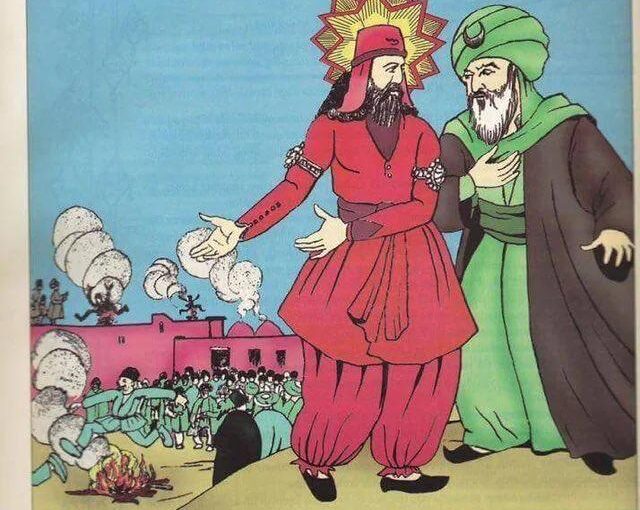
In the 1920s, Soviet Azerbaijan produced a remarkable satirical magazine called Molla Nasreddin. It mocked clerics, superstition, empire, and authority with a sharpness that would soon be extinguished by Stalinist conformity. One cartoon from that period shows two figures standing side by side: Lord Zoroaster in red, radiant and amused; Prophet Muhammad in green, solemn and slightly defensive. Below them, a crowd leaps over a fire.
Lord Zoroaster turns and says: “You claimed to bring them a new religion, but they still jump over my fire.”
The joke is simple. The implication is not. It is a jab at how ancient Persian customs; Nowruz, fire-jumping, seasonal rites, survived Islamic conversion not as relics, but as living practice. Islam arrived. The civilisation did not leave. The fire stayed lit.
Iran Is Not a Regime Problem
Western policy discourse treats Iran as a regime problem: change the leadership, collapse the system, restore balance. This framing is false. Iran is not a state held together by ideology alone. It is a civilisation-state with deep territorial, demographic, and cultural roots. Regimes in Iran rise and fall within a civilisational container that remains intact.
Islam did not overwrite that container. It was absorbed into it. Persian language, seasonal ritual, historical memory, and a strong sense of territorial identity predate the Islamic Republic and will outlast it. This is why external pressure does not translate into internal collapse. Iran does not experience sanctions or military threats as existential novelties. It experiences them as recurring conditions.
The Repetition of Strategic Illusion
Chris Hedges’ warning is not moralistic. It is historical. The same policymakers who misread Afghanistan, Iraq, Libya, and Syria are repeating the same error with Iran: mistaking frustration for weakness and isolation for fragility. Iran is neither isolated nor fragile. It is large, populous, and regionally embedded.
John Mearsheimer’s realism explains this failure more cleanly. Great powers tend to underestimate states that are not expeditionary but defensive in orientation. Iran is not designed to project power globally. It is designed to deny victory to attackers. A war with Iran would not resemble regime-change campaigns of the last three decades. It would resemble prolonged strategic stalemate.
Why Shock and Awe Fails Against Iran
Alastair Crooke has long argued that the American and Israeli preference for spectacle—decapitation strikes, symbolic bombing, rapid escalation—is mismatched to Iran’s military doctrine. Iran assumes aerial attack as a baseline. Its infrastructure is dispersed. Its command systems are redundant. Its retaliation strategy is layered and regional.
Missile saturation is not about immediate damage. It is about arithmetic. Interceptors are finite. Stockpiles deplete faster than they can be replenished. Attrition favours the defender when the defender is willing to wait. Iran is willing to wait. Its leadership plans in years, not news cycles.
Israel’s Structural Dependence
Israel’s military superiority is tactical, not strategic. It can strike precisely. It cannot absorb sustained missile pressure indefinitely. As Mearsheimer notes, Israel is structurally dependent on continuous American military support in any prolonged conflict. That dependency is new. It did not exist in 1973. It now defines Israeli warfighting capacity.
Every interception is a cost. Every day of open conflict with Iran tightens reliance on U.S. logistics, intelligence, and political cover. Iran understands this asymmetry. Its objective is not battlefield dominance but dependency exposure.
Geography as Leverage
Iran’s most powerful weapon is not ideological or even military. It is geographic. The Strait of Hormuz is not a threat issued by Tehran. It is a structural chokepoint. Roughly twenty percent of global oil passes through a corridor Iran can disrupt without engaging Israel directly.
Even partial disruption would trigger cascading effects: energy price spikes, inflationary pressure, shipping insurance withdrawals, and supply chain shock. In such a scenario, the global economy absorbs the damage faster than Iran does. The assumption that escalation can be controlled ignores this leverage.
War Accelerates Nuclear Proliferation
A war with Iran would not prevent nuclearisation. It would incentivise it. No rational state under existential threat remains non-nuclear while its adversary possesses an undeclared arsenal. Iran’s restraint to date has been political, not technical.
Once Iran crosses the threshold, regional proliferation follows. Saudi Arabia, Turkey, and Egypt would not wait. The non-proliferation regime would collapse under the weight of precedent. What is framed as prevention would become acceleration.
The Occupation Reality
To defeat Iran decisively would require occupation. Not bombing. Not sanctions. Occupation. The scale required would exceed that of Iraq or Afghanistan. The terrain is mountainous. The population is nationalistic and hostile to foreign rule. The costs would be measured in decades, not months.
Iraq and Afghanistan were weaker, smaller, and internally fragmented. They still defeated the occupier through time. Iran is larger, more cohesive, and historically conditioned to endure pressure. The outcome is not uncertain. It is predictable.
Civilisation as the Missing Variable
What Western realism often underweights is civilisation itself. Iran’s cohesion is not enforced solely by coercion or ideology. It is reinforced by habit, continuity, and shared historical reference points. The Soviet Azerbaijani cartoon from Molla Nasreddin captured this with brutal clarity: religions change; rituals persist.
You can impose a system. You can decapitate a leadership. You can even win battles. What you cannot do is dissolve a civilisation that expects resistance as normal.
That is the error embedded in every call for war with Iran. It mistakes pressure for progress and noise for power. And it repeats, almost mechanically, the failures of the last half-century.
I don’t think the comparison holds up.
Gaza is Occupied Palestinian Territory and Israel has been conducting a genocide there for over two years (with support from the US).
Iran is a sovereign state. And-whether we like it or not– the Ayatollahs are the legitimate government of that country. The US and Israel have no right to conduct a regime change operation because they don’t like the Islamic Republic of Iran.
Professor Mearsheimer noted in his interview that if he had been Iran’s national security advisor Iran would have had nuclear weapons long ago. The US doesn’t play these games with countries that are nuclear powers.
At the same time, one must acknowledge that the regime in Iran is brutal and of course many people are rightfully very unhappy with it. That said, no regime in any country would allow this kind of protest. National security is first and foremost– This applies to all nations.
do you understand the status?
Again, I don’t think one can compare Occupied Palestinian Territory to a sovereign state–whatever one thinks of the government of that sovereign state.
Personally, I’m not particularly sympathetic to a theocratic regime but I also don’t believe the US has the right to indulge in regime change operations in sovereign states.
https://www.foreignaffairs.com/iran/iran-and-limits-american-power
.
NY Times excerpt
It is the U.S. government which provided the various regime change groups with the money to smuggle some 50,000 Starlink terminals into Iran
There are additional ways to detect and locate single active Starlink terminals. But to disable a large number of them GPS spoofing is currently the best way to go.
The media ‘regime change’ influencers no longer receive the fresh ‘horror’ videos to keep the public anti-Iran campaign going.
More from NY Times
https://www.moonofalabama.org/2026/01/iran-the-ragtag-network-of-activists-run-by-the-state-department.html
.
With all due respect, I wouldn’t go down this road if I were you. This comment crosses XTM’s red lines.
In general, it’s not done to call a religion a “cult”.
My red lines
a) Condoning Israels genocide of Palestinians
b) Sweeping Under the carpet of Israels role in Irans Riots with intent of Regime Change
c) Ignoring Iranian Diaspora waving Israeli flags. What was the role of the cult in promoting this.
d) The cult is not apolitical, it is an under the radar agent of Israel
The admin is not working as an individual. He takes advice from the Cult Elders. (he said that a couple of months ago when he was writing something about the cult)
To me it does not matter if admin deletes my comment. I will be exposing the cult and it connection to Israel in other forum I participate. May not change the status quo drastically. However will make people aware of the cult and its connection to Israel and will then be suspicious of motives
Sbarr, r u ok?
There are many cults in the world and most have political leanings. eg the Evangelical Churches, supportive of Israel and Presidents like Trump and Bush.
Then you get the Free Masons, they even have a Branch in Sri Lanka. One of my classmates is one and is high up in the hierarchy.
Then there are the Hare Krisna’s. As far as I know they are apolitical.
“Karim Sadjadpour: What Kind of Change Is Coming to Iran?|Foreign Affairs Interview”
https://www.youtube.com/watch?v=I2c0hW7ppDg
“Trump’s Fateful Choice in Iran”
By Karim Sadjadpour
https://www.theatlantic.com/international/2026/01/trump-iran-protests-irgc-khamenei/685648/
Iran is a quagmire to the power of the quagmire