
Pakistan does not announce itself as a great power. That is precisely why it works.
Prussia, built on Position, not Pretension
In a world that is reorganising around blocs, chokepoints, and undersea cables, Pakistan has emerged as one of the most dextrous middle powers on the planet. Not because it dominates geography, but because it understands it. Not because it leads alliances, but because it survives them. Most states are trapped by their alignments. Pakistan is not. It sits at the hinge of the Eurasian landmass: between the Gulf and Central Asia, between China and the Muslim world, between the Indo-Pacific and the Middle East. This position is dangerous for weak states. For competent ones, it is leverage. Pakistan has learned how to convert constraint into flexibility.
Dexterity & Diplomacy as Strategy
Militarily, it is credible without being threatening. Its armed forces are professional, disciplined, and interoperable with multiple systems. Pakistani officers train with the West, plan with China, coordinate quietly with the Gulf, and maintain channels to Iran. This is not confusion. It is optionality. Diplomatically, Pakistan speaks every necessary language. Literally and figuratively.
Speaking every Strategic Language
English gives it access to Anglo-American strategic culture. Urdu and Persianate habit give it fluency in the Muslim world. Its military-intelligence class understands how Washington thinks, how Beijing calculates, and how regional actors hedge. Few states can translate between these worlds without sounding incoherent. Pakistan can. This is why it keeps being invited back into relevance.
Being Invited Back into Relevance
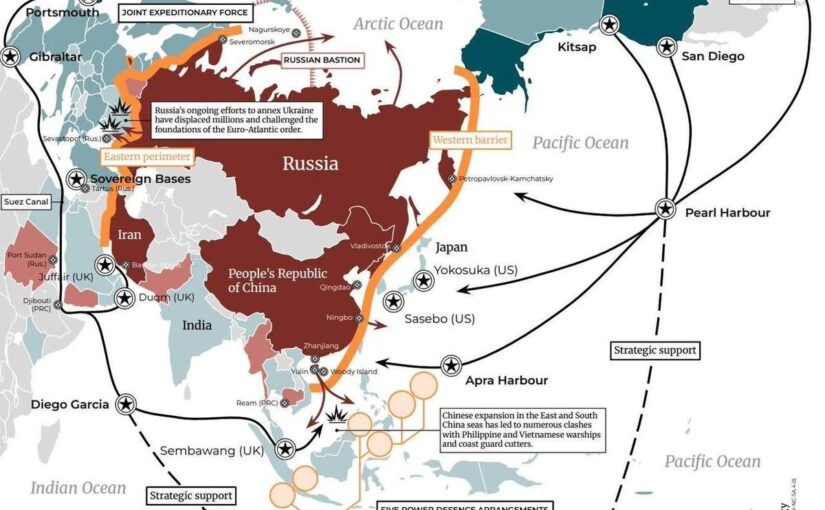
When the United States needed supply routes into Afghanistan, Pakistan mattered. When China needed a corridor to the Arabian Sea, Pakistan mattered. When the Gulf wanted a nuclear-armed Muslim state that did not posture, Pakistan mattered. When Iran needed a neighbour that could disagree without escalating, Pakistan mattered. This is middle-power mastery: being unavoidable without being domineering. The current strategic map makes this clearer than ever. The West is attempting to stitch together the Euro-Atlantic and Indo-Pacific theatres through undersea dominance, submarine fleets, and technological integration.
CRINK
Against this stands a loose counter-bloc centred on China, Russia, Iran, and North Korea. Most countries are being asked to choose. Pakistan has refused to perform loyalty theatre. It cooperates where it must. It abstains where it should. It commits where it benefits. It avoids moral grandstanding and ideological crusades. This frustrates pundits who prefer clarity over competence. But states do not survive on Twitter logic. Pakistan understands a truth that many louder powers ignore: realism is not about aggression. It is about endurance.
Endurance Over Exhibition
Unlike ideologically driven states, Pakistan does not confuse symbolism with strategy. It does not seek regime export, civilisational missions, or permanent enemies. Its doctrine is stability through balance. Its diplomacy is quiet. Its signalling is minimal. Its red lines are clear. This is why Pakistan remains functional while flashier states exhaust themselves. Its military knows how to deter without inviting escalation. Its diplomats know how to say no without burning bridges. Its elites know how to operate inside Western institutions without becoming dependent on them. This is not accidental. It is the result of decades of exposure to pressure. Pakistan has been sanctioned, courted, abandoned, and rediscovered. It has learned not to confuse attention with security. In a period where great powers are overstretched and alliances are brittle, Pakistan’s restraint looks increasingly sophisticated. It does not try to dominate the system. It positions itself so the system cannot bypass it. That is the essence of a successful middle power.
Operating from the Sidelines
Pakistan is not loud. It is not moralising. It is not doctrinaire. It does not pretend to be indispensable. It simply is. And in the coming decades, as undersea cables, energy routes, and continental logistics matter more than slogans, that quiet competence will matter far more than declarations of greatness. Pakistan does not seek the centre of the world. It operates from the seams. That is where the future is being decided.
>Pakistan does not confuse symbolism with strategy. It does not seek regime export, civilisational missions, or permanent enemies.
One might think that an Afghan, or a Bangladeshi perspective on this, may… strongly differ.
And on Iran, that nation is currently in an embattled corner, but I would imagine that an Iran, once restored and stable, is not going to simply ‘forget’ Pakistani …choices made in conjunction with Uncle Sam and Israel, when it was weak and vulnerable.
I feel Pakistan is on a surge post-Pahalgam
hope they will not become overconfident and start a war with india once again. this is widely expected in the indian security circles.
We didn’t “start a war” with India. It was India that violated Pakistan’s sovereignty.
Any violation of Pakistan’s sovereignty will be responded to in the strongest terms. Don’t cross our border and you will be fine.
relative to where it was prior? Of course. But arguably it’s Oct7 and the consequential fallout that has created the … utility opportunity for Pak. Pahalgam and the aftermath of Indias Op Sindoor hits served to arguably allow the US to really step in and pick off Pak when it was really vulnerable. I mean credit where it’s due, Pak has managed to make a bit of temporary lemonade out of lemons – but it’s not really the “reset” that PakMil propaganda wants folks to believe.
Where can the US and Israel find the cheapest muslim ‘foot soldiers’ to enforce their version of ‘peace’ on Gaza? The answer is there. Now lets pretend that Pakistan never was against Israel and that its ….caving and collaboration with Israel in Gaza is some kind of diplomatic nimble masterstroke instead of the hapless non-choice.
Is it in Pakistan’s interests, or even choice, to get embroiled in enforcing Israeli commands in Gaza? Agreeing to do this, in exchange for what, a lunch with Drumpf, yet another loan lifeline for a couple of years? And we are supposed to pretend that its all because somehow Pakistan getting most of its airbases in Op Sindoor bombed, “impressed” the world with its military prowess? Because a couple of planes got knocked down in the 1st few minutes when IAF attempted striking without SEAD? (suppression of enemy air defence)
All it costs, is the rollback of the social ostracization that Pakistan was sinking in over the last few years, and …slow-playing the IMF bailouts. Now of course, one can choose to put lipstick on this pig with high-falutin’ talk of “net security provider” in west Asia, Middle East bla bla, but if it quacks like a duck, falls in line like a duck, its …..pretty much a duck.
On Iran, gee do we wonder if the Pak-Iran border region came in handy to smuggle in all those thousands of rumored star-link terminals? Do you think its in Pakistan’s long-term interests to support Israeli and American efforts at regime change in Iran? Heck, we have our resident BP super Pak Patriot waxing pedantic on “sovereignty” and whether the US has any legal right to attempt ‘regime change’. All while his own government is complicit in the dirty business as we speak.
TL;DR – the terror attack of October 7 is more the cause for Pakistan’s …rehabilitation, not so much Pahalgam.
Fancy photo ops wise – yes.
Economy and security wise – no.
Pakistan had the highest loss of security forces to insurgents in the last 25 years. Economy is still poor, growing slowly.
But sure, Pak generals had a few photo ops.
Really Iran & Pakistan had some really difficult relations ..