
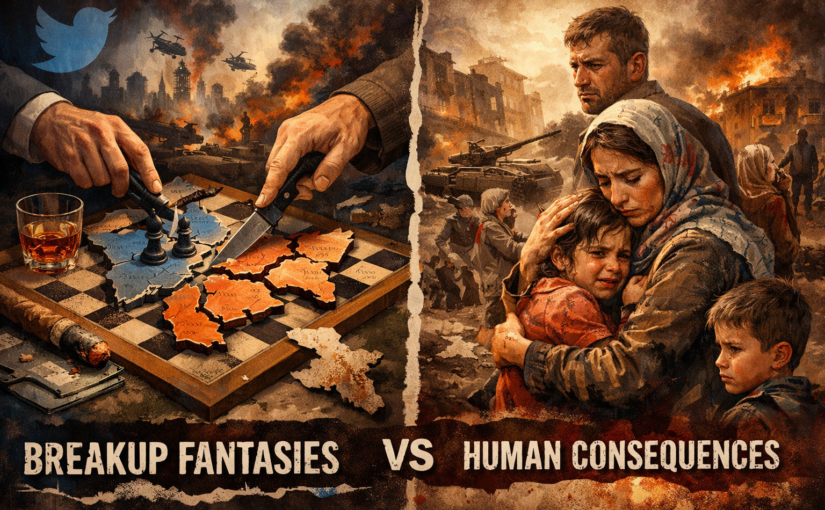
Following my conversation with Kabir; I mulled on the difference between criticising a state and fantasising about its dismemberment.
What should be the type of Critique?
Criticising a political party, a military institution, or a government’s failures is normal. It is necessary. Democracies depend on it. Even flawed democracies depend on it. Pakistan’s military can be criticised. India’s ruling party can be criticised. Iran’s clerical establishment can be criticised. No state is beyond scrutiny. But imagining the territorial breakup of a country, and doing so with visible satisfaction, is something else entirely.
Sacred States?
States are not debating societies. They are containers of memory, trauma, and blood. They are “almost” sacred spaces. For Pakistanis, 1971 is not an abstract lesson in federalism. It is a civilisational rupture. It was war, humiliation, loss of half the country, and a wound that still shapes the national psyche. For Indians, similar fantasies about Tamil Nadu, Punjab, or Kashmir breaking away would be equally triggering. Every nation has red lines embedded in its historical trauma.
Ex-USSR
When commentators casually speculate about Balochistan seceding, or Russian-speaking enclaves peeling off Moldova, or Armenia fragmenting further, they often treat territorial integrity as a chessboard variable. But for the people inside those borders, it is existential.
Geopolitically, fragmentation does not happen because Twitter wills it. States break when institutional weakness meets sustained external force. Ukraine is under invasion, not dissolving by civic boredom. Moldova and Georgia’s frozen conflicts are Russian projects. Armenia’s contraction followed military defeat. Sudan fractured along colonial fault lines and decades of civil war. Indonesia nearly broke in 1998, but the Javanese core held and re-consolidated.
Why States Collapse
The pattern is not that multiethnic states collapse. The pattern is weak institutions combined with sustained external pressure. States endure when they retain a functioning centre, fiscal capacity, coercive force, and often an external guarantor. They fracture when those fail simultaneously.
The Arab Spring Disaster
This is why the memory of the Arab Spring should sober any romanticism about state collapse. What began as domestic protest in several Arab states did not reliably yield stable reform. In multiple cases, the weakening of central authority created vacuums that were filled not by orderly democracy but by militia rule, proxy war, or prolonged instability. External intervention compounded internal fracture.
Why the Iranian Revolution Worked
The lesson is not that reform is undesirable. The lesson is that endogenous reform is structurally safer than exogenous rupture. Change imposed from outside often multiplies instability before it produces renewal; if renewal comes at all. That is why one can prefer gradual internal reform in Iran, for example, over externally engineered collapse. Sovereignty, however flawed, is still a stabilising framework.
A New State may not be a Fake State
There is also a double standard that creeps into this discourse. Some believe that because a country is “postcolonial” or “fragile,” its borders are negotiable in ways others’ are not. Yet no serious commentator cheerfully speculates about the dissolution of France, Germany, or Japan. Territorial integrity is treated as sacred in some cases and optional in others. That asymmetry breeds resentment.
Saffroniate need to let Pak breathe a little
A mature geopolitical culture distinguishes between critique and erasure. It recognises that sovereignty rests on political reality, not emotional approval. Pakistan does not cease to be legitimate because someone disputes its ideological foundations. India does not dissolve because someone critiques its democracy. Armenia is not fictional because it lost territory. Iran is not a laboratory for regime engineering.
Pakistan has a mature system of power distribution
States endure because they possess institutions, coercive capacity, fiscal systems, and external relationships. Pakistan has all four. Its party system is factionalised and regionalised — PPP in Sindh, PML in Punjab, PTI mobilising youth across provinces — but that diffusion is stabilising, not fatal. 1971 was an exceptional convergence of civil war, Indian intervention, and Cold War alignment. That configuration does not casually repeat.
Borders are real but can be unimagined
In a volatile global order — with Germany rearming, Japan recalibrating, Russia testing boundaries, and China underwriting corridors — the last thing serious analysis should indulge in is romanticism about dismemberment. Critique is legitimate. Breakup fantasies are unserious. Geopolitics requires sobriety. And sobriety begins with recognising that borders, however imperfect, are not toys.
Agreed.
My only caveat is that Kashmir is internationally recognized as disputed territory. There is a “Line of Control” and not an international border.
Balochistan is unequivocally a part of Pakistan. There is no debate about this. It is as unequivocally a part of Pakistan as Tamil Nadu is a part of India.
Your larger point is well taken. Basic decency demands that one respect the territorial integrity of nation-states. The Indian nationalists on this site love the Republic of India. I love the Islamic Republic of Pakistan. It’s incredibly rude and triggering to imagine the disintegration of someone’s nation.
yes but Kabir; Kashmir is never leaving India, not now not ever.
it’s likelihood is as much as Baluchistan, facts on the ground dictate that
despite international writ
My point is that International Law exists. Kashmir is not part of India. No country believes that. That is why the international community speaks of “Indian-Administered Kashmir”.
Balochistan is unequivocally a province of Pakistan. People on BP also like to bring up the Durand Line. The Durand Line is an international border not a ceasefire line.
Of course, with both India and Pakistan being nuclear states, I don’t imagine the ceasefire line changing anytime soon. But I will insist that it is a ceasefire line and not a border.
XTM: BB I missed this – glorify in the death of Pakistani soldiers and I’ll start removing high signal comments. Behave
@XTM: Once again celebrating the deaths of Pakistani soldiers!
These trolls are out of control.
East Pakistan was a fully recognised part of Pakistan, recognised by all the countries and international bodies of the world.
And?
Pakistan did not have nuclear weapons in 1971. Neither did India.
Any threat to the territorial integrity of the Islamic Republic of Pakistan will bring the nukes into play. Our nuclear doctrine is in the public record.
This is just absurdist .. Russia has recognised many de facto states
Enjoy! Write a review on both for us
Okay with non desi stuff too? I was planning on writing reviews for desi books/movies/tv shows.
Ofc non & desi both welcome
calm pls RNJ
i) any multi ethnic state is liable to be split. brute force cannot hold for ever. there needs to be an underlying thread which keeps the factions united. for india it is hinduism, ( and its accommodation of others such as christians in the north east and muslims every where). for pakistan it is islam. but islam as it is not a ‘native’ faith of pakistan, is straining at tight leash to hold back the centrifugal forces of nationalism.
ii) i don’t see a pakistani ‘r s s’ which tries to take all in one umbrella.
iii) breaking of sudan and indonesia was historic as these were apart from india, the first countries to split having muslim central rule.
iv) syria ( for alwaites) , iraq ( for kurds) , periphery of fars in iran, will assert independence when the conditions are ripe.
Periphery of Fars in Iran???!???
Fars is the. historic core of Iran
hence azeris and baloch are resistive.
This feels disingenuous – Pakistan is not SSA.
But feel free to back up your claims with evidence?
Realistically having your own state can only be beneficial for the promotion of any kind of ethnolinguistic and cultural identity.
Languages like Telugu and Kannada are almost completely irrelevant internationally despite having more native speakers than many major European languages, because of being subsumed into the pan-Indian state which prioritizes the culture associated with Hindustani dialect speakers.
If we were to ever get a federal EU, I would very much expect languages like Polish, Dutch, Danish, or even Italian, to rapidly become even more culturally irrelevant than Telugu or Kannada presently are, as French, German, and/or English get prioritized as “national languages”. (I think the Europeans understand this of course, which is why I myself always preferred more of an EU-style framework for the subcontinent).
RRR got to the Oscars.
To be honest they maybe global “irrelevant” (but which language can really stand up to English?) but locally salient?
The Dravidian languages rule the South?
Yes, that’s true. I think the Dravidian languages are still somewhat viable for now, hopefully we will resist further federalization though.
I think Hindu has consumed North Indian regional languages, ex Bengali..
The Sikhs have held onto Punjabi, Gujarat is suffused with Hindi & Marathi coexist with it.
I think it’s North India that has homogenised into Hindi-Hindu-Hindustan..
paradoxically, you are starting to see a strengthening of desires in the EU to aspire more towards a centralized union.
I think given India’s diversity, a stronger more federal governance skeleton instead of a loose confederacy was far and away the better choice. Nehru would be rolling over in his grave in dismay to see his distant progeny Rahul spout rhetoric about “union of states”. Its not really a coincidence that such rhetoric on ‘confederacy’ is reminscent of the Southern pro-slavery states desiring secession. Even the United States, which is supposedly such a union, had a massive civil war to decide this case of ‘Federalism’ over so-called “states rights”.
Lol what are you trying to say exactly? If anything in the Indian context, pan-Indian elements have historically been far more socially reactionary.
I’m saying if you want a nation-state to succeed, the governance model that is far more likely to succeed, is a more federalized one. The rhetoric of ‘states rights’ is often a proxy for those who aren’t invested in the ‘federal’ state’s success.
>If anything in the Indian context, pan-Indian elements have historically been far more socially reactionary.
Yeah, hard disagree. I think you’re going to have to back that up, at least a bit.
I disagree – decentralisation is key to progress. the US..
> Yeah, hard disagree. I think you’re going to have to back that up, at least a bit.
I mean, I think this fact is fairly self-evident when comparing the present and historical diversity of political parties winning elections at the state level, vis-a-vis the management at the central level.
Realistically, a more decentralized system would allow states with more progressive leadership vis-a-vis the central management, to push forward their preferred initiatives more effectively without being bogged down by regressive elements from other parts of the country.
India persists because of varna-jati structure naturally weakening ethnolinguistic identities and lending the society towards a form of nation-building which is less modernist, and more civilizational in nature. Pakistani identity is based on a combination of common religious and geographical factors. Both presently seem relatively viable for the longer term despite neither being nation-states in any traditional sense of things.
These are fresh comments