
Wealth Doesn’t Win Wars
A contact in New York mentioned, almost in passing, that the shelves at their local (premium) supermarket were beginning to empty. Not bare, but noticeably thin, the way they go before a blizzard. People panic-buying quietly, without announcement. At LaGuardia, long queues that the local press has barely covered. The official newsflow says nothing. But the supermarket shelves don’t lie.
This is how the consequences of a war 6,000 miles away arrive in the richest city in the world; not with sirens, but with gaps on the grocery shelves and unexplained airport delays that nobody in authority seems in a hurry to explain. The information lag is itself a story. There is roughly a week between what is happening and what is being reported. Don’t believe one’s lying eyes.
BB’s thesis is that military power is ultimately a function of GDP. It is a reasonable working assumption. It is also, we would argue, dangerously wrong in the specific conditions we are now watching play out in real time.
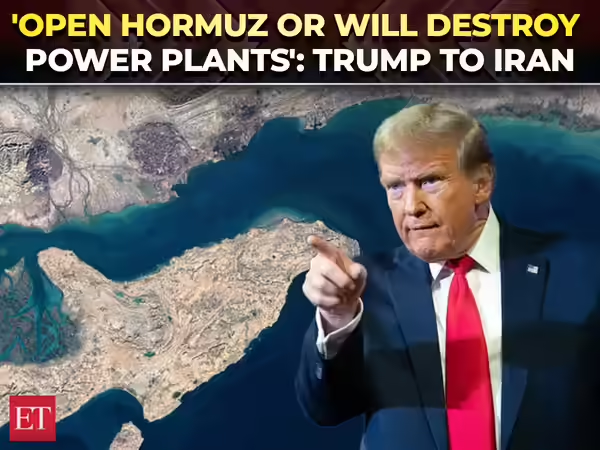
The United States and Israel are the two wealthiest, most technologically sophisticated military powers to have ever jointly prosecuted a war. Their adversary is a sanctioned, inflation-wracked theocracy that has been massacring its own citizens and losing proxy after proxy for two years. And yet here we are, Day 23 of Operation Epic Fury, with Trump issuing a 48-hour ultimatum to obliterate Iran’s power plants unless the Strait of Hormuz is fully reopened, Iran responding that any such strike will be met with attacks on U.S. and Israeli energy and infrastructure assets, Brent crude at $112 a barrel and Goldman Sachs projecting elevated prices through 2027, and the administration having exhausted every economic lever it possesses. The richer side is losing the economic war. The question is whether they know it yet.
Iraq, Afghanistan, and the Sociology of Surrender
The pattern is not new. We have watched it twice in living memory, in the same geography, and both times the lesson was the same.
When the United States invaded Iraq in 2003, the professional Iraqi army collapsed with extraordinary speed. Saddam’s soldiers surrendered in their thousands, sometimes in their tens of thousands. The analysts at the time attributed this to superior American firepower and tactical brilliance.
What they underweighted was something sociological: Saddam, for all his brutality, had delivered two decades of relative stability; a functioning bureaucratic state, salaries, pensions, a middle class with something to lose. Iraqi soldiers had families, flats, futures. They calculated the odds and surrendered. That was rational behaviour in the circumstances.
Then the United States moved into Afghanistan. The experience was entirely different. Afghanistan had not known a stable state since 1978. The Soviet invasion, the civil war, the warlord period, the Taliban; generation after generation had grown up knowing nothing but armed conflict. The American military, to its credit, noted this explicitly: Afghans were ferocious fighters not because of superior training or equipment, but because the threshold of pain they were willing to absorb had been calibrated by decades of collective suffering. They had nothing to lose that they had not already lost many times over. Twenty years later, the Americans left. The Taliban were still there.
Iran today is closer to Afghanistan than to Iraq, and the war planners appear to have modelled it the other way around.
The Martyrdom Variable
Despite more than two weeks of relentless airstrikes, U.S. intelligence assessments now conclude that Iran’s regime will likely remain in place; weakened but more hardline, with the IRGC exerting greater control. The Islamic Republic is structured for siege. Its military has a dual architecture: the regular Artesh of 420,000 men, and the ideologically driven IRGC of roughly 190,000, designed to resist both coups and invasions. The decapitation strategy, kill the leadership, watch the system implode, has instead produced the opposite: the election of a new Supreme Leader signals the Islamic Republic projecting stability and endurance, reassuring the security services and consolidating IRGC power at a watershed moment.
This is the martyrdom variable that wealth-based models of military power simply cannot price. When you tell an ideologically driven adversary that your objective is their unconditional surrender and regime elimination, you have not weakened their will to fight. You have removed any incentive to stop. The Islamic Republic’s theology does not regard death as a cost. It regards it as a currency. Iran’s endgame is not victory but survival; restoring deterrence and regaining the power to dictate the terms of what comes after the war. That is a much lower bar than the one the U.S. and Israel set for themselves, and in asymmetric conflicts, the side with the lower bar almost always outlasts the side with the higher one.
Compare this to Israel’s own recent history. Hezbollah was degraded in 2006, forced back from the border. Then it reconstituted. It was degraded again in 2024. It is now, despite a ceasefire that required its disarmament, already rebuilding its military capabilities while Israel conducts near-daily strikes in southern Lebanon and prepares a ground invasion that has already displaced over a million people. The Lebanese Shia community that produces Hezbollah has not become wealthier or more comfortable in the intervening decades. It has become harder. The bombing campaigns that were supposed to break them have instead been their primary instrument of political cohesion.
The wealthier society, paradoxically, is the one with brittle will. Rich people have one or two children and do not want them dying in open-ended wars for ambiguous objectives. Israel called up 20,000 additional reservists at the outset of this war, on top of 50,000 already mobilised, and the domestic pressure to bring them home is already visible in the polling and the protest movements. Trump’s base, the constituency that elected him precisely because he said he would end the endless wars, is watching oil prices climb and asking when it stops. No more than 20% of the American public supported this war at the outset, with Republican support not exceeding 35%. These numbers do not improve as the Hormuz stays closed and the gas pump climbs. Or the supermarket shelves thin.
Karbala as Operating Principle
To understand why Iran fights the way it fights, you have to understand what it believes it is fighting for. And that requires a detour through theology that most Western analysts, to their considerable cost, have refused to take.
One of the most serious Shia scholars alive argues that the highest human right is not life. It is dignity. The question he poses is stark: if you are kept alive but degraded, humiliated, treated as less than human, what is the value of that life? He roots this in the Quranic understanding that the mission of every prophet was justice, and that dignity falls directly under justice. To be just is to treat human beings as deserving of honour. Not life first. Dignity first.
This is how Shia Islam reads Karbala. Imam Hussein knew he could live if he submitted to Yazid. He could have worshipped in peace. But a life of worship without dignity, having surrendered to an oppressor, had no value. Hussein’s formulation is precise: death is better than losing your honour, and losing your honour is better than going to hell. Most people think death is the worst thing that can happen. Hussein is saying it is the lightest of three doors. Losing your dignity is worse than dying. And surrendering to an oppressor, legitimising tyranny, is the kind of spiritual corruption that leads to hellfire. So submission is both the loss of honour and the road to damnation. They collapse into each other. Death becomes the only clean door. Not a tragedy. A choice.
This is the operating principle of Iran right now, and it is what the Pentagon’s targeting models cannot capture. When bombs fall on Iranian soil, the question the Islamic Republic asks is not how do we survive. It is how do we refuse to be humiliated. These are different questions. They produce different answers. The February 28 strikes did not break Iran because you cannot bomb dignity out of a civilisation that has made dignity its reason for being. You can destroy infrastructure. You can kill people. You can decapitate a leadership. But the idea that human beings deserve to be treated as human beings does not have a military solution.
One observer, writing from within the Sunni tradition, put it this way: for the first time since the original schism, Sunnis and Shias across the Muslim world are united in their reading of this conflict. The leaders may be calculating interests. The streets are not calculating anything. They are feeling something older and more durable than policy.
There is also a question that has not yet received the attention it deserves. Did Ali Khamenei, whatever one thinks of him or of the Islamic Republic, consciously choose the Imam Hussein option? Did he choose to die rather than submit, making of his death a statement rather than a defeat? If he did, even the regional press has not fully absorbed what that means for the civilisational stakes of what follows. A martyr’s death in Shia theology does not close a chapter. It opens one.
Iran Turns the Strait Into a Toll Road
Which brings us to the most audacious move of this war so far; one that has received far less attention than the missile salvoes. Iran is not simply blockading the Strait of Hormuz. It is monetising it.
Iranian lawmakers are pursuing a bill under which countries using the strait for shipping, energy transit and food supplies would be required to pay tolls and taxes to the Islamic Republic, framed explicitly as compensation for providing security along the route. This is not a negotiating gesture. An adviser to the Supreme Leader has already signalled that a “new regime for the Strait of Hormuz” will follow the war’s eventual end, one that allows Tehran to apply maritime restrictions on states that have sanctioned it. And it has already begun in practice: an Iranian lawmaker confirmed that Iran has collected $2 million in transit fees from some vessels, describing it as establishing “a new concept of sovereignty” over the strait after 47 years.
Read that carefully. Iran is not asking to be left alone. It is asking to be paid. It is transforming a military confrontation into a permanent revenue stream and a geopolitical sorting mechanism; friendly nations pass, adversaries don’t, and everyone pays for the privilege of knowing which category they fall into. The IRGC has established a controlled shipping lane near Larak Island, prioritising vessels from friendly nations such as China, India and Pakistan, while those linked to the U.S., Israel or their close allies remain effectively barred. This is not a blockade. It is a new customs regime, imposed by force, on the world’s most critical waterway.
The Trump administration’s 48-hour ultimatum on the power plants is, in this light, a response to having lost the economic argument entirely. You do not threaten to obliterate power plants unless you have run out of other options.
Pakistan: The Indispensable Wildcard
No analysis of this war is complete without Pakistan, and most analyses have shortchanged it badly. Pakistan is not a bystander. It is simultaneously one of the most constrained and most strategically pivotal actors in this entire theatre.
Consider the geography. Pakistan shares a 900-kilometre border with Iran, with deep cross-border ties between ethnic Baloch populations on both sides. Gwadar Port, positioned at the mouth of the Arabian Sea, offers China and Pakistan a strategic gateway that bypasses the Strait of Hormuz entirely; and amid current Gulf disruptions, stakeholders have highlighted its role as an alternative transshipment hub. That single fact reshapes the strategic map. While the world watches Hormuz, the alternative corridor runs through Pakistani Balochistan. China, which is coordinating directly with the IRGC to protect its energy supplies, has every incentive to ensure that corridor remains open and functional.
Pakistan’s domestic position is no less complicated. Public sentiment strongly supports Iran, complicating the government’s position. In Karachi, protesters attempted to storm the U.S. Consulate on 1 March; at least 10 people were killed when U.S. Marine guards opened fire. The Pakistan Navy has launched Operation Muhafiz-ul-Bahr to escort its own merchant ships through the Gulf, while the government has announced emergency austerity measures including a four-day workweek and two-week school closures to conserve fuel reserves. Pakistan is, in other words, already on a war footing’ without being at war.
The deeper danger is Balochistan itself. If instability in Iran weakens central authority in its peripheral regions, the Baloch question could acquire renewed significance, Iranian Baloch grievances have historically resonated across the border and could embolden separatist narratives inside Pakistan’s own Balochistan province. The BLA is already active. CPEC infrastructure, billions in Chinese investment running directly through this territory, is already a target. A destabilised Iranian borderland does not just threaten Tehran. It threatens Islamabad, Beijing, and the entire overland architecture that China has spent a decade building as an alternative to Hormuz dependency.
This is why Pakistan is genuinely indispensable in ways that have nothing to do with troop numbers or GDP. It sits at the intersection of every pressure point in this war: the Iran border, the Baloch insurgency, the GCC’s security needs, the China-Russia axis’s logistical interests, and India’s energy exposure. It cannot afford to join any side fully. It cannot afford to stay neutral entirely. And its choices in the next few weeks will do more to shape the post-war regional order than most of the countries currently firing missiles.
India’s Miscalculation
The Indian dimension is where the civilisational stakes become most visible. GauravL’s post on the Indian RW’s pivot toward Iran has been one of our sharpest recent observations. The Hindutvavadi commentariat that was photographing itself in solidarity with Tel Aviv eighteen months ago is now quietly posting about Iranian sovereignty. This is not ideological inconsistency. It is economics expressing itself through politics, with unusual speed. 90% of India’s LPG imports pass through the Strait of Hormuz. LPG prices have risen sharply, with long queues forming at distribution centres across the country. When the gas cylinder price moves, Indian public opinion moves with it.
The government in Delhi has been playing a more sophisticated game, and has still miscalculated. Modi visited Israel just 48 hours before American and Israeli warplanes struck Iranian targets. He subsequently strongly condemned attacks on Gulf nations and expressed solidarity with all measures the UAE deemed necessary, while issuing no comparable statement on Iranian sovereignty or casualties. This asymmetry has stripped India of the mediating position it spent fifty years cultivating. India is now among only a handful of nations, including China, whose ships have been allowed safe passage through the strait, which tells you exactly where Tehran is keeping its doors open, and for whom. China, which brokered the Saudi-Iran rapprochement in 2023, is now the only great power with channels into all parties simultaneously. That is not an accident. It is the fruit of not being in the war.
The GCC’s Reckoning
The Gulf states are discovering the price of their own strategic miscalculation. The working assumption in Riyadh was that Iran would be rapidly degraded, the regime would implode or capitulate, and the Gulf’s security architecture could be rebuilt on firmer foundations. Instead, three ballistic missiles were launched toward Riyadh on Saturday, with Saudi Arabia intercepting one while two fell in uninhabited areas, and six drones were simultaneously headed toward the kingdom’s oil-rich eastern province.
The Saudis hired a bodyguard who not only brought the fight to the client’s doorstep but has been systematically killing anyone who might negotiate a ceasefire on the client’s behalf. Israel has assassinated precisely the Iranian officials, Ali Larijani foremost among them, who might have served as diplomatic back-channels for Trump, eliminating the off-ramps before anyone could use them. The question of whether Pakistan or Egypt can fill the resulting security vacuum misses the point entirely. Neither can replace American military capacity. But the relevant question was never military replacement. It was: who now has a channel into Tehran? At present, no one does; by design.
Suez II, or Something Worse
The Suez parallel keeps coming back to us, and it is worth stating clearly why these next 48 to 72 hours matter so much. In 1956, Britain and France launched a military operation they were certain was decisive. The economic and political costs ended their imperial moment within days; but the crucial mechanism was that Washington applied the pressure. Today the aggressor is Washington. There is no external power to apply the pressure. The only check on American escalation is American self-interest, and that brake is slower and less reliable than external coercion.
Two things can happen now. Trump follows through on the power plant threat; and the desalination infrastructure of an entire region goes up alongside it, producing a humanitarian catastrophe that will define his presidency and accelerate every anti-American realignment already underway. Or he backs down, and the ultimatum is revealed as the bluff that the Iranian side has already assessed it to be, Pax Americana formally cedes the Gulf to a new order, and we look back on this week as the hinge.
Either way, what we are watching is a transition. The administration has already exhausted every policy lever, having temporarily lifted sanctions on 140 million barrels of Iranian oil; paying the enemy to survive the war being waged against it. That sentence should be read slowly. China, meanwhile, coordinates directly with the IRGC, protects its shipping, keeps its Gwadar corridor open, and says very little. It does not need to say anything. The new order is establishing itself not through declaration but through the patient accumulation of facts on the water.
These are the most dangerous 48 to 72 hours since the transition from Pax Americana to whatever comes next began in earnest. The Whole Foods shelves in New York will tell you more about how it’s going than the official briefings will.
History’s vote is clear. Wealth doesn’t win wars against people who have learned to live without it.
– XTM, from the two Cambridges
I wonder if Pakistan having the second largest shia population factors into things. To what extent do you think the current political thought leadership of Iran think of Pakistan as strategic civilizational depth? It’s hard to study Indian history without taking consideration of persianate cultural influences, as the single largest exogenous influence. I don’t expect the reverse to be true in the same degree, but how would you measure it? Most persians I know sense a commonality, but don’t know what to make of it. Kind of an uncanny “so similar but also jarringly different”
Admin Note: have turned this into an Open Thread. This is how getting geniunely dangerous; if the desalination plants in the region are hit, this becomes hugely existential.
I saw on YouTube an interesting view. accordingly Iran after this war might resemble Yeltsin’s Russia and eventually an Iranian Putin might emerge.
If Iran charges for SoH well..
Interesting :
1. for people outside the ‘Muslim life’ in India, Persian has become a part of the so called native tongue. many persian words are so deeply ingrained in Indian languages that they are no longer foreign.
listeners of Urdu see persian as a flowery emblishment.
Persia and it’s way of life is a distant memory for most.
Few days back Brahma challeny said that Iran is our neighbour and ‘not some distant mid eastern country’ citing the maritime distance.
Pakistan might be different.
es we need to write on Persian soon
managed to update this piece..