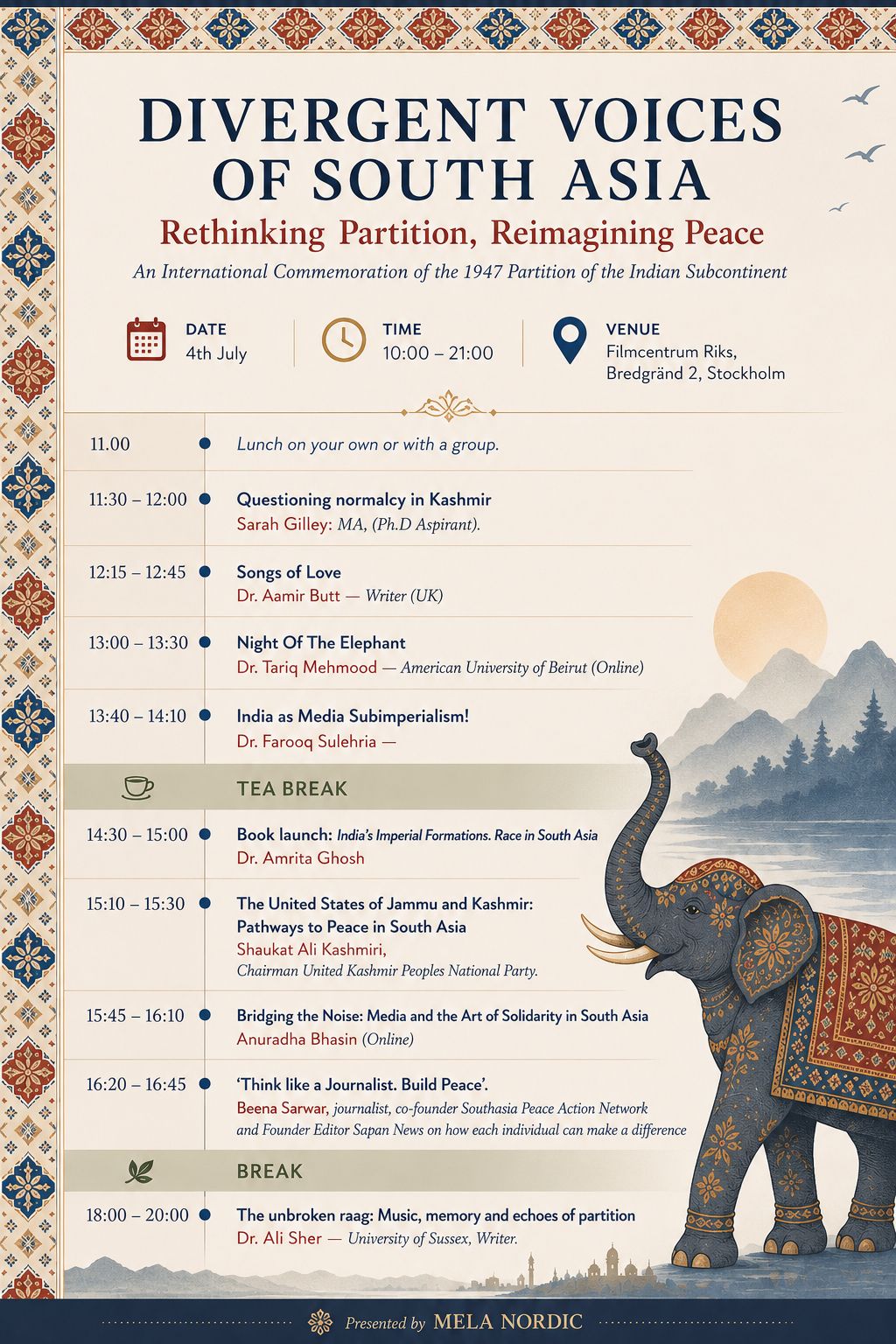
Notes on the closing talks of “Divergent Voices of South Asia: Rethinking Partition, Reimagining Peace” – Mela Nordic, Filmcentrum Riks, Stockholm, 4 July 2026. First of two parts.
(Quotes are drawn from a rough live transcript and lightly edited for clarity; read them as close paraphrase rather than verbatim.)
There was something quietly apt about the calendar. On the Fourth of July, the day one republic celebrates the border it drew for itself, a room in Stockholm spent ten hours mourning a border drawn for someone else. Mela Nordic’s day-long commemoration of the 1947 Partition, Divergent Voices of South Asia: Rethinking Partition, Reimagining Peace, earned its title honestly. The programme ran from Sarah Gilley questioning the manufacture of “normalcy” in Kashmir, through Farooq Sulehria’s provocation “India as Media Subimperialism!”, to the launch of Amrita Ghosh’s India’s Imperial Formations: Race in South Asia, to Shaukat Ali Kashmiri of the United Kashmir Peoples National Party; a man whose politics manage the rare feat of being equally inconvenient to Islamabad and to Delhi. Divergent voices in the strict sense: nobody in that room agreed on everything, and the organisers plainly did not want them to.
The late afternoon saw two back-to-back talks by two of the subcontinent’s most stubborn journalists. Anuradha Bhasin, executive editor of the Kashmir Times, joined by video link for “Bridging the Noise: Media and the Art of Solidarity in South Asia.” Hers is the name on the Supreme Court petition that forced the January 2020 ruling that indefinite internet shutdowns are impermissible and that any shutdown must answer to proportionality and be published; a judgment that wrote the rules without lifting the blackout, which tells you most of what you need to know about the terrain she works. She was followed, in person, by Beena Sarwar, journalist, filmmaker, teacher, co-founder of the Southasia Peace Action Network, whose talk is the subject of Part II.
Heard in sequence, the two talks assembled themselves into something neither quite was alone: Bhasin supplied the blueprint, Sarwar the working prototype. This first part takes the blueprint, and holds it up against the graveyard of everyone who has tried to build it before.
The one story
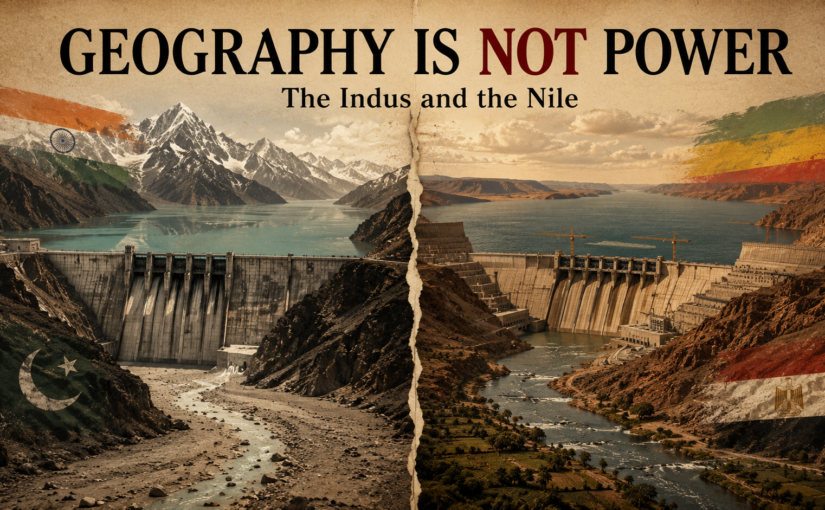
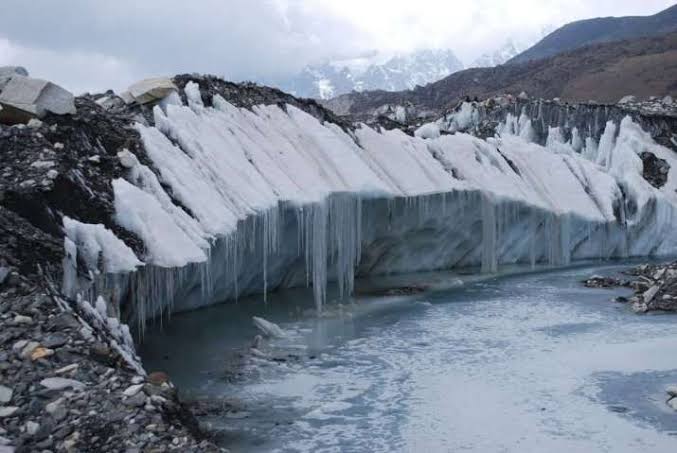
Bhasin’s talk built to a set of concrete proposals, and the sharpest of them was a reframing so simple it is astonishing how rarely one hears it. The single most important story in South Asia right now, she argued, is the melting of the Himalayan glaciers; and it is being covered entirely through national lenses. Pakistan’s floods. India’s heatwaves. Nepal’s vanishing ice. The poisoned politics of the Indus Waters Treaty. Four national stories, four national blame games. “These are not separate stories,” she said. “They are one story“; the story of a shared ecosystem under shared threat. The meltwater, after all, does not stop to have its papers checked at Wagah.
From that reframing flowed her first proposal: well-funded, editorially independent cross-border journalism collaborations; joint investigations, joint reporting on shared rivers and shared climate data, joint coverage of health crises, literacy, and what is actually happening inside each country’s universities and laboratories. Not from the nationalist angle, not from the blame angle, but from the angle of what is actually happening.