Is Pakistan primitive?

By new Precedent, ceasefires are lifted by default, and maintained only where a commenter requests one on Online Safety grounds, as K has (BB – RNJ – 0M).

We argued in “The Patriarchy Survives Everything” that has no religion.

Over the last month, in order not to be Islamophobic, a line was surreptiously moved. The proposition that women should be confined to the home and kept out of higher education stopped being an outrage to be dismantled in public and became a “perspective” to be weighed.

Silence on the right of a woman to leave her own house, and called the silence respect. A space loud for one liberty and mute on another has not been even-handed; it has been captured. That is the moment the emperor lost his clothes and the courtiers agreed not to mention it.

How a country starts eating halal

RNJ consistently brings up Nassim Taleb’s seminal piece on “The Most Intolerant Wins: The Dictatorship of the Small Minority.” Continue reading Is Pakistan primitive?

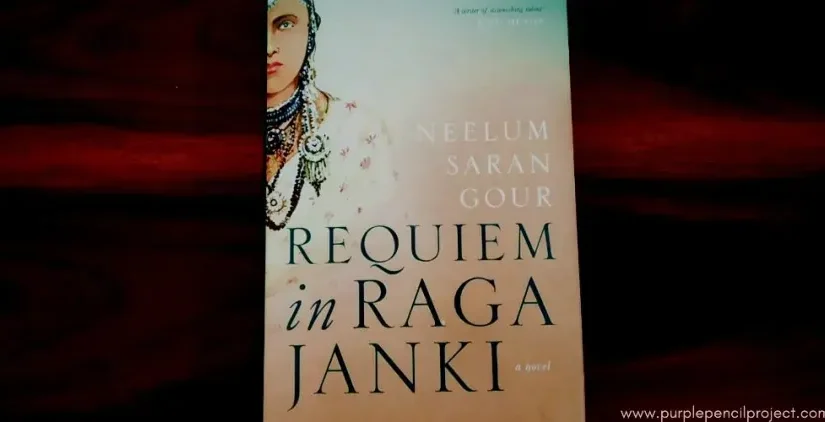
Review: Requiem in Raga Janki by Neelum Saran Gour

Neelum Saran Gour’s novel Requiem in Raga Janki (Penguin Random House India, 2018) is a fictionalized biography of Janki Bai Ilahabadi (1880-1934), one of the most famous Hindustani classical singers of the early twentieth century. Janki Bai was an extremely successful gramophone artist in the early days of recording. She performed at the Grand Delhi Darbar in December 1911, where George V was crowned as Emperor of India. She also wrote Urdu poetry, most famously the Diwan-e-Janki.

Gour begins the novel by describing one of the most famous stories associated with Janki Bai, when she was stabbed by a jealous lover (depending on the version of the story, the man was either her lover or the lover of her father’s mistress). Janki received 56 stab wounds, which led to her receiving the nickname “Chappan Churi” (56 knives). After the stabbing, her father’s mistress, Lakshmi, ran away and Janki’s father abandoned his wife and children to go searching for her. Janki and her mother Manki Bai were then sold to a brothel in Allahabad. In order to protect her daughter from becoming an ordinary sex worker, Manki Bai arranged for her to recieve a high level of musical training from Ustad Hassu Khan of the Gwalior gharana (school) of Hindustani classical singing. Her success at this art is what made Janki a bai or courtesan– a highly valued female entertainer.

The rest of the review can be read on Substack 


Indus Water Treaty: What lies in the future?

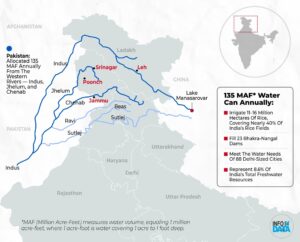
Indus Waters Treaty was signed in 19 Sept 1960 between India and Pakistan under mediation provided by the World Bank. As a political compromise between Pakistan and India seemed improbable the US and UK decided to pressure both into signing onto a technical treaty which could outline the claims and limits of both nations on the flow of the water. Over the years it was touted at the most successful and unequal water sharing agreement where the upper riparian nation only made claim to a minor portion of the river’s waters.

The Indus basin was categorized into two groups of rivers. With the Eastern Rivers (Beas, Ravi, and Sutlej) being controlled by India and the Western Rivers (Indus, Chenab and Jhelum) being controlled by Pakistan.

Many still blame Nehru for this treaty in India for only allowing India to control less than 20% of the Indus’ waters, while many in Pakistan still decry the unequal nature of the treaty in directly awarding a set of rivers to India as that may eventually cause droughts in the parts of Pakistan which are mainly fed by the Eastern rivers. However, the main calls for renegotiations of the treaty have originated in India which at this point has put it into ‘abeyance’. In this post we will go through the main areas of dispute in the treaty and what the possible solutions for the current impasse may be.

Continue reading Indus Water Treaty: What lies in the future?

Review: The Medici Boy-Art and Homoeroticism in Renaissance Florence

Another great read for Pride Month.  I am a big fan of historical fiction, particularly those books set in Renaissance Italy. 

Renaissance Florence was a period of great artistic ferment. Under the patronage of the Medici family, artists such as Donatello, Michelangelo and Leonardo produced great works of painting and sculpture. Among the best known of these works are the sculptures of David produced by Donatello (c. 1440s) and Michelangelo ( 1501-1504).

John L’Heureux’s novel The Medici Boy focuses on the creation of Donatello’s David (the titular “Medici boy”). The story is narrated by Luca Mattei, a former monk who works as Donatello’s apprentice. Luca becomes jealous of his foster brother, Agnolo, who serves as Donatello’s inspiration for David and later becomes his lover. Donatello’s relationship with Agnolo serves as the major plot complication since Agnolo is repeatedly denounced as a sodomite. His illegal activities also threaten to bring down Donatello and through him his patron and friend, Cosimo de’ Medici.

The rest of the review can be read on Substack.  For a woman’s perspective on the Medici, see this review of Maggie O’Farrell’s The Marriage Portrait, which is inspired by the marriage and possible murder of Lucrezia de’Medici (1545-1561) at the hands of her husband Alfonso II d’Este, Duke of Ferrara. This alleged murder also served as the inspiration for Robert Browning’s poem “My Last Duchess“–itself a classic of English Literature.

Note: Modern historians believe that Lucrezia died of pulmonary tuberculosis


The joy of watching Vaibhav Sooryavanshi

After the twin pleasures of the Indian cricket team’s campaign in the T20 World Cup in February and early March and Dhurandhar: the Revenge in late March, the thing that has given me a lot of joy throughout the months of April and May is watching Vaibhav Sooryavanshi’s batting in the IPL.

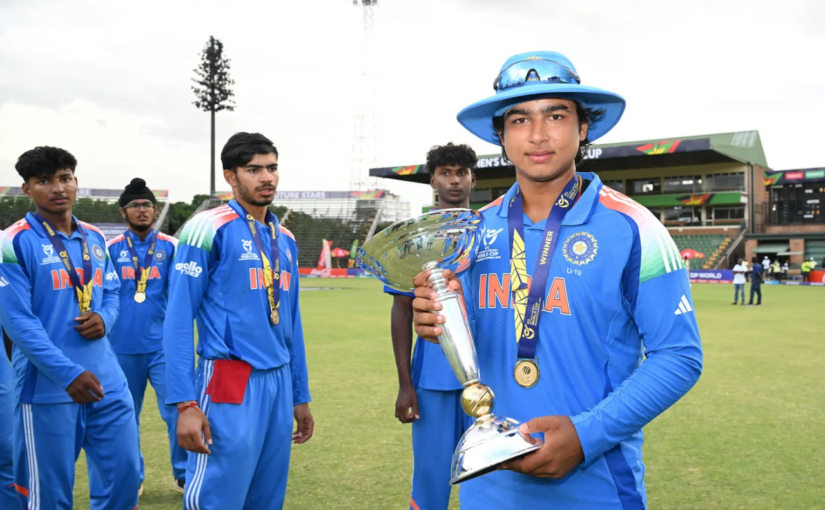
As I write this, he has been selected for the Ireland and England tours in late June-July, becoming the youngest Indian to get an international callup ever, surpassing the great Sachin Tendulkar. He also won the IPL MVP award along with the Emerging Player Award (usually people win them years apart, not in the same year) along with a variety of other awards. This follows the U-19 World Cup in February where he was Man of the Match in the final as well as Man of the Tournament.

And it is not just me, but the entire cricketing world which has been set aflutter by his exploits. His extremely fast pace of play (even compared to some of the fastest players in the world) plus his insane shot making and bat swing have made him a fan favourite already.

Continue reading The joy of watching Vaibhav Sooryavanshi

Is Kabir Right?

Kabir’s claim, is that much of the Saffroniate comes to Brown Pundits for one purpose: to litigate Pakistan, and to litigate the Muslim. Take that fixture away and the room goes quiet. The post on Hindustani classical music sinks without a ripple. The translated short story draws three comments and dies. Only the threads that arm the two camps against each other run to hundred+.

Is he right?

Continue reading Is Kabir Right?

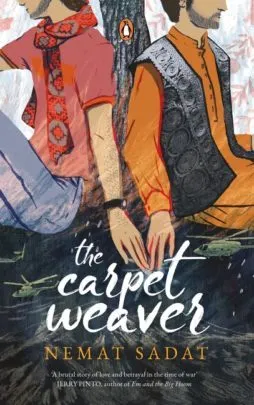
Review: The Carpet Weaver by Nemat Sadat

Since it is Pride month, I am sharing an excerpt from my review here.  This novel is about Afghanistan by an Afghan writer, so it hopefully adds to the conversation on that topic as well. In general, I think there needs to be more discussion on BP about non-normative sexualities. 

The Carpet Weaver, Nemat Sadat’s debut novel, is the story of a young Afghan man coming to terms with his sexuality amid a backdrop of civil war and political unrest in 1970s and ‘80s Afghanistan.As one of the few South Asian novels featuring homosexuality as a central theme, it is an important book. However, the plot could fairly be called cliched. Certainly, readers of Khaled Hosseini’s The Kite Runner would find much that is familiar in this novel.

The rest of the review can be found on Substack.  Also see my review of Khaled Alesmael’s novel Selamlik.


The Patriarchy Survives Everything

The day before yesterday, we published a general interest piece on the Philippine birth rate. Within a day it had drawn over a hundred comments and stopped being about the Philippines at all. It became, in turn, a debate on female autonomy, a referendum on Islam, a quarrel about civility, and a meditation on why human beings have stopped reproducing themselves. This is what Brown Pundits does that almost no other space on the internet can do, and it is worth pausing to say why, and to say plainly where we stand.

The diagnosis and the cure

Qureishi proposed, with complete seriousness, that the only solution to collapsing birth rates is to restrict female access to contraception, higher education, employment, and political representation. We disagree with every word of that cure. Restricting half of humanity from education and public life is functional enslavement, whatever euphemism of “policy” it travels under, and we said so in the thread.

The ecumene does not breed any longer

But we will not pretend the diagnosis is wrong merely because the doctor is. Birth rates are plunging everywhere, faster than any demographer predicted, and the $300 billion South Korea spent on subsidies did not move the needle. Q is right that this is not a money problem. He is wrong about what kind of problem it is.

The fashionable answer is that women got free and chose otherwise. Our answer is the opposite: everyone got less free, and women are simply the first to act on it. People are voting with their wombs. They are refusing to manufacture children for a world whose only offer is endless consumption, a working (waged?) life that begins at twenty-five and ends at sixty-five, and a retirement of warehoused loneliness. Marx called the failure to see one’s own condition false consciousness. The modern consumer is the Ye Olde Peasant with better teeth and a credit card, and somewhere the peasant knows it.

On the day of the trillionaire

Continue reading The Patriarchy Survives Everything

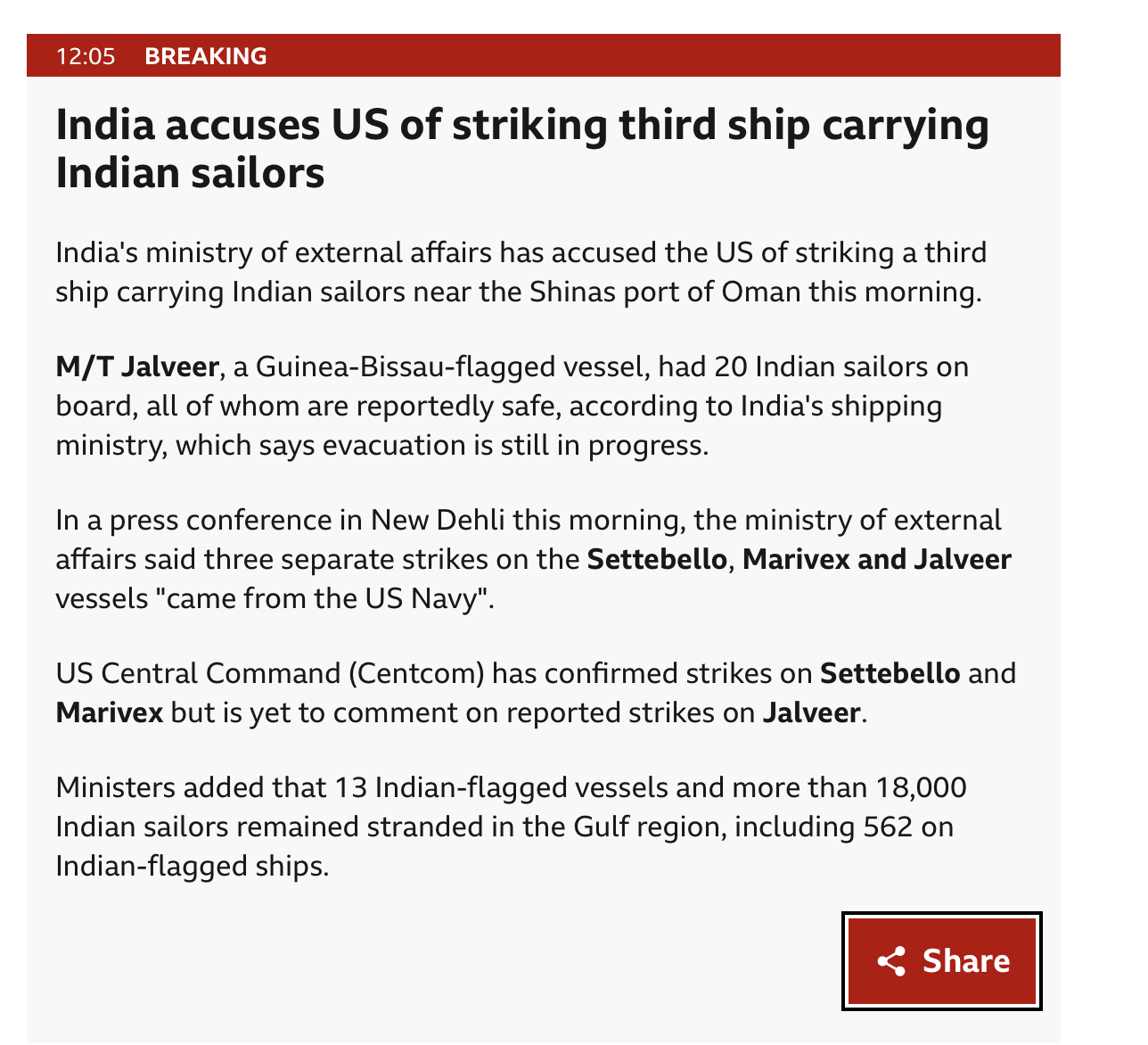
Open Thread: India, Israel, US & Iran

What is going on? We haven’t been following the Middle East for the past month and a half. India-US relations seem to be shakier?

Brown Pundits