Two House Precedents

We apologise for overriding 0M-3’s excellent post, on Geography is Power, but we are pushing it up and allowing it to breathe.

We also second Kabir’s proposal for a book club, with Midnight’s Children as our inaugural read ahead of India and Pakistan’s Independence anniversaries in mid-August.

One. Online-safety reports go by email. From now, any online-safety violation must reach us by email. That is the investigative channel. If it does not land in the inbox, it is not in front of us, and for our purposes a violation we never see did not happen. Send it to us directly.

Two. What Brown Pundits is about: biodiversity and bio-density. Two aims. Density: a 20 comments per post. Diversity: five voices per thread, not a closed loop of a handful names. A hundred comments from a small circle is a monologue. A hundred from ten is an ecosystem, and the ecosystem is what we are here to keep alive.

A post unlikely to reach either metric may be held in abeyance or returned for reworking.

We have felt the losses. BB stepping back, and Indosaurus before that, cost us more than volume. They were bridges. BB in particular always found the connective tissue to sports and the economy that the rest of us missed. So read this as an open invitation home. We will be reaching out, and if either of you is reading, the room is still yours.

Geography is Power

The goal of this post will be to act as a counter to XTM’s post about geography not being power. It will rely on realism as a doctrine of international relations to de-cypher the significance geography has had on the Indian Subcontinent and how it has affected the trajectories of the nations within it.

Geography initially reared its head in discussions of strategy during the times of Mackinder and Mahan in the early 1900s. Where Mackinder so boldly stated that “Who rules East Europe commands the Heartland; who rules the Heartland commands the World-Island; who rules the World-Island commands the world.”. However, these words were written in colonial era Britain as a device to fear monger about the Russians as they were the perfect counter to their strategy of controlling the world with sea power through internal lines of transportation through Cold Siberia. With that cold logic Russia which had been the ally of British through the two world wars became a target. Continue reading Geography is Power

Great South Asian Novels in English

In an attempt to change the subject from India/Pakistan sniping (side note: I find it very telling that somehow any post on BP eventually becomes a referendum on Pakistan)  I am offering this list of great South Asian novels written in English.  The restriction to English is partly because English is the main language I read in and partly for simplicity’s sake. India alone has dozens of major languages in which Literature is produced.  In order to make the list manageable,  a restriction to English is necessary.

In no particular order:

1) A Suitable Boy by Vikram Seth– This is one of my favorite novels not only in the category of South Asian Literature but globally.

2) Midnight’s Children by Salman Rushdie–  Probably one of the greatest Indian novels

3) Shame by Salman Rushdie– one of the best novels written about Pakistan

4) A Fine Balance by Rohinton Mistry–  an amazing description of Indira Gandhi’s Emergency

5) Cracking India/ Ice Candy Man by Bapsi Sidhwa– A powerful depiction of Partition seen from the perspective of a 10 year old Parsi girl in Lahore. Sidhwa was one of the greatest Pakistani writers in English. She’s particularly important because she was a member of a non-Muslim minority.

6) The Reluctant Fundamentalist by Mohsin Hamid– one of the best depictions of “War on Terror” Pakistan

7) Haroon And The Sea of Stories by Salman Rushdie–  This is supposedly a children’s story but it’s a great allegory about freedom of speech

8) The God of Small Things by Arundhati Roy– one of the greatest Indian novels in English

9) A Case of Exploding Mangoes by Mohammad Hanif– One of the best Pakistani novels in English.  Explores the death of General Zia in a helicopter crash

10) An Equal Music by Vikram Seth–  This novel has nothing to do with South Asia but it’s on this list because Seth is Indian.  It appealed to me primarily because I’ve been trained in Western music.

11) The Black Album by Hanif Kureishi–  A great novel by a British Pakistani writer. Set in London in 1989, the story deals with the clash between liberalism and fundamentalism and the fallout of the Rushdie affair.

Bonus:  My Temples, Too and River of Fire by Qurratulain Hyder– I’m breaking my own rule here since these were originally written in Urdu but Hyder herself translated them into English.  Essential reading on the experience of Muslims in UP around the time of Partition.

Also see this list from “Brown History” entitled “30 South Asian Novels to Read Before You Die” 

I’d be interested to hear everyone’s thoughts about any novels on this list or any other South Asian novels in English that you all would recommend.


Pink boots

1.oh God!! Germany out.
2. Brazil scrapping through. Japan gave Good fight.
3. Morocco hanging on. Netherlands out. What a game!! 
4. Can’t believe and understand why grown up men should wear pink boots.
5. Kick and run northern European football is out, south European irritating tiki-taka is the normal now.
6. People are commenting on the large number of African-descended individuals in the game.

Continue reading Pink boots

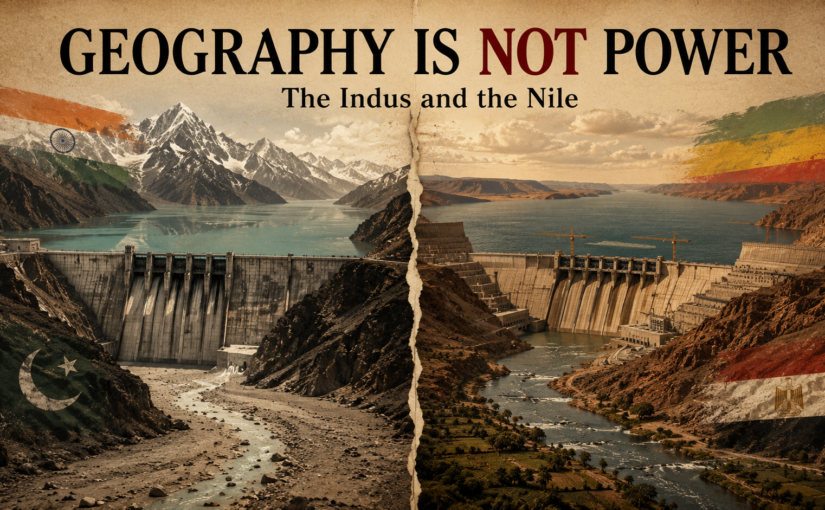
Geography Is Not Power

The Indus Waters Treaty and the Nile

While the previous thread argues about whether Panini held a Pakistani passport, a more useful quarrel is flowing past us. In April 2025, after the Pahalgam massacre, India held the Indus Waters Treaty in abeyance. It did this the day after the attack, a fortnight before the missiles of Operation Sindoor. The water came first. That order tells us something: New Delhi reached for the river before it reached for the air force, because it believes the river is the better weapon. We think it is wrong about that, and the reason why takes us a long way from the subcontinent, to the Blue Nile.

The instinct underneath India’s move, and underneath most of the commentary on it, is that the country upstream holds the whip. Sit at the top of the river and you control the tap. It is a tidy idea and it is false. Whether the upstream state is master or supplicant depends not on the map but on which side can make the other bleed.

India is running a bluff it cannot yet call. The treaty India suspended was built to survive exactly this. Signed in 1960 under World Bank mediation, it gave Pakistan the three western rivers and India the three eastern ones, and it contains no exit door. A party cannot lawfully walk away or hold it in abeyance; it stays in force until both sides agree to change it. India knows this, which is why, when it asked twice, in 2023 and 2024, to renegotiate, and Pakistan refused to come to the table, India was left with grievance and no remedy. The Court of Arbitration has since ruled, more than once, that the suspension has no standing and that the limits on India’s water control still bind. India calls the court illegal and presses on.

Continue reading Geography Is Not Power

Who did the Brits conquer India from?

We asserted that West crushed and humiliated the Mughals. 0M-3 answered that the humiliation was an inside job: it was the Marathas who broke Mughal power, and when Delhi passed to the Company in 1803 the treaty was signed with the Marathas, the emperor not even a party to it.

Did the British take India from the Muslims or from the Hindus? The empire the British inherited had already fallen apart, and it had fallen apart along lines that almost had nothing to do with faith.

The British conquered successor states, not an empire.

Aurangzeb died in 1707, and within a generation the Mughal map was a fiction. Hyderabad went its own way under the Nizam by the 1720s, Bengal and Awadh became nawabis in all but name, and the Marathas took the centre. The spectacular blows did not come from London. Nadir Shah of Persia sacked Delhi in 1739, carried off the Peacock Throne and the Koh-i-Noor, and left tens of thousands dead in the streets in a single day. The Afghan Ahmad Shah Durrani came back to plunder again and again after him. By 1788 the emperor Shah Alam had been blinded by an Afghan adventurer and was living as a pensioner of his Maratha keepers. When General Lake walked into Delhi in 1803 he collected a prisoner the Marathas had been holding, not a throne. The British did not topple the Mughals. They arrived to read the will.

The frontiers were not religious frontiers.

Press the communal map onto the eighteenth century and it tears at once. Tipu Sultan, the Muslim tiger of Mysore, ruled a country that was mostly Hindu and ran his revenue through a Brahmin, Purnaiah. Ranjit Singh, the Sikh lion of Lahore, ruled a Punjab that was mostly Muslim. The Maratha and Nawabi states alike were administered by Hindu clerks and financed by Hindu bankers. There was no Muslim India and no Hindu India waiting to be defeated. There were states, and the faith of the man at the top told you very little about the people beneath him, still less about the men who ran his treasury.

The conquest was paid for and fought by Indians.

Plassey in 1757 is remembered as a battle. It was closer to a purchase. Siraj-ud-Daula lost because his own commander, Mir Jafar, stood aside, and Mir Jafar stood aside because the Jagat Seths, the richest Hindu banking house in Bengal, had decided their Nawab was bad for business and bought his army out from under him. Seven years later at Buxar the Company beat the Nawab of Awadh, the deposed Nawab of Bengal, and the Mughal emperor himself, all three together, and then took the right to tax Bengal to pay for the next war. The armies that did this work were Indian, sepoy and Hindu and Muslim in the great majority, marching on credit raised against Indian land. The Company was paramount because Indians found it paid to make it so.

The disunity is the story.

The faith of each beaten ruler is almost beside the point. The British did not conquer a religion. They completed a hostile takeover of a bankrupt estate, with Indian money, Indian troops, and a long row of victories over rulers who were Muslim, Hindu, and Sikh by turns and who would never combine.

Soundscapes of Muharram (Kabir’s Open Thread)

As promised, this is going to be my only post this week.

1) Soundscapes of Muharram  

By Mansoor Raza

This is particularly timely since it is currently Muharram and Ashura is this week.

From the dust of Pakistan’s independence in 1947 emerged a sonic revolution that would permanently rewrite Karachi’s spiritual DNA.

Rooted in classical Urdu, Arabic and Persian literary traditions, the noha — a profound elegiac lament commemorating the tragedy of Karbala and the martyrdom of Imam Husain (AS) — travelled across a fractured Subcontinent in the hearts of millions of families that migrated to Karachi. Over the last three-quarters of a century, this localised ritual of displacement morphed into a defining cultural powerhouse.

Driven by global shifts and technological eras, 12 trailblazing master orators of the noha [elegiac lament] arose, not merely as reciters, but as architectural anchors and boundary-breakers who fundamentally re-engineered the soundscape of devotion.

2) DAWN reviewed Anjum Altaf’s book A Modern Introduction to Indian Music and Other Essays Including a Primer on the Physics of Sound 

Part primer, part Socratic conversation and part cultural history, this engaging volume explores the theoretical foundations of Indian classical music

The book is unique and quite different from other Pakistani authors’ books on music, as it is interactive. It is the outcome of shared learning, in which a group learns from each other by pooling knowledge, and is more exciting and effective than passively being exposed to an expert’s views. In fact, the essays started off as blog posts that were then commented upon by readers. Those discussions are included in the book, almost like a Socratic dialogue.

The book has also been published in India by Primus Books


Pakistan, the Successor State to Islamistan

The settled view of Pakistan, is that it is the most ideologically Islamic state the world has ever produced, and that each decade carries it further into theocracy. We think the settled view is wrong.

The Pakistani elite has quietly secularised. And far from hollowing the state out, this is precisely how Pakistan became what it was always designed to be: the successor state to British India’s Muslims. Islam was the vehicle. Pakistan is the destination.

Islam remains the public language of legitimacy.

Privately, among the stakeholders who actually run the place, the operating priorities are entirely secular. The society on the ground is conservative and devout. The class at the top, the one that keeps the state alive, believes in Pakistan far more than it believes in Islam.

It helps to separate three things that we mean by Islam. There is Islam as faith, the private conviction of the believer. There is Islam as identity, the badge of who one is and whom one stands with. And there is Islam as state language, in which Pakistan explains itself to itself and to the world.

The elite has not surrendered the third, and it has not wholly shed the second. What it has let go of is the first as a terminal value: the notion that the purpose of the state is to realise Islam, rather than to deploy it.

Faith has gone from ultimate to instrumental.

This migration is what we mean by secularisation. This is not the familiar story of liberalisation. We are not saying Pakistan grew tolerant, or irreligious, or fond of gin. We are saying something narrower and stranger. Pakistan’s elite secularised the priorities of the state without secularising its language. Strip away the Islamic vocabulary and look at what the stakeholder class optimises for, and the list is unmistakable: state survival, strategic depth, military capability, sovereignty, national prestige, and the reproduction of the elite itself.

Continue reading Pakistan, the Successor State to Islamistan

Brown Pundits