By Furqan Ali
The original review was published at Ink-e-Lab.
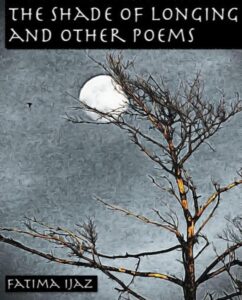
Title: The Shade of Longing and other Poems
Author: Fatima Ijaz
Publication Date: 01/11/2021
No. of Pages: 87
Publisher: The Little Book Company
Fatima Ijaz, born in Karachi, studied linguistics in the United States and currently serves as the editor of The Pandemonium Journal. Her debut poetry collection, The Shade of Longing, offers a complex interplay of memory, language, and abstraction, often resisting closure and certainty.
In the preface, she articulates a powerful and poignant idea that serves as a compass for the book’s aesthetic and emotional journey:
“The contemplation of the past involves an evocative presence of a surreal present…In doing so, you are in a heightened state of present-past – a double consciousness that is more than the sum equal of its parts”
This is, in many ways, a deeply Hegelian thought. One is reminded of the famous assertion in The Phenomenology of Spirit that:
“That the True is actual only as system, or that Substance is essentially Subject, is expressed in the representation of the Absolute as Spirit-the most sublime Notion and the one which belongs to the modern age and its religion. “
In essence: the memories, she is talking about, are sort of in itself objects (fixed) and also subjects (variable—dependent on the person recollecting).
Reading this book feels like discovering a cache of love letters written in a fever of emotion, letters meant for someone dearly beloved. But just before mailing them, the writer realizes how insufficient they are. So she burns them all, and what emerges from the ashes are these poems: not just expressions of feeling, but indictments of language itself. A complaint, perhaps, that language lacks the fidelity to truly capture the depths of human experience.
By acknowledging the futility of language, she leans into abstraction. She chooses uncertainty over certainty and, the infinite over the finite, and invites the reader to participate in meaning-making. The gaps in her verse are not absences—they are openings. The reader is asked to bring their own memories, their own hauntings, to fill in the silences.
In the poem “Echo of a word, x memory,” the structure is minimal yet haunting. A single word—“(stray)”—is repeated eight times on one line, and this continues for thirteen lines. The effect is disorienting, hypnotic. Memory here is not narrative, it is reverberation, a stutter echoing in an unreachable corridor of time.
Celestial imagery recurs throughout the collection (stars, suns, moons) often to widen the emotional and metaphysical frame. She reaches for the planetary to express the personal, as in lines like:
“The face of the sun is smeared with the curse”
“I saw the shadow moon hunt down oblivion”
“Language emerges out of this exchange between fiery sun and eternal sky”
“The moon becomes a cosmic mirror on such…”
Another recurring anthropomorphic presence is that of bones and the black crow, symbols that oscillate between the sacred and the ominous.
“there wasn’t an ounce of regret in my bones / I knew I had practiced the art – and thus – the sacrifice.”
“Then there is the stubborn case of the black crow…”
In the poem “Tear-Drop,” regret and remorse seep through the lines:
“It does not matter, because I can touch / The midnight with my azure-blues / Perhaps the blame is on the harpsichord / Perhaps it’s on one of us / The black consciousness has entered / and there is no un-doing it.”
Her language—or rather, her suspicion of language—remains central. The “shade” she refers to is not just the shadow of longing but also a hue: the specific color of yearning that permeates the book. It’s a longing that refuses to be pinned down, named, or resolved.
In the penultimate poem, the titular piece, she writes,
“Do you think we become in the end / characters of our own stories? Do we finally / own them enough to discard them, have the infinite power / to reform our mind of its strange habitat?”
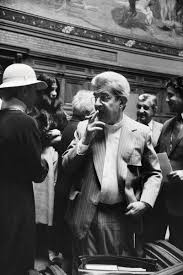
This is a moment of quiet brilliance. One could read this as a critique of ideology—first acknowledging the narrative scaffolding of the self (“I”) and then, in almost Lacanian fashion, gesturing toward the Real (one of Lacan’s three registers). To “discard” the story is to momentarily crumble the illusion of coherence.
Shade of Longing is not a book that yields itself easily. It is not meant to be understood in one sitting. It is a space to dwell in, misread, reread, and reinhabit. Like ghosts or witches watching from the periphery, these poems linger long after the final page is turned. Their magic lies not in answers, but in the haunting questions they leave behind.
That’s all folks.
Another excellent book review!
I must admit I didn’t really understand the references to Hegel and Lacan.