Vande Mataram, Dhurandhar and the Politics of Performative Nationalism |The Wire Wrap

Recently, we’ve seen some heated debates in parliament around Vande Mataram and electoral issues, a visit from Russian President Vladimir Putin, and a vicious online campaign against critics of the film Dhurandhar. Jahnavi Sen is joined by lawyer Shahrukh Alam and The Wire’s political editor Ajoy Ashirwad Mahaprashasta to discuss all of this.

Pratap Bhanu Mehta’s Powerfully Insightful JNU Lecture on “Reflections on Global Political Thought”

This video presents an extraordinary intellectual experience with this powerful lecture delivered by Pratap Bhanu Mehta — Senior Fellow at the Centre for Policy Research and Lawrence S. Rockefeller Distinguished Professor, Princeton University. Recorded by me (Samim Asgor Ali, the owner of this YouTube Channel) on Monday, 1st December at 3:30 PM in the SSS-1 Committee Room, JNU, under the banner of the JNU Lecture Series, this talk titled “Reflections on Global Political Thought” dives deep into some of the most urgent questions shaping our world today — The global crisis of ideas reshaping modern political landscapes, how shifting political imaginations influence democracy and governance, the profound dilemmas of contemporary political theory, why global political thought must reinvent itself for a radically changing world.

What does it feel like to be a Muslim in Modi’s India? Have they become second class citizens?

In the context of X.T.M’s post “Who can speak for the ‘Muslim minority’ of India?” , this video is extremely relevant.

I am often accused on BP of having an “anti-Indian” agenda when I state facts such as that the BJP doesn’t have a single elected Muslim parliamentarian.  Yet, these are the exact same arguments being made by Najeeb Jung, who has been the Lt. Governor of Delhi and the Vice Chancellor of Jamia Milia Islamia and thus is not at all a Pakistani.

Today we focus on questions that few people are likely to address yet they are important and need to be honestly answered. What does it feel like to be a Muslim in Modi’s India? How do Muslims feel when they are lynched in the name of cow protection, accused of love jihad, hear calls to boycott their businesses, pilloried in campaign speeches and told to go to Pakistan? Does this suggest that Muslims are becoming second class citizens in India? As a result has the fraternity that binds India’s communities been fractured and weakened? And what is the Prime Minister’s response to this?

Has Indian democracy entered a one-party era? Pratap Bhanu Mehta explains|SpeakEasy-Episode 2

In the second episode of Frontline’s SpeakEasy, independent journalist Amit Baruah speaks with political scientist Pratap Bhanu Mehta about the future of Indian democracy and the global turn towards strongman politics. Mehta examines whether India is drifting toward one-party dominance, why Hindutva has become the ideological centre of gravity, and how political fragmentation, weakened institutions, and a fading opposition have reshaped the democratic landscape. He warns that India’s constitutional norms are being stretched to “infinite elasticity”, that authoritarian trends are deepening, and that the ruling elite may no longer find it easy to relinquish power if pushed into opposition. From the collapse of AAP’s political promise to the Congress’s leadership crisis, from institutional capture to the dangers of partisan citizenship, Mehta draws parallels between India and other democracies sliding toward executive overreach—including the United States and France.

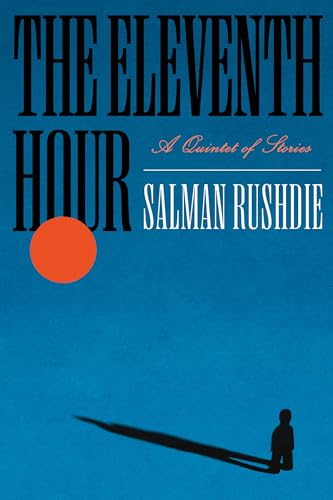
Salman Rushdie on Free Speech, India and How He’s Making the Most of Life|The Mishal Husain Show

Salman Rushdie was nearly killed when he was stabbed 15 times on stage in upstate New York in 2022. His injuries were so severe that he lost an eye. It was an attack that came decades after he was first subjected to death threats over his novel, The Satanic Verses. Once he had recovered, he found he was unable to write fiction. However, after publishing an account of what happened to him, the stories returned, with five brought together in his latest book, The Eleventh Hour. In this conversation with Mishal Husain, Rushdie talks about free speech, the family connection they both share and the places he’s called home, from India to Britain and the US.

Aasiya (Part 2)–Translation from the Urdu

Last week, I shared the first part of my translation of Aasiya, a story from Bilal Hasan Minto’s Urdu short story collection Model Town.  Today, I am posting the second part of the story.


Abba and Naveed Bhai were very angry when they heard this story. Because Abba was an advocate of human rights and other similar causes, he said categorically he would report Apa Sughra to the police. Naveed Bhai agreed.

“This is criminal,” Abba had said in English and his use of this admirable language of global importance impressed me very much and drove home the real significance of this incident. Although I was still hesitant to speak English, I had no doubt of its position. Naveed Bhai also spoke it with great fluency. He would often converse even with me in this important language and it is true that I would sometimes respond spontaneously in it.

“She should go to jail,” Naveed Bhai said, putting English to use again. Continue reading Aasiya (Part 2)–Translation from the Urdu

The tyranny of geography

Maleeha Lodhi in DAWN:

Today however, Pakistan faces a three-front security challenge. On the eastern front an implacable foe continues to issue threats and insist its ‘Operation Sindoor’ — the name of its military action against Pakistan in May — is not over. On the western frontier, Pakistan and Afghanistan remain engaged in hostilities. Pakistan also alleges active collusion between Kabul and New Delhi in terrorist attacks on the country. The third front is at home, reflected in the surge in militant attacks that is undermining domestic peace and stability.

And:

Given New Delhi’s hostility and absent any communication between the two countries, a high degree of unpredictability and risk of miscalculation characterises the situation. Pakistan thus has to keep a watchful eye on the western front and remain in a state of military preparedness. The existential threat after all can come from India, not Afghanistan.

While Pakistan may be unable to do much in the near term to defuse either of the two external fronts (ideally the Afghan front should be over time) the home front is what it can and should control. Two provinces are afflicted by insurgency while terrorists are also striking across the country. Despite notable counterterrorism gains, the internal security situation remains troubling with rising fatalities from terrorism likely to make 2025 the deadliest year in a decade.

Pakistan needs a more effective counterterrorism strategy. Strengthened border controls must involve zero tolerance for corruption and criminality that allow militant movement. The government should also evolve a differentiated approach to deal with militant violence in Balochistan and KP. In Balochistan, the underlying sources of long-standing public disaffection need to be addressed. Law enforcement should be accompanied by political and economic measures to win hearts and minds. Effective counter-insurgency operations in KP require rising above partisan politics for better coordination with the opposition-controlled province to secure community support.

Defeating militant violence ‘within’ is a strategic compulsion as a continuing three-front situation is obviously untenable.


Indian Ink: Literary Insights into Colonialism and Identity

[Tom Stoppard passed away yesterday (November 29) at the age of 88.  In that context, I’m cross-posting this essay I wrote on his play Indian Ink which had a major impact on me] 

Flora: You are an Indian artist, aren’t you? Stick up for yourself. Why do you like everything English?

Das: I do not like everything English.

Flora: Yes, you do. You’re enthralled. Chelsea, Bloomsbury, Oliver Twist, Goldflake cigarettes, Winsor and Newton
 even painting in oils, that’s not Indian. You’re trying to paint me from my point of view instead of yours—what you think is my point of view. You deserve the bloody Empire!

(Tom Stoppard, Indian Ink, pg. 43)

Great works of art often reveal insights about history in ways that are more accessible than academic historical accounts. One work that was especially powerful in doing so for me is Tom Stoppard’s play Indian Ink. Ever since I first read this play some years ago, it has provoked me to think about the colonial experience in India as well as issues of identity and nationalism more generally.

In the tradition of Forster’s A Passage to India and Scott’s The Raj Quartet, Indian Ink examines the colonial experience through focusing on the relationship between one particular couple. Set in two time periods (1930s India and 1980s England), the play tells the story of Flora Crewe, an English poet visiting India, and Nirad Das, an Indian artist who is painting her portrait. Over the course of the play, Flora and Nirad’s relationship changes from a formal, distant one to a more intimate one. However, their relationship also reveals major points of tension and of culture clash. Nirad constantly feels the need to impress Flora with his knowledge of England and of English culture, while Flora wants him to be himself. As the quote that I started this post with shows, she wants him to paint her from his own point of view. He eventually does so, painting a nude portrait of her in the style of a Rajput miniature. Flora recognizes that he is working in his own tradition and has stopped trying to ape the English. She tells him “This one is for yourself
 I’m pleased. It has rasa” (74).

The play also makes interesting points about the reinterpretation of history, something that is a part of national and ethnic conflicts even today, both in South Asia and in other parts of the world. For example, in the modern portion of the play, Anish (Nirad’s son) and Mrs. Swan (Flora’s sister) discuss the events of 1857, which Anish refers to as “the first War of Independence” and Mrs. Swan insists on calling the Mutiny (17). History is written by the victors and later reinterpreted by various political groups to suit their own agendas. For example, in modern India, the BJP reinterprets the Mughals as a foreign occupying force, religiously motivated by their negative feelings towards Hinduism. Other historians argue that this perspective is not an appropriate way to view the Mughals, many of whom assimilated and became “Indian.” History remains a powerful force that can be used for various politically motivated ends. Stoppard’s play forces the audience to question the truth of any of these interpretations. Continue reading Indian Ink: Literary Insights into Colonialism and Identity

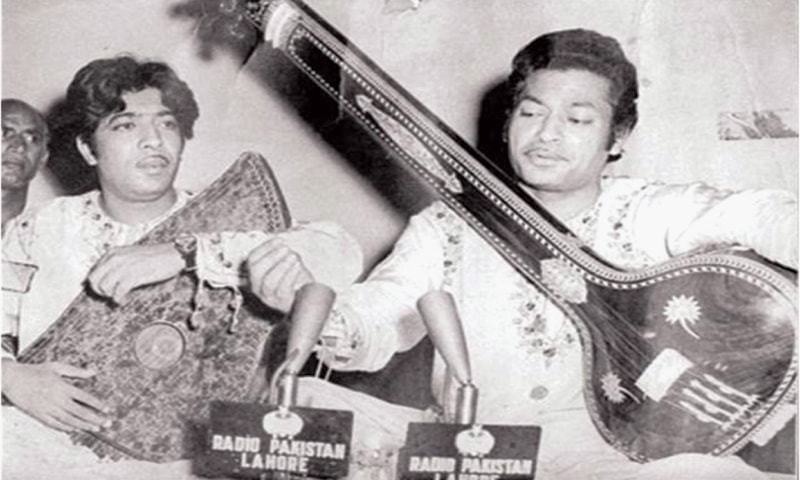
The Cosmos of Ustaad Saami

By Syed Hasnain Nawab in DAWN 

[Note: Ustaad Naseeruddin Saami and his sons–The Saami Brothers– won the Patron’s Award at the 2025 Aga Khan Music Awards, held in London on November 22]

Hailing from Delhi’s famed Qawwal Bachcha gharana [musical lineage], Jaan traces his musical ancestry back to the likes of the 19th century Delhi gharana luminary Tanras Khan and Mian Saamat bin Ibrahim — with the latter being the principal disciple of Amir Khusrau. As the Saamis put it, their ancestors were chosen not by happenstance but by what the family believes to be Divine designation, stating, “Knowledge is given to whoever has a right to it, who deserves it. This is chosen and sent by God.”

In this vein, Jaan sees himself and his sons not simply as musicians but as carriers of a spiritual directive. Traditionally, these gharanas have maintained and safeguarded their expansive knowledge by transmitting centuries’ worth of musical heritage and experimentation seena-ba-seena [from ustaad to pupil].

Continue reading The Cosmos of Ustaad Saami

Raja Mohan on Indian Foreign Policy and the Rebalancing of Asia

In this episode of Asia Inside Out, Rorry Daniels, Managing Director of the Asia Society Policy Institute (ASPI), speaks with Raja Mohan, ASPI Non-Resident Distinguished Fellow and author of the forthcoming India and the Rebalancing of Asia. Daniels and Mohan discuss India’s relationship China, the U.S., and Russia; regional headwinds impacting New Delhi; and India’s strategic vision for its role in a changing Asia.

Brown Pundits