
What’s going on?
Category: Open Thread
Open Thread – 01/07/2022 – Brown Pundits
Open Thread – Renewal of Covid Restrictions in India
Let the chats begin. Feel free to discuss other things here. As Razib hasn’t added an Open Thread I thought I should
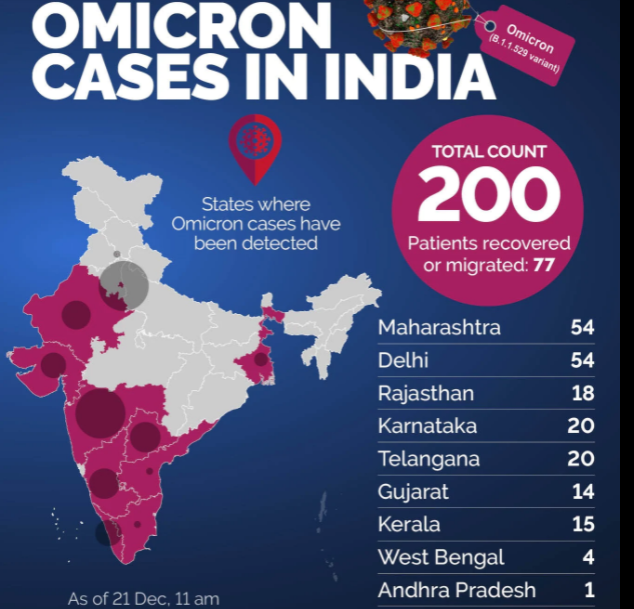
What’s the latest on Omicron ? My amateurish take below.
What makes SARS-CoV-2 dangerous is it’s a Upper+Lower Respiratory track infection. Upper track causes high infectivity and lower track causes higher severity (compared to seasonal colds). Looks like Omicron is more Upper track than Lower track (unlike Alpha and Delta). That maybe one of the reasons (other than vaccinations and pre infections) why till now Omicron cases are milder – as they don’t affect lungs as badly as earlier variants. Hence this variant might actually end up inoculating large swathes of people at low cost and thus ending the pandemic
Yet in India we continue to display the numbers of Omicron morbidly (even for asymptomatic). Absurd lockdowns and restrictions like Night curfews and interstate RT PCR testing are commonplace in the country. What lies ahead for the people whose work is dependent on the whims of the governments (especially state) makes me very cynical.
It seems Indians by and large think they’re “Ruled’ by governments. In Western societies citizens know they’re “Governed”. I guess that explains why in India we have had no protests against the string of senseless restrictions and lockdowns last 18 months.
Open Thread – 12/3/2021 – Brown Pundits
Lots of Indian tech CEOs. This is just the world in 2021.
Open Thread – 11/19/2021 – Brown Pundits
Modi?
Open Thread – 10/29/2021 – Brown Pundits
Please make sure to subscribe to the podcast. We’re still posting things and sometimes there isn’t a blog post associated with it.
The Sintashta horses!
The origins and spread of domestic horses from the Western Eurasian steppes:
Domestication of horses fundamentally transformed long-range mobility and warfare1. However, modern domesticated breeds do not descend from the earliest domestic horse lineage associated with archaeological evidence of bridling, milking and corralling…at Botai, Central Asia around 3500 BC3. Other longstanding candidate regions for horse domestication, such as Iberia5 and Anatolia6, have also recently been challenged. Thus, the genetic, geographic and temporal origins of modern domestic horses have remained unknown. Here we pinpoint the Western Eurasian steppes, especially the lower Volga-Don region, as the homeland of modern domestic horses. Furthermore, we map the population changes accompanying domestication from 273 ancient horse genomes. This reveals that modern domestic horses ultimately replaced almost all other local populations as they expanded rapidly across Eurasia from about 2000 BC, synchronously with equestrian material culture, including Sintashta spoke-wheeled chariots. We find that equestrianism involved strong selection for critical locomotor and behavioural adaptations at the GSDMC and ZFPM1 genes. Our results reject the commonly held association7 between horseback riding and the massive expansion of Yamnaya steppe pastoralists into Europe around 3000 BC driving the spread of Indo-European languages. This contrasts with the scenario in Asia where Indo-Iranian languages, chariots and horses spread together, following the early second millennium BC Sintashta culture.
The paper is open access. Basically the Sintashta seem to have triggered the equine revolution across Eurasia.
Open Thread – 10/18/2021 – Brown Pundits
What’s going on?
Open Thread – 10/02/2021 – Brown Pundits
My Substack post on caste is finally up. Thanks for your patience.
The podcast released three episodes in three days. An interview with Wahid Majrooh, Former Minister of Public Health of Afghanistan. Another with Pashtana Durrani, an Afghan activist. And of course the one with Shazia Ilmni. Just subscribe on Apple and Stitcher.
Open Thread – 09/17/2021
I’ll probably be writing a piece (free) for my Substack on caste so that people can use it for a reference. The lie that it was “invented by the British” seems pretty pervasive and will spread in the next few years for various ideological reasons, so it is useful to always remember the truth even as the lie becomes regnant. Falsity always collapses, but it takes a while.