Pak Journalist Blames Munir for India and Pak Blasts

Fascinating take by Taha Siddiqui.

Taha is in exile.

He says Red Fort and the bombing in Pakistan both done by Munir.  Is it sour grapes or does he have evidence that points to Munir?


Taha Siddiqui, a Pakistani journalist living in exile in Paris, is a strong critic of Pakistan’s military. He has claimed on X that the suicide bombers involved in the Delhi and Islamabad blasts were ‘assets’ of the Pakistan Army. Pakistani journalist Taha Siddiqui has linked the recent blasts in Delhi and Islamabad to suicide bombers he termed as ‘assets’ of the Pakistan Army. His claim has drawn wide reactions online. The blast near Red Fort in India on November 10 claimed at least 13 lives while 12 people were killed in the Islamabad explosion, the next day, on November 11.”


https://newsable.asianetnews.com/amp/world/pakistani-journalist-taha-siddiqui-pak-army-assets-claims-delhi-islamabad-blasts-articleshow-r0sg3mc


Red Fort Attack and Aftermath: Initial Thoughts by Manav S.


Red Fort Attack and Aftermath: Initial Thoughts by Manav S.

Last evening’s devastating car-explosion near the Red Fort in Delhi is not only a cruel assault on innocent lives but an assault on the very symbolism of our nation. According to early reports, a vehicle detonated close to the busy metro zone at the historic Red Fort complex, killing at least eight people and injuring more than twenty.  The government has invoked anti-terror legislation and launched a full probe under the Unlawful Activities (Prevention) Act (UAPA). 

First, we must recognise the human tragedy behind the headlines. Lives shattered, families devastated, fear spreading in a city already grappling with chronic insecurity. For those of us of South Asian heritage who carry memories of communal strife, of migration and displacement, this attack touches a deeper chord of vulnerability and of collective memory. Hospitals have reported frantic cries, missing persons, relatives screaming for loved ones. 

Second, the choice of location amplifies the message. The Red Fort is not just another landmark: it is an emblem of India’s sovereignty, its layered history, its identity. To strike here is to strike at the heart of public confidence and to send a message of audacious defiance. As scholars writing on “brown diasporic publics” know, our public spaces carry meaning not just for those inside India, but for those of us abroad who anchor our identity in ‘homeland’ narratives. This attack disrupts that anchor.

Third, we must resist both fear and simplistic narratives. The invocation of terror laws suggests the state is treating this as a planned act of violence, not an accident.  But let us guard against quick binaries: Us vs Them, Hindus vs Muslims, India vs Outsiders. In a plural society like ours, sweeping communal attributions too often deepen fault-lines rather than heal them. Our commentary must demand both justice and wisdom: meticulous investigation, transparent process, and safeguarding civil rights in the process.

Fourth, what does this mean for our shared public culture? For someone born in Punjab and now living across borders, the explosion challenges our sense of movement, of belonging, of normalcy. We think of carrying family across continents, of re-configuring identity in Washington–DC and Delhi , how do such apparently random acts of terror recalibrate the psychic cost of migration and the distance between home and homeland? The answer is: they make the cost higher, the emotional freight heavier.

Finally, the path forward must hold three imperatives: one, empathy – for all victims, irrespective of religion, class or residence; two, accountability – for whoever plotted, financed or enabled this attack; and three, renewal – of the public realm, the shouting panic, the fear-laden sighs, with something stronger: resilient civic culture, public institutions we trust, cross-community solidarity.

As a brown pundit, I urge our readership to see beyond the flashes of violence, beyond the political spin, and to ask the deeper questions: What kind of society are we building? What kind of public spaces do we imagine, and what cost are we willing to pay for them? For if we shrug now, the symbolic scar will grow — far after the immediate blast damage is repaired.

In that moment of stillness after the blast, we owe to our fellow citizens not just sorrow, but vigilant hope.

Two of my recent essays

I have two pieces of writing I want to share. The first is an essay I wrote on Iqbal for his birthday (9th November), exploring how we have misread him, and how, in a way, he misreads himself.

https://inkelab.substack.com/p/iqbal-an-uninteresting-poet

The second piece discusses how book reviews can nudge critical readership in Pakistan. It includes a situational analysis of reading habits in the country, the role of reviews and sugarcoating, and the emerging Bookstagram and BookTok communities.

https://dunyadigital.co/books/jumpstarting-critical-reading-the-power-of-a-book-review

Would love to know what you people think about both. Thanks!

Mamdani and India — A Strategic Moment

The Desi Mayor and the Mirror of India: What Zohran Mamdani’s Victory in New York Means for a 2050 India

by Amb Manav Sachdeva

When Zohran Mamdani — the 34-year-old Indian-heritage, Muslim-American democratic socialist — clinched the victorius count for the mayoralty of New York City, it was more than an American political event. It was a global inflection point. For the first time in history, the world’s most influential city is poised to be led by a man who not only traces his lineage to India but proudly identifies himself as desi — as an inheritor of South Asian pluralism, Muslim humanism, and diasporic imagination.

For India, Mamdani’s win ought not to be filtered merely through the lenses of political affinity or ideological tension. Nor should it be reduced to whether he has praised or criticized Narendra Modi. It must be read as a civilizational opportunity — a chance to reflect on how India sees itself through the mirror of its far-flung children, and how it chooses to relate to a diaspora that has become not just prosperous, but powerful.

From Symbolism to Strategy Continue reading Mamdani and India — A Strategic Moment

Mahabharata war and Yuga cycles

Anyone who is slightly familiar with Hindu mythology or Hindu cosmology knows that ancient Indians were fond of extremely large time periods. According to traditionalists the war of Mahabharata happened more than 5000 years ago (3102 BCE). A Yuga is supposed to last for 1.08 million years. A Yuga cycle, consisting of 4 Yugas, is 4.32 million years long. Who came up with these numbers ?

The story behind these numbers is quite interesting. Although the word Yuga goes back to Vedic age, Vedic texts do not mention these numbers. The specific numbers were first introduced by Aryabhata, who was born in 476 CE. According to his definition a new Yuga begins whenever all five visible planets along with the Sun and the Moon have zero celestial longitude (we are using the current terminology here, Aryabhata used the word Yugapda to denote a Yuga). The first verse of Aryabhatia, his only surviving work, states the following :

Aryabhatia 1.1 : In a yuga cycle the revolutions of the Sun are 4,320,000, of the Moon 57,753,336, of the Earth eastward 1,582,237,500, of Saturn 146,564, of Jupiter 364224, of Mars 2,296,824, of Mercury and Venus the same as those of the Sun.

The accuracy levels of these estimates are reasonably high, ranging from 99.9 percent (period of Saturn) to 99.999 percent (period of Earth’s rotation). It is possible to get this level of accuracy from 20-30 years of naked eye observations. Not surprisingly, the exact numbers are all wrong. Assuming an error margin of 0.3 degrees for an observation, one needs 3600 years of sky watching to count the exact numbers of revolutions in 1.08 million years. Aryabhata definitely knew this but he also accepted the traditional view that the current Yuga started during the war of Mahabharata (Aryabhatia 1.3). Seven astronomical objects having celestial longitudes close to zero is a very strong condition, and the initial estimates he obtained from 20-30 years of observations were good enough to rule out all years in the past few thousand years except 3102 BCE. So he concluded that the beginning of the current Yuga and Mahabharata war happened in in 3102 BCE.

Aryabhatia 3.10 : When three Yugas and sixty times sixty years had elapsed (from the beginning of the Yuga cycle) then twenty three years of my life had passed.

Since he could directly see the positions of the celestial objects during 499 CE vernal equinox, the assumption that they all had zero longitude in 3102 BCE meant having observations separated by 3600 years. This allowed him to make extremely precise claims about their periods. At the same time he was forced to increase the length of a Yuga to 1.08 million years to ensure that all the celestial objects make complete revolutions.

Why did he come up with the concept of Yuga cycle and how did he know that we are in the fourth Yuga of the current Yuga cycle ? This is related to two abstract points corresponding to apsidal and nodal precession of Moon’s orbit. Aryabhata wanted to include them in the list of celestial objects but his initial estimates showed that their celestial longitudes were closer to -270 degrees and 180 degrees in 3102 BCE. So he introduced a 4.32 million years long Yuga cycle and assumed that we are in the fourth Yuga.

How do we know all these details ? As remarked earlier, Aryabhata’s model was not accurate enough to go 3600 years in the past and detect a Yuga changing moment. However if we calculate the positions during 499 CE equinox using modern technology and apply Aryabhata’s model to go back another 3600 years, then celestial longitudes of the first seven objects become close to zero. The probability of this being a pure coincidence is less than one in a billion. The only logical conclusion is that Aryabhata was born in 476 CE and his definitions and methods were as described above.

In Burma, of Burma, but not Burmese…yet

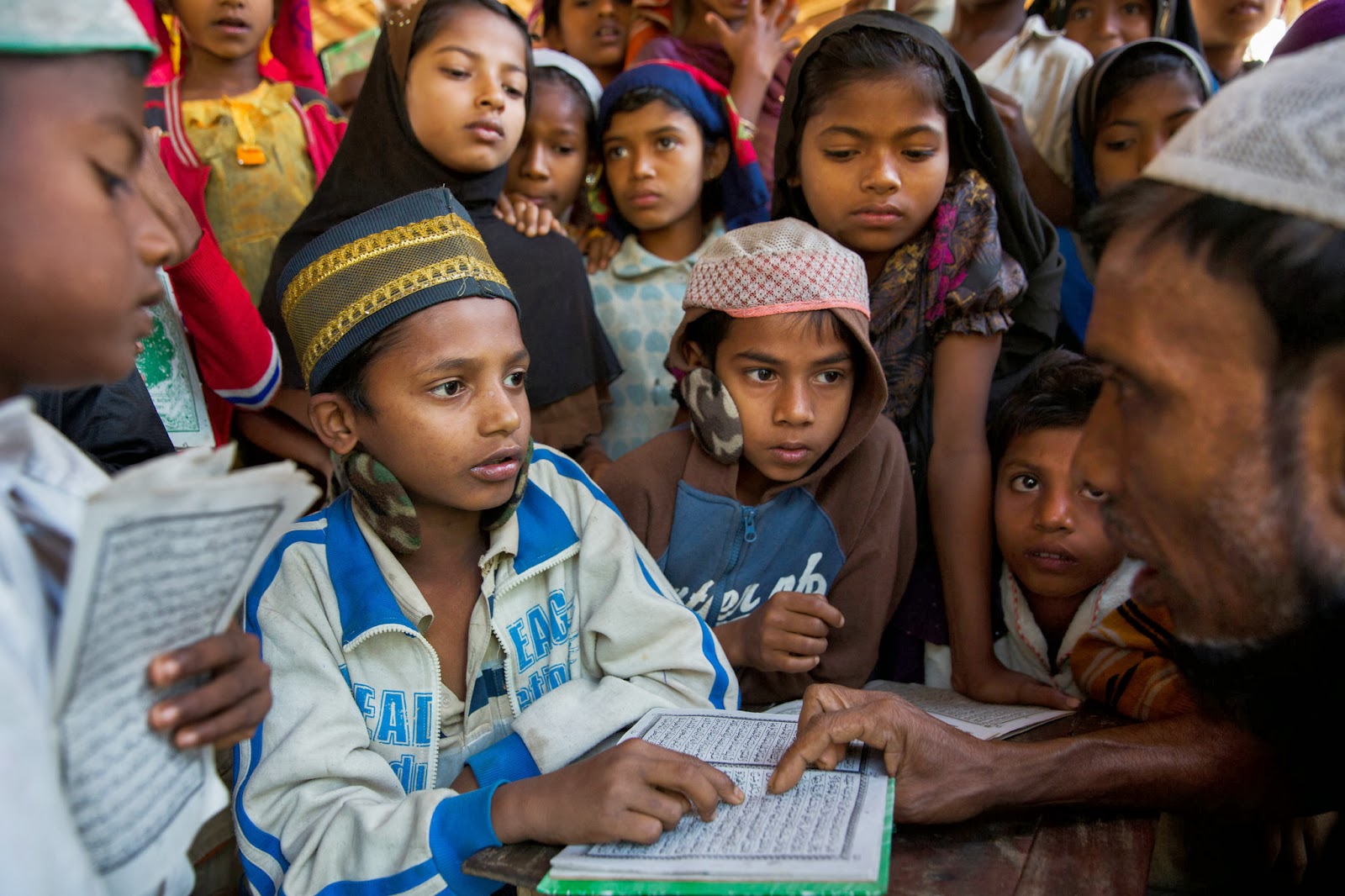
The New York Times has an article up which surveys the situation of Rohingya Muslims in Burma, which is without hyperbole perhaps analogous to that of Jews in 1930s Germany. The title, “Rise in Bigotry Fuels Massacre Inside Myanmar,” emphasizes I think the fact that this is not a conflict driven solely, or even primarily, by religious difference. Because of the lack of good data it is difficult to say with any confidence, but it seems likely that Rohingya are only around ~50% of the Muslims in Burma. Many of the rest are likely descended from people who intermarried with the majority Burmese community (I have read that Aung San Suu Kyi is descended in part from such a lineage), and exhibit no difference aside from religion. Though the ethnic Burmese (Bamar) are the majority of the population, it is not an overwhelming one. More unifying is the fact that on the order of 80 to 90 percent of the population adhere’s to Theravada Buddhism.

But the issue with the Rohingya’s is not just their religious difference, but that to all practical purposes it seems that they are Bengali peasants of relatively recent origins. This is the accusation that the Buddhists, who are mostly ethnic Rakhines, make in Arakan.

Brown Pundits