The Clearly Evident Out of India Migration from Ancient DNA

While the two recent ancient DNA papers have set the Indian media abuzz with talk of whether Aryans were indigenous or whether they came from outside, almost all the English media has ignored the fact the genetic data also shows the migration of ancient Indians or Harappans into neighbouring regions of Eastern Iran and Central Asia.

A couple of articles took note of it but tried to minimise its relevance. Tony Joseph at The Hindu says,

Another spin around the new studies suggests an ‘Out of India’ migration. This is also misleading. If by ‘Out of India’ migration we are referring to the fact that some Harappans visited neighbouring civilisations or cultures such as the Bactria-Margiana Archaeological Complex (BMAC) or Shahr-i-Sokhta, with whom they had trade and cultural links, these are well-known and unsurprising facts.

Girish Shahane at the Scroll.in, opines about the Indus Periphery samples,

The obvious explanation is that the 11 people had travelled to those locations from an Indus Valley Civilisation region. Their presence in such far-flung places testifies to the extensiveness of Indus Valley Civilisation commercial and cultural contacts. It does not suggest a migration out of India extensive enough to change the genetic profile of foreign lands, because if that were the case the 11 individuals would not have been obvious outliers.

Both these writers are hardly excited by the fact that there is indeed evidence of Indian migration into Eastern Iran & Central Asia and they try to explain it away non-nonchalantly as the evidence of Harappans’ trade & cultural contacts.  I mean, why is the overwhelming obsession just about proving the supposed Aryan migration ? Isn’t it exciting that we now have clear and indisputable evidence of ancient Indians already, as early as 3300 BC (the earliest dated Indus Periphery sample), migrating and living in advanced Bronze Age civilizations outside of the traditional geographic boundary of South Asia. What was the nature of these interactions should naturally arouse considerable curiosity.

The writers also grossly underestimate the genetic influence of Harappans on both its neighbouring regions.

What the research paper says

Let us quote directly from the paper which published these 11 ancient South Asian migrant samples and see what it has to say on the matter –

We document 11 outliers—three with radiocarbon dates between 2500 and 2000 BCE from the BMAC site of Gonur and eight with radiocarbon dates or archaeological-context dates between 3300 and 2000 BCE from the eastern Iranian site of Shahr-i-Sokhta—that harbored elevated proportions of AHG-related ancestry (range: ~11 to 50%) and the remainder from a distinctive mixture of Iranian farmer– and WSHG-related ancestry (~50 to 89%).

While this part of the research is reported by our writers they fail to note another equally important piece of research from the same paper which states,

Unlike preceding Copper Age individuals from Turan, people of the BMAC cluster also harbored an additional ~2 to 5% ancestry related (deeply in time) to Andamanese hunter-gatherers (AHG). This evidence of south-to-north gene flow from South Asia is consistent with the archaeological evidence of cultural contacts between the IVC and the BMAC and the existence of an IVC trading colony in northern Afghanistan.

When we take both these statements together we get the clear picture. Not only were migrants from the Harappan civilization present in Eastern Iran and Central Asia, infact the genetic admixture from these Harappan migrants was present in all the native people of these regions and was not just consigned to the Harappan migrants only. It is puzzling as to why this crucial information has completely been ignored by almost everyone.

This Harappan admixture was apparently not present in the earlier period in Central Asia before 3000 BC which would mean that the Harappan admixture happened in the transition phase between the Copper Age in Central Asia and the formation of the Bronze Age urban civilization of BMAC when the population of this region increased greatly.

Quite clearly, the migration and mixing of Harappans with the Central Asians and Eastern Iranians co-incides or slightly pre-dates the transformation of these socieites into large urban civilizations and likely played a crucial role in the transition of these culture into urban Bronze Age civilizations.

How is this not an important finding ?

It is quite strange that this clear evidence of Out of India migration is being sidelined and neglected. Let us dig a little deeper and show what the quite comprehensive and large Supplementary section of the paper has to say on this Out of India migration.

What the Supplement Says

The primary ancestry source of all these ancient samples from Central Asia & Eastern Iran was the Iranian farmer related ancestry, the same ancestry type which was also the main ancestry of IVC people.

This Iranian farmer related ancestry was the main ancestral source in Central Asia even in Chalcolithic period (4000 – 3000 BC) which means that already by the Chalcolithic period the populations of Central Asia and NW South Asia had a lot of shared ancestry before the IVC migration into Central Asia during the Bronze Age. How old is this shared ancestry should be a matter of future research.

The analysed data from Central Asia and Eastern Iran in the Bronze Age consists of about 60 samples from the sites of Gonur, Sappali, Jarkutan (Dzharkutan) & Bustan associated with the BMAC or Oxus Civilization of Central Asia, 2 samples each from Parkhai & from Aigyrzhal in Kyrgyzstan, also from Central Asia and finally 17 samples from the large Eastern Iranian settlement of Bronze Age Helmand civilization, Shahr-i-Sokhta (fig. S17, pg 202).

Quoting from the Supplement, they observe from the admixture plot (fig S18, bottom panel, pg 203) that,

“… some individuals from each site also harbor trace amounts of a component that is maximized in Andamanese Hunter-Gatherers (AHGs) and Dravidian speaking groups in southern India. Particularly revealing is our observation of outlier individuals from several of these sites that are exceptions to these patterns. We hypothesize that these individuals were migrants from South Asia (or descendants of recent migrants)…” (pg 202)

Based on the results of the admixture-f3 stats (fig S21-S23) on the BMAC and Shahr-i-Sokhta main group of samples they further observe,

For the BMAC main cluster, we also observe significant (Z<-3) admixture signals with a source from pre-Copper Age Iran and Turan and a source related to present day groups within the Indian subcontinent, a signal that we do not detect in individuals from the earlier period in Turan (Fig S 21 – Fig S 23). This is consistent with the hypothesis that the main BMAC cluster harbors a proportion of ancestry from gene flow from the south, plausibly from South Asia… We observe that the individuals from Shahr-i-Sokhta, also show significant admixture-f3 statistics with one source as AHG. Taken together with the fact that there are individuals with significantly high proportions of AHG-related ancestry at both sites, this suggests that there was gene flow from South Asia out into Turan during the BA (pg 206).

Finally moving onto the qpAdm admixture analysis, our researchers note,

To better understand the population changes associated with these BA settlements we studied proximal sources. We first observe that there are many models that fit under our acceptance criteria, but they are of a similar nature, in the sense that all involve a population from the previously described Copper Age period with additional ancestry related to present-day South Asians. Most working models involve populations from Turan with additional South Asian related mixture, for example present-day individuals from South Asia with minimal Steppe pastoralist-related ancestry, or outlier individuals from Shahr-i-Sokhta and BMAC sites with high proportions of AHG-related ancestry (pg 210).
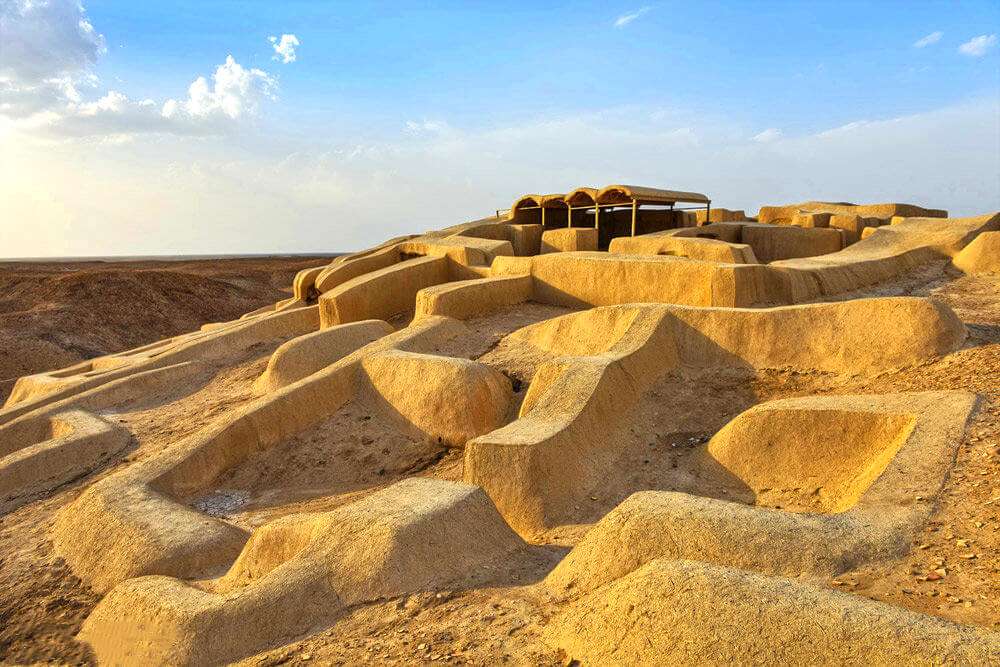
When we look at analysed aDNA samples Shahr-i-Sokhta, we see that out of a total of 17 samples, as much as 8 of them are classified as migrants from the Harappan civilization by our authors. So essentially about 50 % of the population at Shahr-i-Sokhta was made up of migrants from the IVC. Infact, barring one sample which they classify as an outlier, the other 8 samples, which the authors label as Shahr_I_Sokhta_BA1, also harbour IVC ancestry and the best fitting qpAdm model (p-value – 0.658) suggests that this S_I_S_BA1 group harboured as much as 20 % ancestry from these IVC migrants (table S30, pg 212).

It may also be noted that the IVC migrants at Shahr-i-Sokhta date from a period between 3300-2000 BC while the other group of 8, labelled the main S_I_S_BA1 group only date between 3300-2600 BC. All in all, this cumulative genetic evidence alone is enough to show that Shahr-i-Sokhta was enormously influenced by the Harappans.

This is further underlined when one looks at the archaeological evidence which shows substantial similarities between Shahr-i-Sokhta and sites to its east in the Indian subcontinent. Shahr-i-Sokhta itself only came into existence as a habitation site around 3300 BC but the other major site of the Helmand civilization, Mundigak, found about 425 kms east along the course of the Helmand river in Afghanistan, has a beginning going back to the 5th millenium BC, and it already shows significant cultural parallels with older sites such as Mehrgarh to its southeast. The main cattle type at Shahr-i-Sokhta was also of the Indian Zebu variety further cementing the strong east to west cultural and genetic flow at the site.

To try to brush this off vaguely as evidence of ”commercial and cultural links” and trying to de-emphasize the importance is quite telling.

In contrast, the Italian archaeologist Massimo Vidale, one of the principal researchers at Shahr-i-Sokhta in recent years and one of the contributors of this Narasimhan et al paper, states the following on page 110 of Supplementary section,

The archaeological and genetic evidence thus suggest that a flow of migrants from the northwestern borderlands of South Asia was active at the beginning of the local settlement, and that the same flow, different from the earlier one from northwest, intensified in the following centuries. We unfortunately do not have ancient DNA from Period III and the later centuries of the Shahr-i-Sokhta sequence when cultural influence from the Indus Valley Civilization appears to become stronger.

To be sure, what percentage would a trader community consitute in the population of a foreign city ? And out of these traders, how many are going to end up dying and getting buried in that foreign land ? Perhaps 1 or 2 %. It surely cannot be as high as 50 % besides also contributing your ancestry to all the local people in the foreign land.

But that is what we see at Shahr-i-Sokhta and therefore this is evidence of very deep cultural and perhaps religious and linguistic links.

The body of archaeological literature documenting the links between the IVC, Eastern Iran & BMAC is quite significant and I intend to write on it, God willing, in the next post to complete and complement the picture given by genetic data.

Moving to Bronze Age Central Asia, the authors document 3 samples from the major site of Gonur in the Margiana region of the BMAC which they classify as IVC migrants along with the 8 already noted at Shahr-i-Sokhta. Alongside these 3 samples, there is a slightly later sample dating to around 1500 BC from the site of Bustan, labelled as Bustan_BA_o2, which is not similar to the 3 Gonur IVC migrants but can be modelled as 70 % Swat_IA + 30 % IVC migrants. So this is also for all intents and purposes a likely migrant from South Asia but with a very different genetic profile.

But besides this, as can be read from the quotes from the Supplement and main paper given above, all the ancient samples of the main group of BMAC people also harboured ancestry from South Asia which was absent in the earlier period.

In the proximal models for the BMAC main cluster (table S28, pg 210), we can observe that the BMAC Bronze Age population can be modelled as deriving between 70-75 % ancestry from Shahr-i-Sokhta_BA1 which itself harbours about 20 % IVC ancestry. Therefore this suggests that the BMAC main cluster, its core population, harbours about 15 % ancestry from IVC.

Therefore, we see all pervasive South Asian admixture in Central Asia just before the region becomes urbanised and perhaps organised into a state. This suggests that the South Asian or IVC migration and admixture in Central Asia could have played a leading role in the transition of the region into an urbanised state with major cities like Gonur.

Our authors argue that the 2 samples from Aygyrzhal in Kyrgyzstan in the eastern part of Central Asia, do not have any South Asian ancestry but this is belied by the fact that in all proximal models (table S31, pg 212), these 2 samples show about 17 % admixture from IVC migrants.

Nor is the IVC genetic influence this far to the east in Central Asia an anamoly. A study of mtDNA  from some ancient Tarim Basin samples (4000 YBP), showed the presence of the indisputably Indian lineage M5, besides other lineages such as U7, U2e & R* which are also widely present in South Asia, Central Asia and Iran.

As pointed out by Silva et al 2017, mtDNA M5a was clearly part of outward South Asian migration towards Iran in the Bronze Age. Therefore its presence also in Tarim Basin in the same timeframe explicitly confirms it to have been there as part of South Asian migration and admixture in the Tarim Basin in that early period.

Winding up the genetic evidence, we observe that in the Bronze Age, the IVC genetic influence extended in an enormous arc from Shahr-i-Sokhta in Eastern Iran to the Tarim Basin mummies in modern Xinjiang, China with the genetic influence on the Helmand civilization (Shahr-i-Sokhta) being quite overwhelming and that on the BMAC also being all-pervasive.

How is this major Bronze Age genetic phenomenon not a significant event of Out of India migration ? Whether this was related to Indo-European migration, only time will tell.

It is a matter of archaeological record that the greatest influence on BMAC was from IVC and the Eastern Iranian civilizations of Halil Rud (Jiroft) and Helmand which were themselves heavily influenced by IVC. Infact, when there is evidence of such overwhelming cultural and genetic links between these regions, political links between these regions would have been a definite reality. Infact, as Mesopotamian records of the 2nd quarter of the 3rd millenium BC, the Eastern Iranian state of Marhasi (perhaps Halil Rud) was closely in political alliance with Meluhha (the IVC).

It is quite instructive that the historically known core region of Indo-Iranians was already greatly in confluence from the Early Bronze Age period.
Article 370 Revocation Through the Eyes of an Indian-American Immigrant – Part II

In the first part of this article Article 370 Revocation Through the Eyes of an Indian-American Immigrant – Part I I provided a historical, geographic and demographic context to the Kashmir conflict. In this part I provide contemporary political context and speculate on what the future might hold for J&K.

I was a teenager in North-Central India (Uttar Pradesh) when the Kashmir Valley exploded into the national consciousness as a full-blown armed insurgency and secessionist movement in 1989-90. India at that time had state-controlled TV media and most adverse news out of J&K was suppressed. However, we had all heard about Islamic terror groups targeting Hindus. Many of these Hindus trickled into refugee camps in and around New Delhi which was a city I often visited to see relatives, so people had begun to be familiar with the scale of the violence against Hindus despite the attempts of state-controlled media to conceal it.

India’s Rationale for Preventing Kashmir’s Secession

In general, the attitude of most Indians since the late 1980s and early 1990s when the conflict became radicalized has been to hold on to the Kashmir Valley by any means necessary. There is a simple rationale for that position. Around 20% of the population of India is not Hindu (with religious minorities being broken up roughly in 70%/10%/10%/10% proportions of Muslim/Christian/Sikh/Other) and there are close to 200 million Muslims in India in a country of 1,400 million people. Indians have always been proud of having a secular Constitution and State, uniquely so in South Asia. India is the most ethnically and religiously diverse nation in the world bar none. Each and every resident of J&K has always been a full-fledged citizen of India. So, it is a hard pill for any Indian to swallow that 7 million Muslims in the Kashmir Valley feel that they cannot be equal citizens of India and must secede to Pakistan. It would raise questions about the unity of India and its tradition of religious and ethnic diversity. It would also put a question mark against the nearly 200 million Muslims in the rest of India. Consequently, almost all Indians feel an emotional and visceral reaction against allowing even just the overwhelmingly Muslim majority Kashmir Valley region of J&K to secede. India has Muslims in positions of power and influence in every field, ranging from Government to Sports and Entertainment. Some of the biggest Indian movie stars are Muslim minorities. Every Muslim of J&K had more than equal citizenship in secular India. There was simply no reason for a secession movement other than religious fascism.

Most Indians are united on Kashmir policy, regardless of political affiliation. Even If Modi lost the next election in 2024 and even if a Communist government was in power, there is very little chance that their actual policy on J&K would differ very much other than in public rhetoric. That is because a religion-based secession would be disastrous to India’s identity. Continue reading Article 370 Revocation Through the Eyes of an Indian-American Immigrant – Part II

23andMe says Bangladeshis are more Bengali than West Bengalis!

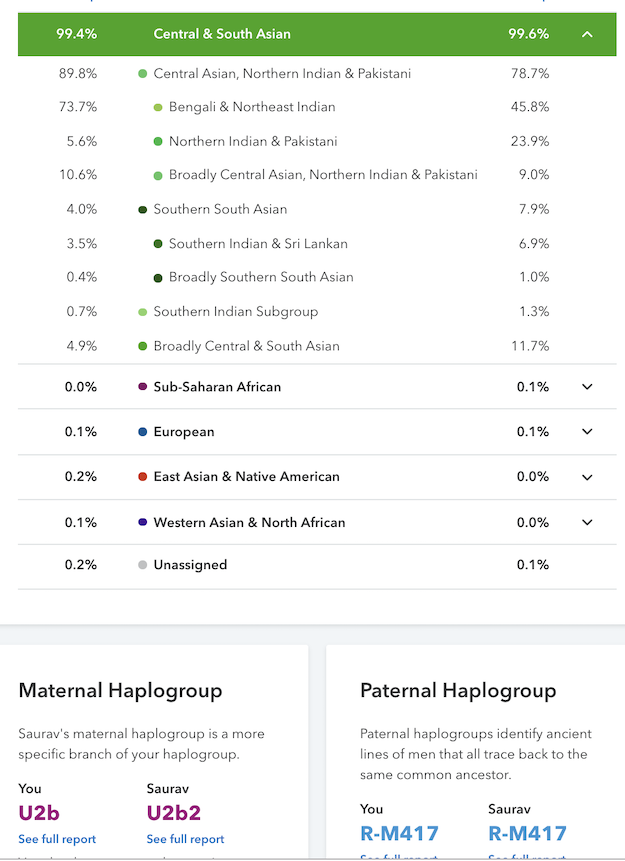
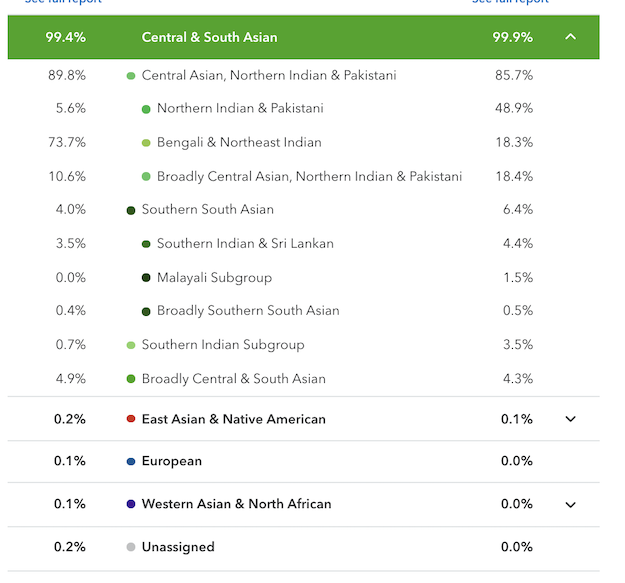
As some of you may know 23andMe updated its South Asian ancestry panel. On the whole, I’ll give it a thumbs up, but, you need to be aware of the way they’re framing things. For example, pretty much every Bangladeshi has more “Bengali” ancestry than people from West Bengal.

The profile above on the left is mine. On the right is a friend whose background is West Bengali, of the Kayastha caste. Basically, 23andMe seems to be taking the East Asian enriched ancestry of Bangladeshi Bengalis as more diagnostic of being Bengali.

Now, compare me to a Bengali Brahmin (on the right):

So in all likelihood, Tagore’s ancestry composition would result in not so much “Bengali”….

Xinjiang and Kashmir, China and India

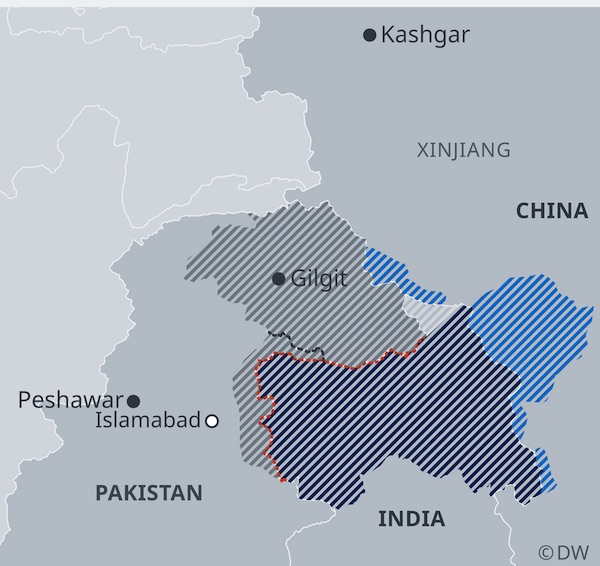
This post isn’t really to state something unequivocal…it’s just to observe that Kashmir and Xinjiang are not that far apart geographically.  The great translator of Buddhist works into Chinese, Kumārajīva, may have been the son of a princess from Kucha (on the southern fringe of the Tarim basin) and a Kashmiri.

What is happening to the Uyghurs is being extensively covered in the Western media. But from what I can tell Kashmir has become a major cause on the Left in the West, while Xinjiang is far less. “Solidarity with Xinjiang” returns 300,000 results for me on Google, while “Solidarity with Kashmir” returns 6,000,000.

There are major differences of course. The magnitude of what’s happening Xinjiang seems to be far greater than what’s happening in Kashmir. And, India is a democratic nation, while China is most definitely not.

The Indian cultural Left is in India, but not of India

A comment on Twitter about the lack of the Islamic world’s own Arundhati Roys, and therefore the lack of Leftism. My own reaction is that this is wrong. There is plenty of Leftism in the Islamic world, just not the sort of cultural criticism that Arundhati Roy specializes in.

To give an example, the PLO has several Communist member parties, and its largest element, Fatah, is Left-nationalist. Though the high-tide of Marxism in the Islamic world, and the developing world in general, was in the 1970s, the ghost of Left-nationalism haunts us to this day (the Syrian Ba’ath party has its origins on the Left, though today it is basically an Assad family enterprise). India, there remains to this day a militant Marxist movement.

So what’s going on with people like Arundhati Roy? I think the best way to understand her is that she is part of the global English-speaking intelligentsia, and as such caught up in cultural currents which are beyond, and above, her Indian milieu. She applies the tools and concerns which are validated among the global cultural Left to an Indian context.

It’s not just an English-speaking phenomenon. There is a global elite cultural movement united by share mores and disposition. Consider the movements for gay rights in East Asia, which seem to be clearly shaped by Western precursors. But, I think the Indian English-speaking elite exhibits the tendency to imitate and replicate far faster than in other developing societies because of its shared cultural presuppositions and linguistic fluency with the Anglosphere.

The Origins of the Neolithic in the Indian subcontinent

Last week was a good one for all those who had been waiting endlessly for the Rakhigarhi aDNA paper to see the light of day and also for the pre-print ‘The Genomic Formation of South & Central Asia’ to come out in a peer-reviewed journal.

Unfortunately, the talk around both these papers has quickly degenerated to only figuring out whether these papers support an Aryan Migration or whether they do not.

However, the combined data that has come out from these two papers is a treasure trove of information and this data has enormous implications for a lot of other theories of South Asian prehistory.

I wish to focus one post for each of these important discoveries starting with the important discovery about the antiquity of IVC ancestral population in South Asia and its implication for origins of farming in the region.

The graphical extract given above is quite self-explanatory. But let us also quote from the paper itself to re-inforce what the graphical extract implies :-

The Iranian-related ancestry in the IVC derives from a lineage leading to early Iranian farmers, herders, and hunter gatherers before their ancestors separated, contradicting the hypothesis that the shared ancestry between early Iranians and South Asians reflects a large-scale spread of western Iranian farmers east. Instead, sampled ancient genomes from the Iranian plateau and IVC descend from different groups of hunter-gatherers who began farming without being connected by substantial movement of people.

They elaborate on what the implications of this finding is –

Our evidence that the Iranian-related ancestry in the IVC Cline diverged from lineages leading to ancient Iranian hunter-gatherers, herders, and farmers prior to their ancestors’ separation places constraints on the spread of Iranian-related ancestry across the combined region of the Iranian plateau and South Asia, where it is represented in all ancient and modern genomic data sampled to date. The Belt Cave individual dates to 10,000 BCE, definitively before the advent of farming anywhere in Iran, which implies that the split leading to the Iranian-related component in the IVC Cline predates the advent of farming there as well…Thus, the Iranian-related ancestry in the IVC Cline descends from a different group of hunter-gatherers from the ancestors of the earliest known farmers or herders in the western Iranian plateau.

So the paper on the Rakhigarhi aDNA sample makes it abundantly clear that the geneticists find the Iran farmer/herder related ancestry in the IVC people to have split up from the actual Iranian farmers/herders atleast before 12,000 years ago. This is well before the origin of farming on the Iranian plateau. Therefore, the clear implication of this is that the Iranian Neolithic Farmers did not contribute ancestry to the ancestors of the Harappans but that the ancestors of Harappans and the early Iranian farmers/herders descend from a common ancestral source that existed more than 12 kya.

What was the place of origin of that ancestral source ? We do not know that as yet so to assume that it is coming from Iran, as some are doing, is not borne out by evidence. It may well have originated in South Asia before moving into Iran.

I have written at length on this topic at my blog.

Infact, the deep pre-Neolithic origins of Iran N like ancestry in South Asians was already becoming apparent that as early as 2011 when this major paper on South Asian populations made the following observation –

… regardless of where this component was from (the Caucasus, Near East, Indus Valley, or Central Asia), its spread to other regions must have occurred well before our detection limits at 12,500 years.

Even before this, in 2004, when a paper, by this very same Estonian team, on mtDNA lineages shared between Iran & South Asia had come out, it was already noted that the spread of shard mtDNA lineages between the two regions was quite old.

This separation between the South Asian & Iranian farmer/herder ancestry not just dates to before 12 kya but it likely dates to the very end of the Last Glacial Maximum, somewhere around 18-17 kya.

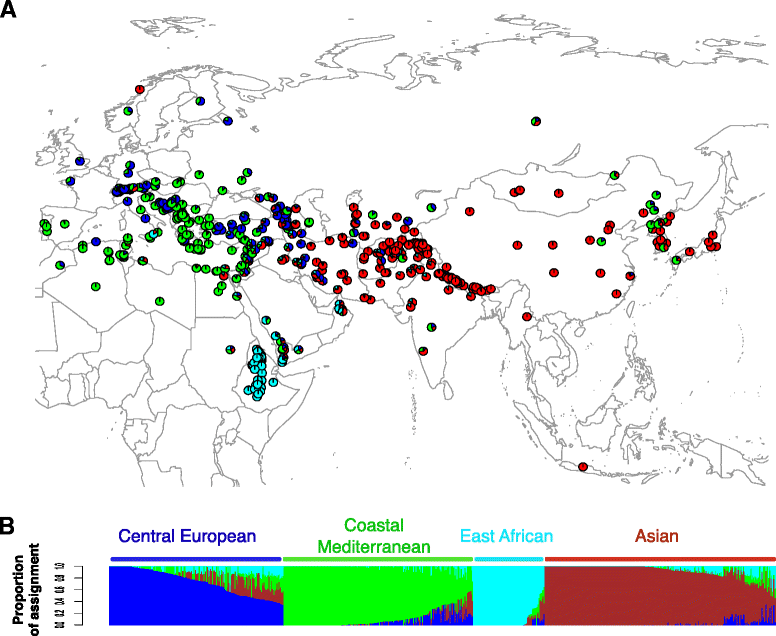
Figure 1

The above graphic shows the early split of mtDNA U7 across Eurasia. One can quite clearly see that the oldest splits seem to be between Iranian plateau & South Asia. This pattern is also observable for other shared mtDNA & y-dna lineages shared between these 2 regions. For more on this please refer to my blog.

Therefore, the Rakhigarhi provides one more line of evidence to re-inforce what was already evident from many previous studies on modern DNA, that the major portion of the shared ancestry between the Iranian plateau and South Asia was not brought into South Asia from Iran by the Iranian farmers but had separated from the ancestors of Iranian farmers/herders well before 12,000 years ago. With this Rakhigarhi paper getting such widespread coverage, one can only hope that from now on this fact will become known to much more people than it had been previously.

South Asian Neolithic

Since it has now become clear that there was no migration of early Iranian farmers into South Asia, so it has begun to be argued that farming must have been adopted by local NW hunter gatherers of South Asia through spread of ldeas from the fertile crescent.

While this is certainly plausible, it rests on the premise that farming began independently only once in the Fertile Crescent and it spread from there to everywhere else.

This is however not so straightforward. There are similarities at Mehrgarh with the Neolithic sites of the Eastern Fertile Crescent or the Iranian Neolithic but not with the Levant or Anatolian Neolithic. The archaeologist who discovered the Neolithic site of Mehrgarh and carried out decades of excavation over there, J F Jarrige, had this to say

The similarities noticed between Neolithic sites from the eastern border of Mesopotamia to the western margins of the Indus valley are highly significant. A sort of cultural continuum between sites sharing a rather similar geographical context marked with an also rather similar pattern of evolution and transformation becomes more and more evident. But the Neolithic of Mehrgarh displays enough original features to imply an earlier local background which has so far not been documented. Nevertheless the cultural dynamism shown by the inhabitants of Mehrgarh as early as level I of Period I indicate that the Neolithic of Balochistan cannot be interpreted as the “”backwater” of the Neolithic culture of the Near East. (link)

So indeed there are cultural similarities between the South Asian Neolithic and the West Iranian Neolithic and we know that the early farmers of both these regions were also separated from a common ancestor but the genetic evidence makes it clear that the common ancestor likely lived at the end of LGM aroynd 18 kya rather than the beginning of Neolithic around 9-8 kya.

It is not quite clear how the early South Asian & Iranian farmers interact or relate to each other during this Neolithic phase but it is quite clear that the early Iranian farmer was significantly different than the nearby farmers of the Levant & Anatolia both genetically and even culturally while he has much more in common with his much distant eastern cousins. Might not this imply that the origins of these Iranian farmers lay to the east close to its South Asian cousins ?

Jarrige provides several lines of evidence that suggest that the Neolithic in South Asia developed independently of West Asian input.

Lorenzo Costantini has shown that the plant assemblage of Period I is dominated by naked six row barley which accounts for more than 90% of the so far recorded seeds and imprints. He has also pointed out the sphaerococcoid form of the naked-barley grains with a short compact spike with shortened internodes and small rounded seeds. According to him, such characteristics in the aceramic Neolithic levels can be ascribed to probably cultivated but perhaps not fully domesticated plants. Domestic hulled six-row barley (H. vulgare, subsp. vulgare) and wild and domestic hulled two-row barley (H. vulgare subsp. spontaneum and H. vulgare subsp. distichum) have also been recorded, but in much smaller quantities. According to Zohary quoted by R.H. Meadow, the distribution of wild barley extends today to the head of the Bolan Pass. It is therefore likely that local wild barleys could have been brought under cultivation in the Mehrgarh area.

The main crop at Mehrgarh was barley by far and we see that there is enough evidence to suggest its local domestication from nearby wild varieties.

There is also genetic evidence to suggest two independent centers of barley domestication.

There has long been speculation that barley was domesticated more than once. We use differences in haplotype frequency among geographic regions at multiple loci to infer at least two domestications of barley; one within the Fertile Crescent and a second 1,500–3,000 km farther east. The Fertile Crescent domestication contributed the majority of diversity in European and American cultivars, whereas the second domestication contributed most of the diversity in barley from Central Asia to the Far East.

It is abundantly clear that the barley used by South Asian Neolithic farmers fits in very well with this second domestication scenario.

Jarrige also notes,

The presence of bones of relatively small subadult and adult animals in the trash deposits of the early levels confirms, according to R.H. Meadow, the domestic status of at least some of the goats. Meadow has also clearly shown that “” though in the course of Period I at Mehrgarh, the remains of sheep and cattle became to increasingly dominate the faunal assemblages of the successive strata, at the same time, the animal represented grew smaller in body size”. By the end of Period I, cattle bones amount for over 50% of the faunal remains. Osteological studies as well as clay figurines indicate that zebu cattle (Bos indicus) is well attested in Period I and became most probably the dominant form (Fig. 12). Mehrgarh provides us therefore with a clear evidence of an indigenous domestication of the South Asian zebu. We know today that Bos indicus and Bos Taurus, the non-humped bull from the Middle-East, have a different genetic origin. Therefore the assumption that farming economy was introduced full-fledged from Near-East to South Asia needs to be questioned.

The archaeological & genetic evidence therefore clearly implies a local domestication of indigenous cattle just as is the case with the domestication of barley. Even the goats and sheep were likely domesticated from local wild populations of the same. We may bear in mind that the Iranian Neolithic farmers were essentially goat herders and did not have cattle for a long period before it eventually came in from the Anatolian-Levant region. So they couldn’t possibly bring in the know-how or cattle domestication to South Asia.

With such an abundance of evidence at our disposal it becomes clear that the origins of Neolithic economy in South Asia can be attributed to local South Asian Hunter Gatherers, deeply related to Iranian farmers/herders, who started it by indigenous domestication of barley and cattle from local wild ancestors. So the only question that remains is whether the Neolithic technological knowledge came in from the Fertile Crescent.

That is difficult to answer, but we may end here by noting that in the case of the Near Eastern Neolithic, the transition from hunting gathering phase to the farming phase brought about an admixture of Iranian Farmer like admixture in the local Anatolian HGs. 

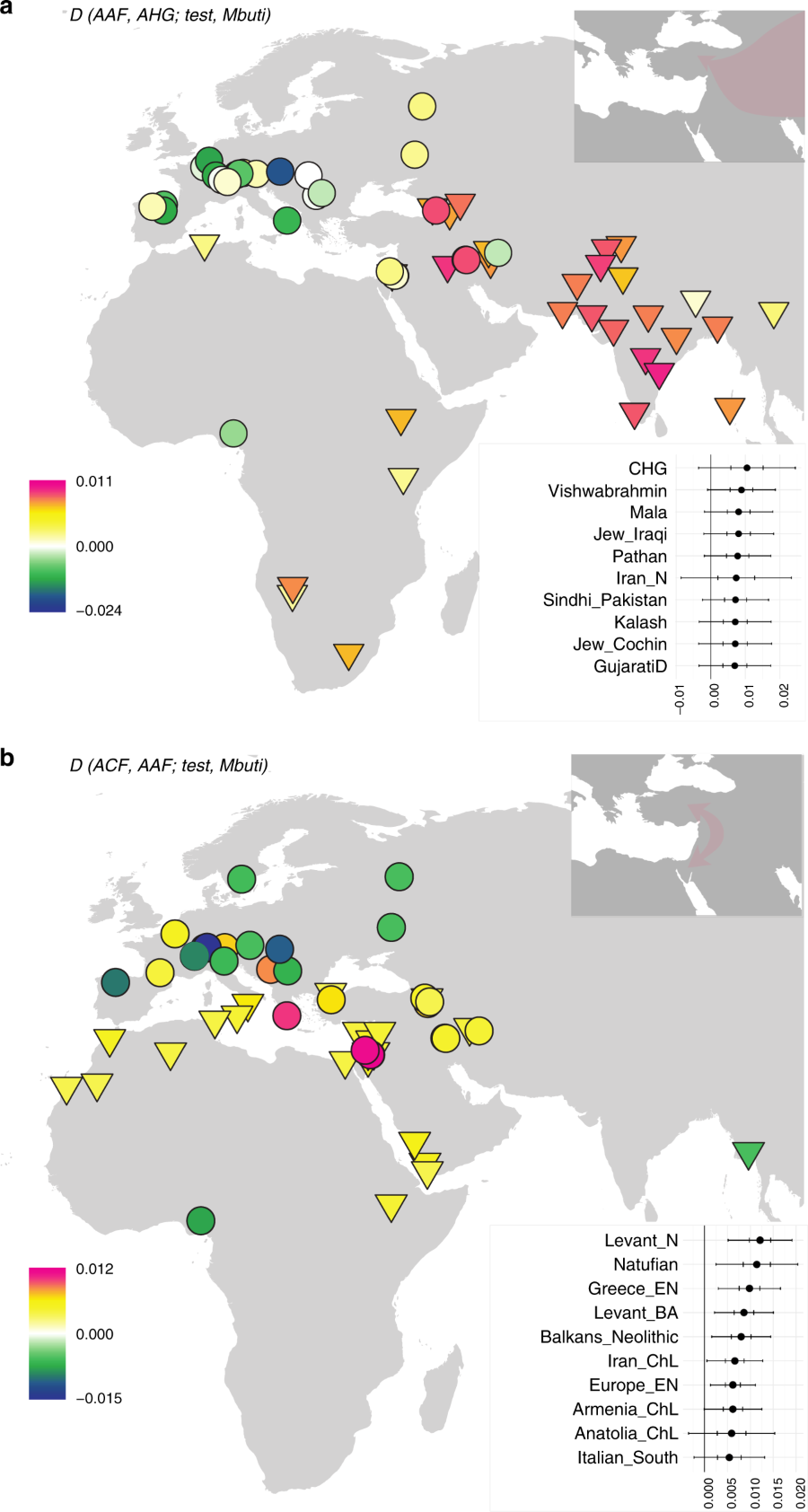
Fig. 2

In the above figure a, AHG is Anatolian HG while AAF is Anatolian Aceramic Farmer. We see from this graphic that, with a transition from AHG to AAF, we see that there is an influx of admixture into AAF which brings it slightly closer to Iranian Farmer & CHG ancestry. In contrast no such admixture is seen in South Asian farmers.

So might this indicate that the Neolithic technology spread from East to West ? Future research will surely shed more light on it but it should be clear to everyone that South Asia most likely was an independent and major center of Neolithic transition and deriving its origin from the Fertile Crescent looks rather unconvincing.

We may also look afresh at the question of origins of Central Asian Neolithic and whether it derived from Iranian Neolithic or South Asian Neolithic.


The Sintashta were swarthy

One of the things that I’ve always been curious about is why some Indian populations are not fairer in complexion if they had so much steppe. The logic here is that the “most steppe population” are peoples such as the Lithuanians, and these are very fair-skinned groups. If, for example, North Indian Brahmins were ~30% steppe, and these steppe people looked like Lithuanians, wouldn’t we see more blondes in northern India?

I’ve posted on this before, but after today’s conversation with Vagheesh, I checked the data on his Sintashta samples on the Hiris-Plex pigmentation panel. Pigmentation prediction in ancient populations are pretty sketchy…but the Sintashta are actually not that different from many modern Northeast Europeans.

Spot-checking some major loci where Europeans are very distinct,  such as KITLG, OCA2-HERC2, and SLC45A2, it is clear to me that the Sintashta were much more darkly complected than modern Northern Europeans.

To give a concrete example, rs16891982 in SLC45A2 is at 2% minor allele frequency in British 1000 Genomes samples (3% in Tuscans, 18% in Spaniards). The minor allele frequency is 12.5% in 64 Sintashta chromosomes.

The derived SNP associated with blonde hair in Northern Europeans, and found at about 20% frequency in those populations, was found in none of the 32 calls where that position was returned.

I doubt the Sintashta were very dark. Rather, their pigmentation was probably more in the range of Southern Europeans like Sardinians if I had to bet.

(one of the implications here is that the results which indicate strong selection for lighter complexion in Northern Europeans into historical times are probably detecting something real)

Continue reading The Sintashta were swarthy

Browncast Episode 66, ancient India and DNA with Vagheesh Narasimhan

Another BP Podcast is up. You can listen on LibsyniTunesSpotify,  and Stitcher. Probably the easiest way to keep up the podcast since we don’t have a regular schedule is to subscribe at one of the links above.

You can also support the podcast as a patron. The primary benefit now is that you get the podcasts considerably earlier than everyone else. I am toying with the idea of doing a patron Youtube Livestream chat, if people are interested, in the next few weeks.

Would appreciate more positive reviews!

This show is an interview with Vagheesh Narasimhan. The two papers are freely available at his website. Many of the papers mentioned are at the Reich lab website (free). We do mention a Southeast Asia ancient DNA paper that is from the Willerslev group.

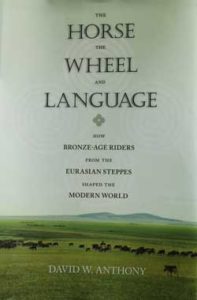
I do recommend The Horse The Wheel and Language. It’s a little out of date but take it seriously, not literally.

Kushal Mehra’s interview with Niraj Rai worth a listen.

An article on the reception to the research within India.

Brown Pundits