
Please keep the other posts on topic. Use this for talking about whatever you want to talk about.
Please note our podcast, Twitter, and RSS feed. Also, our Patreon.
 Update: A reader points out my example may not indicate what I assumed. Another reason why Twitter sucks: easy to misunderstand. The general point though stands.
End update
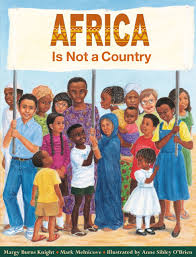
Over the past generation or so there has been a meme, “Africa Is Not a Country”, which reflects the reality that many well-meaning people don’t know much about Africa, to the point where they confuse a diverse continent for a country.
There is a similar reflex though which to me is redolent of the same intuitions and confusions: making Islam into a racial identity. This is particularly common among two groups:
– the type of people who have Greek statue images in their Twitter profiles
– the type of people who have pink-hair avatars and rainbows flags in their Twitter profiles
I won’t say much about the former.
But the latter is interesting and curious to me personally. Many in my immediate family are Muslims (e.g, parents, the vast majority of my cousins). I come from a line of ulems and Sufi mystics. The law of the Hanafi tradition is deeply embedded in my family’s culture. Though never a big believer myself in the religion, I had a vaguely Muslim identity until my tweens, and know a bit about the religion intellectually.
To illustrate the phenomenon I’m talking about, recently an Asian American comedian made fun of Catholicism in a sacrilegious manner (I didn’t think it as very funny since it was derivative and unoriginal). In response, some people asked him to insult Islam. To this, he said “how bout you make fun of ISLAM?” (yikes) to straight up rampant racism (yikes).
In other words, engaging in blasphemy against Islam is racism to him (which is blasphemy to a progressive).
It has gotten to the point where progressives have accused me of being an anti-Muslim racist when I suggest that many Muslims are Creationists. Progressives are of course being stupid but note these progressives are often white secular types who in their lives don’t encounter believing Muslims. They have the idea of what Muslims represent to them. It’s about them, not Muslims.
Perhaps others have different experiences, but the way I was raised as a Muslim, the idea that Muslims are a race would be deeply offensive since Islam was presented as the most antiracist and egalitarian of religions. Believing Muslims assert they have a deep connection to the Ground of all Being, not that they are a corporeal identity-group. In contrast, many secular progressives are taking the far-right racialization of Muslims and enshrining it into their understanding of the religion, so that Islam, the belief-system, becomes a “protected class.”
Of course, the reality of what Muslims believe and how they live their life might not comport with progressive expectations, which seem to involve someone just like them, but with a headscarf on. From the perspective of an Islam-skeptic person though the lesson is clear: Islam is now the progressive party at prayer. Though real Muslims often have major issues with progressives and their modern cultural projects, progressives have embraced their idea of Islam and Muslims in the fight against the Greek statue profiles.
We live in a really strange world.
Addendum: As an atheist from a Muslim background I have looked dimly upon Muslims and the Islamic project for much of my life. But progressive revolutionary rhetoric and action have softened my heart toward the religion and the people. It turns out that religion is not the root of all evil.
 Much of the discussion over the last few weeks on this weblog (see “Open Thread”) has involved the internal politics of India, and its clearer trajectory in regards to a Hindu sense of self. Most of the comments are not really worth reading, as they repeat platitudes. I have said little because I know very little which would add much to the discussion.
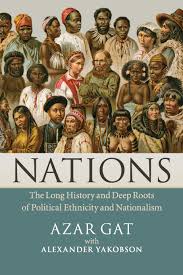
That being said, let me take a break from pre-Christmas activities, and just express the framework or “filter” which I use to understand what’s going on in India (and elsewhere) today. I am not someone who believes that to understand modern social-political ideologies in post-colonial nations all you need to do is understand the colonial experience. On the contrary, I lean toward the position that many national identities have deep roots and histories (e.g., China, Iran, and England, to name three). For more on this perspective, see Azar Gat’s Nations.
But, neither is it true colonial, Western, and international, currents are irrelevant in understanding notionally primal and indigenous nationalists and pan-nationalisms. To give three examples. Chinese nationalism in the early 20th-century explicitly looked to the West, and east toward the success of Japan, in attempting to create a post-imperial identity. Iran in the early 20th-century coalesced around a resurgent Persian national identity in a multi-ethnic society which had heretofore been bound together by Shia Islam (imposed on Iran by Turkic Safavids in the 16th and 17-century). Finally, the emergence of the German nation-state under the Kleindeutschland vision is hard to understand without the French Revolution, and the shock it imposed on German elites, and in particular the Prussians.
These three instances are clear, distinct, and organic nationalisms. In many ways, elements and configurations of these nationalisms were preexistent to the 19th/20th-century variety. The Safavid state under Shah Abbas I to me served as a template for the Pahlavi project. There were inchoate elements of German nationalism in various polities of the Holy Roman Empire, in particular in the Habsburg domains, where aristocratic cosmopolitanism was always balanced with the hegemony of German culture around Vienna. Finally, the imperial Chinese state in various forms was already proto-modern quite early. I would emphasize the Northern Song period, around 1000 A.D.
But there are other nationalisms developed in the 20th-century which created something de novo in a very real sense. Kemal Ataturk attempted to fashion a form of Turkish post-Ottoman identity explicitly modeled on a Western European template. Though Ottoman Turks did have an ethnic identity, and some level of ethnic chauvinism, the reality is that the Ottoman identity was primarily one of religion. Modern Turkish is written in a Roman alphabet. This means that modern Turks are detached psychologically from the literature of the Ottoman period, which is written in Arabic script. This was clearly a conscious attempt by Ataturk to fashion something new and unmoored from the past.
Even more nebulously, Pan-Turkism and Pan-Arabism appealed to an ethnonationalism more organically suited to the European context and history. Though Pan-Turkism never became much more than moral and logistical support by the Turkish government for various national resistance movements (Turkey has long supported a community of Uighurs), Pan-Arabism was influential in much of the Arab world in the middle of the 20th-century.
Pan-Arabism was closely connected to Arab Nationalism and in particular the Ba’ath parties. A reductive way to describe Ba’athism is that it was a escape valve for religious minorities to espouse a form of nationalism that united them with Muslims, and often Sunni, majorities. But Ba’athism became popular for a reason. The rationale for Ba’athism may have some connection to the discomfort with majoritarianism by minority elites in the Arab world, but the 20th-century demanded a form of social cohesion beyond what Sunni Islam had earlier provided (the radical Leftism of some Arab nationalist movements is another path).
Because of Arab opposition to Western imperialism in the early 20th-century, it is not surprising that Ba’athism has been connected in some way to fascism. The problem with our understanding of fascism and right-wing nationalism in the early 20th-century is that Nazism has overshadowed all other forms. But movements to challenge Communism’s appeal to the young and radical were diverse and widespread. For example, right-wing Zionism of the Revisionist school (the ideological ancestors of the Likud party) had connections to these broader trends.
Which brings me to three ideologies which also arose in the modern period: Hindu nationalism, Pan-Islamism, and the “Two-nation theory.” Hindu nationalism and Pan-Islamism arose at the same time, as notables and intellectuals within Hindu and Muslim traditions reacted to the shock of Western modernity. Both these traditions have a mythos of being primal, but the reality is that many elements are quite modern.
To illustrate this, the Iranian Islamic Republic was an explicit attempt to turn back toward indigenous forms and values, but it retains a broad democratic system of governance (democracy being Western). The Shia movement in Iran clearly had resonances with earlier Pan-Islamists, in particular in its early ambitions, and over the past few centuries had integrated and reacted to stimuli from the West far more extensively that modern traditionalist Shia establishments.
Hindu nationalism is in a similar boat. On the one hand, its roots are ancient, and it reflects a vision with deep local roots. But it has had to adapt and develop tools which are quite modern, and only comprehensible in the modern context. Which brings us back to some associations of right-wing Hindus with right-wing movements elsewhere…and a connection to Nazis and genocide.
You could present the case that Hindu nationalism is particularly pernicious at the root. It is brown Nazism of a sort. I am very skeptical of this take, because Hindu nationalism has a rationale of its own, and must be viewed as an indigenous reaction to Western imperialism. Palestine’s Zionist Revisionists associated with Italian fascists in the 1930s. If you know the history of Italian fascism this is not so peculiar. Similarly, various Arab notables and nationalists expressed pro-fascist, and later even pro-Nazi views. Some of this is due to shared affinity because of common enemies, while some are purely mercenary and situational.
This brings me to the “Two Nation Theory.” As above, this is based on a myth. The collapse of Ashraf hegemony, the rise of Indian Muslims, reconfigured the social and political landscape. Muhammed Ali Jinnah was the grandson of a Hindu merchant of ambiguous sectarian affiliation who was personally not particularly pious. The idea of an Indian Muslim nation makes sense for such a man, but not the Turco-Persian grandees of yore.
For various reasons, the Indian republic rejected this vision. I believe that in doing so they rejected the march of history, which has been toward greater sectarian identity and passion. Western commentators attempt to understand Hindu Nationalism on their terms, but just like the rise of an indigenous Indian Muslim identity is now stripped of West Asian accretions in the substance*, Hindu Nationalism is not comprehensible without understanding the interests and foci of native elites.
Where does this leave us? Everywhere and nowhere. In the past and looking to the future. Extracted out of the context of world history over the past 200 years Hindu Nationalism can seem uniquely invidious. But I doubt it is so unique at all. Rather, it is a novel cultural complex that draws deeply on indigenous atavisms. It is part of a broader waxing of local movements the world over.
* Pakistanis may claim West Asian origins or associations, but the national language is Urdu and Indo-Aryan dialect. The Ashraf of yore would have enshrined Persian as the national language.
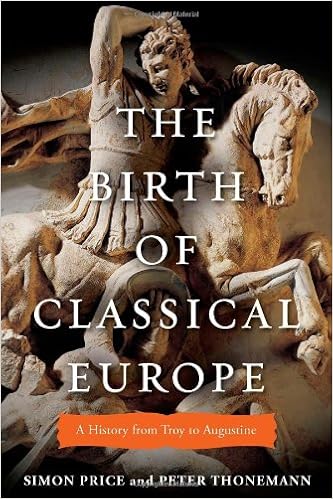
This book is a great review of the rise and fall of classical Europe, from the earliest civilizations in Crete and Greece to the fall of the Roman Empire and the rise of Christianity. The authors are professional historians and remarkably free of either Left or Right wing cant. They provide an excellent summary of the rise of Mediterranean civilization and the origins of the notion of Europe. They manage to pack a remarkable amount of facts into this book, including quantitative data where possible (“X percent of all crockery at this site changed from Greek to Etruscan between Y and Z years” kind of thing). Greco-Roman nerds will know many more details obviously, but even they will not be disappointed with how much information and perspective the authors can fit into a small space. Well worth reading.
From Dr Hamid Hussain
20 December 2019
I wrote a piece about recent changes in Kashmir. While working on the background, I stumbled on an interesting chapter of Kashmir & Pakistan history that I have never seen in any mainstream publication. I decided to dig a more deeper to understand it better. Following is the outcome of that exercise. I thought it was important for those interested in the history of the region. Enjoy.
Regards,
Hamid
Ahmadis and Kashmir
Hamid Hussain
“Independence of Kashmir can only be achieved by Kashmiris. Outsiders can only help in two ways; with financial support and by advocating their cause. Kashmiris should forget that outsiders will fight their war. Such outside help will not be useful; in fact, it will have opposite effect on the struggle for independence. If control of the struggle is in the hands of outsiders, it is possible that they will sell Kashmiris for their own interests. It is in the interest of Kashmiris that they should get advice as well as financial help from outsiders but never ask them to come and fight their war in Kashmir. In this case they will lose control. Long term sacrifice and not temporary emotional outburst will serve their cause and long term sacrifice can only be done by Kashmiris”. Head of Jama’at Ahmadiyya, Mirza Bashir Uddin Mahmud, 27 September 1931
Jama’at Ahmadiyya is a sect founded by Mirza Ghulam Ahmad (1835-1908). In early twentieth century, it was a small community with disciples mainly from Punjab; the birthplace of the founder. There was much hostility against the group in view of doctrinal differences especially when Mirza claimed to be Messiah and prophet. Agitation of orthodox clerics over decades finally culminated in an unprecedented act where Pakistan’s parliament declared the sect non-Muslim in 1974. This started a wave of persecution forcing many Ahmadis to leave the country and find refuge all over the world. General hostility including outright abuse against the group is at such an abnormal state that it is impossible to have any kind of meaningful discourse about the role of Ahmadis in Kashmir as well as independence movement of Pakistan. This part of the history disappeared from almost all historical works in Pakistan.
Kashmir was a Muslim majority princely state ruled by a Hindu Dogra ruler. Kashmiri Muslims were economically poor and politically powerless. Muslims of neighboring Punjab, many with Kashmiri heritage were concerned about the plight of Kashmiri Muslims. In 1911, they established All India Kashmiri Muslim Conference (AIKMC) in Lahore. This organization remained only on paper with no connection with Kashmiri Muslims and no program. In the summer of 1931, simmering discontent in Kashmir resulted in riots. On 25 July 1931, leading Muslims mainly from Punjab gathered at Simla and established All India Kashmir Committee (AIKC). The list of attendees of this meeting included literary and intellectual powerhouse Sir Muhammad Iqbal, head of Ahmadiyya community Mirza Bashir Uddin Mahmud Ahmad, leading Punjabi politician Sir Mian Fazal Hussain, Nawab of Maler Kotla Sir Muhammad Zulfiqar Ali Khan, Nawab of Kanj Pura Ibrahim Ali Khan, leading cleric of Delhi’s Barelvi community Khawaja Hassan Nizami and a former teacher of the leading orthodox Sunni seminary Darul-Uloom Deoband Maulvi Mirak Shah. Fazal Hussain wanted Iqbal to head the organization but on recommendation of Iqbal, Mirza Mahmud was unanimously chosen as president of AIKC. Muslims of different walks of life were members of AIKC including politicians affiliated with different parties, lawyers, educationalists, landed aristocracy, clerics from different schools of thoughts, journalists and businessmen. At no other time, such a consensus developed among diverse Muslim population of India. Continue reading The Role of the Ahmediyya Movement in Kashmir
I. Turning of the Wheel: Baba Nanak and Babur
In 1519, Babur invaded India – ‘ever since coming to Kabul we had been thinking of a Hindustan campaign, but for one reason or another it had not been possible,’ he writes in the Baburnama (translated by William Thackston, see pp 270-280). For some time his armies had been campaigning on the frontiers of the Hindu Kush, but these campaigns had yielded ‘nothing of consequence to the soldiers’. So, he turned to Hindustan. In the next few months, despite dogged resistance by the Afghans, Gujjars and Jats of the upper reaches of the Jhelum and Chenab, northern Punjab was subjugated, and plundered, by Babur’s armies. Babur himself spent most of his days inebriated, contemplating the legacy of Timur and setting poems to rhythmic metres. While his next great invasion of Punjab would come few years from then, in this interregnum, Punjab burned.
Among the towns and villages devastated was the settlement of Sayyidpur.
It was not long after Babur’s march of death through Punjab that Guru Nanak returned home from his western voyages – to Mecca, through Baghdad, Masshad, Khurasan, to Kabul, Peshawar, and, finally, to Sayyidpur. To the house of a humble carpenter, Bhai Lalo (Janam Sakhi Parampara by Kirpal Singh, pp 138-140). Continue reading Sangat and Society: the Sikh remaking of the North Indian Public Sphere
People now and then ask me why JR contributes to this weblog when I think he’s profoundly wrong on some issues. First, being wrong is no sin. Even being offensive is no sin. I am a traditionalist in regards to expression.
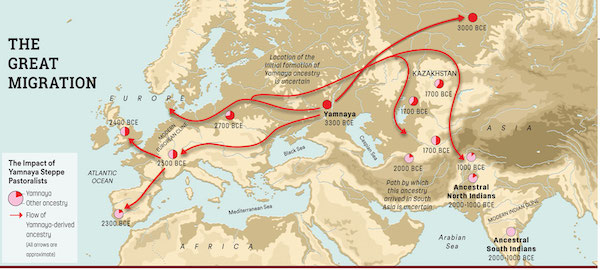
Second, JR presents what I believe to be the wrong position with a reasonable command of the sources and in a logical and coherent manner. He has not convinced me, but I have sharpened my own views (and to be frank, I believe that both of us have changed positions over the last four years as new data has emerged). Unfortunately, this is in contrast with the bluster, ad hominem and incoherence of many opponents of the idea of the exogenous origins of the Indo-Aryans. I used to think these people were malicious, but I think a lot of them are just stupid. So I hold it less against them.
JR presents what strikes me as an Indocentric view. He is quite clear that he sees his project as compensatory and reactive to the traditional Eurocentric view. My own position is quite naively positivistic, and I attempt to be cross-cultural. Of course in the details, I fail because to be subjective is to be human (my own view is going to be Eurocentric because my cultural orientation is American). Knowledge of the empirical world accumulates despite our shortcomings. JR has made an appeal to me as a person of subcontinental origin on occasion, but this lever is pulling on a string of emptiness. I am one of the Last Men who are weak in regards to racial self-conception.
Sometimes you really know what people are about by what they don’t talk about. Americans don’t talk directly about money, but we care about it a great deal. Indians don’t talk about caste directly in personal detail, but clearly they care about it a great deal. And the converse is also true. Much of my bluster about R1a1a-Z93 is that I find lineage to be a humorous and frivolous fixation, though I am latitudinarian is accepting that others may differ with me on this. It is a matter of disposition for me, not a deep principle. AMT or OIT has little emotional valence for me.
Finally, I have to admit that I have become disillusioned with the calm and conscious lying and obfuscation which I know to occur in sciences with which I am familiar. When Westerners have strong ideological priors and beliefs at stake, scholars abandon fidelity to the truth so as to tack to the winds and align themselves with the regnant ideologies of the age. They are servile creatures who bend to power. I do not have it within me to look down upon Indians for their bias and motivated reasoning when I know that Janus reigns supreme in Western academia. I thought “we” were better than this. I know now that that was a delusion. The courage of men fails. They will forsake friends and break bonds of fellowship. The truth is nothing next to these betrayals.
But I still vainly hold to the ideals of the old religion. Truth above all, strive for it even when it discomfits, and when you miss the mark so often. Knowledge is its own regard.
JR’s post, The Unravelling of the AMT, consists primarily of marshaling evidence from archaeology and linguistics (genetics being secondary). The contention is that the lack of archaeological disruption during the period between 2000 BC and 1000 BC, as well as no evidence in the extant literature of Indo-Aryan recollections of foreign homeless, should argue against an exogenous origin for Indo-Aryans. As I have no deep knowledge of these two fields, let us grant these assertions.
The reason that JR’s extensive argumentation does not convince me is that even granting the low probability of AMT conditional on the facts which he brings to the table, the probability of OIT is even lower conditional on the facts we know about other Indo-European societies. Alone, and isolated, if I grant the level of archaeological disruption to be minor, and if I grant that indeed Indian oral history does not record an external homeland, the model of mass migration in the period between 2000 and 1000 BC does strike me as unlikely (let’s put the genetics to the side).
But, if you reject AMT for this period, then we must explain Indo-Europeans in Europe and in the Near East. Logically the rejection of AMT entails OIT, and OIT presents far greater problems to me than AMT. From a cross-cultural perspective, a model that explains the current distribution of Indo-European languages must explain all of the different branches and their locations as parsimoniously as possible. There will be errors and loose ends in the model, but we have to iterate from a plausible starting point. AMT resolves more problems than it creates. OIT creates more problems than it resolves.
And yet to be entirely frank…I do think JR’s arguments will gain more and more traction with Indians. Indians are entirely Indocentric quite often, so arguments that operate within this framework will be persuasive. I find this personally uncongenial, but I am getting the sense as I get older that I have an abnormal interest in a disparate array of cultures and societies (some commentators, who may or may not have low IQs, express frustration that I refer to other societies and cultures since they are clearly ignorant of things beyond their shores). Here in the United States, there are “Ethnic Studies” departments that seem to exist so that people of a particular ethnicity can study their own history. They are quite popular and ideologically motivated.
The broad world out there is fading for the positivist vision. The age of science is giving way to the age of magic. The time for public discussion and calm inquisition of the facts has probably passed us by. Truth, understanding the shape of reality for its own sake, is a small cultic affair. And yet do well to remember, the lies that give you comfort are lies nevertheless!
The thought of writing this article came as I recalled a recent interview of Vagheesh Narasimhan with the Caravan magazine, where he explains how in his view, the Indo-Aryans must have spread across South Asia.
Before coming to what Vagheesh said in the interview, let us take a brief detour so that his comments could be understood in its proper context.
Except for the truly ignorant on the subject, it is clear as daylight to all scholars, whether Indian or Western, that the Rigvedic geography is centred in North India, more specifically around Punjab, Haryana & Western UP. The westernmost lands mentioned in Rigveda are the eastern regions of Afghanistan and these were certainly peripheral in the scheme of things of Rigvedic Aryans.
Yet, through the last two centuries several attempts have been made to parse out some sort of evidence from Rigveda or any of the early Vedic texts, in the form of memory or otherwise, that could support the argument of an extra-Indian homeland of the Rigvedic Indo-Aryans. However all such attempts have come to naught.
Let us go through the opinion of the mainstream western Indologists on the matter so that there remains no room for doubt on the matter.
Edwin Bryant notes in his seminal book,
The first prominent note of discord between traditional exegesis and Western scholarship was sounded because of the lack of explicit mention, in the Vedic texts, of a foreign homeland of the Aryan people. As mentioned previously, this conspicuous silence had been noted even by nineteenth-century Western scholars (e.g., Elphinstone 1841). The absence of any mention of external Aryan origins in traditional Sanskrit sources is, to this day, perhaps the single most prominent objection raised by much of the scholarship claiming indigenous origins for the Aryan culture. (pg 59)
Already in the middle of the 19th century we have scholars such as Curzon (1855) who argues, “Is it legitimate … to infer that because the Aryans early spread to the South . . . and extended themselves over the peninsula, they also originally invaded, from some unknown region and conquered India itself?” (pg 65) and Muir(1860) who notes that “none of the Sanskrit books, not even the most ancient, contain any distinct reference or allusion to the foreign origin of the Indians” (pg 63)
Bryant quotes Srinivas Iyengar, who in 1914 quite pertinently said,
The Aryas do not refer to any foreign country as their original home, do not refer to themselves as coming from beyond India, do not name any place in India after the names of places in their original land as conquerors and colonizers always do, but speak of themselves exactly as sons of the soil would do. If they had been foreign invaders, it would have been humanly impossible for all memory of such invasion to have been utterly obliterated from memory in such a short time as represents the differences between the Vedic and Avestan dialects. (pg 59)
Bryant refers to Indian scholars as early as the latter half of the 19th century who object to the external origins of the Indo-Aryans, which should clear the doubts of those who think that opposition to AIT/AMT is a modern Hindutva invention.
As per Bryant, “… the fact that the Vedas themselves make no mention of any Aryan invasion or immigration reveals a major epistemological concern in this debate. ” (pg 59)
Bryant concludes the chapter thus, “The sequence of texts does seem to suggest a movement of the Brahmanic geographical horizons from the Northwest to other parts of India. Nonetheless, the Indigenous response needs to be considered: the texts give no obvious indication of a movement into India itself. Indigenous Aryanists, on the whole, are prepared to accept a shift of population from the Sarasvatl region eastward toward the Gangetic plain…But they do not feel compelled to then project this into preconceived hypothetical movements into the subcontinent itself in the pre- and protohistoric period.”
Hans Henrich Hock, a well-known linguist and Sanskritist, in his contribution to this major volume, The Indo-Aryan Controversy, also observes,
Some publications claim that the Rig-Veda contains actual textual evidence for an Aryan in-migration…suffice it to state that none of them provide unambiguous clues that the point of origin for these travels was further (north-)west or outside of India/South Asia, or that the direction of travel was to the east or further into India/South Asia. (pg 290)
Hock rather candidly tells us that “…the passages cited by Biswas and Witzel do not provide cogent evidence for Aryan in-migration and thus cannot be used to counter the claim of opponents of the so-called “Aryan Invasion Theory” (e.g. Rajaram and Frawley 1997: 233) that there is no indigenous tradition of an outside origin.” (pg 291)
Another major linguist George Cardona concurs that “… there is no textual evidence in the early literary traditions unambiguously showing a trace of such migration. “(pg 38)
Cardona goes one step further and analyses a particular passage Michael Witzel, an ardent proponent of the AMT, cites from the Baudhayana Srauta Sutra, to support his argument of textual evidence.
America has a national crisis in math capacity, competence and merit. American students sharply underperform students in many countries all over the world. Including Vietnam, which is a poorer country than India per capita. We will heavily refer to the 2018 OECD PISA report in below paragraphs, but the below chart graphic is from the 2015 OECD PISA scores report because math scores are reported for more countries in the 2015 report. Perhaps the 2018 report will be revised to add more countries in the future:

Note that these six countries were among the poorest countries in the world in the 1950s, far poorer than poor Americans or poor Europeans or poor Chileans can even imagine. In 1979 China was unbelievably poor. Much of the population of China–perhaps as many as 100 million–had starved to death because of extreme poverty in the 1970s. Poor children around the world are outperforming American children in mathematics despite extremely low education spending per student and very low socio-economic level of their legal guardians, where socio-economic level is defined as:
Do any American high school student subgroups perform well in Mathematics? Yes, “people of color” or “minority” Americans perform well in Mathematics. America’s “people of color” or “minority” students are orders of magnitude more likely to get an 800 on the mathematics SAT than European Americans. If we assume this is an extreme tail end distribution issue related to European Americans having a lower standard deviation and non standard distribution in mathematics performance relative to “people of color” or “minority” Americans, we can explore the breakdown of Americans who score between 750 and 800 on the Mathematics SAT. Here European Americans perform far better relative to “people of color” or “minority” Americans. In 2015 16,000 European Americans scored 750 or higher. 33,000 “people of color” and “minority” Americans scored 750 or higher. We further know that 51% of SAT test takers were European Americans and 49% were “people of color” or “minority” Americans. “People of color” or “minority” Americans are [33,000/16,000]*[51%/49%] or 2.15 times as likely to score 750 or higher on the mathematics SAT compared to European Americans. If we examine the 107,900 test takers who got SAT math scores of 700 or higher; 59,900 are “people of color” or “minority” Americans, versus 48,000 European Americans. “People of color” or “minority” Americans are [59,900/48,000]*[51%/49%] or 1.30 times as likely to score 700 or higher on the mathematics SAT compared to European Americans. For data junkie geeks like me there is a lot more data on SAT math score distributions here and here. The Greta Anderson article’s comment section in particular has some very intelligent commentators who have studied the American SAT score distribution. This is likely to be the subject of many future blog posts and Brown Pundits Podcasts.
What about this is worrying?:
Future articles and podcasts are planned all six of these future disciplines. If you are curious about fused AI-brain interface synthesis intelligence, please watch my main man Elon Musk:
Some say that the tension and relationship challenges between America’s four big castes–European Americans, European “Latino” Americans, Black Americans and Asian American–are driving low math scores for European Americans “AND” other Americans. One example is where thought leader Mark J Perry explores the possibility that tension between the European American caste and the Asian American caste are lowering American mathematics performance. Excerpts of his article are reproduced below: