 (source)
The Chalcolithic & Bronze Age civilizations geographically closest to the Harappan or the Saraswati-Sindhu civilization were the twin Eastern Iranian civilizations of Helmand and Halil Rud/Jiroft and the Central Asian civilization of BMAC spread over the southern margins of Turkmenistan & Uzbekistan and as far east as Tajikistan.
We have discussed the genetic evidence which showed profound Harappan influence in Helmand and BMAC while the aDNA from Halil Rud civilization, situated in the Kerman province of modern Iran, further west of Shahr-i-Sokhta, remains to be sequenced and published.
After having had a look at the genetic data that supports an Out of India migration into these adjacent regions of Eastern Iran & Central Asia, it would be in the fitness of things to also have a brief encounter with the archaeological evidence that can prop up the above said genetic evidence.
The archaeological data is much varied and quite interesting. However there is a lot more to learn and perhaps we have so far just scratched the surface.
Helmand & Halil Rud
The twin civilizations of Helmand and Halil Rud, situated to the west of the Harappan civilization, were not known until a few decades ago and even today we know very little about them. In many ways, we know even less about them than what we know about the Harappan civilization itself.
From what we know it is fairly clear that both of these Eastern Iranian civilizations preceded by several centuries the BMAC civilization and were roughly contemporaneous with the Harappan civilization. All of these southern civilizations, including the Harappan, are in turn considered to have played a defining role in the formation of the BMAC, a proposition which has been confirmed by ancient DNA evidence.
Both the Helmand civilization and its western neighbour, the Halil Rud civilization were intimately in contact with their geographically massive eastern neighbouring civilization of the Harappans.
In order to avoid an unduly long post, I shall limit myself over here to the very intriguing linkages of Harappans with the Helmand civilization only.
Helmand & Harappan
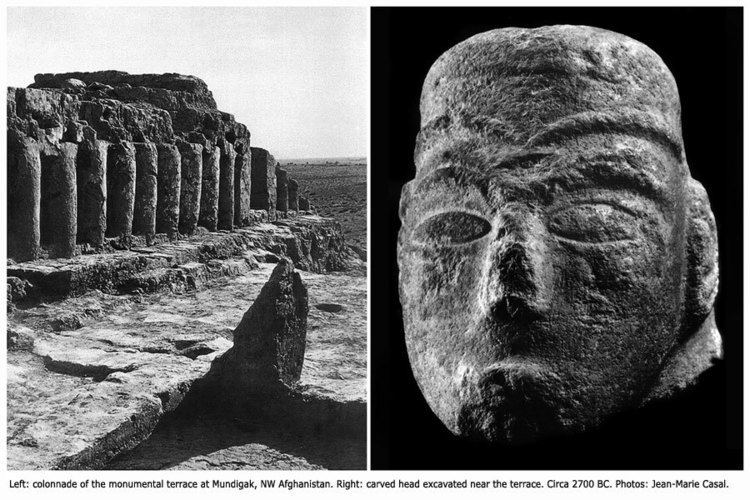 (Mundigak, Afghanistan)
 (Burnt Building, Shahr-i-Sokhta)
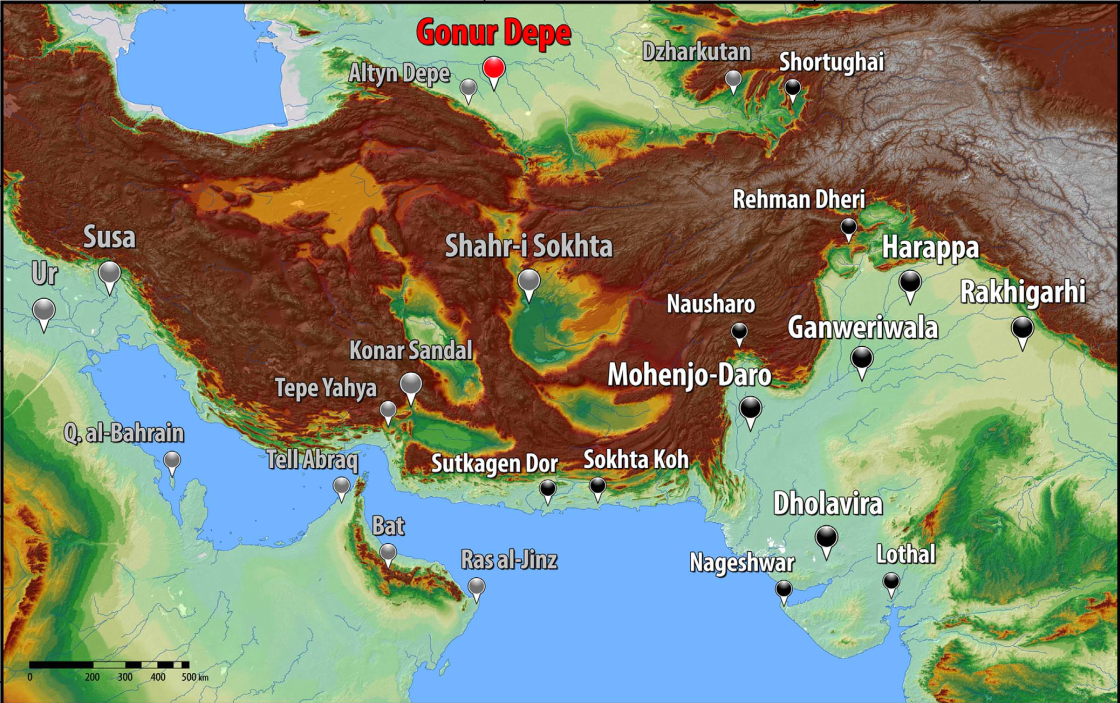
The Helmand civilization centred on the river Helmand which flows from Afghanistan into Sistan province of Eastern Iran. We know atleast two of its major sites – Mundigak in Afghanistan and Shahr-i-Sokhta in eastern Iran.
The genetic evidence from Shahr-i-Sokhta, the biggest Helmand site, confirms that the relations with the Harappans were quite strong with nearly half of all ancient samples from that site considered to have been migrants from the Harappan region, especially from Baluchistan and the rest of the ancient samples showing admixture from these migrants.
According to the French archaeologist, Jean Francois Jarrige, the principle excavator of Mehrgarh, as stated in this article, the foundation of Mundigak, the other Helmand site, can be interpreted as the settling of people from Baluchistan of the Mehrgarh Chalcolithic tradition and the remains of Period I at Mundigak fit almost perfectly the cultural assemblage of Mehrgarh Period III.
It is also significant that the pottery of Mundigak I, the earliest occupation of the “Helmand” cultural complex, corresponds to the Mehrgarh III pottery, in technique—quality of the paste and manufacture— as well in the shapes and decoration, probably within a phase dated to the end of the 5th millennium. The pottery of Mundigak I-II (fi g. 2: 3-5, 7-8) can also be related to the context of Balochistan ceramic productions, especially from Mehrgarh IV around 3500 BC. (link)
The foundation of Mundigak, incidentally dates to around 5000 BC and is therefore significantly older to the foundation of Shahr-i-Sokhta, its sister site in Helmand more than 400 kms to its west, whose earliest dates go only upto 3300 BC and where we have already seen that the Harappan or Baluchistani migrants were already present from the earliest period.
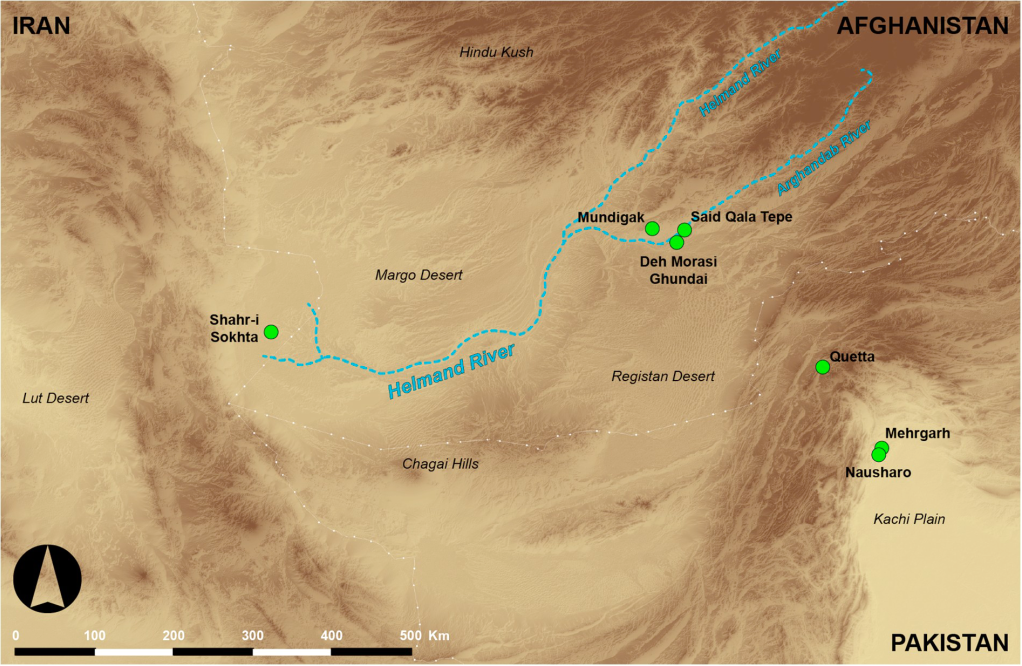
While , “..there is general agreement that Shahr-i Sokhta and Mundigak have the same material culture including similar buff ceramic material, validating the existence of a Helmand Valley archaeological culture at the time corresponding to Period I at the former and Period III at the latter…” it also needs to be understood that “Shahr-i-Sokhta I nonetheless has inter-regional connections that are not recorded at Mundigak. In particular, a series of objects point to contacts to the west…”(link)
With regard to Shahr-i-Sokhta, which in its most expansive phase was atleast around 150 hect. it should be noted that “…Shahr-i-Sokhta I is the foundation period of this site and that no other site (or no context at this site) has been observed thus far in Seistan with older archaeological deposits. Since no evidence for an older settlement is observed in this region, the most rational reconstruction is that Shahr-i Sokhta was founded by communities coming from (an)other area(s) in the late fourth millennium BCE.” (link same as above).
An important provenance study of the Shahr-i-Sokhta ceramics also indicated a strong influence from the west from the Baluchistani region and Mundigak. Almost all of the deluxe pottery that was found at the site and associated with elite graves was of non-local origin and were imports from the Iranian and Pakistani Baluchistan region.
The authors of this study also observe, “The possibility indeed remains that, for instance, the cultural assemblage at Mundigak, or a part of it, belonged to people who later moved to Shahr-i-Sokhta.”
We have already noted earlier how, Mundigak itself likely derives from the Mehrgarh Chalcolithic tradition of Pakistani Baluchistan. This tradition, also known as Damb Sadat or Quetta pottery tradition is one of the 4 major early pottery traditions of Early Harappans.
Continue reading The Archaeological Evidence for OIT – I