
Please keep the other posts on topic. Use this for talking about whatever you want to talk about.
Why did Bhutto Select Zia as Chief
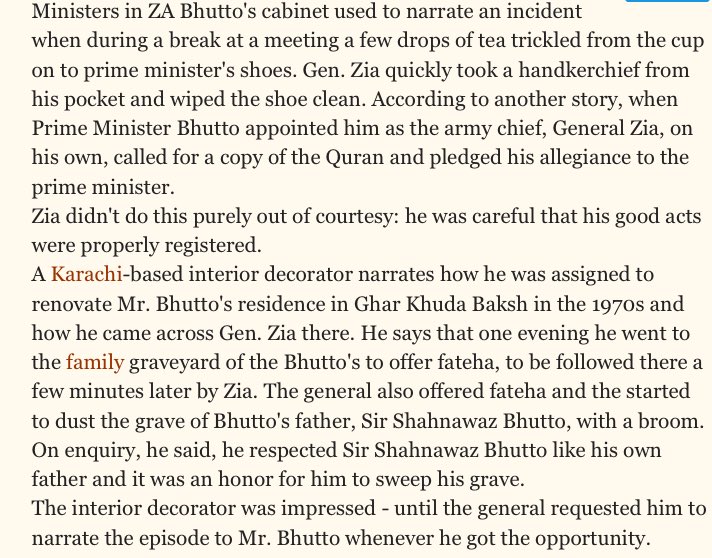
Because Zia was a world champion at sucking up to him.
An interesting snippet from Major Agha Amin
FROM MY MARCH 2001 INTERVIEW WITH MAJ GEN NUK BABAR SJ AND BAR —-Why did Mr Bhutto select Zia as a coas?
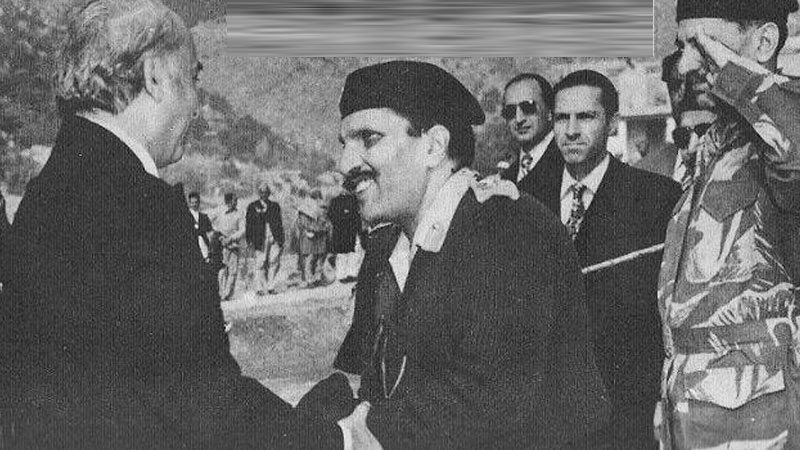
There were a number of reasons and these were discussed with me personally by Mr Bhutto, while in detention at Murree. One was the pretended humility and this disarmed Mr Bhutto into the belief that he would pose no threat to the nascent democracy. Secondly, his performance when he invited Mr Bhutto to the centenary celebrations of 11 cavalry at Kharian. He took pains to ascertain Mr Bhutto’s tailor in Karachi (Hamid Khan) and had a Blue Patrols as Colonel-in-Chief of Armoured Corps. On entering the room, Mr Bhutto found a suitcase on his bed and on inquiry was told that it contained the Blue Patrol. The next day, Mr Bhutto was requested to climb a tank and engage a target. Quite obviously the target was hit. Then was his performance while on deputation in Jordan, where he killed a large number of Palestinians (Black September), Mr Bhutto was led to the belief that if he was so loyal to Jordan, he would be even more loyal to Pakistan. His prime performance came at Multan, where he invited Mr Bhutto as Colonel-in-Chief. After the function, when Mr Bhutto had barely returned to Mr Sadiq Qureshi’s house, when he was informed that General Zia requested to meet him. Mr Bhutto was surprised, having met him in the mess a little earlier. However, he called him into Mr Sadiq Qureshi’s study/library. Gen Zia on entrance went round the Almirah, looking for something and on inquiry he revealed that he was looking for a copy of the Holy Quran. On finding a copy he placed his hand on and addressing Mr Bhutto he said, “You are the saviour of Pakistan and we owe it to you to be totally loyal to you”. Then was the fact that there was little to pick and choose amongst the other aspirants. The only other suitable candidate was General Majeed Malik who was Mr Bhutto’s favourite as a sound professional. Unfortunately was involved in the International Hotel Scandal where he was caught with Mustafa Khar. He was sent as Ambassador to Libya. Finally, of course was the American angle. They had picked Zia as suitable material at Fort Leavenworth, followed his career progress and possibly lobbied in his favour. They made it known to friends months in advance that he would be appointed coas. Zia’s obsequeous behaviour made Mr Bhutto think that he was a non-political man. Pakistani democracy was at an infant stage and could not afford an Army Chief with political ambitions. Then there was not much choice. Gen Sharif was considered politically unreliable since he had been very close to Ayub Khan. Jillani had no command experience and was the head of isi. Akbar Khan had not performed well as a goc 12 Division in Kashmir in 1971 war. Gen Aftab and AB Awan had no command potential and were not suitable.
Book Review: Descent into Chaos
An old review from Major Amin, it remains topical.
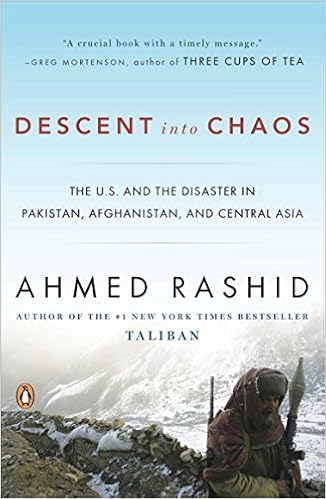
Descent into Chaos , Ahmed Rashid, Allen Lane,2008.ISBN No .978-1-846-14175-1
Book Review
Major A.H Amin (Retired)
11 October 2008
Ahmed Rashid acquired fame and became darling of the west when his book on Taliban was published in 2000 or so.Descent into Chaos is another bestseller as far as publishing statistics is concerned.It is a tragedy that the West,guardian of the present worlds intellectual property projects what suits its political and social interests and stifles what it finds “ politically unacceptable”.Seen in this background what Ahmed Rashid writes is acceptable to the west.Possibly because what he says fits hand in glove with western perceptions about how to shape the future.
As normal the book has some factual errors.Some insignificant some not so insignificant and some which not have escaped the sagacity of a known Afghanistan hand like Ahmed Rashid. Continue reading Book Review: Descent into Chaos
Hindutva jumped the shark
I am fucking speechless.
https://twitter.com/brownpundits/status/1153991827034386432
I am shocked on so many levels. This chap believes he can speak to the Muslim condition because his children’s nanny is a Muslim.
This reminds me of that film with Emma Stone, the Help, where she is the wonderful white woman speaking about the black help (one of the black actresses later said they always regretted making that film).
Wow just wow; the level of denial floods the Nile. I’m sorry people take exception to my constant banter about Urdu-Persian (languages are not peoples especially in a South Asian context where caste, creed and community is hyper-operative) but this is just so wrong.
Hindutva either accepts Muslims who either works for them or kowtows to them. This just repulses me.
Podcast with Suhag Shukla of the Hindu American Foundation
 Update: The podcast was recorded yesterday. So I edited it today, so if you are a patron you can already listen.
I’ll be interviewing Suhag Shukla of the Hindu Amerian Foundation for the BrownCast. I have some questions I’m going to ask, but this is a podcast where I am willing to take suggestions.
So if you have questions, put them in the comments (note that I’m not going to be the only person on the podcast, so I can’t guarantee I’ll be able to get to your question).
William Dalrymple, Imran Khan & Xerxes’s Jinnah moment-
One of the Hoi Polloi, or rather a penny-store Machiavelli, writes:
(Oh also nice job critiquing Zach’s H-M chasm and his Urduised worldview ? Was getting pretty boring listening to him and his friends go on about the same thing over and over again)
We haven’t listened to the episode so are unaware of what was exactly said. Neither do we know what H-M means but assuming His Majesty (though ShahenShah is preferable)?
On a personal level I take issue with “Urduised” because it’s known that I am partial to PAU (Persian Arabic Urdu).
Urdu is simply the liminal of civilisational elegance. The Great Moguls would have spoken Arabic to God, Persian among themselves and Urdu to their sub-alterns (such as the stable hands and chaiwallas).
Otherwise on a more personal note I don’t know who “my friends are.”
If, as I suspect, he means the CamCast Quarter then our views are radically different from one another. MJ is lightly coated with Saffron, V is a Nehruvian capitalist and J belongs to a very prominent (& known) right-wing family.
I myself am very partial to aristocracy and Monarchy. Perhaps that’s because I’ve spend the vast majority of my life in a country defined by both such institutions.
I was impressed to wake up this morning to William Dalrymple liking our tweet (Kiara Advani is now one of the foremost Mughalists).
https://twitter.com/brownpundits/status/1153172297764790272?s=20

In my more Tharoorian avatar; I would have ranted about Dalrymple being a coloniser and what not.
But the more I think about it, the more I’ve come round to how sound Two Nation Theory is.
Indeed my own life choices reflect that. I am not a Muslim and therefore I’m adopting Indian culture. If I were a practising Muslim there is no way I could choose the Saffron path.
Finally in one of the threads it was asked when Bangladesh would have its own Modi or IK.
I don’t think ethnically homogeneous and “sound” nations like Bangladesh will ever have a need to produce such leaders.
Partition is the Great Angst of the Subcontinent and it’s something that consumes both Pakistan & India. If there had been no Pakistan/Islam, there probably would have been no BJP or RSS or Modi.
However Pakistan, being such an artificial nation, has to produce these leaders to provide it with a coherent narrative.
Pakistan is always a few steps from collapse (in cricket & in life), which leads to chronic instability but also the potential for greatness.
A good example is below where Imran Khan is clearly lying through his teeth but is doing it with such elan that the reporter is flummoxed.
I prefer my leader to have that grace and polish and to have the ability to duel with dexterity. It’s a bit like the Great Moguls; the illusion is more important than the reality.
"…it was the ISI that gave the information which led to the location of Osama bin Laden" –Pakistan's PM #ImranKhan @FoxNews#ImranKhanVisitsUS #PMIKInUSA pic.twitter.com/5CzMKCymGI
— Raza Ahmad Rumi (@Razarumi) July 23, 2019
The final tweet is of interest to me:
https://twitter.com/curioserian/status/1153371394605871104?s=20
Hindutva foams at the mouth constantly trying to tell Pakistanis where our ancestors came from. Their desperation at getting us to buy into the Brahmanical hierarchy is cute but a touch manic to be honest..
Rethinking privilege in the 21st-century
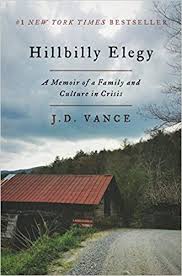 One of the strange admissions I will make is that I have not read Hillbilly Elegy: A Memoir of a Family and Culture in Crisis. This is J. D. Vance’s book describing the various social and cultural forces which maintain deep pockets of poverty and dysfunction across much of greater Appalachia. Vance, though a Yale-educated lawyer, is from this region, and of the deprived class.
I say strange because I happen to be cited in the book. Vance has told me that some of my writing on the historical origins of the Scots-Irish made him aware that he was not just a white American, that he had a very particular ethnicity in the broader Anglo-American context. The fact is that Vance’s politics are broadly consonant with mine, and I tend to be wary of reading books where I suspect I will agree with the overall message. I don’t find it useful to simply reiterate my own opinions, as I already hold them.
With all that said, I recently saw on Twitter that a literal Communist academic accused Vance of promoting the white genocide meme because he wrote about replacement level fertility among Americans. Just like an inquisitor sees witches behind every corner, American Leftists see a fascist and a racist everywhere they look. But that’s not the interesting point.
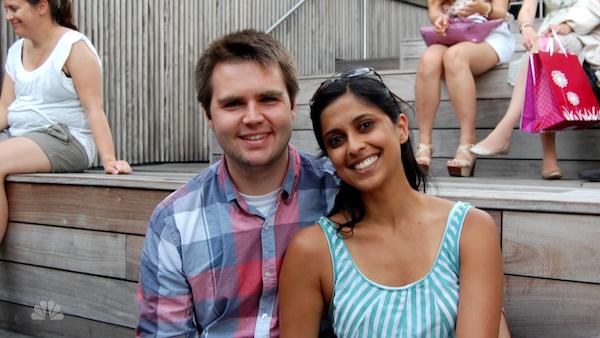
Vance responded that he had a mixed-race son.
I am not a specialist on J. D. Vance, so this was news to me. I didn’t know anything about his personal life. A little Google yielded the fact that Vance is married to an Indian American, a law school classmate. And, a little more research quickly yields the fact that she is from a much more privileged class background than J. D. Vance (most Americans would be!). In fact, judging by the community that she grew up in, it is highly unlikely that her family was not upper-middle-class (OK, it was easy to look up her parents and their professions, they are doing very well).
The question I pose here is that as the children of Mr. and Mrs. Vance grow up, will they perceive that they obtain privilege from their white father? Is J. D. Vance more privileged than his wife? A plain reading would probably result in the admission that this is ludicrous. The Vance children will grow up with a paternal lineage defined by hardscrabble lives, with the squandering of opportunities. In contrast, their maternal family will be descended from successful professionals. Immigrants who sunk roots in San Diego.
There is a lot of talk today about “intersectionality.” Usually, I don’t find that that is in good faith. But let’s take the intersecting parameters of the backgrounds of the Vances into account. Who is more privileged? I suppose it depends on how you define “privilege,” but my own personal take is that in fact, J. D. Vance’s wife is more privileged by background than he is, despite her visible nonwhiteness (which no doubt does result in some discrimination).
In the years before the Civil War, popular racial supremacism arose in the American South to engender solidarity of identity for whites, from the poor masses to the rich planter elite. It was the solidarity of the “aristocracy of the skin.” This explicit racial caste system was such that the poorest white was above the status of the most accomplished black. The way in which we talk about race and class in much of American discourse seems to default back to this idea.
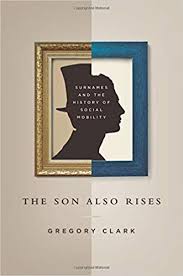 Many of my white academic friends (not all!) from working-class or poor backgrounds believe that because of their class status, they now have the same privilege as other white people. That the past is the past. That is, white people can move up and down the class hierarchy, and yet retain the skin privilege. History does not shadow them in the way that it does the dusky folk.
White people are magic.
As the 21st-century progresses I think some of us, of all races, need to move beyond this way of thinking. Many South Asian academics I know personally who come from privileged backgrounds speak of themselves as a subaltern and marginal people. But there’s nothing subaltern and marginal about their lives. Empirically I think the “white people are magic” thesis is just wrong. They bleed just like the rest of us.
From the earth to the moon!
 Congrats to India on launching the Chandrayaan! Here is an explainer. And an older WSJ piece, India Looks for Its Own Elon Musk to Win the Space Race with China.
It’s a commentary on our times that the 21st-century “space race” is between India and China (and Elon and Jeff). As for me, I’m pretty happy, because no matter who wins the race, the human race will benefit from inspiration, science, and technology.
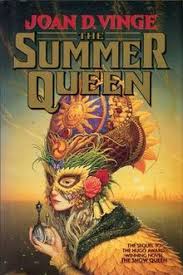
The only “brown” thing I will note is that Joan D. Vinge’s space opera Summer Queen features a dominant civilization which is obviously based on that of the Indian subcontinent. Brownz in space!!!
Imran Khan in DC
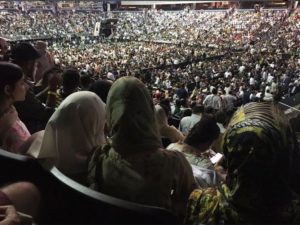
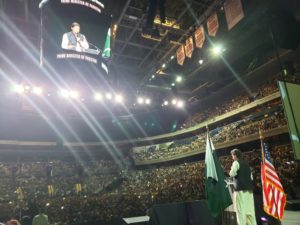
So, thirty thousand Pakistani-Americans gathered in DC to hear PM Imran Khan, billed as the largest gathering of Pakistanis in North America ever. I am seeing that Bangladeshi and Bangladeshi-American social media is somewhat impressed. It is doubtful that any Bangladeshi leader can even pull half that crowd in North America. This is also a little bit puzzling. By most measures and in popular discourse, Bangladesh has been doing far better than Pakistan economy and society-wise in the last ten years. So how come a Pakistani leader, in midst of economic stagnation, fiscal crisis, currency crisis etc etc back at home manage to pull such a crowd? Is Imran Khan really popular among Pakistanis? Is there a home-expatriate divide? I am curious to know from Pakistanis.
On being Indian
The Living Lakshmi writes on being Indian
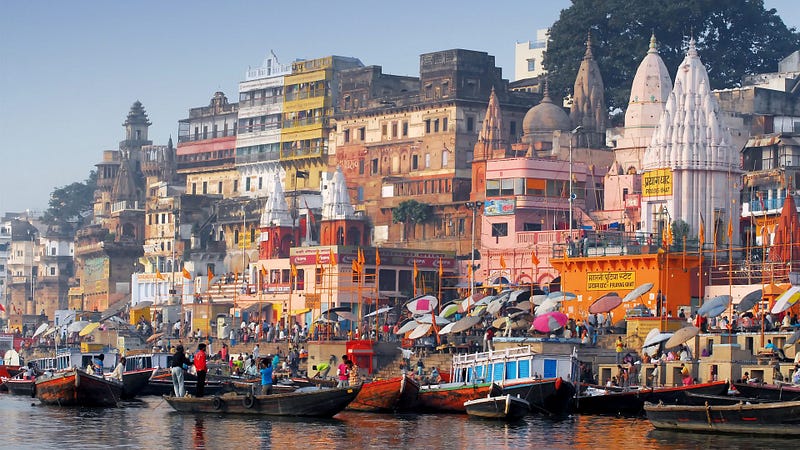
I left India many years ago to live in Britain but having said that I have always felt deeply connected to her. I was born and raised in Madras (now Chennai) and like many Indians living abroad would attest; one feels tethered to her in ways that transcend culture or habits.
I invariably gravitate to news on India and Indians as a default, despite 12 years of living away, my Facebook and Twitter are overwhelmed with stories about India (this is of course a result of the accounts I follow).
I’ve always kept loose track of the big Bollywood releases, and have never been successful at adapting my palette to anything away from desi food. Then of course it is hard to ignore Indian politics, no matter where you live in the world; the news finds a way to your timeline or twitter feed.
I don’t think this has anything to do with patriotism, it is a default. It is the inability to shake away some aspects that are hard-wired. If you lived in India long enough to soak in her distinctive and unique qualities, you remain tethered for life.
If someone asked me to describe what it means to be Indian?
- I would say we come in all colors, shapes and sizes, between the length and breadth of India.
- There are innumerable dialects spoken, there are groups, sub-groups and sub-sub-groups people like to organize themselves into. These could be religions, languages or other clustering factors.
- We don’t dress the same, speak the same or even think the same way.
- It is quite possible to find two Indians who share nothing in common except the country they belong to.
- This lack of tidiness has never been a cause of dismay but the very essence, the very description of India, her distinguishing trait in the world.
It’s what makes us better than our neighbors.
To try and mask over this amazingly messy, glorious, mixture would be a travesty and something that needs to be safeguarded against. This strong heterogeneity has no influence on how people interact at a micro-level. Within the country people migrate to states they didn’t hail from and find ways of flourishing, magically.
Hence, a really succinct definition of being Indian would be ‘being liberal’.
It were these — liberalism and secularism, the founding principles of the state of India. By and large Indians everywhere in urban and rural areas have lived by and embraced these principles.
In the India I grew up in, it was not important whether you were a temple or a church goer but if you can help someone make headway. There was no time or room to focus on subjects inconsequential to ones prosperity. In a country like India, to prosper is the underscoring dominating aspiration.
Have things changed in today’s India?
Here is my take: While the mainstream news will tell you otherwise, (and frankly enough virtual and physical ink has been spilled on discussing the rise of Hindu nationalism post 2019 national elections) I don’t think the government in the world’s largest and perhaps most untamed democracy can so easily sweep through and change the way people fundamentally behave.
While it is important to fight illiberalism, barbarism and racism; we cannot be so consumed by dissent that we forget to focus on issues of material significance and our growing superpower status in the world. For India, the ruling government or its leanings have always been extraneous. The individuals and the institutions have mattered much more.
As a country we have several pressing matters at hand, we are trying to make our mark alongside China as one of the world’s largest economies. We need to clean up our cities and preserve our monuments, we need to educate more people and give jobs to a lot more.
We need to make things better for millions of farmers. We need to market our culture, food, art, literature in an increasingly globalising world. We need to make better films, write better books, do better science and retain our brilliant minds.
We need to stay relevant. We need to sell more to the world so we can be more prosperous. With over a billion people in tow we cannot afford to lose this race, but we will if we continue to squabble over matters of little material significance.
There is so much we can already offer to the world and so much more to work towards. This is both our burden and our duty. Let’s not get distracted.