How US Unemployment Numbers are Created

Many of us take numbers like Unemployment as Gods Truth.

First the last paragraphs of a CNN piece on Unemployment numbers
https://edition.cnn.com/2025/08/01/business/trump-job-report-number-fire

For example, the BLS posted a notice in June stating it stopped collecting data for its Consumer Price Index in three cities (Lincoln, Nebraska; Buffalo, New York; and Provo, Utah) and increased ā€œimputationsā€ for certain items (a statistical technique that, when boiled down to very rough terms, essentially means more educated guesses).

That worried Federal Reserve Chair Jerome Powell. In testimony before Congress in June, Powell said he believed the BLS data to be accurate, but he was upset about what could become a trend.

ā€œI wouldn’t say that I’m concerned about the data today, although there has been a very mild degradation of the scope of the surveys,ā€ Powell said at the time, in response to a question about survey data quality. ā€œBut I would say the direction of travel is something I’m concerned about.ā€

How many actually know that these numbers are model generated. At BLS (US Bureau of Labor Statistics) they use a version of the Birth and Death model. This is a model initially built to model Population Dynamics and other related Biological Processes (i). It is also used in Finance to Build Credit Curves which are used to Price Credit Default Swaps (CDS)

As I have worked a little bit on Credit Curves and CDS 15-20 years ago ((2005-2010) can add a little more detail. One samples the number of companies created, credit rating down grades, out of business etc. Then the Birth and Death model is used to get a broader picture and the Credit Curves created by numerical and statistical models.

There are other methods too, such as using the Prices of CDS at different maturities (end date). Then using numerical models to generate the forward curve (i.e. the credit regime in the next few years)

So now we realize that what we think is an absolute value of a Unemployment or Bond Price is really a kind of guesstimate laundered through numerical models. What about the Bond Price or a Stock Price someone pays. Is that an absolute VALUE. Again the issue is that what was the mental or other analysis that went into that Price offer. Could it have been erroneous. eg. A dear friend and classmate participated in the Sri Lankan mob protests (Aragalaya) in 2022. One of his reasons was that the economy fell because of “unprecedented reductions of taxes resulting loss of revenue of 30%”. Erroneous thinking as it was 7% reduction in VAT taxes on transactions for goods and servicing. The reduction excluded VAT on Financial Services. It is an arithmetic impossibility to have 7% reduction in taxes to cause loss of revenue by 30%.

Anyway back to US Unemployment Model and excerpts from description

Difficulty in capturing information from business birth and death units is not unique to the CES program; virtually all current business surveys face these limitations. CES adjusts for these limitations explicitly, using a statistical modeling technique in conjunction with the sample for estimating employment for private-sector industries. Without the net birth–death model-based adjustment, the CES nonfarm payroll employment estimates would be considerably less accurate.

You can read the steps in using data and creating the Unemployment figures here.
https://www.bls.gov/opub/hom/ces/calculation.htm#business-births-and-deaths

The BIG TAKE home, be it Unemployment Numbers or Bond Price, these are GUESSTIMATES laundered thru numerical and statistical models.   Worse these are not indicative at inflexion times of economic change.  i.e. Economic growth in the process of change to Economic Downturn or vice versa

Reference
(i) Novozhilov, A 2006: Biological applications of the theory of birth-and-death processes
In this review, we discuss applications of the theory of birth-and-death processes to problems in biology, primarily, those of evolutionary genomics. The mathematical principles of the theory of these processes are briefly described. Birth-and-death processes, with some straightforward additions such as innovation, are a simple, natural and formal framework for modeling a vast variety of biological processes such as population dynamics, speciation, genome evolution, including growth of paralogous gene families and horizontal gene transfer and somatic evolution of cancers

 

šŸŽ¶ Bravo, Kabir | Artists Across Borders

This Sunday, something quietly powerful is taking place: Indian and Pakistani artists will share a virtual stage, and among them is our very own Kabir Altaf, performing as a Hindustani classical vocalist and ethnomusicologist based in Pakistan.

Kabir shared that Sheema ji personally invited him to sing, and he’s planning to perform the Kabir bhajan already available on Spotify. A simple act but a potent one. Rooted in shared heritage, offered in public.

It’s easy to be cynical about India–Pakistan relations. But these moments matter. When musicians from Sindh and Delhi, translators from Karachi, and filmmakers from Mumbai come together, even on Zoom, they create a space that politics cannot reach. A space where memory, performance, and shared roots do the work diplomacy cannot.

This is the kind of initiative we need more of: not policy, but presence; not diplomacy, but dialogue. These exchanges don’t dilute identity; they deepen it.

Bravo and huzzah to Kabir, and to all involved.


šŸ—“ Event:

Indian–Pakistani Artists in Dialogue

šŸ“… Saturday, 3rd August 2025

ā° 7:30 PM Pakistan time / 8:00 PM India time

šŸ‘©ā€šŸŽ¤ Moderator:

Sheema Kermani – Bharatanatyam dancer, theatre personality, Karachi

šŸŽ™ Featured Speakers & Performers:

  1. Dr. Syeda Saiyidain Hameed – Writer, former Member of India’s Planning Commission

  2. Dr. Ghazala Irfan – Philosopher and Chair, Department of Humanities, LUMS; affiliated with All Pakistan Music Conference

  3. Anand Patwardhan – Documentary filmmaker, Mumbai

  4. Saleema J. Khawaja – Vocalist of Punjabi Kafi and Guru Nanak verses, Lahore

  5. Neela Bhagwat – Hindustani vocalist (Gwalior Gharana), Mumbai

  6. Azhar Shan – Folk musician from Sindh

  7. Dhruv Sangari – Hindustani classical and Sufi vocalist, Delhi

  8. Zainub J. Khawaja – Musician, member of Harsukhiyaan, Pakistan

  9. Yousuf Saeed – Documentary filmmaker, known for work on classical music in Pakistan, Delhi

  10. Kabir Altaf – Hindustani classical vocalist and ethnomusicologist, Pakistan

  11. Nishtha Jain – Documentary filmmaker, Mumbai

  12. Zahra Sabri – Lecturer and translator, Karachi

  13. Zulaikha Jabeen – Independent scholar, India


šŸ”— Join via Zoom

Click here to join

Meeting ID: 897 8701 6742

šŸ“Æ Back at Peak: 22,453 Monthly Readers and Rising

Even the stats now confirm it: we’re back at our highest readership in our ~15 years.

22,453 monthly readersĀ and rising. 100+ comments on most new posts.

No ads. No algorithm. No social media amplification. Just a small, steady core of thinkers, returners, and writers keeping the conversation alive. This isn’t mass media — it’s a deliberately narrow beam.

A place for:

  • Tight but Broad Church curation

  • Long-form thinking

  • Commentary that draws blood when needed but never aims cheap

The current moment feels like a return, not just of older names, but of why BP was built in the first place: a public space for Brown(ish) minds to work through power, faith, identity, language, and sometimes just the week’s news Ā on our own terms.


Related: Brown Pundits, big in India!

Why Pakistan Won’t Go the Way of Iran

I’ve been enjoying the new direction Brown Pundits has taken since the recent shake-up. Posts are now generating 100+ comments, and that kind of engagement creates a virtuous cycle. You want to write more, think more, respond more. I’m leaning into that.

For now, a lot of the content burden rests on me and that’s okay. It’s been encouraging to see older names return: Girmit, for instance. It feels like a slow reconsolidation of the original readership. Letting people return on their own terms.

Meanwhile, BRAHM, my newsletter, has taken on a different role; a home for more composed writing, life pieces, and the slow launchpad for my business. I just posted something there recently, which I’ll link to for now and follow up on soon. But here, on BP, is where I let myself think in public. Where I go long. Where thoughts breathe.

Continue reading Why Pakistan Won’t Go the Way of Iran

India, Pakistan & the Central Asian Dancefloor

India and Pakistan used to dance together; locked in step, even if offbeat. Now, they move in opposite directions, occasionally brushing shoulders, never quite facing each other.

Take this month. On one hand, India is set to join the Central Asian Football Association’s (CAFA) Nations Cup; a sporting signal of its growing diplomatic footprint across post-Soviet Asia. On the other hand, India pulled out of the WCL 2025 cricket semi-final against Pakistan, citing the tragic Pahalgam terror attack. The result? Pakistan walked into the final uncontested.

Two headlines. Two very different moods. One shows India gaining legitimacy in a new regional club. The other reflects how fragile the bilateral dance with Pakistan remains. Continue reading India, Pakistan & the Central Asian Dancefloor

why romanticism?

There is no context to this poem; it was a pure exodus of emotions. An expression / defence of romanticism in this capitalist, postmodern, post-ideological world.

why romanticism?

unbeknownst vacillate

under the sun’s jaws —

especially in Peshawar

every creature looks toward

the God of hunt —

to chill or to kill

Continue reading why romanticism?

Sticky Thinking; A Quick Note on Originality & Visibility

This is just a quick note inspired by Indosaurus’s excellent suggestion; which I’d like to add to. I’m pinning this post to give it visibility.

First, it’s great to see the voluminosity of posting lately. Some days the blog pulses with original thought; other days, the comments surge while posts remain sparse. Both are signs of life and I’m glad for that.

But as Indosaurus rightly observed:

ā€œA lot of the posts over the past 2 weeks are reposts from old publications elsewhere / mass media publications… I see no real point in posting to BP if it is going to get submerged off the top page within a few hours… Would it be possible to pin 100% original unpublished content to the top of the page?ā€

I think that’s a very reasonable proposal. There’s value in resharing good content, but I agree we should prioritize original, unpublished writing, especially content that reflects the spirit of Brown Pundits. So here’s what we’ll trial:

* Original, unpublished pieces will be pinned where appropriate. I request Editors / Authors to use their judgement / ā€œnousā€ to sense what is original and / or value-add.

Please continue to post, read, comment, and share. But also reflect on what sticks, and why. Let’s keep the signal high.

I cannot moderate as effectively as before so I’ll relying on the Editors, Nivedita & Furqan, for support. I hadn’t realised I had made Furqan an editor a few days back as I wanted him to add Dead Poetstanis to BP.

As again we aren’t going to get this perfectly right as we grow so apologies if I/we misstep.


The Fading Red

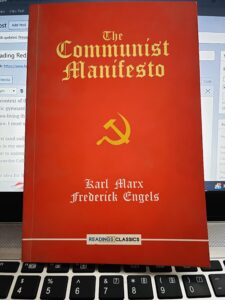
The context of this poem is a bit complex. I wanted to experiment with some poetic gymnastics to venture into new terrain, like writing from the perspective of non-living things. So I chose The Communist Manifesto. Such a paradoxical choice, I must say in hindsight.

The copy I still possess.

I first (and sadly, the last time) read it many years ago, sometime in 2019, when I was in my second (and final) year before university (though I never actually went to university, another detour we can explore some other time). I was at Edwardes College then (see the post “Against Platonic Love” for more details).

The idea for the poem surfaced after watching a dogfight — intellectually speaking — between the Slovenian philosopher Slavoj Žižek and Canadian psychologist Jordan Peterson. If you haven’t already, I recommend watching their full debate.

Continue reading The Fading Red

What kind of nationalism is it to live in India and have an Arabic name?

I’d said to myself: Why don’t I do my own Bhartiya-karan, that is, Indianise myself, before someone else thinks of doing it? The first problem was my name. Perhaps you don’t know: my name is Iqbal Chand. It occurred to me that ā€œIqbalā€ is an Arabic word. What kind of nationalism is it to live in India and have an Arabic name? And so, I changed my name to Kangaal Chand. As it happens, this name is far better suited to my financial condition considering that ā€œkangaalā€ means ā€œpoorā€. And why just me, it suits the rest of my country too.

The second problem that arose was of the dress. There was no trace of Indianness in the pants, coat and tie that I wore. In fact, all three were a reflection of my slave mentality. I was amazed that I had worn them all this while. I decided to wear pajamas instead of pants. But then, a certain Persian person told me that the pajama had come to India from Iran. And so, I began to wear dhoti and kurta. But not a kameez, as the word ā€œkameezā€, too, is of Arabic origin and it reeks of the stench and stink of an Arab!

The third problem was of hair! After all, was it not treachery against the country, a blatant form of antinationalism, to keep one’s hair fashioned in the English style? I instructed the barber to keep only one lock of long hair at the back of my head and shave off the rest. He did exactly that. I had seen images from ancient India showing men with long and lush moustaches. Following their example, I began to grow my moustache. When my friends saw the large moustache on my somewhat small face, they assumed that I had put on a fake one, possibly because I was acting in some play. Forget my friends, when I saw myself in this new look, I began to feel that I had been created not by God, but Shankar, the cartoonist. But I did not lose heart. One has to do all manner of things to be Indian.

An excerpt from a story by Kanhaiyalal Kapoor in ā€˜Whose Urdu Is It Anyway?: Stories by Non-Muslim Urdu Writers’, edited and translated by Rakhshanda Jalil.


As the posting on BP (and the comments) are pretty fast and furious; my capacity to edit and moderate is getting pretty stretched..

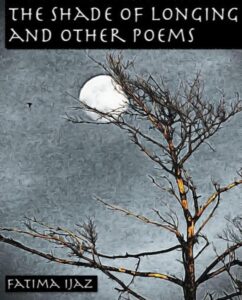
Obscure and Obscurity: Fatima Ijaz’s Shade of Longing

By Furqan Ali

The original review was published at Ink-e-Lab.

Title: The Shade of Longing and other Poems

Author:Ā Fatima Ijaz

Publication Date: 01/11/2021

No. of Pages: 87

Publisher: The Little Book Company


Fatima Ijaz, born in Karachi, studied linguistics in the United States and currently serves as the editor of The Pandemonium Journal. Her debut poetry collection, The Shade of Longing, offers a complex interplay of memory, language, and abstraction, often resisting closure and certainty.

In the preface, she articulates a powerful and poignant idea that serves as a compass for the book’s aesthetic and emotional journey:

ā€œThe contemplation of the past involves an evocative presence of a surreal present…In doing so, you are in a heightened state of present-past – a double consciousness that is more than the sum equal of its partsā€

This is, in many ways, a deeplyĀ Hegelian thought. One is reminded of the famous assertion in The Phenomenology of Spirit that:

ā€œThat the True is actual only as system, or thatĀ Substance is essentially Subject, is expressed in the representation of the Absolute as Spirit-the most sublime Notion and the one which belongs to the modern age and its religion. ā€œ

In essence: the memories, she is talking about, are sort of in itself objects (fixed) and also subjects (variable—dependent on the person recollecting).

Reading this book feels like discovering a cache of love letters written in a fever of emotion, letters meant for someone dearly beloved. But just before mailing them, the writer realizes how insufficient they are. So she burns them all, and what emerges from the ashes are these poems: not just expressions of feeling, but indictments of language itself. A complaint, perhaps, that language lacks the fidelity to truly capture the depths of human experience.

By acknowledging the futility of language, she leans into abstraction. She chooses uncertainty over certainty and, the infinite over the finite, and invites the reader to participate in meaning-making. The gaps in her verse are not absences—they are openings. The reader is asked to bring their own memories, their own hauntings, to fill in the silences.

In the poem ā€œEcho of a word, x memory,ā€ the structure is minimal yet haunting. A single wordā€”ā€œ(stray)ā€ā€”is repeated eight times on one line, and this continues for thirteen lines. The effect is disorienting, hypnotic. Memory here is not narrative, it is reverberation, a stutter echoing in an unreachable corridor of time.

Celestial imagery recurs throughout the collection (stars, suns, moons) often to widen the emotional and metaphysical frame. She reaches for the planetary to express the personal, as in lines like:

ā€œThe face of the sun is smeared with the curseā€

ā€œI saw the shadow moon hunt down oblivionā€

ā€œLanguage emerges out of this exchange between fiery sun and eternal skyā€

ā€œThe moon becomes a cosmic mirror on such…ā€

Another recurring anthropomorphic presence is that of bones and the black crow, symbols that oscillate between the sacred and the ominous.

ā€œthere wasn’t an ounce of regret in my bones / I knew I had practiced the art – and thus – the sacrifice.ā€

ā€œThen there is the stubborn case of the black crowā€¦ā€

In the poem ā€œTear-Drop,ā€ regret and remorse seep through the lines:

ā€œIt does not matter, because I can touch / The midnight with my azure-blues / Perhaps the blame is on the harpsichord / Perhaps it’s on one of us / The black consciousness has entered / and there is no un-doing it.ā€

Her language—or rather, her suspicion of language—remains central. The ā€œshadeā€ she refers to is not just the shadow of longing but also a hue: the specific color of yearning that permeates the book. It’s a longing that refuses to be pinned down, named, or resolved.

In the penultimate poem, the titular piece, she writes,

ā€œDo you think we become in the end / characters of our own stories? Do we finally / own them enough to discard them, have the infinite power / to reform our mind of its strange habitat?ā€

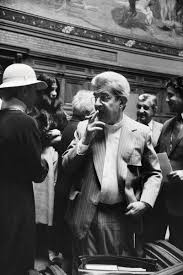
This is a moment of quiet brilliance. One could read this as a critique of ideology—first acknowledging the narrative scaffolding of the self (ā€œIā€) and then, in almost Lacanian fashion, gesturing toward the Real (one of Lacan’s three registers). To ā€œdiscardā€ the story is to momentarily crumble the illusion of coherence.

Jacques Lacan (French psychoanalyst and psychiatrist)

Shade of Longing is not a book that yields itself easily. It is not meant to be understood in one sitting. It is a space to dwell in, misread, reread, and reinhabit. Like ghosts or witches watching from the periphery, these poems linger long after the final page is turned. Their magic lies not in answers, but in the haunting questions they leave behind.

That’s all folks.


Brown Pundits