
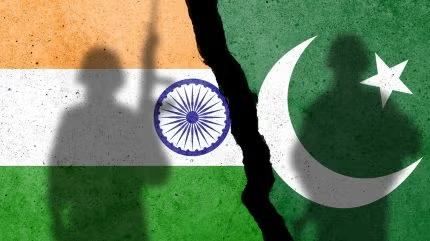
Poorer Pakistan OutFoxes Richer India?

“No one wants a strong India. But PM Modi opened doors. He strengthened the military, advanced the economy, maintained balanced relations with the West, Russia, and China. That is serious statecraft” –Aleksandar Vučić, President of Serbia

India is richer

Strip away the noise and a simple asymmetry remains. India will almost certainly remain richer than Pakistan for the foreseeable future. The gap in GDP, fiscal depth, technology, and demographic scale is widening, not narrowing. On material indicators, India has the advantage. Yet material advantage does not always translate into strategic dominance.

India is louder

India is a mass democracy. It is electorally accountable, media-saturated, and sensitive to public opinion. Governments must justify escalation. Markets react to instability. Voters punish miscalculation. This imposes restraint.

Pakistan is tighter

Pakistan is structured differently. Power is narrower. Decision-making is concentrated within a smaller elite, with the military as the central institution. That creates rigidity in some domains but flexibility in others. Strategic continuity does not reset every five years. Public opinion matters, but it does not directly determine policy in the same way it does across the border.

Structural Differences

This structural difference shapes behaviour. India must think about global markets, coalition politics, and reputational cost. Pakistan can absorb economic stress more easily because its political system is already insulated from full electoral volatility. That insulation produces durability, even under strain.

The list gets smaller. There are six countries who sent the head of state/government to all three: 1) Beijing military parade 2) Davos Board of Peace launch 3) Washington BOP 1st meeting They are: Armenia | Azerbaijan | Indonesia | Kazakhstan | Pakistan | Uzbekistan

Like Israel Continue reading Poorer Pakistan OutFoxes Richer India?
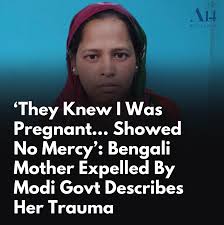
A Republic Cannot Deport, Humiliate or “Outbreed” Its Own People

“We are not from Bangladesh. We are Indian. Why did they do this to us?”

That question should shame the Indian state. On the facts as currently established, Sunali Khatun, a pregnant Indian woman, her husband, and their child were detained in Delhi, deported across an international border without due process, imprisoned in a foreign country, separated, and left to survive on charity and court orders. Their crime was not illegal entry. It was speaking Bengali, being Muslim, and being poor. This was not a mistake or overreach. It was state violence carried out through paperwork and silence.

India has procedures for suspected illegal migrants

They exist to prevent this outcome. They were ignored. There was no verification with the home state, no due process, no public record, and no accountability. A family was pushed across a border, reportedly beaten when they tried to return, and abandoned. That is not law enforcement. It is expulsion by force. When a state confuses language with nationality and religion with foreignness, it stops governing and starts hunting.

Citizenship is not a favour

It is a legal fact. India is not meant to be a blood, language, or religious state. Citizenship is defined by law, not accent or poverty. When the weakest are forced to prove citizenship under duress while the powerful are never asked, law collapses into power. This is how republics rot: not through coups, but through habits.

This is not an isolated lapse of manners towards the Muslim minority

It is the same logic in a smaller, more public form. When a Chief Minister can pull down a Muslim woman’s veil at a government appointment ceremony, and senior ministers can defend it as “show your face” patriotism, the message is clear: Muslim dignity is conditional, and visibility is enforced, not consented to. The argument is always the same. It is dressed up as procedure, security, or “rule of law,” but it operates as dominance.

Muslim Identity is seen as a National Threat

Today it is a veil tugged down in a room of officials. Yesterday it was a Bengali-speaking family pushed across a border. In both cases, the state treats Muslim identity as an offence to be corrected in public, and citizenship as something that can be suspended by suspicion. This is how discrimination becomes policy: first through humiliation, then through paperwork, then through expulsion.

Bengal, like Kashmir, is not a border zone to be cleansed Continue reading A Republic Cannot Deport, Humiliate or “Outbreed” Its Own People

Brown Pundits