
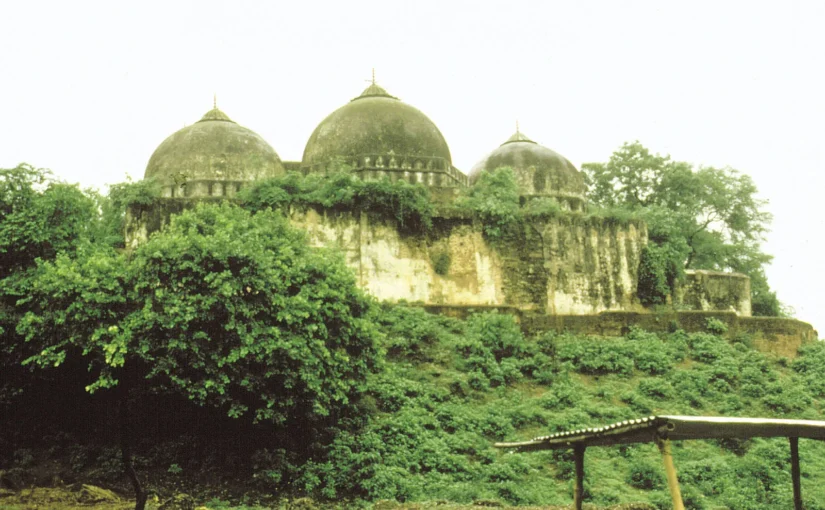
Should Babri Masjid have been moved to Pakistan?

This deliberately provocative piece draws on Kabir’s recent comments, Arkacanda’s excellent essay, Musings on & Answers, and Nikhil’s profound piece in “Urdu: An Indian Language.”

If India wants to avoid future Babri Masjids, it needs a clearer, more orderly doctrine for handling irreconcilable sacred disputes. Excavation, relocation, and compensation should be formalised as the default tools, rather than allowing conflicts to metastasise into civilisational crises. Geography matters. Some sites carry layered sanctity for multiple traditions; others do not. Al-Aqsa, for instance, is both the site of the Jewish Temple and central to Islamic sacred history through the Isra and MiÊżraj. Babri Masjid was not comparable. It had no unique pan-Islamic significance, while the site was widely regarded within Hindu tradition as the birthplace of Lord Ram. The same logic applies to Mathura, associated with Lord Krishna. Recognising asymmetry of sacred weight is not prejudice; it is common sense. A rules-based system—full archaeological excavation, dignified relocation of structures where necessary, and generous compensation—would allow India to preserve heritage without endlessly reopening civilisational wounds.

Urdu is not an Indian language but Hindu nationalists made it one

It is a Muslim-inspired language that emerged in India. That distinction matters. Blurring it creates confusion, not harmony. There was an early misstep in North Indian language politics. Modern Hindi was deliberately standardised on Khari Boli rather than on Braj Bhasha or Awadhi, both of which possessed far richer literary lineages. This decision, shaped by colonial administrative needs and North Indian elite nationalism, flattened a complex linguistic ecology and hardened later divides. One unintended consequence was the permanent preservation of Urdu within the Indian subcontinent. Because Khari Boli Hindi remained structurally interchangeable with Urdu, Urdu survived as a parallel high language. Had Braj or Awadhi become the standard instead, that mutual intelligibility would have collapsed, and Urdu would likely have been pushed entirely outside the Indian linguistic sphere.

Persian Linguistic Pride

Today, a similar impulse is at work. There is a growing tendency, often well intentioned, to Indianise the Mughals and Urdu, to fold them into a seamless civilisational story. This misunderstands both history and the settlement that Partition produced. Partition did not merely redraw borders. It separated elites, languages, and political destinies. Urdu crossed that line with Muslim nationalism. It cannot now be reclaimed without ignoring that choice. I say this as someone with both an Urdu-speaking and Persian-speaking inheritance. When I chose which tradition to consciously relearn and deepen, I chose Persian. Not out of sentiment, but judgment. Persian language nationalism remains rigorous, self-confident, and civilisationally anchored. Persian survived empire, exile, and modernity without losing coherence. It carries philosophy, poetry, statecraft, and metaphysics as a single, continuous tradition. Shi‘ism, Persianate culture, and Persian literature remain intertwined. They preserve depth rather than dilute it. As a Bahá’í, that continuity has personal resonance. But the argument does not depend on belief. It stands on history.

Urdu as the “Muslim tongue” Continue reading Should Babri Masjid have been moved to Pakistan?

Indian Ink: Literary Insights into Colonialism and Identity

[Tom Stoppard passed away yesterday (November 29) at the age of 88.  In that context, I’m cross-posting this essay I wrote on his play Indian Ink which had a major impact on me] 

Flora: You are an Indian artist, aren’t you? Stick up for yourself. Why do you like everything English?

Das: I do not like everything English.

Flora: Yes, you do. You’re enthralled. Chelsea, Bloomsbury, Oliver Twist, Goldflake cigarettes, Winsor and Newton
 even painting in oils, that’s not Indian. You’re trying to paint me from my point of view instead of yours—what you think is my point of view. You deserve the bloody Empire!

(Tom Stoppard, Indian Ink, pg. 43)

Great works of art often reveal insights about history in ways that are more accessible than academic historical accounts. One work that was especially powerful in doing so for me is Tom Stoppard’s play Indian Ink. Ever since I first read this play some years ago, it has provoked me to think about the colonial experience in India as well as issues of identity and nationalism more generally.

In the tradition of Forster’s A Passage to India and Scott’s The Raj Quartet, Indian Ink examines the colonial experience through focusing on the relationship between one particular couple. Set in two time periods (1930s India and 1980s England), the play tells the story of Flora Crewe, an English poet visiting India, and Nirad Das, an Indian artist who is painting her portrait. Over the course of the play, Flora and Nirad’s relationship changes from a formal, distant one to a more intimate one. However, their relationship also reveals major points of tension and of culture clash. Nirad constantly feels the need to impress Flora with his knowledge of England and of English culture, while Flora wants him to be himself. As the quote that I started this post with shows, she wants him to paint her from his own point of view. He eventually does so, painting a nude portrait of her in the style of a Rajput miniature. Flora recognizes that he is working in his own tradition and has stopped trying to ape the English. She tells him “This one is for yourself
 I’m pleased. It has rasa” (74).

The play also makes interesting points about the reinterpretation of history, something that is a part of national and ethnic conflicts even today, both in South Asia and in other parts of the world. For example, in the modern portion of the play, Anish (Nirad’s son) and Mrs. Swan (Flora’s sister) discuss the events of 1857, which Anish refers to as “the first War of Independence” and Mrs. Swan insists on calling the Mutiny (17). History is written by the victors and later reinterpreted by various political groups to suit their own agendas. For example, in modern India, the BJP reinterprets the Mughals as a foreign occupying force, religiously motivated by their negative feelings towards Hinduism. Other historians argue that this perspective is not an appropriate way to view the Mughals, many of whom assimilated and became “Indian.” History remains a powerful force that can be used for various politically motivated ends. Stoppard’s play forces the audience to question the truth of any of these interpretations. Continue reading Indian Ink: Literary Insights into Colonialism and Identity

Why does the West get Immigrants and not Indigenous

A post as a result of discussion I had with a classmate, now an Aussie for about 30 years

Classmate: As for Australia and need for immigrants…. insufficient labor supply for the growing economy!

My reply::Plenty of Labor, the Indigenous Aborigines.
Why are they (First Aussies) not being educated, Racism ??

Classmate:  Barr…you are clearly unaware of the reality..there is no simple solution to the barriers faced by Aborigines in integrating into the Australian economy.

My long reply, the crux of this Post
There are parallels of why Immigrants are preferred over Aus Aborigines and why the Brits got Indentured South Indian Labor for the Estates in Ceylon  (Same as why Immigrants are preferred  over African Americans in US too)

Indenture Estate Labor in Ceylon was essentially undocumented, i.e. not given any legal status (Residency ) or even Birth not recorded, The reason was simple, residency or similar would have meant Ceylon Labor Laws would have been applicable. Ceylon Labor Laws were pretty decent and reasonable for those times. So it was easier to control undocumented South Indian Labor. Sinhalese were notorious for NOT being docile and prone to Litigation. Just keep in mind only a select few Ceylonese got a decent education. Universal literacy (and Life Expectancy) only happened after Independence. Tamil were more prone to violent crime, but among themselves. Oppressed rarely fight the oppressor in this caste the high caste Tamils.

Continue reading Why does the West get Immigrants and not Indigenous

Brown Pundits