
With Europe and America increasingly locked in an acrimonious struggle over the future of Greenland, we examine the fate of the western world. Could it end up divided and at odds with each other? Could NATO collapse? And if that happens, will Russia and China be the only countries to gain? And what sort of international order will we then have to grapple with? Join me live at 4.30 p.m. (11.00 a.m. in the UK/Ireland) on Tuesday the 20th of January to hear Bill Emmott, the former Editor-in-Chief of The Economist and Chairman of the International Institute for Strategic Studies, address these questions.
Tag: Open Thread
Prof. John Mearsheimer: Dismantling Iran, The Four Part Strategy (Iran Open Thread)
Prof John Mearsheimer argues that Western media misrepresents events in Iran as an organic, popular uprising against a mismanaged regime. Instead, they claim the unrest follows a familiar U.S.–Israeli four-step regime-change playbook. Economic warfare: The U.S. imposes sanctions that deliberately damage Iran’s economy, creating widespread hardship. Protests then arise largely in response to these externally induced economic conditions. Fueling protests: The U.S. and Israel allegedly encourage, organize, and support mass protests, citing evidence such as Israeli media reports, statements by U.S. officials, Mossad involvement, and the use of Starlink terminals by protesters after Iran shut down the internet. Disinformation campaign: Western audiences are told the protests are purely internal and democratic, while messaging inside Iran is designed to convince people the regime is collapsing and momentum is unstoppable. Military intervention (planned but not executed): Once the regime appears near collapse, U.S. and Israeli military force would be used to strike infrastructure and elites to finish it off. According to the speaker, this strategy has failed because protests have sharply declined and the Iranian government’s crackdown has largely succeeded. Israeli commentators and even President Trump’s shifting rhetoric are cited as acknowledgments of failure. The concern now, they argue, is that Trump—having expected the regime to be on its last legs—may consider military force to “rescue” a collapsing strategy, despite reduced U.S. combat power in the region and Iran’s stated intention to retaliate directly against U.S. and Israeli targets.
Open Thread
1) “Dargahs Beyond Belief” by Shah Umair
2) “After Khaleda and Hasina: What lies ahead for Bangladesh and India?”
3) “Politics of History: Manu Pillai with Salil Tripathi”
4) Trump is ‘Chest Beating’ Over a Retreat| ‘The Opinions’ Podcast
The Demise of Brown Pundits Is Much Exaggerated
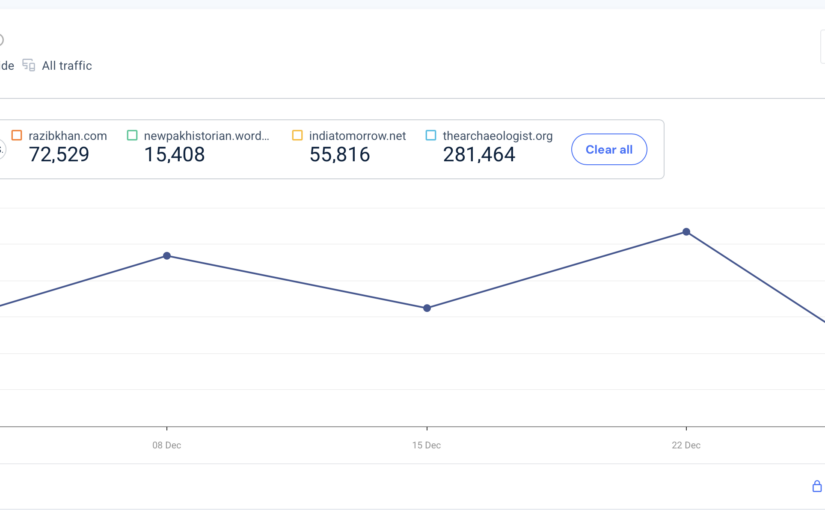
Every few months someone asks whether Brown Pundits is “dying.” I understand the instinct. The internet is littered with abandoned blogs. Attention is fickle. Writers drift. The centre does not hold. And yet, when I actually look at the numbers, the mood often turns out to be wrong.
We had a real dip. In September and October we were running at roughly 55–65k monthly readers. Then we fell hard, to around 33k. This month, we have bounced back to roughly 53k. That is a 60% jump on the trough. A lot of it is mobile. A lot of it is casual readership rather than the old-school desktop cohort. But it is still real people arriving, reading, and sharing.
The geographical pattern is also telling. India and the United States remain the main pillars, as you would expect. But Bangladesh has surged in a way we did not anticipate. That matters because it suggests we are not only a niche diaspora salon. We are also being read inside the region, by people who do not need South Asia explained to them. Continue reading The Demise of Brown Pundits Is Much Exaggerated
Khaleda Zia, Bangladesh’s first female prime minister, dies at 80 after prolonged illness (Open Thread)
1) Khaleda Zia, Bangladesh’s first female prime minister, dies at 80 after prolonged illness
Begum Zia was Bangladesh’s first female prime minister–and only the second female prime minister of a Muslim majority country (Benazir Bhutto was the first).
Prime Minister Modi has expressed his condolences as has PM Sharif of Pakistan. PM Sharif called Begum Zia “a committed friend of Pakistan”.
She will be given a state funeral on Wednesday (December 31) and then buried alongside her late husband, Ziaur Rahman. Her son, Tarique Rahman, recently returned to Bangladesh after seventeen years in self-exile. He is expected to be prime minister if BNP wins the February elections.
2) Khaleda Zia: How Begum Khaleda influenced Bangladesh, India| Analysis
Join The Hindu’s Suhasini Haidar, Kallol Bhattacherjee and Stanly Johny as they decode the influence of Khaleda Zia, Bangladesh’s first woman prime minister. Zia, along with archrival Sheikh Hasina, defined the country’s politics for a generation.
3) “Inside ‘The Great Shumsuddin Family”: Anusha Rizvi in Conversation|Speak Easy-Episode 4″
In the fourth episode of SpeakEasy, senior journalist Amit Baruah is in conversation with filmmaker Anusha Rizvi, on her latest film “The Great Shamsuddin Family” and the questions it raises about fear, belonging, and everyday life in contemporary India. Rizvi discusses how the film unfolds over the course of a single day, capturing the quiet anxieties of a middle-class Muslim family in Delhi. She emphasises that there is no single, uniform idea of “Muslimness” in the country, a point the film quietly makes through its characters and situations. She reflects on why the film avoids overt drama, instead foregrounding the persistent undercurrent of fear—of being misunderstood, misread, or targeted—that shapes ordinary decisions, conversations, and silences. The conversation also explores Rizvi’s approach to representation, her resistance to stereotypical portrayals of Muslim households in cinema, and her focus on women characters who navigate work, family, and crisis with agency and humour. Rizvi also speaks about how social media, surveillance, and heightened public hostility have altered the emotional landscape in which artists and citizens now operate.
Open Thread
1) “How Indian media sold out|The Caravan Long View Ep 5”
In this episode of The Caravan Longview, Hartosh Singh Bal and Sushant Singh provide an analysis of the structural decay within Indian journalism and how its inherent vulnerabilities have been weaponised for political gain. They argue that the “Godi Media” phenomenon was not an overnight accident, but the result of a pre-existing, fragile ecosystem being systematically re-engineered into a disciplined machinery for narrative management.
2) “Osman Hadi is becoming a Malcolm X for Bangladesh, influence multiplied after death”
Bangladesh has been on the boil since the death of a prominent student activist, Osman Hadi and a core component of it has been the anti-India sentiment. But what is driving it? It is just a student leader’s death, Sheikh Hasina’s exile to India post 2024 or more? Bangladeshi political analyst Shaquat Rabbee speaks to Debdutta Chakraborty on this and more in ThePrint #Uninterrupted
3) How Buddhist nationalism in Sri Lanka and Myanmar shatters the global myth of Buddhism as peaceful
How did a religion symbolised by its guiding tenet of non-ahimsa or non-violence see a shift where the monks ended up picking swords in pursuit of a nationalist identity across South and South East Asia? Author & journalist Sonia Faleiro discusses this and more in ThePrint #SoftCover, where she discusses her newly released book, The Robe and the Sword with Debdutta Chakraborty
4) Aamer Rahman on “Reverse Racism”
Open Thread
Some interesting links:
Trump says US will ‘permanently pause’ migration from ‘all third world countries’
Maulana Abul Kalam Azad|The Tragic Genius Who Tried to Save United India| Inqalaab (in Urdu)
Bihar Elections (Open Thread)
A Sweep in the Making as NDA Leads on 200+ Seats; RJD Ahead on Only 24
This thread is for your thoughts on the election results in Bihar. You can also use it as an Open Thread.
I will not be heavily moderating this thread but-as always- egregiously anti-Pakistan comments will be summarily deleted. Otherwise, go for it.
Genetics open thread
On popular request — or curiosity. Two recent studies are making the rounds:
-
Kashmiris and Central Asians: Nature – February 2025
-
Sri Lankans and South Indians: Nature India – February 2025
I’m generally skeptical of population genetics papers, what is their point exactly? But presumably this will awaken the Commentariat, who have been quieter lately.
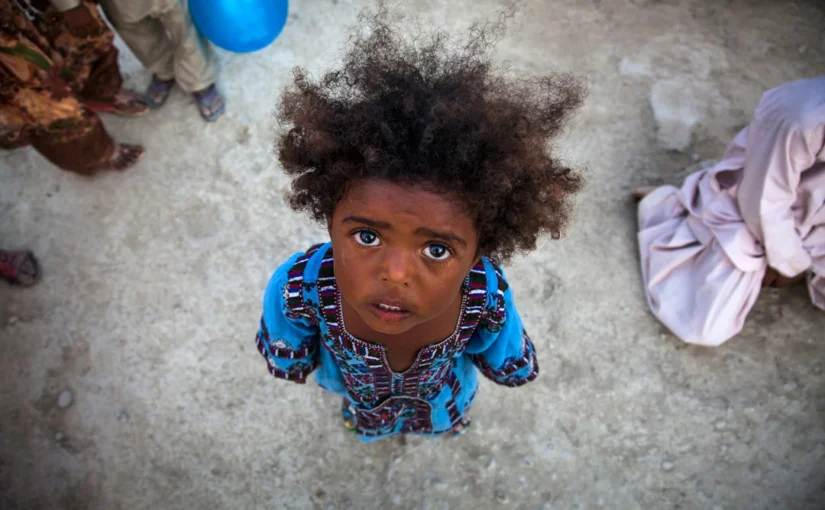
If nothing else, consider it intellectual cake; open to everyone, rich in speculation. As an aside the young girl featured is a Baloch.
Open Thread
Post about whatever you find interesting.
Here is an insightful interview between Karan Thapar and Shyam Saran (former Foreign Secretary) focusing on Indo-US relations
Check out this clip from Pakistan Idol. This is a just a teaser of highlights from the Lahore audition round. I believe that the contestants were told they could not sing Indian songs, which seems to be primarily a way to avoid everyone defaulting to Bollywood (There is also probably a patriotic angle). After all, we have our own great composers and singers such as Medhi Hassan, Farida Khanum, Noor Jehan, and Nusrat Fateh Ali Khan. At the level of classical music, the tradition is obviously part of a shared culture.
There is a lot of musical talent in Pakistan and proper training would help to nurture it. However, with all the other issues that the country is facing, art and culture have never really been a priority. Finally, as a classically-trained musician myself, it is my firm belief that one cannot be successful in any kind of music without a firm foundation in Hindustani classical (which was the case with the greats such as Medhi Hassan, Madam Noor Jehan, and Farida Khanum). India has obviously owned this culture much more than Pakistan–the reasons behind this are the subject of my dissertation.