
What Genetics Can, and Cannot, Explain About Caste

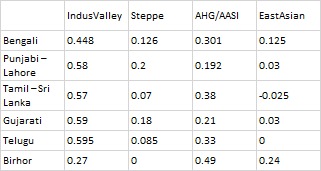
A recent WhatsApp exchange between GL and Sbarr captures a recurring Brown Pundits problem: how genetic data, textual tradition, and social history get collapsed into a single argument and then talk past one another. The immediate trigger was a table circulating online, showing ancestry proportions across South Asian groups; Indus Valley–related, Steppe, AASI, and East Asian components. The numbers vary by region and language group. None support purity. None map cleanly onto caste. That much is uncontroversial. What followed was not a dispute about the data itself, but about what kind of claims the data can bear.


GL’s Position (Summarised)

GL’s argument operates at three levels: historical, linguistic, and genetic.

  1. Caste as fluid history

    GL argues that the four-fold varna system hardened late. Terms like Vaishya did not always mean ā€œmerchantā€ but originally derived from viÅ›ā€”ā€œthe people.ā€ In this reading, Vaishya once referred broadly to non-priestly, non-warrior populations, including farmers and artisans.

  2. Elite religion thesis

    Early Śramaṇa movements, Buddhists, Jains, Ajivikas, are framed as elite projects. Renunciation, non-violence, and philosophical inquiry required surplus. Most people, GL argues, worshipped local deities and lived outside these doctrinal systems.

  3. Genes as complexity, not identity

    GL points out that Steppe ancestry and Y-DNA lineages are unevenly distributed. Some peasant groups show higher Steppe ancestry than some Brahmin groups. Maternal lines are largely local. The conclusion is not reclassification, but complication: caste cannot be reverse-engineered from genes. GL’s underlying claim is modest: simple caste narratives do not survive contact with deep history.


Sbarr’s Position (Summarised)

Sbarr’s objections are structural and definitional.

  1. Varna as stable social fact

    In lived Hindu society, Vaishya has meant merchant since at least the Dharmashastra period. Etymology does not override usage. Peasants were not Vaishyas. Shudras worked the land. Dalits lay outside the system.

  2. South Indian specificity

    Sbarr stresses that the North Indian varna model does not transplant cleanly into the Tamil world, where Brahmins, non-Brahmin literati, Jain monks, and Buddhist authors all contributed to classical literature. Claims of universal Brahmin authorship are rejected.

  3. Genes do not make caste

    Even if some peasant or tribal groups show Steppe Y-DNA, this does not make them Brahmins or twice-born. Genetic percentages are low, overlapping, and socially meaningless without institutions.

Sbarr’s core concern is different from GL’s: the danger of dissolving concrete social history into abstract theory.


Where the Debate Breaks Down

The argument falters because the two sides are answering different questions.

  • GL is asking: How did these categories emerge over millennia?

  • Sbarr is asking: How did people actually live, identify, and reproduce hierarchy?

Genes describe populations. Texts describe ideals. Caste describes power. None substitute for the others.


The Takeaway (Without a Verdict)

The ancestry table does not refute caste. The Manusmriti does not explain population genetics. Etymology does not override social practice. What the exchange shows, usefully, is the limit of WhatsApp as a medium for longue-durƩe history. Complex systems resist compression. When they are forced into slogans, everyone ends up defending a position they did not fully intend. That, more than Steppe percentages or varna theory, is the real lesson here.

Have we seen the face of Rama?


One of the problems with looking up pictures of the Kalash people of Pakistan is that photographers have a bias toward highlighting the most European-looking villagers. Let’s call this “Rudyard Kipling Lost White Races” syndrome. Therefore for your edification, I post the YouTube above which is probably more representative of what the Kalash look like.

The reason I post a link to what the Kalash look like is that it is germane to the answer to the question: what did the Indo-Aryans look like? The past tense is key since “Indo-Aryans” today means a lot of people in South Asia, in a literal sense.

In the post below Zach L. made a passing comment:

(1.) The AASI’s, which are sort of co-equivalent to the Negritos and Anadamese Islanders (one of the first coastal waves out of Africa that somehow also ended up in the Amazon). It’s interesting that they are substrate to every South Asian population (I think there are trace amounts in Central Asia, Afghanistan and even Iran).

(2.) the ā€œDravidianā€ farmers out of Iran. They are probably related to the J1/J2 types and might be an olive skinned population. Prominent in Sindh and Southern Pakistan through to South India (high % in Gujarat – must have been a locus of some sort).

(3.) our beloved Aryans who are especially prevalent among Brahmins, the Punjab and Haryana (though arguably the Haryanvis and East Punjab descend from Scythians to some extent). These look ā€œEuropeanā€ but it’s a very different look to #2.

The Aryans are conventional European (light eyes, light hair, white skin) the ancient Dravidians would have (probably) looked like Middle Easterners (olive skin, dark hair dark eyes) and the AASI, ” looks like Papua New Guineans.

I can’t see any disagreement with point number two.

As for the AASI (“Ancient Ancestral South Indians”), we need to be careful here. They diverged from the ancestors of the people of Papua New Guinea ~40-50 thousand years ago. The divergence from the Andamanese, who probably migrated from mainland Southeast Asia, was not too much later. Aside from being very dark-skinned, the various extant “Australasian” people can be quite distinctive in appearance. The people of Papua, and native Australians, are quite robust. A substantial minority have blonde hair color due to a mutation common among Oceanians. The “Negrito” people of Southeast Asia and India all seem to be have adapted to a narrow relic niche, and may not be representative of their ancestors.

That being said, there is a particular non-West Eurasian look that many South Asians have which we can presume is the heritage of the AASI.

The comment about Aryans looking like Europeans raised my eyebrows a bit. This is a touchy subject, and to be honest my initial reaction was to be skeptical. But the more I read the primary literature to check up on Zach, the more reasonable this seemed to be. The dominant steppe signal into South Asia does resemble the people who were pushing into Central and Western Europe 1,000 years earlier than the Indo-Aryans, who were moving southward probably ~3,500 years ago. This is clear in rather simple statistical genetic analyses-populations such as the Kalash and Pathans for example show strong evidence of “European-like” gene flow.

Current work out of David Reich’s lab suggests that the Kalash are the best modern proxies we have for the “Ancestral North Indians,” the ANI. This population is modeled as:

– ~30% “steppe”, which is very similar to the ancestry which expaned westward into Europe between 3000 and 2500 BCE
– ~70% “Indus Periphery”, which seems the likely ancestral contribution of the people of the IVC, and is a heterogenous mix of Iranian-farmer and AASI

The mid-range estimate for the emergence of the Kalash mix is ~2,500 years before the present, but these usually have some downward bias, so it is reasonable that it would be greater than ~3,000 years. The samples from the Swat Valley dating to this period show gradual increase of “steppe” ancestry over time.

So one reason to be skeptical that the Indo-Aryans were “European-like” in appearance is that by the time they were flourishing in the lands previous inhabited by the IVC they may already have been more than 50% genetically like the people of the IVC. In which case, a minority would be very European-looking, but most would look vaguely West Asia, with some looking more stereotypically South Asian. If you look at the video above I think you do see the Kalash look this way.

One reason I’ve always been skeptical of the idea that the Indo-Aryans looked European, or, that their demographic impact was large, is that it seemed unlike both could be true. The expression of blue eyes among Indians was too low of a percentage.

Here is the frequency at a major SNP which predicts a lot of the blue vs. brown eye color.

Continue reading Have we seen the face of Rama?

Brown Pundits