
Belated Holi 2026 Thread

Since what seems like World War 3 broke out a week ago,  the fact that Holi was this past Wednesday (March 4) completely slipped my mind.  I’m surprised that no one else on BP mentioned it either.

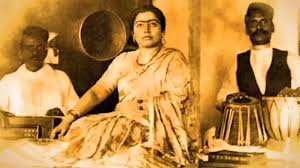
I just want to briefly share this recording of Gauhar Jaan singing “Mere Huzraat ne Madeene mein manayi Holi” (My Prophet played Holi in Medina).  This is an example of the syncretic culture of Hindustani music.  A Muslim artist (born Armenian Christian) singing a composition that references the Prophet of God celebrating a Hindu festival.  This is the syncretic culture that has sadly been lost on both sides of the Radcliffe Line.

There is an excellent book on Gauhar Jaan titled My Name is Gauhar Jaan! (2010) by Vikram Sampath.

After the jump, there is another beautiful composition sung by Venkatesh Kumar. This is a thumri in Raga Mishra Kafi entitled “Aaj Khelo Shyam Sang Hori” (Let’s Play  Holi with Shayam (Krishna) today” Continue reading Belated Holi 2026 Thread

Thumri and Social Change

Since there has been some discussion about “Indian” and “Pakistani” music recently– and in the spirit of being “high signal”– I am cross posting this essay I wrote about thumri and social change. The essay was originally submitted as part of my M.Mus coursework at SOAS, University of London. 

Thumri is a semi-classical genre of Hindustani vocal music, associated primarily with the emotional expression of romantic longing. It is said to have originated in the 18th century from a mixture of folk and art music. The genre reached its height in the 19th century at the court of Wajid Ali Shah, the last nawab of Avadh, who was an enthusiastic patron and even composed several thumris.

Since the 19th century, thumri repertoire and performance style have undergone several changes. These include the de-linking of the genre from the courtesan tradition, the separation of music and dance, and a re-interpretation of lyrics in a devotional, rather than erotic, framework. These changes were linked to the impact of British colonialism, particularly social reform movements such as the Anti-Nautch Campaign. In addition, the shift in patronage from royal courts to concert halls led to the emergence of non-hereditary female performers. In order for performing thumri to be considered acceptable for “respectable” women and to avoid offending the new middle-class audience, the genre was de-eroticized and reinterpreted in a spiritual fashion. This often entailed the sanitization of lyrics. Continue reading Thumri and Social Change

Brown Pundits