
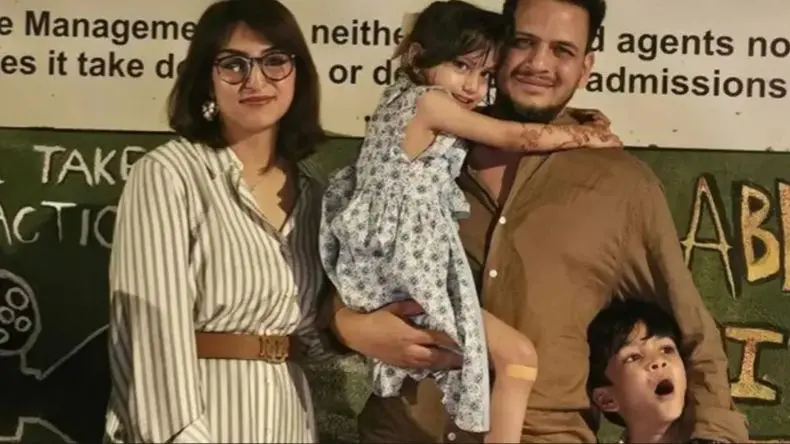
In the aftermath of the extremely tragic plane crash in Ahmedabad (the photo features the late Ali family, may they rest in the Highest Heaven), one tiny detail stood out; not the cause of the disaster (still contested), but who was being heard. Many of the victims’ families interviewed by the BBC were of Muslim origin (it was also during the Eid Holiday break). And while that may seem incidental, it reveals a subtle, recurring pattern in India’s public discourse.
Three threads emerge:
1. Visibility by Design (or Selection?)
The BBC, like many global media platforms, often seeks out minority voices; both for diversity optics and as a counterbalance to state narratives. That’s one possibility.
But it’s also true that Muslim families are simply more visible in many urban, diasporic, and expressive contexts. They articulate grief publicly, often in English or Urdu (which by corollary gives them an instinctive grasp for expressive Hindi), and tend to engage with institutions, media included, more readily than the stereotype suggests.
2. Migration as a Mirror
There’s no question that a disproportionate number of Indian Muslims are leaving India; visibly and consciously. From Canada to the Gulf, a steady exit is underway. Whether for safety, opportunity, or disillusionment, the result is the same: the global Muslim Indian voice is expanding just as its domestic leverage contracts.
This migration also makes them more likely to be represented when tragedy strikes; as travellers, students, entrepreneurs. They are part of the mobile, global Indian class, even if they are not always seen as part of the national mainstream.
3. Not Afraid to Speak
Perhaps most strikingly, many of the Muslim voices in this coverage spoke freely; about the crash, the authorities, the investigation. There was no visible fear, no careful calibration of words. In a country often described as stifling dissent, that confidence is revealing.
It challenges lazy assumptions about Muslim passivity or isolation in India. It also hints at something else: when a group is already structurally outside of state power, it has less to lose in speaking its mind.
The Muslim Question (A Bad Term for a Real Reality)
The phrase “Muslim question” is uncomfortable, and rightly so. But it persists in India not because of propaganda, but because of the complex civilizational footprint Muslims leave:
- They are the largest minority, and India’s historical Other
- They rarely align with the state, regardless of the party in power
- They remain overrepresented in high-visibility domains; film, sport, fashion; much like African-Americans in the U.S.
That visibility invites both admiration and scrutiny. It can breed respect, and it can invite repression. Muslim India is not silent. It is not hiding. It is speaking, moving, migrating, protesting, grieving; often more visible in crisis than in celebration. And that, perhaps, is the quiet paradox: a group with less power, but more presence.
yes it’s a cover-up for sure.. I feel that but then why is the Indian government helping to cover it up by blaming the pilots.
Cloaking bigotry in secular-speak:
https://theprint.in/opinion/naseeruddin-shah-zohran-mamdani/2689124/
A bit tangential, perhaps relevant to point 3 you make?
Can you elaborate on this: “They rarely align with the state, regardless of the party in power”?
During the Congress era, there were several prominent Muslims in politics. Salman Khurshid was Minister of External Affairs in the Manmohan Singh government.
Omar Abdullah was Minister of State for External Affairs in Vajpayee’s government.
Currently, the BJP doesn’t have a single Muslim MP.
Not so much as corrupt as greedy
When the first Ethiopian Airlines crashed one of my good friends (white) claimed it was Pilots fault. Backed up his claim quoting his brother who is Prof at MIT
A few months later the news dribbled out.
Boeing had been taken over by a Wall Street Equity firm.
They kicked out all the old experienced Engineering and Technical staff (I guess big pay too). Hired off the street Techs (H1-B?)
I am not impressed with US tech direction. Everyone is more worried about their backsides than doing a good job. No job security.
Disclosure: I was a Grad Student (Physical Oceanography) and then a H1-B for about 15 years. I came back to SL after first round, but went thru separation of wife and assets (by choice). So went back as they say to make my fortune as they say. No regrets as they say calling it quits at about 52.