
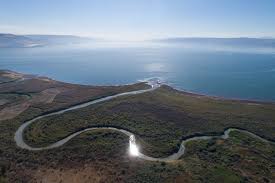
I wanted to share something that floored me. Through Sahil Bloom, I came across this poem by Kahlil Gibran, and it struck me with its simplicity and depth. As an aside, it is worth remembering that Gibran was deeply inspired by ʻAbdu’l-Bahá, whose vision of unity and spiritual renewal touched many thinkers and artists of his time.
For the Commentariat, it’s worth noting that one of the 20th century’s greatest poets had Muslim antecedents: Gibran’s maternal great-grandfather converted from Islam to Christianity, a reminder that conversion did happen, and that traditions were more porous than the common perception that “Muslims can never leave Islam.”
The River Cannot Go Back
It is said that before entering the sea
a river trembles with fear.
She looks back at the path she has traveled,
from the peaks of the mountains,
the long winding road crossing forests and villages.
And in front of her,
she sees an ocean so vast,
that to enter
there seems nothing more than to disappear forever.
But there is no other way.
The river cannot go back.
Nobody can go back.
To go back is impossible in existence.
The river needs to take the risk
of entering the ocean
because only then will fear disappear,
because that’s where the river will know
it’s not about disappearing into the ocean,
but of becoming the ocean.
Religions divide, not unite
eg Irish Catholics and Protestants
The various sects and religion in Palestine
Muslims and Hindus in India
in contrast Communist China which is Atheist is united
i
Hmm – that’s contentious
Objects in the distance may appear more solid than they are in reality.
wonderful poem.
thank you – as Furqan, our resident poet, remarked it’s reminiscent of Khusraw’s poem
Oh Khusrau, the river of love
Runs in strange directions.
One who jumps into it drowns,
And one who drowns, gets across.
https://archive.blogs.harvard.edu/sulaymanibnqiddees/2015/03/07/the-river-of-love/
[…] converted under early Islam. Over the Ottoman centuries, many of these villagers converted again, this time to Maronite Christianity, as Maronite monasteries and Khazen patrons expanded southward into […]