
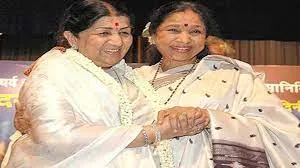
Since we have been discussing Asha Bhosle, I am sharing this essay which I had written on the construction of femininity in Indian vocal music. This piece was originally written as part of the coursework for my M.Mus in Ethnomusicology from SOAS, University of London.
Musical genres and styles are often linked to gender roles. Different vocal qualities are associated with societal ideas about appropriate masculinity and femininity and then reflected in music. In recent decades, much ethnomusicological scholarship has focused on the gendered and constructed nature of the human voice.
In this essay, I will discuss the construction of femininity in Indian vocal music, both classical and popular. I will particularly focus on Lata Mangeshkar (1929-2022), one of India’s most popular playback singers who for decades held a virtual monopoly as the voice of the film heroine. Mangeshkar’s voice was associated with qualities such as innocence, purity and self-sacrifice, seen as those of the ideal Indian woman.
Prior to the second half of the nineteenth century, the only Indian women who sang in public were those of the hereditary courtesan class. As a response to British colonialism, there was a concerted effort to cleanse music of its associations with “debauchery” and to create a space for “respectable” middle-class women to perform. This led to stylistic changes in several genres. For example, thumri—a genre of song and dance traditionally associated with courtesans—was de-eroticized and re-interpreted in a spiritual frame. Since dance in particular was associated with immorality, it was separated from music. Whereas the courtesan would accompany her singing with gestures, “respectable” female performers restricted themselves to singing.
In her article “Gender and the Politics of Voice: Colonial Modernity and Classical Music in South India”, Amanda Weidman discusses the emergence of upper-caste women on the concert stage in early twentieth century South India. Just as North Indian music had to be rescued from the courtesans, South Indian music had to be reclaimed from devadasis, hereditary temple performers from a variety of non-Brahmin castes. The sign of successful classicization was the transformation of music and dance into “arts” fit for upper-caste middle-class “family women” (Weidman 2003: 194).
Weidman discusses how the shift from the courtesan’s salon to the public concert hall led to a shift in music. She writes: “The concert hall, unlike a private salon ensured there was a respectable distance maintained between the performer and the audience, not only physically but also psychologically: in public, the performer performed for no one in particular” (210). The lyrics of the compositions were focused on spirituality, seen as an appropriate subject for women. In addition, a convention of music performance developed in which too much physical movement was seen as unseemly. A kind of “performance of nonperformance” became the ideal (214). Finally, a dress code developed which made female musicians’ bodies “visible as a certain type: a respectable family woman” (215).
Just as femininity was constructed in classical music, Indian films also associated certain values with voice types. Mangeshkar’s high-pitched unadorned voice suggested the qualities of the virtuous heroine while that of her sister Asha Bhosle was often associated with the character of the vamp.
In her article “Meri Awaaz Suno: Women, Vocality and Nation in Hindi Cinema”, Pavitra Sundar argues that Mangeshkar’s “desexualized vocal style helped contain the dangerous visual and aural presence of female bodies in public”. Mangeshkar “consciously moved away from the vocal heaviness and nasality of her predecessors, singers like Noorjehan and Shamshad Begum. Her voice was ‘cleansed’ of all those qualities that would in time be read as markers of decadence, immodesty and by extension, in the warped logic of Indian nationalism, Muslimness” (Sundar 2008: 149). While the vocal styles of Noorjehan and Shamshad Begum were associated with the courtesan milieu, Mangeshkar’s voice came to be associated with middle-class (Hindu) femininity.
Sanjay Srivastava notes that when Mangeshkar did give public performances, she often stood rigidly on stage and sang with her head buried in a notebook. This non-performativity reflects the fact that she was famous mainly as a disembodied voice. Secondly, Mangeshkar’s public persona was that of the respectable housewife and mother of the nation. Through strategies of motherliness and sisterliness, Mangeshkar contained the seemingly disreputable role of the woman as entertainer. Srivastava contrasts these strategies with those of the ghazal singer Begum Akhtar who, he notes, drank and smoked and “made no effort, even in old age, to project the image of either an asexual mother figure or a generically ‘respectable’ grandmother” (Srivastava 2004: 2022). The development of Mangeshkar’s singing style forms a part of the Hinduisation and gentrification of the figure of the ‘ideal’ Indian woman. As Srivastava notes: “This was to be the woman fit to carry the mantle of ‘bearer of our traditions’ (2023).
It is interesting to note the differences between the vocal styles of Mangeshkar and Bhosle. While Mangeshkar’s voice was associated with purity and innocence, Bhosle’s voice was considered to have a seductive quality. Sundar writes: “It was not the voice of a woman in the respectable private sphere. The teasing, pouting and ‘oozing sensuality’ of Bhosle’s voice were all crucial elements of the stock vamp figure in 1960s cinema, a role often played by the actor-dancer Helen”. Though the two sisters’ voices were similar in pitch, the “actively desiring presence audible in [Bhosle’s] voice deprived her of the sobriquets of perfection heaped on Mangeshkar” (Sundar 2008: 150-51).
The dichotomy of vamp and virgin meant that female vocalists “had only two places from which to speak, or sing, in Hindi cinema”. The “sexiness” of Bhosle’s voice was in danger of being perceived as “too modern” or “Western”. She managed to straddle the line between these two extremes because of her versatility and proficiency as a singer. Sundar notes: “Though more glamorous in style and non-traditional in her outlook than Mangeshkar, Bhosle also took care to maintain her respectable middle-class image. She remained quiet on the details of her first marriage and thus staved off media gossip. Her second marriage to the music director Rahul Dev Burman is held in high regard because it represents the union of two musical giants” (Sundar 2008: 151).
This dichotomization of voices (between the virgin and the vamp) was limited to the realm of female playback singing. The voices of male singers did not carry any specific moral connotations. Because there were multiple male singers, the meanings attached to their voices were not as fixed as they were in female playback. Second, the presence of men in cinema—both on and off-screen—did not threaten patriarchal norms. Men’s voices do not “carry the weight of morality, sexuality and Indianness” (Sundar 2008: 151-52).
In both Indian classical and film music, there was an association of certain values with a particular kind of voice. Women in South Indian classical music were supposed to evoke domesticity and spirituality while in the film world Mangeshkar’s voice evoked the character of the ideal wife and mother. The only other option for female playback singers was to evoke the vamp. The examples of these two types of performers allow us to see how the human voice is not natural but is constructed according to prevalent societal values.
References
Srivastava, Sanjay. 2004. “Voice, Gender and Space in Time of Five-Year Plans. The Idea of Lata Mangeshkar.” Economic and Political Weekly. 2004. https://www.jstor.org/stable/pdf/4415027.
Sundar, Pavitra. 2008. “Meri Awaaz Suno: Women, Vocality, and Nation in Hindi Cinema.” Meridians 8 (1): 144–79. https://www.jstor.org/stable/40338915.
Weidman, Amanda. 2003. “Gender and the Politics of Voice: Colonial Modernity and Classical Music in South India.” Cultural Anthropology 18 (2): 194–232. https://doi.org/10.1525/can.2003.18.2.194.
