
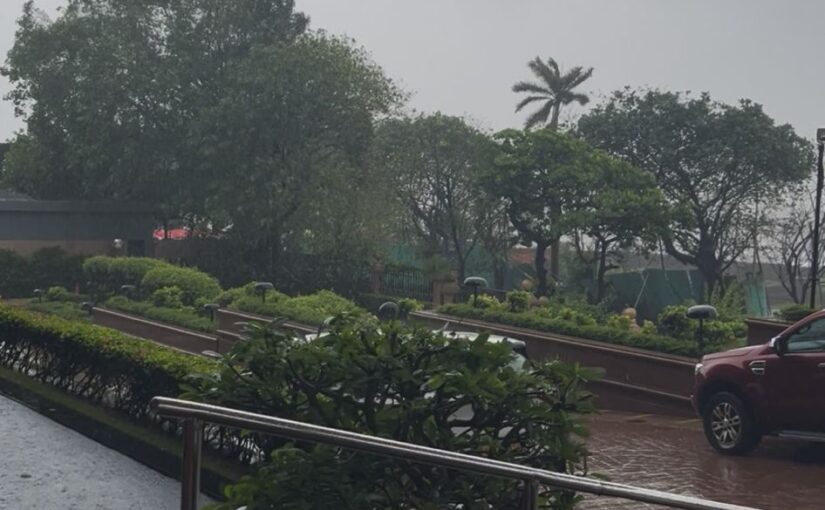
I. Bombay: Between Beauty and Brutality
I’m writing from Bombay, where the monsoon floods are overwhelming; visually and viscerally. The rain hammers the city with a kind of sublime fury. From certain vantage points, it’s breathtaking. But it’s also undeniably brutal for those without scenic surroundings or structural shelter. It’s a reminder that Indian beauty is often doubled with burden.
II. Burden Burst: The Commentariat Awakens
Lately on Brown Pundits, I’ve noticed a revival. Old voices returning, new ones emerging, and many ideas worth engaging. But some themes have worn thin; for instance I’m in broad agreement with Indosaurus & I don’t want to waste too much breath on Audrey Truschke. And frankly, Aurangzeb is not a hill I want to die on. In fact, perhaps one of the key misreadings by Muslims in the subcontinent was turning every ideological disagreement into a hill to die on. Maybe it began with QeA-Jinnah and the Great Allama but it ossified into a pattern. Everything became a matter of principle, rather than pragmatism.
III. Concession Is Not Compromise
Compromise is seen as weakness, but I’m more interested in the capacity to concede especially when history clearly shows you’re wrong. The Mughals installed a two-tier system, subordinating Hindus and even native Muslims. Contrast that with the Suri dynasty, particularly Sher Shah Suri, who in just two decades built the Grand Trunk Road and reshaped governance without the alienation that marked the Mughals. If Hindutva attacked the Suri legacy, I’d call it pure bigotry. Sher Shah ruled with the land, not over it.
IV. Of STEMIs and Lutyens
Kabir’s jibe about Hindutvas lacking humanities depth amused me. At Cambridge, all the STEM kids lean Hindutva, while the humanities circles skew liberal, Lutyens-style. The liberal Indian intelligentsia today plays the role of interlocutor between Indian reality and Western liberalism. The Hindutva core, by contrast, is indigenous but often struggles to translate its worldview into global discourse. They have power, but not fluency with the Master’s tools.
V. Philanthropy, Ego, and the Indian Imagination
Nivedita raised a sharp point: Indian philanthropy is misguided, often chasing Western validation. I’d go further; philanthropy is always tangled with ego. One of my disappointments with the Ambani wedding was that it could’ve been held at a restored ancient Indian sites. India’s royal families have done an incredible job turning palaces into heritage hotels, but many civilizational treasures still rot. Imagine if India’s ultra-rich funded the infrastructural revival of temples, forts, and forgotten cities and then wove celebrations into them.
VI. Brand India and the Power of Names One of the most quietly consequential choices modern India made was the renaming of its globally iconic cities: Bombay to Mumbai, Calcutta to Kolkata, Madras to Chennai, Bangalore to Bengaluru. These were names known across the world; synonymous with trade, literature, colonial memory, and cosmopolitanism (and all are “British cities”). And then they were localized, in part rightly, but in the English language, branding suffered. It’s curious, for instance, that New Delhi never dropped the “New”, perhaps to distance itself from its Mughal predecessor. Much as I admire the name Bharat, and use it often, there’s no denying the incalculable global capital embedded in the word India. Changing Bombay to Mumbai is a bit like Coca-Cola changing its name and expecting the same shelf pull. Civilisational heritage and global branding aren’t always at odds but they do need careful negotiation.
VII. India and Pakistan: Two Lost Visions
India’s modern state is bottlenecked by bureaucracy, but it has moments of imaginative brilliance. Pakistan, by contrast, never committed to becoming the capitalist foil to India’s socialist DNA. It could have been the Singaporean UAE of the subcontinent; hyper-capitalist, autocratic, effective. But its obsession with Kashmir, and its inability to embrace its feudal core as an asset, stunted it. QeA-Jinnah and the Great Allama dreamed poetically and tactically, but not structurally.
We’re left with two nations, both haunted by misreadings. Both drenched in rain; India with its romance, Pakistan with its regret. And here I am, in a Monsoon Bombay, watching it all unfold.
well written. enjoyed it.
>>>Imagine if India’s ultra-rich funded the infrastructural revival of temples, forts, and forgotten cities and then wove celebrations into them.
I feel so strongly about this – having visited Ajanta/Ellora, and Angkor Wat – the contrast in presentation, facilities ….saddened and infuriated me. Its been more than a decade since I visited the former, so I’m hoping things have improved. More than a decade prior to that, I remember going to the IVC site at Lothal, and was so disappointed with the sad little museum and the unprotected nature of the site. When I got to see Akrotiri (the cycladic Pompeii) a few years later, the contrast… was significant.
I do feel, that this too is an iterative problem. With time and the wealth steadily accruing in Indian society, the ‘civilizational treasures’ will slowly start getting the TLC and funding required. It can’t happen soon enough or fast enough.
On a separate note, I miss the rains of Bombay. It will be forever Bombay for me and not Mumbai, but that’s a generational thing I guess. Would have appreciated more photo/videos shared along with this piece!
I am leaving Bombay now- but yes shall share pictures. Beautiful city; rapidly becoming one of my firm favourites in the Indian Subcontinent.
There is just something about the sea bathing the city constantly on all sides that makes it magical. Manhattan with a heart..
Nice article, it got me thinking. Kulothunga is the Chola Emperor, controlling peninsular India and sovereign overlord of the bay of Bengal, one of India’s greatest kings. Ramanuja is a Brahmin priest with no army, dependent on patronage, fleeing Kulothunga’s wrath.
Yet look at Narrative control, the Chola Emperor is Krimmikanta and Ramanuja is Ramanujacharya.
Brahmins could pretty much retro fit scripture and stories as they liked and switch out the deity in a temple with no historical fuss.
STEM departments churn out engineers and Titans of industry, multinational CEOs who stride across the internet.
Yet the narrative control remains with the Brahmins of humanities, dependent on the Narayan Murthys for grants but in full control of the story.
If only Kulothunga had the internet and an AI assistant.
With Kulothunga the Cholas lost their 80 year hold on Northern (Anuradhapura) Sri Lanka
The invasion was essentially for plunder and the end of Anuradhapura as the capital.
But the Cholas never really consolidated their control over southern Sri Lanka, which in the case lacked large and prosperous settlements to tempt long-term Chola occupation.
The crisis in the country left a scattering of turbulent chiefs and intractable rebels whose allegiance, if any, was at best opportunistic which proved a problem to both sides in the conflict, frustrating both the Sinhalese kings and the Cholas.(Very Sri Lankan in my opinion, switching allegiances at the drop of a hat)
In the following decades led to the Sinhalese kingdoms and capital being moved to the South.
https://en.wikipedia.org/wiki/Chola_conquest_of_Anuradhapura
More Interesting stuff
Kulottunga’s inscriptions are generally silent in regards to Lanka or with regards to any campaigns or wars against the Sinhalese rulers. According to Sastri, Kulottunga was content with keeping the Chola empire from disintegrating on the mainland and was not that affected with the loss of the island nation
It is of interest to note that Vijayabahu married Lilavati, the daughter of Jagatipala, a former ruler of Rohana, after she escaped from the Cholas and returned to the island kingdom.[102] Jagatipala was originally a prince of Ayodhya* (in Uttar Pradesh ??) who had migrated to Lanka and become ruler of Rohana. He was slain on the battlefield during the Lankan expeditions of Kulottunga’s predecessor.
He was slain on the battlefield during the Lankan expeditions of Kulottunga’s predecessor, Rajadhiraja Chola I, when the Sinhalese kingdom lost four crowns in quick succession.[103] At that time, this princess along with her aunt or mother was taken captive by the Chola forces. These events are described in great detail in the Mahavamsa (the Culavamsa) and in an inscription of Rajadhiraja Chola
**I will need to check Culavamsa to see if Ayodhya in Uttar Pradesh or Ayutthaya in Burma
Checked.Culavamsa
Then a powerful prince of the line of Rama, known by the name of Jagatipala, a Sovereign’s son who had come from the town Ayojjha{4}, slew Vikkamapandu in battle and ruled as a mighty man in Rohapa four years
Footnote by Translator
[4] Skr. Ayorlhya, the present Oudh in India, situated on the river Gogru
https://en.wikipedia.org/wiki/Kulottunga_I
Good stuff but how much of these records match up against others. I would imagine the Sri Lankan monk narrative consistency is excellent compared to the Indian (Brahmin) ones which heavily mix theology and myth making.
Heavy rains have also hit Karachi (I just woke up and learned this). KPK and GB are dealing with severe flooding. Climate change in South Asia clearly knows no borders.
On Hindutva and STEM: I just want to say that this is not unique to India. There has been a lot of research done showing that people in STEM tend to be much more right-wing than people in the humanities. Humanities education is associated with left-wing views in most countries. Perhaps this is because in Science and Math (at least at the lower levels) there tends to be one right answer at the back of the book. Humanities are open ended, all about how well you write and how well you argue.
I briefly worked at a university in Karachi last year. The men on the Engineering faculty had Islamic beards. The ladies were in niqab. In contrast, the Humanities faculty was full of modern, stylish Pakistanis and even Westerners.
South Asians tend to go for STEM. It’s only natural since that’s where the jobs are. At the aforementioned university, fully one third of the entering class was doing Computer Science despite this university branding itself as one that focused on “liberal arts” (to its credit it does have a strong core curriculum). But then South Asians should not complain when Westerners become the interpreters of South Asia’s history. No one is stopping you from getting a Phd in History, you just can’t be bothered.
one point about philanthropy,
there used to be a system where a brahmin student would come for an evening meal either every day or one day a week to brahmin houses which were relatively well off. this was called ‘ vaara anna’, vaara meaning week.
while this was acknowledged by the student, there was no ‘tom toming’ by the giver!!!.
even now, free ‘anna daana’ in temples and public functions in south india is almost a norm.
and all these in addition to the land grants, scholarships, cash grants to individuals and by individuals to temples, villages are well documented.
yesterday some one gave 135 cr to tirumala temple in gold!!.
This year’s monsoon has been particularly intense. The rains in Bombay always carry a romantic charm.
yes they really were beautiful; Bombay-Mumbai is rapidly growing on me
It will be even more impressive once the metro is finished. I believe it has the potential to become the Indian version of Hong Kong in the next 15 to 20 years, emerging as the first truly global city in the subcontinent.
God willing