
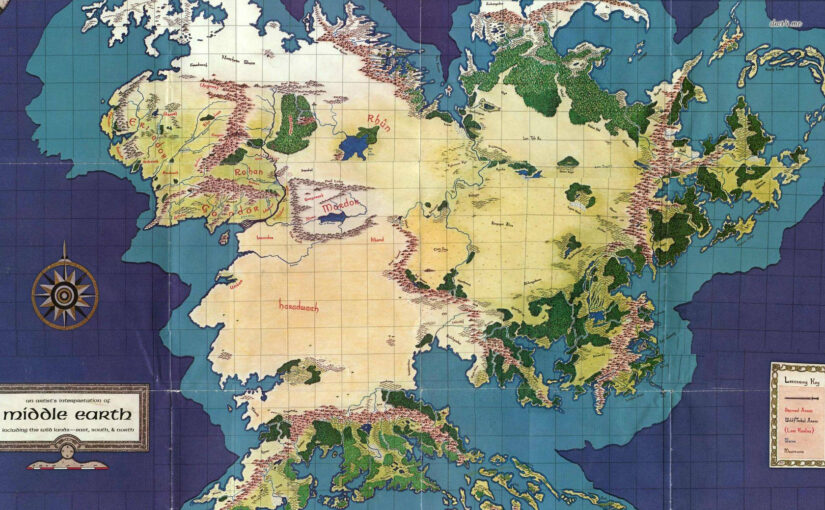
After our discussion on industrialisation in India, I began to wonder: if the Earth were one country, one government, one infrastructure grid, one economy, where would its industrial heart lie?
Geographically, the answer is obvious. The natural centre of the world, for energy, labour, and trade routes, isn’t London, New York, or Beijing. It’s the triangle between the Persian Gulf, the Indo-Gangetic plain, and the Red Sea.
Deserts rich in hydrocarbons. River basins dense with labour, water, and grain. Seas that touch every continent. If the world were united, this belt, Arabia to India to the Nile, would be the Ruhr, the Great Lakes, and the Pearl River Delta combined.
The Natural Order of Geography
Before empire, this region was the planet’s connective tissue. Spices, silk, horses, and steel moved from India to Arabia to Africa. Energy, grain, and knowledge flowed through the Red Sea and the Persian Gulf like the arteries of the Earth. It was not the “Middle East”; it was Middle Earth.
Then came empire. The Suez Canal, while restoring an ancient route, channelled its benefits northward. Instead of linking Africa, Arabia, and India on their own terms, it bound them to London and Paris. The partition of India and the carving of borders across deserts and coasts further severed what geography had once joined. The world’s industrial axis was shifted thousands of kilometres north, to colder latitudes sustained by colonies.
The Cost of Displacement
The West’s industrial revolution ran on stolen geography. Coal and cotton from India, sugar from the Caribbean, oil from Arabia, labour from Africa. Instead of allowing the world’s natural basins of production to evolve around energy, water, and sun, empire exported the raw and imported the refined. Infrastructure served extraction, not development.
A century later, much of the Global South still burns fuel it doesn’t refine, exports ores it doesn’t smelt, and imports machines it could produce itself — because the industrial heart was forcibly relocated.
If Empire Had Never Happened
In a de-colonised world with seamless infrastructure, the planet’s production would hum between:
- Eastern Arabia’s energy belt, power, aluminium, petrochemicals.
- Gujarat and the Indo-Gangetic plain, manufacturing, agro-industry, machine goods.
- The Red Sea and Suez corridor, shipping, shipbuilding, logistics.
The Indo-African Triangle would be the beating heart of global industry; powered by sun and sea, feeding the world through two oceans. Instead, centuries of empire re-routed that pulse to the North Atlantic, sustained by force, finance, and fossil fuel.
The Lesson
Colonialism was not only moral theft; it was geographical sabotage. It rearranged the map of production against nature itself. Every post-colonial economy still pays that rent in shipping costs, currency exposure, and energy dependency.
The price of empire lies not just in blood or humiliation but in the loss of the world’s natural efficiency; a global system forced to beat off-rhythm from its geographic heart.
When the balance finally returns, as trade tilts once more toward the Indian Ocean and the Gulf, it will not be the rise of the “Rest.” It will be the Earth’s geography correcting an historical error.
Wouldn’t it be fair to say that the Industrial Revolution occurred partly due to the rise of scientific knowledge? And that rise of science happened in the West. The Renaissance–which displaced God and put man at the center– happened in the West. Enlightenment thought happened in the West.
So while colonialism is part of the answer (and I’m not here to defend colonialism), it’s not the complete picture.
I think you are half-right but even the age of Scientific Discovery and Industrialisation was based on an Imperial Model?
I am not saying what should be done but just the true historical understanding
‘Both’ are 2 sides of the same coin. The temporary technical advantage gained by the ‘west’ in technology was deployed in a self-feeding virtuous (or vicious) cycle to ruthlessly extract resources from the ‘have-nots’. Or even the ‘haves’ as in the subcontinent and China.
I referred to the Renaissance. This was important because it led to a way of thinking in which man not god was placed at the center of life. We arguably still haven’t reached that point in South Asia. Without the Renaissance, there would have been no Enlightenment and no rise of Secularism. Without the Enlightenment, there would have been no scientific advances.
You have to give the West credit where credit is due.
This is what I remember from AP European History.
Yeah I’m not sure if I buy into this to the extent you are.
well not sure if its inevitable. The CCP is trying to hardwire its current manufacturing monopoly by building out OBOR – It also helped them monetize the overcapacity in construction they had built out during their internal build.
The sad reality of history is that entities that manage to acquire advantage due to technology or military supremacy, are going to attempt to make it ‘sticky’ over as long a duration as they can.
The sad reality of history is that entities that manage to acquire advantage due to technology or
The reality is that any successful entity (including corporates) has its own destruction built in
Similar to economic law of marginal product and average product–
eventually, increased investment into sociopolitical complexity
becomes costly and unprofitable.
Main concepts are:
1) human societies are problem solving organizations,
2) sociopolitical systems need energy to maintain themselves,
3) increased complexity increased costs per capita,
4) investment in sociopolitical complexity as problem solving response often reaches point of declining marginal returns.
Joseph Tainter Collapse of Complex Societies.
Kind of similar to Jared Diamonds Guns, Steel … and Collapse.
Apparently Jared Diamond Collapse refers to Tainters work a lot.
https://www.amazon.com/Collapse-Complex-Societies-Studies-Archaeology/dp/052138673X
I’ve read that Guns Germs….book. I thought he extrapolated a bit..too far and too much.
Collapse of Complex Societies is more text book style.
I have pdf. Will have it as a link for a few.
Let me know
That would be great!! Thanks!
Done
Download via link below
https://wilpattuhouse.com/MiscStuff/Tainter.pdf
Thank you. Will try and get around to reading this. Appreciate it 🙂
Yes exact – it wasn’t so innocuous
This Fungus Eats Radiation — And Scientists Are Taking Notes.
Inside the radioactive ruins of Chernobyl, researchers found a strange black fungus that doesn’t just resist radiation — it thrives on it.
The fungus, Cladosporium sphaerospermum, produces high levels of melanin, the same pigment in human skin — but here, it acts like a biological solar panel, soaking up ionizing radiation and converting it into chemical energy.
Scientists call this survival trick radiosynthesis, a process similar to photosynthesis but powered by radiation instead of sunlight
From Research Article
https://pmc.ncbi.nlm.nih.gov/articles/PMC2677413/
Life on Earth has always existed in the flux of ionizing radiation. However, fungi seem to interact with the ionizing radiation differently from other Earth’s inhabitants. Recent data show that melanized fungal species like those from Chernobyl’s reactor respond to ionizing radiation with enhanced growth. Fungi colonize space stations and adapt morphologically to extreme conditions. Radiation exposure causes upregulation of many key genes, and an inducible microhomology-mediated recombination pathway could be a potential mechanism of adaptive evolution in eukaryotes. The discovery of melanized organisms in high radiation environments, the space stations, Antarctic mountains, and in the reactor cooling water combined with phenomenon of ‘radiotropism’ raises the tantalizing possibility that melanins have functions analogous to other energy harvesting pigments such as chlorophylls.
fascinating
I enjoyed reading this. Thanks for sharing.
The United States and Israel were the only two countries that voted against a UN resolution in December 2021 to make access to food a human right. The resolution passed with 186 countries in favor
The US and UK stance on Israel and Gaza has lost their moral standing in the world. In my opinion it will bring down the US. Maybe some redemption if in Mid Term Elections Congress members who get AIPAC money get voted out. Unhappily Senators dont need to stand for elections.
https://web.facebook.com/reel/4299201737035310
The corrupt third world kleptocracies would like nothing better than to use the argument of access to food as a human right to extort money from taxpayers in industrialized countries.
First world hegemons like the US and UK still keep extorting wealth and destroying other countries.
eg US ongoing
a) terrorizing of Venezuela to take over its Oil wealth
b) 30+ years of embargo of Cuba