More than 2 years ago I had appeared on the Brownpundits podcast to elucidate a moderate liberal opposition to the Juggernaut of BJP under the prime ministership of Narendra Modi. My political position back then is clear in this interview. My political hope for the 2019 election was a reduced majority for BJP in 2019 to counter some of the nasty excesses which come up in Indian politics when a political party gains absolute power. I was sympathetic to moderate/liberal Hindutva – as in I would have preferred a Gadkari over Modi for what it’s worth. Being a skeptical person by nature, I had never swallowed the whole agenda driven home by Indian and Global Liberal Media viz Cow lynchings or Saffronisation of textbooks or so-called Intolerance debate. My primary criticisms of the BJP government from 2014 to 2019 were the abuse of independent institutions – especially the courts and reserve bank and especially the win-at-all costs mentality when it came to elections – including Hindu-Muslim polarization during elections.
In spite of all my public and social criticisms of the Government and Hindutva project, for most part of the election campaign I considered voting for BJP as the alternative to Modi appeared scarier than anything Modi offered. However, the nomination of Sadhvi Pragya from the Bhopal seat was something I could not digest.
It would be clear to the regular followers on this blog or my followers on twitter or elsewhere that my political orientation has somewhat changed, so let me attempt to flesh out what has been the change and how it came about. One blogpost which summarizes my political/social position in 2020 as liberal is here.
Article 370:
The position of Congress and a whole lot of “opposition” on changes to article 370 (apart from AAP/BSP) is objectively disconnected from ground reality (as was their criticism of Indian government action in Balakot). Nationalism in Indian context has never been associated with the bad odour of European Nationalism, but this reality seems increasingly lost on Indian Liberals.
CAA NRC protests and Delhi Riots:
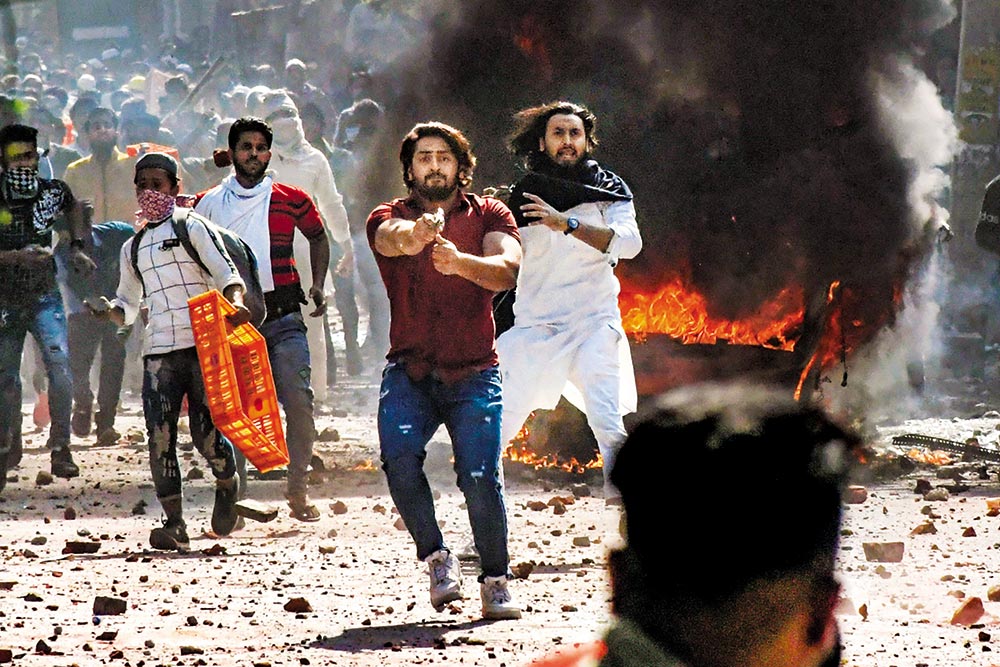
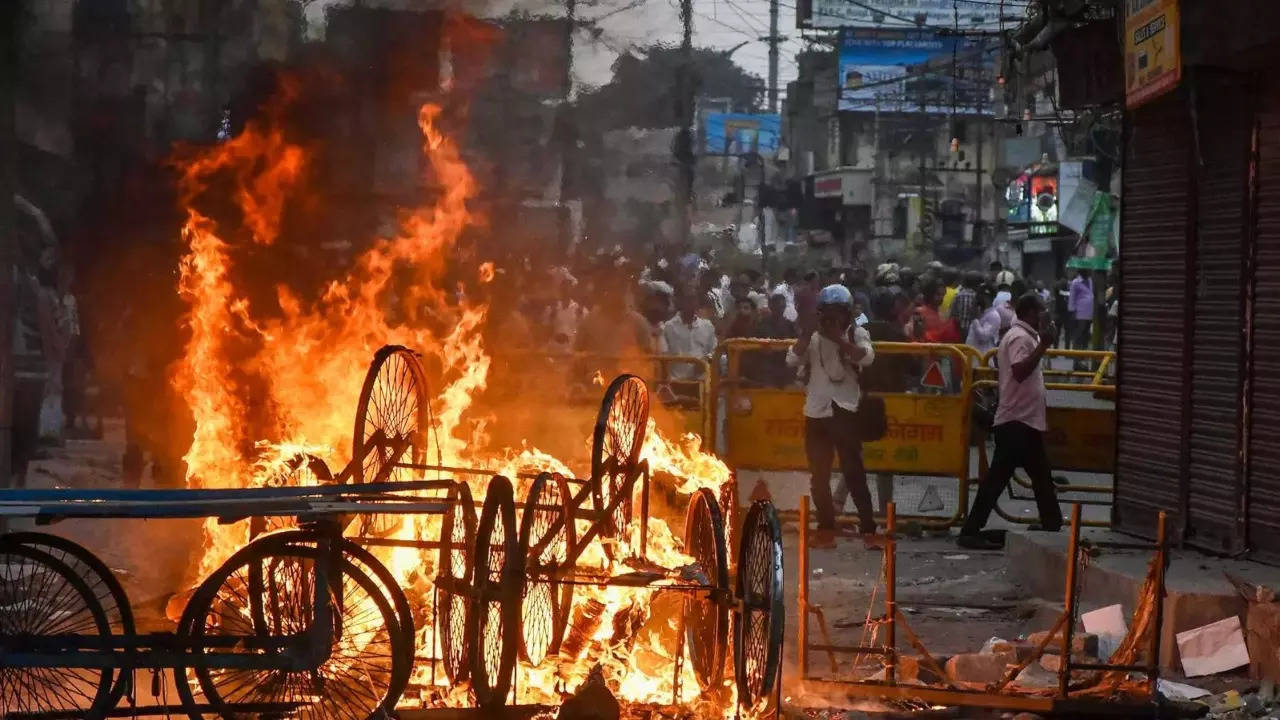
I had described CAA as “the Straw that broke the camel’s back” back in 2020, but the CAA agitations themselves had raised serious doubts in my minds about the Liberal project wrt protests. In retrospect Islam wasn’t just the rock that broke liberalism, but Islam was the rock used by Liberals to attempt to break Hindutva while Liberalism itself became collateral damage. The unconstitutional and often violent protests which led to loss of crores worth of property and finally riots in the national capital were not merely supported but actively encouraged on by Indian Liberals. I had a written the following article calling out the illiberalism of the liberals over the Bloomsbury Delhi riots fiasco. In essence the position a huge segment of Indian liberals espoused was “Free speech till I like it”. I unsubscribed from Newslaundry after a lot of to and fro debates in the letters to Newslaundry section. I continued with my subscription of Swarajya and the Print. I would see this as my transition from Center-Left to Center.
Only the truly deluded would call a riot where 25+% dead are from the majority community (with apparent state support) a pogrom or carnage, but this was a fairly mainstream view in Indian liberal circles.
Covid:
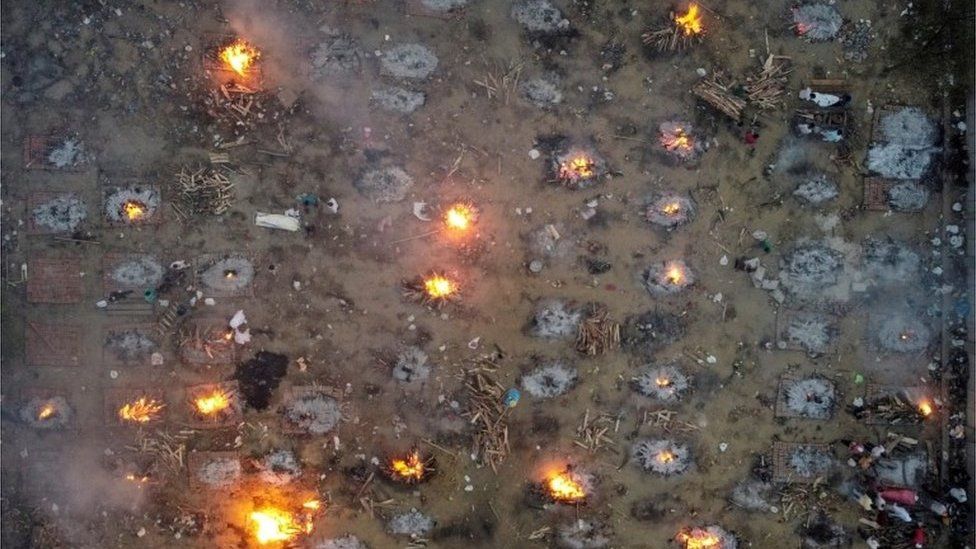
The covid lockdowns truly brought out two extremes in Modi Government’s responses to the problem from the knee jerk overreaction in 2020 to the casual underreaction in March-April 2021. A lot of blame that the government received from all sides was justified, but where justified outrage gives way to sedition or atrocity-porn is often difficult to discern. Yet from the coverage of 2nd wave, it’s fair to say that Indian liberal media (in sync with western media) was extremely unfair in handling India – much to the detriment of Indian image worldwide.
While initial vaccine policy of the Modi government was rightly panned by commentators on all sides of the spectrum, till this day I have not come across a serious liberal voice who is happy with the vaccination program undertaken by the Modi government (an exercise unlike any other in the history for its sheer scale).
Farm Laws:
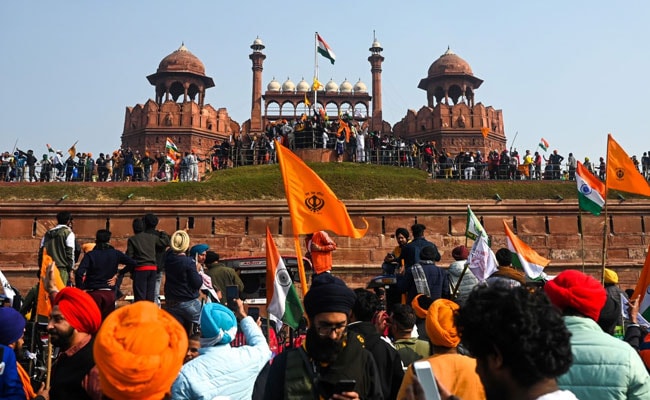
The Government subsidised policies like (i) Rice production in Northwest India, or the (ii) Sugar production in UP and MH have been among the worst agro-economic policies in the 21st century. There is almost a global economic consensus in the need jettison the MSP driven subsidies, for their economic as well as environmental impact. In early 2021, traders, landowners and farmers from 2.5 states with immense help from inside and outside the country, brought a government with majorities in both houses of the parliament on its knees. If a government with comfortable majorities, popular mandate cannot introduce reforms which are popular with the majority of Indian electorate (including farmers), it speaks volumes of the Negative Veto that immensely small minorities can hold over the strongest government this country has seen in 3 decades.
If a Modi government with 304 seats in the Lok Sabha (350 for NDA) cannot bring in much needed reforms, a BJP minority government wouldn’t even be able carry out attacks it carried out against Pakistan. So much for the moderate centrist position for checks and balances. In essence, India remains a democracy with extremely weak state where heckler’s veto is so mainstreamed that moderate centrism is nothing but naiveté at best.
Journalistic integrity (Eg: Lavanya suicide):
I had published this rant when the Lavanya controversy broke on social media. To this day I do not cannot say with certainty if the episode was exactly as represented in the Hindutva social media, but it did make the hypocrisy of coverage pretty clear to me. On its own, this episode isn’t a particularly outrageous one (among a pattern of Liberal media coverage) but this particularly made the Liberal media pattern clearer to me than it had ever been before. The constant gaslighting of atrocities on Hindus owing to fears of Hindu majoritarianism across the board has gone unnoticed for long enough.
Hijab Controversy:
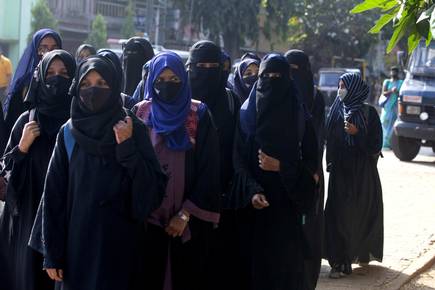
The fact that in year 2022, a dozen girls under the influence of now banned PFI, can hold schools at an impasse over their “right” to drape themselves in a modesty garb (not the headscarf – Hijab is translated loosely as a modesty garment). On the liberal side, only Shekhar Gupta had understood the potential significance of controversy. Given the stance Indian liberals took during the Karnataka Hijab controversy, their silence on Iranian Anti Hijab protests isn’t surprising but consistent with the Faustian bargain they have committed.
Kashi Vishwanath – Nupur Sharma controversy:
The court verdict of the Kashi Vishwanath excavations notwithstanding, the claims of the Hindu side regarding the existence of Shivling in the Wuzu khana is something difficult to digest for even the most irreligious Hindus (like myself). While it’s imperative to disassociate the acts of medieval religious fanatics from Muslim population today, all the actions of the previous 300 years (if the continued existence of Shivling in Wuzu khana is proven) cannot be wished away. I had personally never been a fan of so-called Truth and Reconciliation program, as I favored the view that contemporary problems don’t need to have their solutions in the history, but this episode has thrown a heavy wrench into that pet-theory of mine.
The Nupur Sharma episode which followed, particularly the antics of “Fart-Checkers” made the binary even clearer with principles being were jettisoned wholesale. An example below:
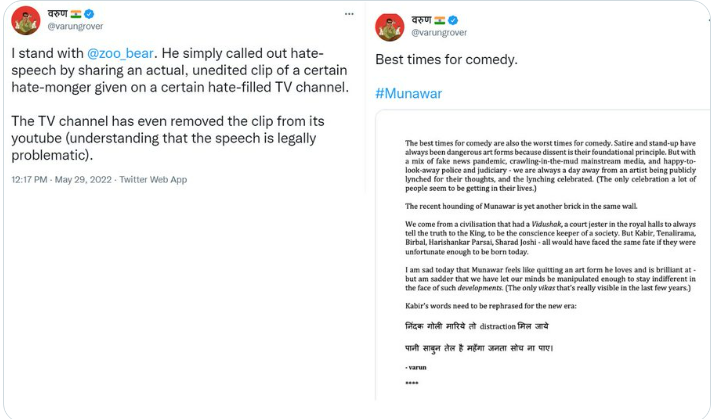
Munawar Faruqi continues to gain meaningful livelihood in India, Nupur Sharma has no option but to spend the rest of her life as Salman Rushdie did in the 90s and 2000s. A dozen or so Hindus who have committed the act of “blasphemy” have already given up their lives in last 10 years of Hindu resurgence. 100 years after the ethnic cleansing of Kohat Hindus over blasphemy the house of Congress MLA was torched in BJP ruled Karnataka over Newton’s Third Law Blasphemy. What has changed in last 100 years? Additionally, in 2022 the Umesh Kolhe and Kanhaiyalal murders are objectively worse as they weren’t even accused of blasphemy themselves.
An important point worth noting here is, Umesh Kolhe was murdered on 21st June, the news of his death at hands of Islamists only became public on 2-3rd July after Shinde-Fadnavis wrestled the political reins of Maharashtra from the hands of the “Secular” MVA.
Indic/Bharatiya movements:
While I have my disagreements with the Decoloniality movement – crystalized in J Sai Deepak’s India that is Bharat series (my reviews: book 1 – book 2), the movement is one of immense consequence. My own views have changed a lot over last 3-4 years on topics like Temple control, “Coloniality and its legacy” etc after honest engagements (with disagreements) with these thoughts. The colonial hangover is something which has impacted minds of all Indians growing up to a large extent – be it due to Textbooks, Media, Pop-culture. However, once we become aware of some of the inherent biases of these institutions, the impact they had in shaping us will be somewhat eroded with time.
Kashmir Files: (My Review)
Objectively speaking Kashmir files can be proved to be less biased than Haider. While Kashmir files has no positive Muslim character, Haider has no positive Pro-India Kashmiri. Haider was a concoction of imagination while Kashmir files is based entirely on facts (though it can be accused of being selective). Yet Haider was well received by Indians of all ideological spectrum (when it was initially released) while every attempt to discredit Kashmir files was made by the almost the entire Liberal Media and Entertainment industry. Clearly a film like Kashmir files could not have been released hadn’t it been for the overwhelming majority enjoyed by BJP at the Centre.
Love Jihad:
Data points about Cow theft lynching in the range of noise were enough to make India “Lychistan” globally, while statistically significant cases (in the range of hundreds over last 7-8 years) of inter-faith abuse/fraud – more colloquially known as Love-Jihad, was looked at as a conspiracy theory by even Hindutvavadis till a few years ago. Now thanks to the fearless reporting by the likes of Swati Goel among others, “Love Jihad” cases are coming to light at a truly alarming rate. Personally, I have been hearing such cases for at least 2 decades, but I have never taken these rumors or conspiracies seriously. From a purely sociological perspective, it seems an inevitability given the trajectories of various communities in India.
History and perspective:
What one gains out of reading world history is context. Systemic Oppression was a norm and not an outlier in all societies just its flavor varied according to culture. A member of so-called Oppressor Group, guilt tripped into the real and imagined sins of his ancestors will inevitably gain a different perspective about his/her history once he/she reads world history more thoroughly. The “enlightened” position of jettisoning all traditions – lock stock and barrel, appears over the top after getting 30000 feet view of history. As a result, one learns to love and own their own culture without the necessity to always feel ashamed for the past, thus being more committed to defending it.
Coming to recent history, the Pakistan movement remains incompletely studied in school curriculums as well as pop history. Books like Creating a New Medina, MJ Akbar’s Tinderbox (Review by Maneesh Taneja) and now J Sai Deepak’s India Bharat and Pakistan are shattering the hold of mainstream and popular historians the popular discourse. After reading both sides of the history of Islamic exceptionalism in India, one can’t help noticing the unnerving parallels in the events leading to the Khilafat movement in 20th century to events in 21st century.
Being judgmental of the Indian leaders of the 20th century may be unfair, but not learning from their mistakes would be downright foolish. For all the mistakes they may have committed with the benefit of hindsight, the likes of Gandhi, Nehru and Patel in all likelihood understood the unique problem posed to Indian civilization by Islamic exceptionalism. Their tactics and strategies may have been proven wrong, but one can at least say they understood the problem they were facing. Can the same be said about the “Secular” leadership today? Or does the RSS with its moderate face in 2022 play the role of Indian national congress in 1940s and 1950s? Maybe – Maybe not, but the “Secular opposition” today is far removed from the position of even Nehru, let alone Gandhiji or Sardar Patel.
the Other side:
All the points mentioned above cannot whitewash any of the fair criticism (of which bucket load exists) of the Hindutva movement in general and the Modi government in particular. I continue to hold the view that the Abrahamisation of Hinduism is undesirable. I also continue to think the Hindu view of Cow-protection is extremely unpragmatic in the 21st century market driven economy with a population of 1.3 billion. The Bilkis Bano remission cannot be anything but a blot on Indian civilization as a whole. I am extremely skeptical of the apparent resurgence of Hindu orthodoxy visible on Twitter (though one can’t be sure of its implications on the ground). My reservations around the cult of personality of the Narendra Modi remain as strong as ever but it would be childish to deny the fact that Hindutva needs Modi. Almost all the criticisms of authoritarian tendencies one can make of the BJP are criticisms one can make of the opposition with more fervor. (Ketaki Chitale, Arnab Goswami, Bengal violence etc etc).
the Die is cast:
I had read Rajiv Malhotra’s “Breaking India” 7 years ago, I had agreed 50% with his thesis (though I was a BJP supporter back then). More importantly I had found the remaining 50% far-fetched, overstated and conspiratorial. I don’t think I need to re-read the book to claim that I would agree with around 80-90% of the book’s thesis today. From celebrity activists expressing solidarity with Farm law protestors to 9/11 being chosen for Dismantling Global Hindutva, the global anti Hindu/India conspiracy angle doesn’t appear far-fetched if one keeps an open mind and consumes information from all sides of the spectrum. Links of the Communist-Missionary nexus with protests like Sterlite copper plant or the Dravidian or Ambedkarite movements is now out in the open. The manufactured controversies around Mohammad Shami and Arshdeep Singh were so transparent that I am astounded more honest people from the Liberal side haven’t picked it up. Ditto for the call of Arab intervention in Indian domestic affairs – an act even Owaisi condemns in public.
I generally avoid using larger than life words like civilizational cause and arc of history or existential crisis. But the 2.5 front war is here, and it is not a merely political war but a civilizational one. In this context, Liberal Idealism which I once espoused appears to be just another face of pompous and self-righteous naiveté.
As Christopher Hichens famously put it
The barbarians never take a city until someone holds the gates open to them.
The DIE is CAST, Indian liberalism is dead. We might as well pick sides.