My usual 7 PM PDT Friday night chat on Clubhouse will be about the genetics of Italy (Saturday morning India time). this link should work (if you are on an iPhone click it).
What Can Biden’s Plan Do for Poverty? Look to Bangladesh. The usual Nicholas Kristof thing. That being said it is interesting that when there is talk about Bangladesh’s economic success (relative), a fair number of Indians point out major issues (reliance on the single sector for export). This is all fine…but honestly, it feels l ike sour grapes. In 2020, a horrible year, Bangladesh was #3 in growth in the world (and the fastest large nation).
Going to do an interview with a linguist who studies Proto-Indo-European for my podcast. Interesting how his papers suggest Indo-Iranian and Balto-Slavic are a clade. R1a FTW!
Update: Someone on the Subreddit found the archives of the original BP site from 2011/2012 (I have the archives in MySQL but haven’t loaded them; we suffered intense hacks from Hindutva in 2012/2013 so moved to blogspot for a while).
Also, BP got a Clubhouse Club! So we’ll do chats there soon.
Recently a Bohra Patel emailed me to express some exasperation that people are quoting me saying that the ancestry of South Asian Muslims is almost all from Hindus (or non-Muslims). Basically, I say things like this “99% of the ancestry of South Asian Muslims is indigenous.” This means some people are going to be 75% indigenous, but the majority probably have no West Asian segments of DNA. This does not mean they don’t have a genealogical line of descent. I myself am ~100% South Asian if you look at my genes…but my maternal grandmother’s father was from a lineage that had migrated to Bengal in the 19th century from Delhi. Before they were in Delhi they had left Persia in the 17th century with the forced conversion of the whole religious class to Shia Islam. This is validated through a Koran with all direct male line descendants listened. I am not one of those descendants (my maternal grandmother is not “in the book”), but I’m pretty sure my distant cousins who are paternal descendants no longer have any detectable Iranian ancestry either. Why?
The reason is that eight generations back there is only a 50% chance that you will any segment of identifiable DNA from an ancestor. Another way to say this is that 200 years ago you had many ancestors, but there’s only a 1 out of 2 probability that you will have identifiable DNA passed down through the generations from that person. Since my Iranian lineage (a man who left Iran, settled in South Asia, and married into the South Asian Muslim community) dates back 350 years, it’s totally unsurprising that there’s no evidence that isn’t documentary at this point.
In any case, I’m looking more closely at the assertion I made above. I ran a supervised analysis on some samples. You can see the results below. I’ll probably do f-stats too…but that takes a while to run. I may ‘update’ my estimate from 1% to closer to 5%, though I’m not convinced. The Bohra Patel is in the sample, it’s clear they are enriched for “Yemenite Jewish” ancestry. But, even with 200,000 markers, there are Hindu individuals that are 1-2% (Tamil Brahmin) because of the way the model is set up.
Really what’s needed are huge Y chromosome panels. Since that’s an unbroken lineage, and the gene flow is mostly through men from everything we know.
But the real problem is Iranian ancestry because there is something of a “cline” in the northwest of the subcontinent. How exactly are we supposed to detect Iranian ancestry in Punjabis that is recent? Ultimately it’s going to have to be IBD segments in large panels.
That being said, there is an indirect way to detect Muslim West Asian ancestry: look for Turkic and African segments. These come from Muslims, and so can serve as a tracer that is much more distinct from the Indian genetic landscape.
Finally, the flip side of these comments about the minimal impact of West Asians on the genes of South Asian Muslims is that it should make us more skeptical of the arguments of some Hindu nationalists and Muslim fundamentalists about how brutal the Turks were. I’m sure they were brutal…but they didn’t leave much of a genetic impact on Muslims, let alone Hindus. Most people were likely pretty insulated from the predations, probably because cities were demographic sinks anyhow.
A Muslim Indian is kind of annoyed that I say “Muslims in the subcontinent are descended from Hindus.” By this, I mean 99% of the ancestry.
Of course, it can be hard to see the impact of Iranian ancestry. I’m going to look more closely to update my estimate.
I recently got contacted by a British research group. They sample thousands of Bangladeshis, and unlike the Pakistanis, they saw no internal structure aside from some individuals who seem to be a Tibeto-Burman tribal people. Like I said: the Bangladeshis might be called Hindus by Pakistanis, but the Pakistanis marry like they’re Hindus, the Bangladeshis don’t.
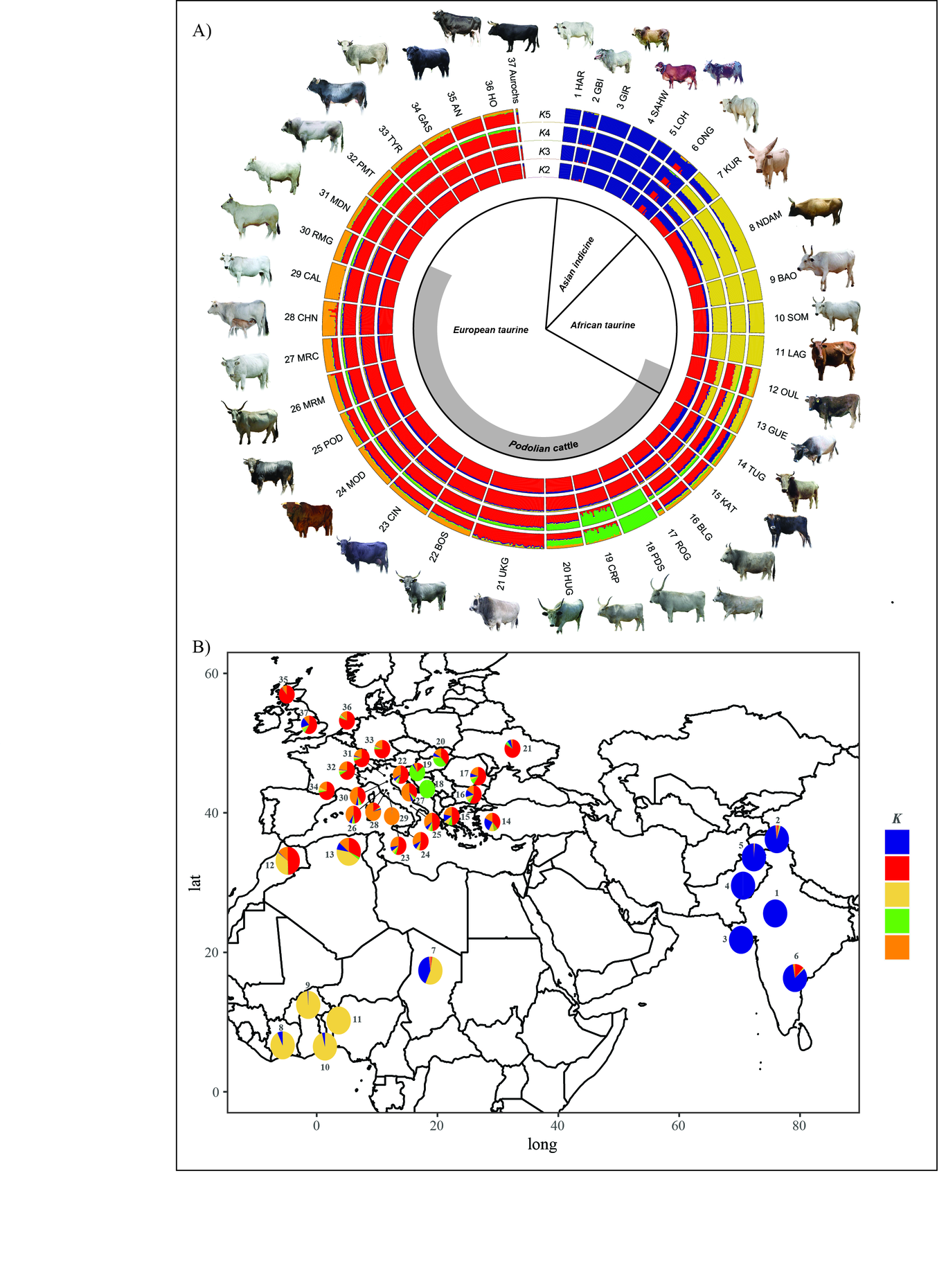
I haven’t written a post on the blog since July 2020. This has partly been due to a slightly more busy schedule and partly due to the fact that I have become a little ambitious and am trying to write more comprehensive and voluminous articles which take time to prepare. After having written about the dating of the Kushans on my blog, I delved into the linguistics aspect of Indo-European origin. Having been only partly through the subject, I came across a recent paper on the Podolian cattle of southern and eastern Europe, which are distinguished by their significant levels of Indicine admixture.
I decided to write a more lengthy and detailed article on the migration of Indicine cattle westwards from India but as I went about gathering the data, it dawned on me that there was a great amount of archaeological research, most of which has come up in the last few years, that can be marshalled to make a comprehensive case for OIT. So while keeping the focus on the Zebu migration, I am now making a case of how nicely it ties with an OIT scenario. As things stand, the preliminary draft of my article/paper is already quite big with more than 25k words but then I have managed to stumble on some more important data from Bronze Age Europe which I could not neglect. Adding this to the existing draft will likely enlarge the text by a few thousand more words. Once I am able to complete a legible final draft I am planning to get it published somewhere, God willing, on an online platform. Lets see how it goes.
To just give an idea, let us note that cow was a very important animal for Indo-European people. This Anglo-Saxon guy gives you some good understanding on the topic,
Here is a map from that recent Senczuk et al preprint,
You can see that in a large number of native southern and eastern European cattle, there is significant levels of Indicine Zebu admixture. These regions are Indo-European speaking and includes speakers of Slavic, Italian, Greek and Albanian languages. Now if cow was a very important animal for Indo-Europeans, it is likely that they must have taken it along with them in their migrations. Is it not therefore quite noteworthy, that it is the genetic ancestry of the Indian origin Zebu that unites the cattle of all these Indo-European people ? Is it just co-incidence ?
Moving on, recently, Razib came up with the assertion that a relatively fair-skinned group of people with their origins on the steppe, somewhere around Sintashta, are likely the people who spread the Indo-European culture and language in the Indian subcontinent. He also implied that these ‘fair-skinned’ steppe migrants must have perceived the native people of the Saraswati-Sindhu Civilization as dark-skinned. So essentially, the racist colonial trope of fair-skinned Aryans vanquishing the dark-skinned native Dravidians may be true. This is a very fanciful flight of imagination and it is necessary to show just how groundless it is.
The most popular theory for the origins of Indo-Europeans, is the Pontic-Caspian steppe homeland theory. However, being popular has little to do with being true. David Anthony and James Mallory, both American archaeologists, are today the two most prominent proponents of this theory. Here is what James Mallory says, in a book he co-authored with the linguist D Q Adams,
All too often surveys of the Indo-Europeans eventually conclude with something on the order of ‘scholars have concluded that the most likely area of the homeland is . . .X’ with a brief defence of one particular solution (this type of scholarship has been going on since the late nineteenth century). In fact, we not only lack total consensus but where we seem to find something of a major school it is often formed by deference rather than conviction, i.e. linguists or archaeologists indicate agreement with a particular theory that they have not themselves investigated in any depth. This situation means that a small number of advocates—at times, very vigorous advocates—provide an assortment of homeland theories for the rest of their colleagues to comply with passively. The homeland is an interesting question but it is so difficult to resolve (we have over two centuries of dispute to prove that) and requires the application of so many less than robust means of argument that most archaeologists and historical linguists do not find it a worthwhile enterprise, at least for themselves. The last word is, therefore, far from written…
So, one of the major proponents of the Steppe hypothesis is himself admitting that most academics acquiesce passively with the IE origin theory without having come to the conclusion by any significant research on the topic themselves. There are infact weighty reasons to question the steppe origin hypothesis as we shall see.
Lack of Indisputable proof of Indo-European languages on the steppe before 1000 BCE.
The earliest evidence of an Indo-European language or of Indo-European speakers on the steppe comes from around the 9th century BCE when the Cimmerians (likely Iranian speakers), inhabited the steppe region north of the Caucasus and the Black Sea. This too, is based on the record of Herodotus. There is no inscriptional or literary evidence in their own language that directly attests it. The Balto-Slavic branch of Indo-European languages are today the only IE languages found in and around the proposed Pontic-Caspian homeland of Indo-Europeans. Yet the earliest attestation of a Slavic language on the steppe or anywhere is not earlier than the 6th century CE while the earliest attestation of a Baltic language comes from the 14th century CE. THESE ARE FACTS.
With such a state of affairs, how can you argue that, in a region like the steppe, which is in constant flux, and which has seen language turnovers many times, that Indo-European languages originated around 4000 BCE, when there is no hard evidence of any IE language speaker there before 1000 BCE ? How can we assume that for more than 3000 years from 4000 BCE to 1000 BCE, people on the Pontic-Caspian steppe and its surrounds were speaking Indo-European languages, when there is zero attestation of an IE language during this long period on the steppe ?
It is still understandable if one were to argue that IE groups existed from around 15th century BCE on the steppe, since it is temporally much closer to the first attestation of the Cimmerians a few centuries later. But to suggest that the IE languages were continuously spoken on the Pontic-Caspian steppe from around 4000 BCE right down to Cimmerians more than 3000 years later, without a shred of evidence in terms of attestation of an IE language there is quite incredible. I find it hard that people are so happy and eager to lap up and propogate this shoddy theory.
Earlier attestation of Indo-Iranian languages in South Asia and Near East than on the steppe
As we saw, the earliest evidence of an IE group on the steppe comes around 9th century BCE. This is infact, several centuries later than the arbitrary dating of the Rigveda around 1200 BCE and the presence of Indo-Aryan words among the Mitanni in the 14th century BCE. And mind you, the Mitanni Indo-Aryan elites, land up in Syria with Indian elephants and Indian humped cattle.
According to Chakirlar & Ikram,
In Southwest Asia, the earliest representations of elephants appear in art and mythological literature, originating from eastern Lower Mesopotamia, and date to the end of the 3rd millennium BC (Potts 1997: 260–61). The style of depiction, though, seems to derive from that of the Indus Valley (Salonen 1976: 146–47). This strongly suggests a second-hand knowledge of elephants, rather than first-hand, real-life experience. From Greece to Arabia, no single reference to, or depiction of, an elephant or elephant parts, ante-dates these first finds from the end of the 3rd millennium BC… the Holocene elephants of Southwest Asia were not endemic to the region and that the Early Bronze Age peoples of the region knew about them only through their contact with India, or possibly Egypt. The latter is less likely as these animals were no longer indigenous there by that time, although remembered… Secondly, ancient accounts indicate that live elephants roamed and were hunted in the Orontes Valley, the Upper Euphrates Valley and the Middle Euphrates Valley around modern Ana in Iraq, at least between the end of the 16th and 9th centuries BC, possibly into the 8th century BC (Breasted 1906–07; Gardiner 1964: 179, 201; Moorey 1994: 117; Scullard 1974: 28). The core of this region comprises the area of influence of the Mitanni Kingdom, the main local political player in LBA northern Syria… Based on all the evidence reviewed above, and in the absence of fossil evidence, we also support the hypothesis that the Syrian elephant was not endemic, but arrived in Southwest Asia later in the mid-Holocene as an import from Southeast Asia that took hold locally.
Is it also just another co-incidence that the Mitanni also happen to be Indo-Aryan speakers, a language group dominant across much of North India where these Bronze Age Elephants in Mitannian Syria came from ?
The actual date of the Rigveda, on the other hand, is likely to be much earlier to 1200 BCE and probably before 2000 BCE, when the mightly river Sarasvati of the Rigveda had already dried up. The Rigvedic geography extends from Eastern Afghanistan to Western UP.
Even the Avesta, is older than 1000 BCE, and its geography does not extend further north than the Bactrian region of North Afghanistan. So, we have the attested presence of Indo-Iranians in South Asia more than a millenia before their attestation on the steppe.
This is not all. The linguistic diversity of the Indo-Aryan languages from the Middle Indo-Aryan period is such that the linguists admit, that these languages do not directly descend from Rigvedic Sanskrit but from its sister dialects. According to Thomas Oberlies,
The problem of the linguistic affinity of Pali and the other Middle Indo-Aryan (= MIA) languages is well-known and is undisputed: These languages are by no means straightforward continuants of the Old Indo-Aryan (= OIA) of the Vedic corpus, as in all of them words and forms turn up which cannot be the (regular) outcome of any atte- sted OIA ones…There are a number of words where Pali/Prakrit does not continue what we expect as the regular outcome of OIA. applying the MIA. sound laws. These words point either to the pre-Vedic language or (more probably) to (a) Vedic dialect(s) different from the dominant one.
OIA or Old Indo-Aryan refers to the language of early Vedic texts including that of Rigveda which is Vedic Sanskrit.
According to Claus Peter Zoller,
In the textbooks dealing with the history of Indo-Aryan, a linguistic family tree is drawn with OIA on top and ever new ramifications down to the modern languages, even though every specialist can tell that the different MIA languages (e.g. Pali) are not direct descendants of the Vedic corpus…there is no doubt that at the time of the immigration of Old Indo-Aryan into South Asia a whole bunch of Indo-Aryan dialects/variants existed.
Infact, it has been a long standing theory, going back to the 19th century, that the Indo-Aryan languages can be classed into an Inner Indo-Aryan (represented by Sanskrit and its descendents) and an Outer Indo-Aryan, where the peripheral Indo-Aryan languages in the IA language geography of South Asia are said to have several archaic features in common with other IE languages but not preserved in Sanskrit.
To account for the more southern and eastern geographical presence of these Outer Indo-Aryan in South Asia, the linguists have even proposed that these Outer Indo-Aryan speakers must have migrated into South Asia before the Inner Indo-Aryan speakers who composed the Rigveda.
In other words, when the Rigveda was composed, sometime around or before 2000 BCE, before the drying up of Sarasvati, there were already multiple Indo-Aryan languages present in South Asia, as per the admission of these linguists. Yet, on the steppe, you have no evidence of any IE language until the 9th century BCE and the single parent language of the Slavic languages cannot go further in time than the 6th century CE. So there is a gap of more than two millenium between the earliest attestation of Indo-Aryan languages in South Asia and the earliest attestation of Balto-Slavic languages on the steppe.
So on what grounds can you claim that the Sintashta folks, whose language, we have no clue about and who existed more than a millenia before the earliest attestation of any IE language on the steppe, are actually the precursors of Indo-Iranians in the Indian subcontinent ? Isn’t this stretching the bounds of credulity ? Even if, hypothetically, the Sintashta folks admixed with the people of the Indian subcontinent, it cannot in any way prove that it is these Sintashta folks who spread the Indo-Iranian languages in the region. You simply have no solid proof of what language they spoke. Presence of chariots (questionable) and weapons is not enough. Chariots were also used heavily by the Egyptians and the Minoans and even by ancient Chinese. Yet that does not make them Indo-European.
No proof of cultural intrusion from the steppe into South Asia
As I have already shown here before, there is no archaeological evidence of any steppe cultural marker penetrating into South Asia. As per James Mallory,
This is indeed the problem for both the Near Eastern and the Pontic-Caspian models and, following the logic of this analysis, the Bouckaert model appears to be in the same boat. All of these models apparently require the Indo European languages (including their attendant agricultural vocabulary) to be superimposed/adopted by at least several major complex societies of Central Asia and the Indus… In any event, all three models require some form of major language shift despite there being no credible archaeological evidence to demonstrate, through elite dominance or any other mechanism, the type of language shift required to explain, for example, the arrival and dominance of the Indo-Aryans in India… all theories must still explain why relatively advanced agrarian societies in greater Iran and India abandoned their own languages for those of later Neolithic or Bronze Age Indo-Iranian intruders.
According to Kristiansen et al. (Supplement A of Damgard et al),
…contacts between Bronze Age steppe populations and NMG V and BMAC populations appears to have been one in which the dynamic of cultural influence was stronger on the side of the well-established sedentary food producing populations, and this resulted in the partial assimilation of these initial newcomers to the region both culturally and, to a lesser degree, biologically as well. Third, not all of those who emigrated from the north turned to farming but may have continued a semi-nomadic existence in the highlands, which were unsuitable for the kind of intensive farming practiced in the BMAC homelands or in the regions of Khorezm. Fourth, if there was any Central Asian influence on South Asian populations, that influence likely long predated any development of Iranian, let alone Indo-Aryan, languages, and most likely occurred during the late NMG IV to early NMG V period (ca. 2800–2300 BCE) and even earlier during the Eneolithic from Kelteminar culture groups (4000–3500 BCE).
In other words, not only is there no archaeological evidence of cultural intrusion from the steppe in South Asia but the steppe groups actually ended up getting assimilated into the sedentary agriculturalist society of the Oxus civilization. This is a very significant and fatal blow to the theory of steppe origins of Indo-Europeans. How do groups who get assimilated culturally, get to spread their language, culture and religion ?
In the absence of any solid linguistic attestation of an IE language on the steppe before 1000 BCE, it is merely the presence of the steppe cultural markers attested via archaeology which is taken as evidence of Indo-European presence or spread, as is the case in Europe with the corded ware culture. Now, if this steppe cultural marker did not intrude even in the settled agricultural settlements of Central Asia, what to speak of South Asia, how does the theory of steppe groups spreading Indo-Iranian languages into South and Central Asia, still hold ?
And this is not a minor slip for the PIE on steppe theory. Indo-Iranian languages makes up 311 of the 445 extant Indo-European languages spoken today. In other words, 70 % of all Indo-European languages spoken today are Indo-Iranian. They also constitute 50 % of the population of all IE speakers. Yet, the steppe theory cannot explain how these Indo-Iranians spread from the steppe into these present southern homelands.
Evidence of bidirectional exchange between the steppe and the Oxus
It should also be noted that, not only did steppe groups migrate southwards and got partially assimilated into the settled societies of the Oxus, but the Oxus or BMAC influence also spread further north into the heart of the steppeland. As per David Anthony, the major advocate of the steppe theory,
Stepped pyramids or crenellations appeared on the pottery of Sintashta, Potapovka, and Petrovka. The stepped pyramid was the basic element in the decorative artwork on Namazga, Sarazm, and BMAC pottery, jewelry, metalwork…This motif had not appeared in any earlier pottery in the steppes, neither in the Bronze Age nor the Eneolithic…Stepped pyramids appeared for the first time on northern steppe pottery just when northern steppe pottery first showed up in BMAC sites… later it became a standard design element in Petrovka and Andronovo pottery…A lapis lazuli bead from Afghanistan was found at Sintashta. A Bactrian handled bronze mirror was found in a Sintashta grave at Krasnoe Znamya. Finally, the technique of lost-wax metal casting first appeared in the north during the Sintashta period…Lost-wax casting was familiar to BMAC metalsmiths. Southern decorative motifs (stepped pyramids), raw materials (lead and lapis lazuli), one mirror, and metal-working techniques (lost-wax casting) appeared in the north just when northern pottery, chariot-driving cheekpieces, bit wear, and horse bones appeared in the south.
Besides this material cultural influence from the Oxus on the steppe groups far into the North, there was a gene flow, likely from Oxus into the steppe populations. As per Narasimhan et al.,
In the Central Steppe (present-day Kazakhstan), an individual from one site dated to between 2800 and 2500 BCE, and individuals from three sites dated to between ~1600 and 1500 BCE, show significant admixture from Iranian farmer–related populations that is well-fitted by the main BMAC cluster, demonstrating northward gene flow from Turan into the Steppe at approximately the same time as the southward movement of Central_ Steppe_MLBA-related ancestry through Turan to South Asia.
As per Krzewinska et al,
The Bronze Age Srubnaya-Alakulskaya individuals from Kazburun
1/Muradym 8 presented genetic similarities to the previously published Srubnaya individuals. However, in f4 statistics, they shared
more drift with representatives of the Andronovo and Afanasievo
populations compared to the published Srubnaya individuals. Those
apparently West Eurasian people lacked significant Siberian components (NEA and SEA) in ADMIXTURE analyses but carried traces of the SA component that could represent an earlier connection to ancient Bactria.
Complementing these datasets is the recent Jeong et al paper on ancient samples from Eastern Eurasian steppe, which also documented extensive Iranian farmer related ancestry most likely from BMAC/Oxus from the Bronze Age onward.
Thus, the data clearly indicates a bidirectional cultural and genetic exchange between the steppe groups and people of the Oxus civilization, where those steppe groups coming down south got more influenced by rather than influencing the settled urbanised agriculturalists of the south.
In this milieu, how can one argue that it is the steppe groups that spread their language and culture on the southern populations all the way into India ? On the contrary, since the presence of Indo-Iranian languages is attested much earlier in South Asia than the earliest attestation of any IE language on the steppe, it is more parsimonious to argue that it is these southern agriculturalists who spread their language and culture onto the steppe. Such a proposition, though quite logical, will make people very uncomfortable.
It may well be that it was the dark-skinned southern urbanised agriculturalists that assimilated and acculturated the fair-skinned nomadic steppe groups who then spread the cultural toolkit onto the steppe.
What about the genetic evidence of steppe admixture in South Asia ?
The genetic evidence is also not in favour of a steppe origin of Indo-European people. Whether it is David Reich or Willerslev, both agree that it is likely that the Proto-Indo-Europeans originated within a population with a largely Iranian farmer type ancestry, south of the steppe. Such a population already existed in South & Central Asia since the Neolithic.
So how can we be sure that those early urbanised populations of South & Central Asia were not already Indo-European speaking ? Why should one insist that it is only the steppe ancestry that could have brought the Indo-Aryans into South Asia when we don’t even have any proof of an IE language on the steppe before 1000 BCE ?
The steppe ancestry was clearly absent from Bronze Age Anatolia when we know that Hittite and Luwian groups lived in the region. Nor was R1a found among the Mycenaeans who were clearly Indo-European. Among the Western Europeans, R1a is hardly present and their y-dna profile is dominated by R1b, which is hardly present in South Asia.
When the steppe ancestry is recorded in the ancient Iron Age samples from NW South Asia, we do not find any R1a but find plenty of steppe maternal lineages. This rather supports in favour of the steppe ancestry entering South Asia via the steppe females. It also fits in perfectly with the lack of any steppe cultural marker in South Asian archaeological record. A case can be made that the steppe ancestry spread among South Asians after 1900 BC, when the South Asians took brides from the steppe groups who were also reaching out South. Thus the South Asian people got steppe admixture without any cultural influence of the steppe people by taking the steppe brides.
One final roll of the dice could be that why is it that the steppe ancestry is highly correlated with the high caste individuals in India ? Why do Brahmins have the highest steppe ancestry if steppe ancestry had nothing to do with the spread of Indo-Aryans in South Asia ?
There is also an easy answer for this – the spread of Indo-European or Indo-Aryan languages across much of northern half of South Asia, was followed by what is referred to as the Sanskritization process by the likes of Witzel. It is this Sanskritization which spread the steppe ancestry. A good example of this process spreading the steppe ancestry is the higher steppe ancestry found among Brahmins in South India. There was no language change in South India. There was only heavy Sanskritic cultural influence in South India, yet the Brahmins in this region have a higher steppe component than the rest of the surrounding population. This is what likely happened throughout North India as well,the difference merely being that people across much of North India who got Sanskritized were not Dravidian speakers but speakers of different Indo-Aryan languages that were related to Sanskrit.
As per Witzel, the process of Sanskritization occurred in North India, in the aftermath of the Mahabharata war, when the Kuru state re-organised the Vedic religion and ritual and spread it across the expanse of North India which was already speaking various varieties of Indo-Aryan languages. It is a known fact that the older layer of Indo-Aryan languages across much of North India has been overlaid by a subsequent process of heavy Sanskritic superstratal influence. This was a major political and cultural event according to Witzel who summarizes it thus,
It can be said that the Bh¯arata/Kaurava/P¯ariks.ita dynasty of the Kurus sucessfully carried out and institutionalized a large scale re-organization of the old R°gvedic society. Many aspects of the
new ritual, of the learned speech, of the texts and their formation reflect the wish of the royal Kuru lineage and their Brahmins to be more archaic than much of the texts and rites they inherited. In this fashion, the new P¯ariks.ita kings of the Kurus betray themselves as typical newcomers and upstarts who wanted to enhance their position in society through the well-known process of “Sanskritization.” …The new orthopraxy (and its accompanying belief system, “Kuru orthodoxy”) quickly expanded all over Northern India, and subsequently, across the Vindhya, to South India and later to S.E. Asia, up to Bali…the new dynasty was effective in re-shaping society and its structure by stratification into the four classes (varn. a), with an internal opposition between ¯arya and ´s¯udra which effectively camouflaged the really existing social conflict between brahma-ks. atra and the rest, the vai´sya and ´s¯udra; further, the Bh¯arata/P¯ariks.ita dynasty was successful in reorganizing much of the traditional ritual and the texts concerned with it….The small tribal chieftainships of the R°gvedic period with their shifting alliances and their history of constant warfare, though often not more than cattle rustling expeditions, were united
in the single “large chiefdom” of the Kuru realm. With some justification, we may now call the great chief (r¯aj¯a) of the Kurus “the Kuru king”…we are, I believe, entitled to call the Kuru realm the first state in India…It must be underlined, again, that the developments which brought about the the Kuru realm were lasting and not transient ones as those under the R°gvedic P¯uru or Bharata. In effect, many of the changes in religion and society then carried out shape Indian society even today.
This Sanskritization, like in South India, is likely the reason for the spread of steppe ancestry across the non-Kuru Indo-Aryan states via the Brahmins from the Kuru realm, who would have been primarily responsible for the spread of the re-organised Vedic religion.
What is most interesting is that the Kuru kingdom was centred in the region of Haryana and Western UP, and it is the Jats of Haryana and Western UP, who have the highest steppe ancestry of any South Asian group, higher than the Jats of Punjab or even the Pashtuns further west. It therefore makes perfect sense, that if Sanskritization was spread from a region with a relatively very high steppe ancestry, its genetic influence on those regions it Sanskritized would also result in the spread of steppe ancestry in those regions. And if that spread was mostly related to the spread of Sanskritized Vedic ritual and religion, the group primarily responsible for such a transmission would be Brahmins from the Haryana and Western UP region, where steppe ancestry was quite high. It is therefore hardly surprising that the Brahmins over a period, all across India, began to show higher levels of steppe ancestry than their surrounding non-Brahmin populations.
The only necessary situation for this is that the Sanskritization process must have taken place after the steppe ancestry had admixed into the NW populations including among the Kurus. In other words, if steppe ancestry spread into North or NW India around 1500 BCE, the spread of Sanskritization from the Kuru realm across much of North India, must have been after 1500 BCE.
BPer Mukunda and I were having a discussion on Twitter, which I want to elevate and push to the blog, because it’s somewhat important.
When I was young (20th century) I read stuff about how the Indo-Aryans described the natives of the subcontinent as dark and “snub-nosed.” That their arrival in some ways was a meeting of two different races.
In the 2000’s I read other books and works that suggested that actually, these descriptions were metaphorical. Terms like “dark” in other words reflect an ideological or tribal conflict, with the descriptions pointing to tropes that signal which side is evil and which side is good. This is not a crazy view. The anthropology is clear that a certain level of fictitious dehumanization occurs with inter-group conflict.
So I accepted this view and moved on with my life.
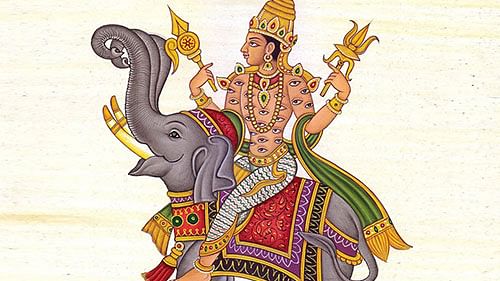
But in the 2010’s things changed. I am now convinced that 3,000-4,000 years ago a people who resembled what we would term “white” expanded within the Indian subcontinent. If modern Armenians are white, then the Indo-Aryans were white. At least initially. In the subcontinent, they met a variety of people. Some of them, such as in Sindh, were of brownish complexion. Others, to the south and east, would have been considerably darker. I also assume that the Vedas were constructed in situ in the Indian subcontinent. That is, they reflect a milieu of people who were encountering the northwest of the subcontinent, and had recently traversed through BMAC (Indra may actually be a BMAC diety).
What’s the upshot here? I know think that the metaphorical view of the physical descriptions should be set next to the literal view. The reality is probably a mix. But the fact is that groups with very different physical appearances did interact in ancient India. The Aryans were almost certainly very light-skinned, with “sharp features”, in comparison to many of the people they encountered. Though one can construct hybrid scenarios, where Indo-Aryan enemies were described in inaccurate ways precisely because those tropes were associated with tribes and peoples the Indo-Aryans had conquered.
Someone who has deep knowledge of the Vedas in Sanskrit and genetics needs to look into this. That’s obviously not me.
Whenever there is a debate on Kashmir, there is often a parallel drawn, particularly in Pakistan, between the accession of Junagadh to India, and the accession of Kashmir (also to India).
The narrative in Pakistan typically goes –
In the case of Kashmir, a predominantly Muslim state acceded to India, as its Maharaja was Hindu. While in Junagadh, India insisted on a plebiscite and eventual accession to India though its Muslim ruler had acceded to Pakistan.
While this criticism may seem superficially sound, it is very specious and misleading as it ignores how different the case of Junagadh was from that of Kashmir. It is worthwhile to reflect on the circumstances surrounding the accession of the two states.
A few things –
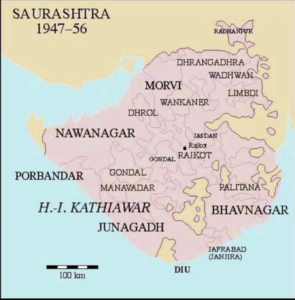
1. Junagadh was not contiguous at all with Pakistan. In contrast J&K in its entirety was contiguous with India. The Nawab’s accession to Pakistan was in violation of the contiguity principle. Here’s a map locating Junagadh in Southern Gujarat.
On the other hand, all of Jammu and Kashmir in its entirety was and is contiguous to the rest of India. So the “contiguity principle” was very much adhered to in the Maharaja’s accession to India
Image Source : wiki
2. Junagadh, with its population of 700K, was ~85% Hindu. The Nawab’s decision to accede to Pakistan was clearly in violation of the wishes of his subjects. In the plebiscite that succeeded the Nawab’s Pakistan accession, well over 95% of the voters chose to accede to India
In contrast, J&K was about 75% Muslim. Also unlike in Junagadh, where Hindus dominated the whole state, in J&K, the Muslim predominance was mainly in the Kashmir valley, while the Hindus were numerous in Jammu and Buddhists in Ladakh.
3. Junagadh’s Hindu population revolted strongly and vocally against the Muslim Nawab’s decision to accede to India. Close to 100K Hindus fled the state in the fall of 1947 as per VP Menon, leading to a near collapse of Kathiawar economy.
The plebiscite in Feb 1948 was prompted by this revolt against the Nawab’s decision. Which ofcourse settled the matter in favor of India. In contrast, in J&K, there was no major clamor among the Muslim population in favor of Pakistan. The major Muslim political body National Conference supported the Maharaja’s decision to accede to India notwithstanding its differences with the Hindu princely ruler. So it was a situation fundamentally different from that of Junagadh.
4. The Nawab of Junagadh unilaterally and hastily decided to join Pakistan, under the influence of his Dewan – Shahnawaz Bhutto (father of Pak PM Zulfikar Ali Bhutto) without even the common decency of letting the Indian govt know of the decision through proper channels.
In fact, Sardar Patel and VP Menon learnt about the decision through the media in late Aug 1947, and later got it confirmed by the Nawab. The Nawab had gone back on the word of his earlier Dewan Abdul Kadir, who had assured Gujarati press as late as April 1947, that the state won’t join Pakistan.
In sharp contrast to the indecent haste and reneging of promise by the Nawab, the Maharaja of Kashmir, Hari Singh, was deeply conscious of the fact that 70% of his subjects were Muslim. He did not accede to India in a hurry.
The accession happened only as late as 26 October 1947, following the invasion of Kashmir by “irregulars” and tribal militias sent from Pakistan. So Hari Singh’s sensitivity and judiciousness was tested to the limits and his hand was forced by Pakistan’s aggression.
5. Next, let’s examine the attitude of India and Pakistan in either case – radically different approaches.
In Junagadh, Muslim league politicians tried to “force” the hand of the Nawab through Shahnawaz, though the Nawab ruled over a Hindu province with no borders with mainland Pakistan.
While in the case of Kashmir, Sardar Patel and VP Menon assured Hari Singh throughout 1947 that they would be okay if he chose to accede to Pakistan. So the Indian attitude was a cool-headed dispassionate one that acknowledged whatever decision Hari Singh would take.
Pakistan in contrast tried to force the issue militarily in Kashmir, not just using its Army and its “irregular” agents, but by cutting off supplies and transport to Jammu from Pakistan, in an attempt to intimidate the Maharaja into acceding to Pakistan.
So these are five major ways in which the case of Junagadh differed from that of Kashmir. Clearly there is no parallel.
There is no ideological contradiction in the way India handled both cases. The Indian reaction was pragmatic and philosophically consistent.
References for the thread :
TCA Raghavan, The People Next Door: The Curious History of India’s Relations with Pakistan
In the first draft of this piece, it was mentioned that Hindus were predominant in Jammu in 1947. I have corrected this to “Hindus were numerous in Jammu”, though maybe not in a majority. The census numbers of 1941 are unreliable on account of WW2, and also the Jammu specific numbers may have been impacted in the course of 1947 on account of both the riots against Muslims in Oct 1947 and against Hindus / Sikhs in Mirpur / Rajouri the following month.
Also the % share of Muslims in the state of J&K has been edited from ~70% to ~75%, as the latter number is a fairer estimate based on 1931 census, while the former number stems from the 1961 census
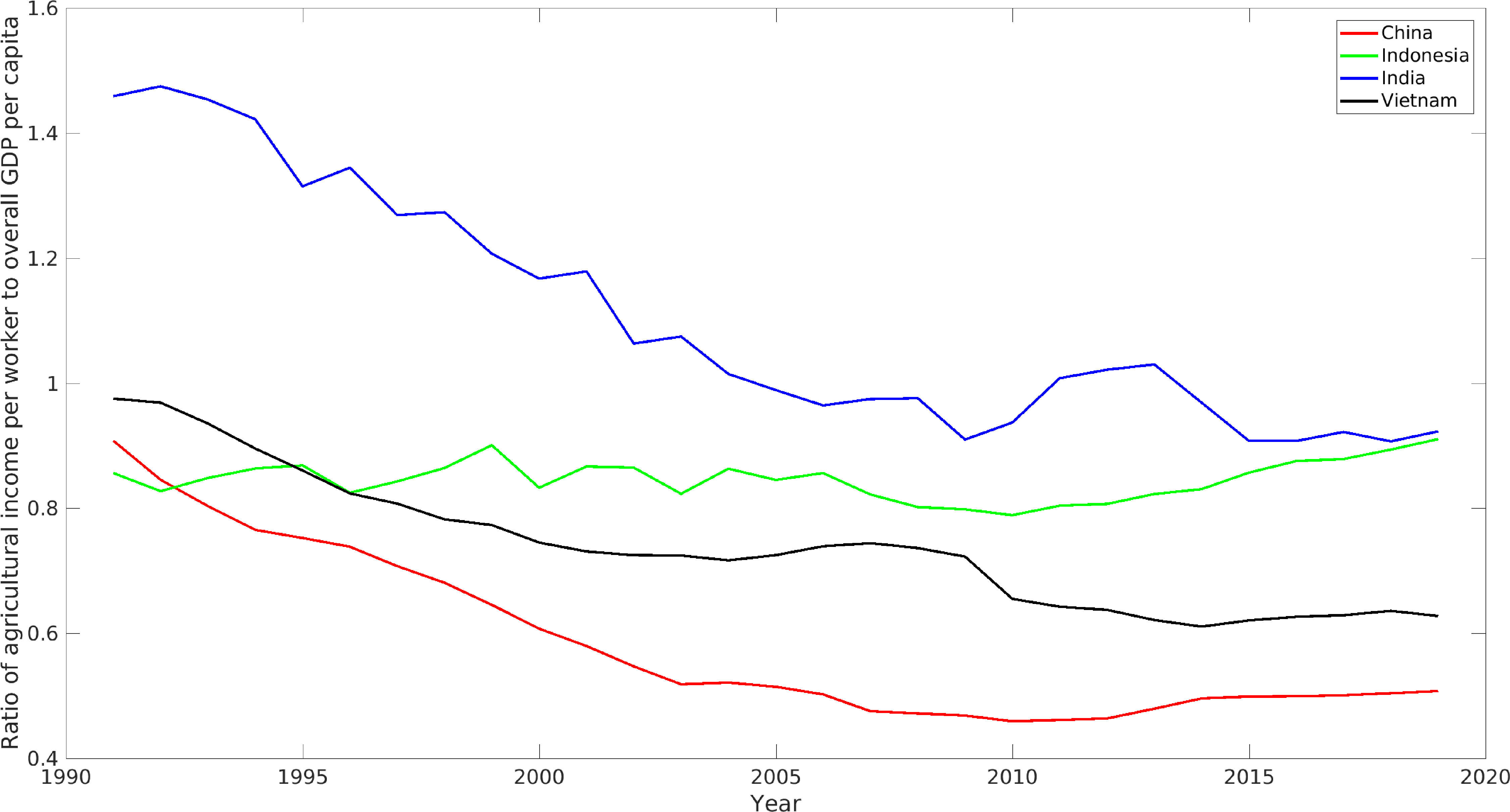
In its period of rapid economic growth, Indian democracy was successful in redistributing gains from urban centered, globalization led growth to the rural agrarian economy. The redistribution of available economic and administrative resources among competing groups is a primary concern of democratic politics. The situation is very different in non-democratic polities. In the figure below, we see that during globalization led growth, the ratio of per worker agrarian income to overall per capita GDP drops to less than a half in China and Vietnam, while it remained above or close to one in India and Indonesia. In other words, agrarian workers in one-party China and Vietnam became relatively poorer while their country became richer, agrarian workers in India and Indonesia did not incur a relative disadvantage.
Ratio of agricultural income per worker to overall GDP per capita for four Asian countries. In democratic, farmer majority India, the rural populace could always command a major share of the state’s redistributive efforts. After an initial decline from 1.4 to 1.0, the ratio in India stabilizes. In one-party China and Vietnam, the emphasis is on efficient agricultural production, not producers, and resources are invested heavily in urban areas.
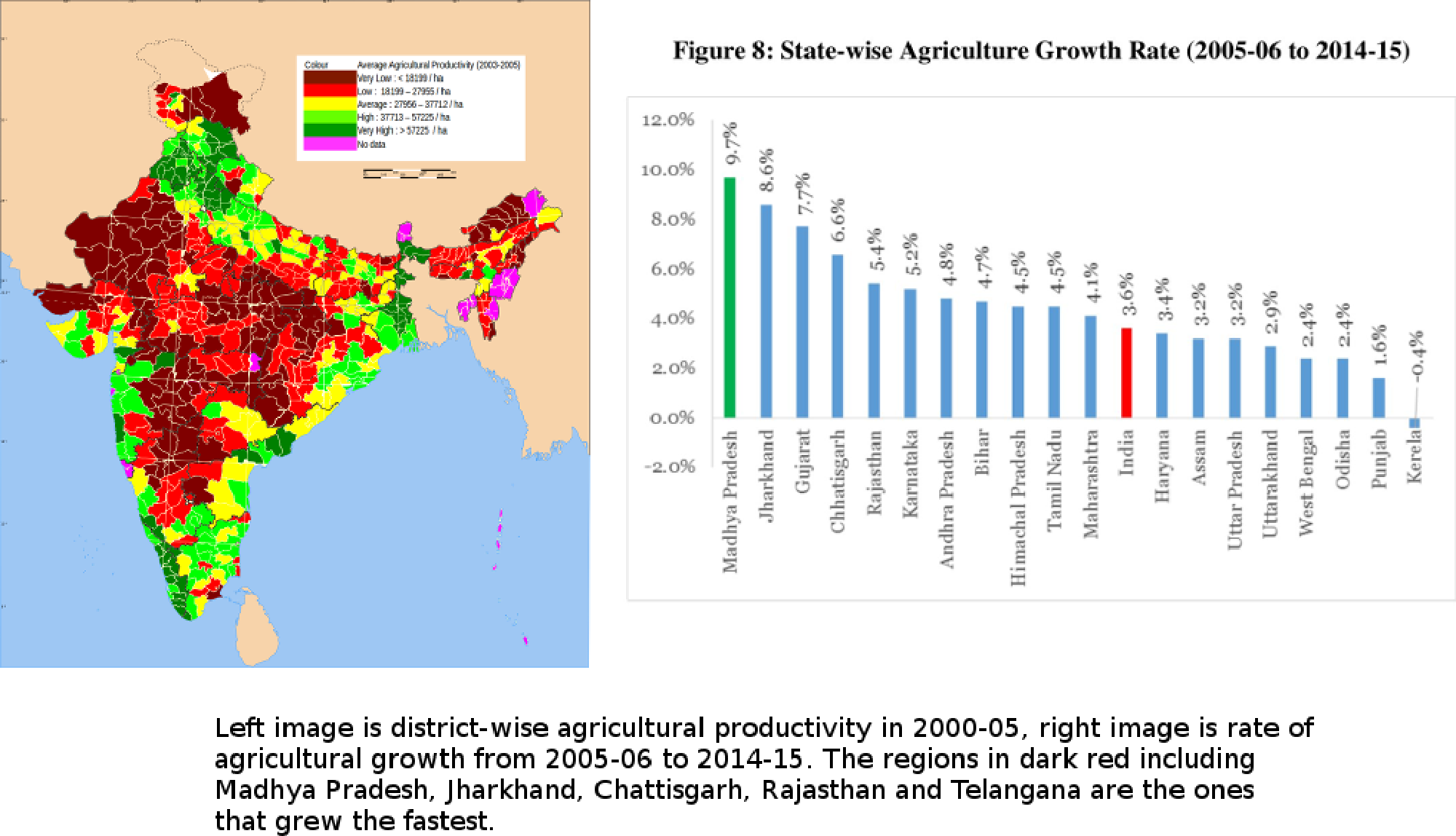
In India the vast rural population with more than a century long experience in political mobilization, has pushed governments to spend money in rural areas. Redistribution has occurred via irrigation projects, rural roads, NREGA, subsidies, loan waivers and recently, direct income transfers. Any negative externality arising from agrarian activity has been borne by urban residents (eg: Delhi smog) but farmers were not penalized. Aside from rural-urban dynamics, democratic redistribution has led to a spatial equalization of agricultural productivity across the country.
Left image is district wise agricultural productivity in 2005. Since then, as the right image shows, agricultural growth has been concentrated in the most backward areas (dark red on left). The primary drivers have been irrigation projects and rural roads.
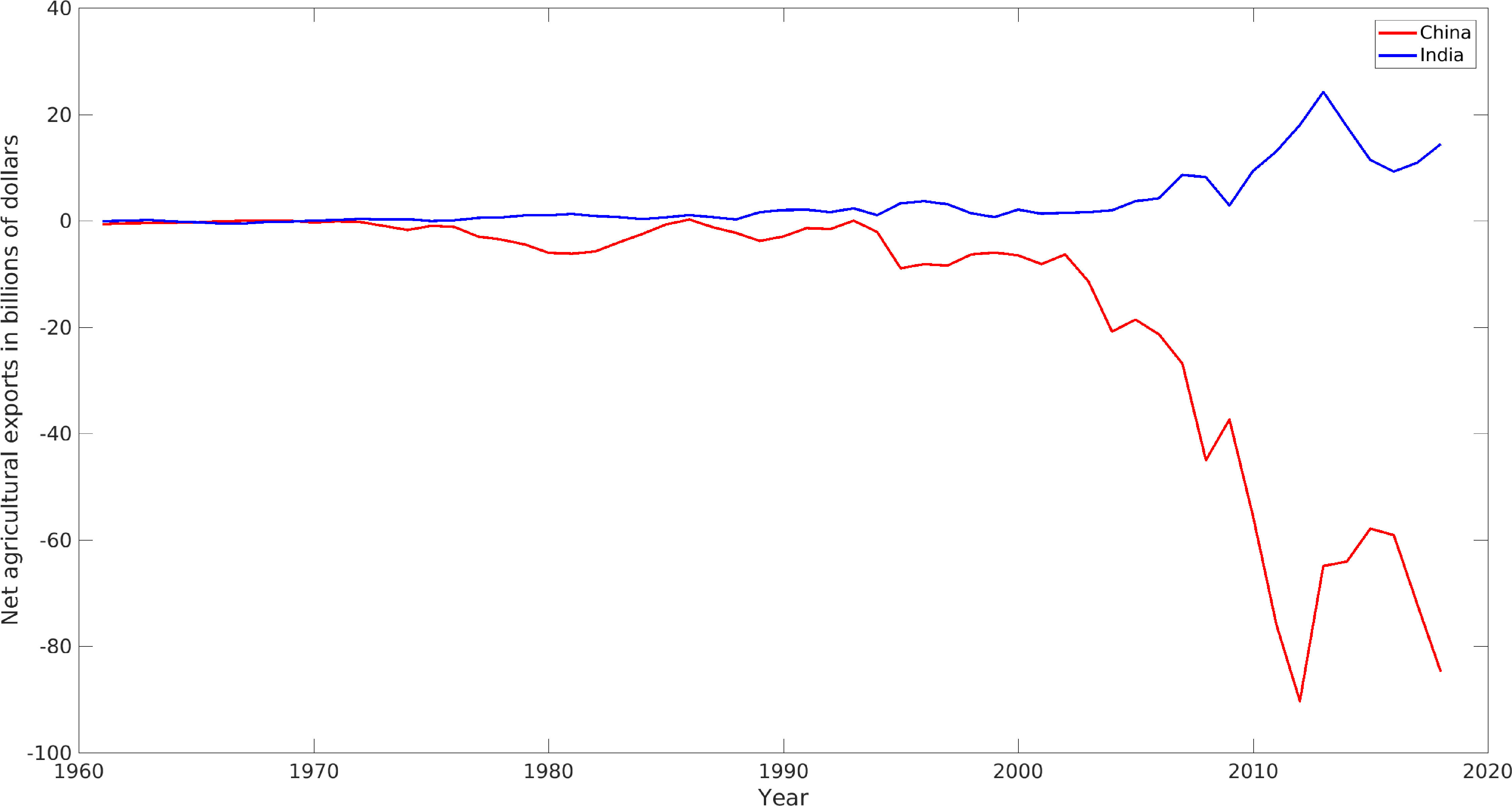
Though the condition of Indian cities is depressing, the upshot of a democracy dominated by the rural majority is comfortable food security. In fact, even though India’s use of pesticide is quite low by global standards, and its agricultural yields, cold-chain infrastructure sub-par, it has become a major net agricultural exporter. This is in huge contrast to China which has become a massive net importer of food. This is an important strategic advantage for India.
Net agricultural trade balance for India and China since 1961. China reverts to a net import situation as soon as its economy starts booming in the 1990s. in contrast India’s exports zoom in its period of economic growth.
There are signs, though, that India’s redistribution toolkit might be reaching the limits of its efficiency. Concurrently, a more reformist Indian government, awash with surplus grain, wants to re-orient farmers towards higher return crops or even an exit from farming. An urbanising electorate may also not be as willing to redistribute their hard earned tax monies towards their rural co-citizens.
The reorientation of the Punjab-Haryana farmer away from rice and wheat will require tact and persuasion, not ordinance fiat. The set patterns are very comfortable from the economic (MSP + diaspora remittances + armed forces recruitment) and psychological (we feed and secure the nation) perspective. The simple promise of higher incomes might not convince historically agrarian communities who havent fully embraced the money economy.
The Prime Minister has proven to be a masterful communicator. We have not yet seen the same skill in his dealings with the farmers. The approach there has oscillated between genuflection and disregard. The potential is there for the 200000 sq. km tract of well irrigated, fertile land in India’s north west to become the new California Central Valley (47,000 sq km). India can then become the land that greatly increases global access to premium agro-products like fresh, dry fruits and vegetarian protein. The latter (beef-mukt world) will also resonate with many urban supporters of the government and even the farmers themselves.