
Were You Colonised or Not? The UN Slavery Vote That Split the World

West vs the Rest

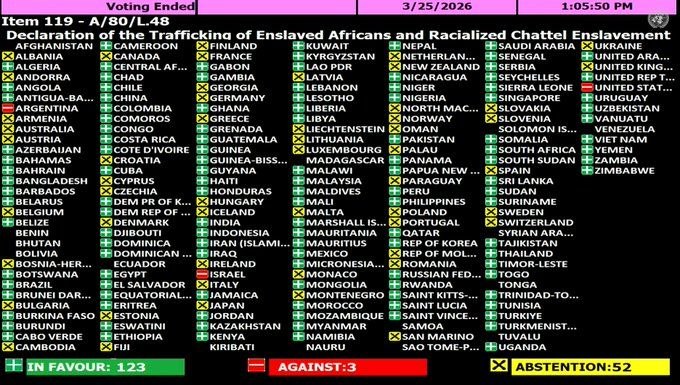
Today’s UNGA vote, 123 for, 3 against, 52 abstentions, is a clean ledger of where the world stands. The resolution declares the transatlantic slave trade “the gravest crime against humanity.” Three countries voted against: the United States, Israel, and Argentina. Ā The UK and all 27 EU members abstained.

The 52 abstentions are the more revealing column. The EU’s stated objection was legal: calling this the “gravest” crime implies a hierarchy among atrocity crimes, which has no basis in international law. That’s a defensible position. It’s also a convenient one for countries that ran the trade.

The US was blunter; its representative objected to the “cynical usage of historical wrongs as a leverage point to reallocate modern resources.” At least that’s honest about what reparations actually means in practice.

The UN is essentially asking whether countries whether they were colonised or not?

The 123 is the story. This isn’t Russia and China championing the Global South; it’s Africa, the Caribbean, and most of Asia doing it themselves. This marks the first floor vote at the UN specifically on transatlantic slavery as a crime, and a call for reparations.

The resolution is non-binding, so nothing material changes today. But the vote is a data point: on a question of historical accountability, the West is either against or abstaining, and everyone else is not.

That’s the fault line. West vs the Rest; and the Rest has the numbers. Gaza, Russia, Iran: all proxies for the same fracture. Russia ran an empire, but its Soviet collapse was so total it no longer reads as imperial. China likewise. So both get to stand on the other side of the line.

And underneath the EU’s legal objection, the “hierarchy of crimes” argument, is something unspoken: the Holocaust has long held the position of singular atrocity in Western moral architecture. This resolution is, implicitly, a challenge to that. The Rest is saying: your crime towards us was graver, or at least as grave. Europe couldn’t vote yes without conceding the point.

Musings on & Answers to “The Partition of Elites: India, Pakistan, and the Unfinished Trauma of 1947” (Part 3)

Part 2

Continuing on, X.T.M says that ā€œIndia’s post-Independence settlement created structural ambiguityā€ and cites four factors in particular:

  • Upper-caste Hindu political dominance at the center
  • Muslim demographic concentrations with limited elite integration
  • A constitutional secularism that promised equality while leaving communal structures intact
  • No acknowledgment that the Muslim League’s victory posed a legitimacy problem

I think his key insight is this: ā€œThe constitution guaranteed rights. It could not guarantee renewed political consent.ā€

The issue as I see it is that the Indian state took the most half-hearted, wishy-washy approach towards the problem of integration. It allowed Muslims to construct bastions of political power while at the same time dividing Hindus along caste and linguistic lines. It allowed criminal elements, many from a Muslim background, to dominate perhaps its most significant sector — the arts — and spread messages of the innate goodness of Indian Muslims and Pakistanis (which is only being suppressed due to both governments’ actions) and the need for peace between Hindus and Muslims, thereby constructing an illusory palace to beguile secularized urban Hindus, while behind the silver screen they fund terrorist attacks in India. The murder of Gulshan Kumar comes to mind as (seemingly) among the least of these crimes, but that he was killed outside a temple is like having salt poured into the wound and mud slung at one’s face. What to speak of 26/11 which has already been talked about, especially recently.

Again, as I mentioned previously, I don’t think the overwhelming issue is that Muslims were allowed to maintain particular political fiefdoms — it’s that Hindus were stymied from establishing systems of political power based on traditional models. When talking about ā€˜independence’, Moldbug (2008) in chapter 2 of An Open Letter to Open-Minded Progressives suggests that:

ā€œOne test we can apply forĀ independence, which should be pretty conclusive, is that the structures of government in a genuinely independent country should tend to resemble the structures that existed before it was subjugated—rather than the structures of some other country on which it may happen to be, um, dependent.Ā These structures should be especially unlikely to resemble structures in other newly independent countries, with which it presumably has nothing in common.ā€

Continue reading Musings on & Answers to “The Partition of Elites: India, Pakistan, and the Unfinished Trauma of 1947” (Part 3)

Brown Pundits