Links on My Browser Right Now – Open Thread

A few pieces I’ve been reading this week:


Reflections

On the Ummah: Muslims have often failed to concede ground in internal debates, which has left them politically boxed in. One reform across all denominations would be to return directly to the Quran as the primary authority. That alone would dissolve many cultural accretions, halal (animals should be stunned before slaughter), hijab (a Sassanian trait), and other practices, into something more adaptive.

And here’s a more speculative question: if the ā€œSatanic Versesā€ were reconsidered if Al-Lat, Al-Uzzah, and Al-Manat were understood as sacred divinities at the threshold of the Lote Tree, would that make Islam more fluid, especially for minority-majority dynamics?

On Kabir: I’m not moderating him out, but readers should be aware that he frames everything through Muslim-rights activism. Engage, but don’t get gaslit into endless provocations. Everyone is entitled to their nationalisms — but they can’t claim liberalism at the same time. That tension makes it worth examining how plurality is treated within the Hindu fold itself. Dharma, unlike the Abrahamic Faiths, tends to all for multiple truths co-existing with each other (Buddhism and indigenous East Asian religions).


šŸ‘‰ Over to you. I’m retreating from heavy moderation — I see BP’s strength in letting the commentariat lead. Biases are fine. Gratuitous abuse is not.

Image

ā€œIn March 1998 the Indian PM Gujral, told … ā€œPakistan was not capable of making atomic bombs.ā€ he had been convinced by Indian Intelligence and Dr Raja Raman, the head of Indian Atomic Energy Commission, who had publicly claimed that nuclear weapon were beyond Pakistan’s reach.ā€

Pakistan as India’s Ukraine?

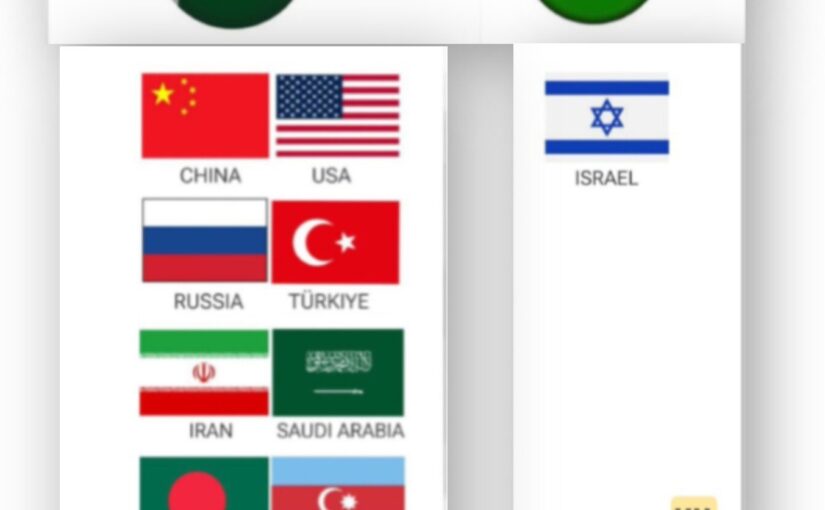
The chart above lays out ā€œstrategic partnersā€ for 2025. Pakistan lists China, Türkiye, Iran, Saudi Arabia, and assorted others. India, by contrast, shows Israel. But the real issue isn’t who collects more flags; it’s whether any of Pakistan’s patrons will ever raise its HDI, improve infrastructure, or embed long-term stability.

I’m interested to hear what the commentariat thinks of this moment. India’s foreign policy is already locking it into superpower status. Pakistan remains reactive, borrowing survival from whoever will lend it.

The analogy that strikes me: India–Pakistan resembles Russia–Ukraine, except if Ukraine had kept nuclear weapons. The parallels are strong:

  • Ukraine, like Pakistan, is a breakaway sibling — the ā€œother halfā€ of a civilizational whole.

  • Ukraine, like Pakistan, survives by appealing to larger patrons.

  • And interestingly, the GDP ratio gap between Russia and Ukraine is almost exactly the same as between India and Pakistan (please fact check me).

Just as Ukraine is considered the homeland of the Russian Empire (Kievan Rus’), Pakistan carries the legacy of Partition as the ā€œIndus homeland.ā€ That symmetry makes the analogy more than superficial.

On Kabir: I understand his consistent emphasis on Muslim rights and Muslim nationalism. Readers should be aware of that lens. I’m not moderating him out, but I would caution the commentariat against being gaslit into endless provocations by Kabir. The question here is not identity politics, but the direction of Indian and Pakistani foreign policy in a critical moment in global history (decades are happening in weeks).

The Pakistani Inferiority Complex

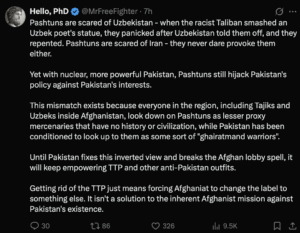
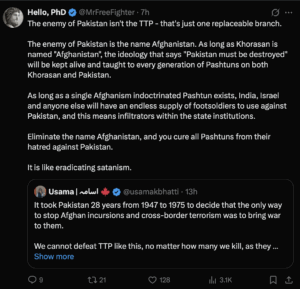
These excellent tweets exhibit a painful pattern that many of us see but few want to name.

Pakistanis, particularly its establishment and elite classes, exhibit a deep inferiority complex towards white (light) Muslims; Arabs, Turks, Persians, and Afghans. These groups are valorized, romanticized, and used as benchmarks for identity and belonging. Meanwhile, other Asian groups, especially within South Asia and Southeast Asia, are seen as lesser. This manifests not only in foreign policy but in pop culture, education, and internalized social hierarchies.

This is why, even if Partition had to happen (and it was undeniably disastrous), Pakistan still could have been something else. It could’ve been a GCC meets Pahlavi Iran construct—a sleek, semi-modernist, high-income Asian Muslim republic with cultural gravitas and economic depth.

Instead, as others have rightly pointed out, Pakistan today has one of the lowest HDIs in its region. Karachi didn’t become Dubai. Lahore didn’t become Paris. Islamabad remains a ghost town of beautiful boulevards and hollow institutions. The promise wasn’t just broken; it was never even understood.

In some ways, Pakistan inherited the worst of both its imagined lineages: neither the intellectual cosmopolitanism of Persianate high culture, nor the industrious civic ambition of Indian civilizational continuity.

This is why tweets like those from @MrFreeFighter land so hard. They expose the psychic dissonance at the heart of the Pakistani state’s anxieties; its hatred of Pashtuns, its paranoia about ā€œAfghanism,ā€ and its inability to deal with its own peripheral ethnic groups as anything but threats.

Meanwhile, Indian Muslims like bombaybadshah, though deeply patriotic to India, often voice critiques of Pakistan with a clarity born of disappointment. They represent what Pakistan could have cultivated: a civic Islam, grounded in identity but untethered to ethnic obsession.

The final irony? South East Asia, Thailand, Cambodia, even Bali, retains more civilizational Dharma than most of Pakistan. Religion is irrespective of that elusive civilisational quality of Dharma, thus the true borders of Bharat lie eastward, not northwest.

Pakistan is not the enemy of India. It is the shattered mirror. And what it reflects, feudalism, insecurity, bigotry, and colonial hangover, is what the entire subcontinent must transcend. Again anyone who reads this can see I’m not saying this from a place of hate but love.


Brown Pundits