On the Question of Who “Owns” the Indo-Muslim Legacy

Reading Sophia Khan’s superb piece on the lost Muslim cities of Hindustan, and then watching the BP comment-thread unfold, a few thoughts crystallised for me; less about “ownership,” and more about the intellectual pattern that keeps resurfacing whenever Indo-Muslim history is discussed.

First: I genuinely did not know that Khan was originally pronounced with a silent n, nor that paan had such a deep Islamicate turn in its social history. Much like music, I had long assumed paan to be a largely Hindu-coded practice. The article forces a re-examination of how intertwined everything actually was. The same goes for Hindustani music: I once thought of it as essentially a Hindu, temple-rooted tradition. Then you realise how much of the courtly synthesis, Persian, Hindavi, Turko-Central Asian, was shaped by Muslims, even if the Vedic lattice underneath remained foundational.

This is partly why I found Bombay Badshah’s objection (“Pakistan cannot claim any of this”) an odd line to draw. One can, of course, make the territorial argument; but it collapses immediately once you observe what India itself is doing: aggressively appropriating the Indo-Muslim aesthetic while deracinating its historical context. If Bollywood, tourism, cuisine, and the Indian cultural machine can freely claim Delhi, Lucknow, Agra, and Hyderabad as national inheritances, then Pakistanis whose families actually come from those cities are hardly crossing an intellectual red line by acknowledging lineage, memory, or loss. Continue reading On the Question of Who “Owns” the Indo-Muslim Legacy
Open Thread: From Floods to LaBal

A few updates from this week:

Sri Lanka is facing severe flooding. Sbarkkum reports major damage to rail and road networks, with Dutch support expected for reconstruction.

Sana Aiyar’s “World at MIT” video touches on her life and work

Sam Dalrymple has a clip on Lahore and Delhi—another reminder of how closely the two cities mirror each other despite partition.

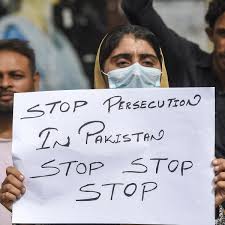
Pakistan’s minority rights bill is worth watching. Continue reading Open Thread: From Floods to LaBal

The Pakistani Inferiority Complex

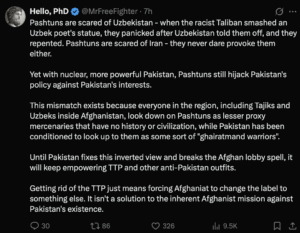
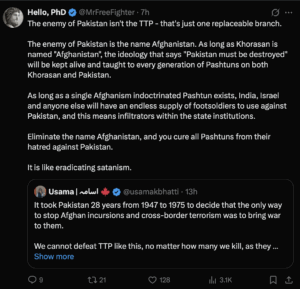
These excellent tweets exhibit a painful pattern that many of us see but few want to name.

Pakistanis, particularly its establishment and elite classes, exhibit a deep inferiority complex towards white (light) Muslims; Arabs, Turks, Persians, and Afghans. These groups are valorized, romanticized, and used as benchmarks for identity and belonging. Meanwhile, other Asian groups, especially within South Asia and Southeast Asia, are seen as lesser. This manifests not only in foreign policy but in pop culture, education, and internalized social hierarchies.

This is why, even if Partition had to happen (and it was undeniably disastrous), Pakistan still could have been something else. It could’ve been a GCC meets Pahlavi Iran construct—a sleek, semi-modernist, high-income Asian Muslim republic with cultural gravitas and economic depth.

Instead, as others have rightly pointed out, Pakistan today has one of the lowest HDIs in its region. Karachi didn’t become Dubai. Lahore didn’t become Paris. Islamabad remains a ghost town of beautiful boulevards and hollow institutions. The promise wasn’t just broken; it was never even understood.

In some ways, Pakistan inherited the worst of both its imagined lineages: neither the intellectual cosmopolitanism of Persianate high culture, nor the industrious civic ambition of Indian civilizational continuity.

This is why tweets like those from @MrFreeFighter land so hard. They expose the psychic dissonance at the heart of the Pakistani state’s anxieties; its hatred of Pashtuns, its paranoia about “Afghanism,” and its inability to deal with its own peripheral ethnic groups as anything but threats.

Meanwhile, Indian Muslims like bombaybadshah, though deeply patriotic to India, often voice critiques of Pakistan with a clarity born of disappointment. They represent what Pakistan could have cultivated: a civic Islam, grounded in identity but untethered to ethnic obsession.

The final irony? South East Asia, Thailand, Cambodia, even Bali, retains more civilizational Dharma than most of Pakistan. Religion is irrespective of that elusive civilisational quality of Dharma, thus the true borders of Bharat lie eastward, not northwest.

Pakistan is not the enemy of India. It is the shattered mirror. And what it reflects, feudalism, insecurity, bigotry, and colonial hangover, is what the entire subcontinent must transcend. Again anyone who reads this can see I’m not saying this from a place of hate but love.


Browncast: Salman Rashid, Travel and History Writer

Image

Another Browncast is up. You can listen on Libsyn, Apple, Spotify, and Stitcher (and a variety of other platforms). Probably the easiest way to keep up the podcast since we don’t have a regular schedule is to subscribe to one of the links above!

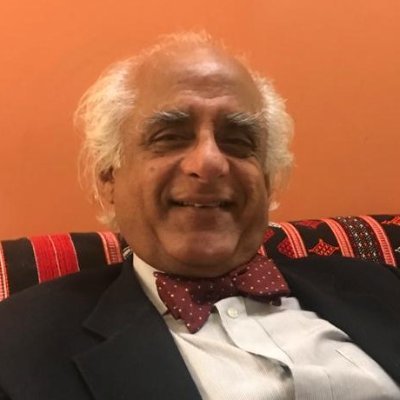
In this episode Omar and Maneesh Taneja chat with Pakistani travel writer and history buff Salman Rashid. Salman has a very popular youtube channel  and tweets as odysseuslahori  . We chat about partition, pakistan, history and whatever else comes up.

Brown Pundits